ACX Now Allows AI Narration — but Only Voice Replicas: The 2026 Rules for Authors & Narrators
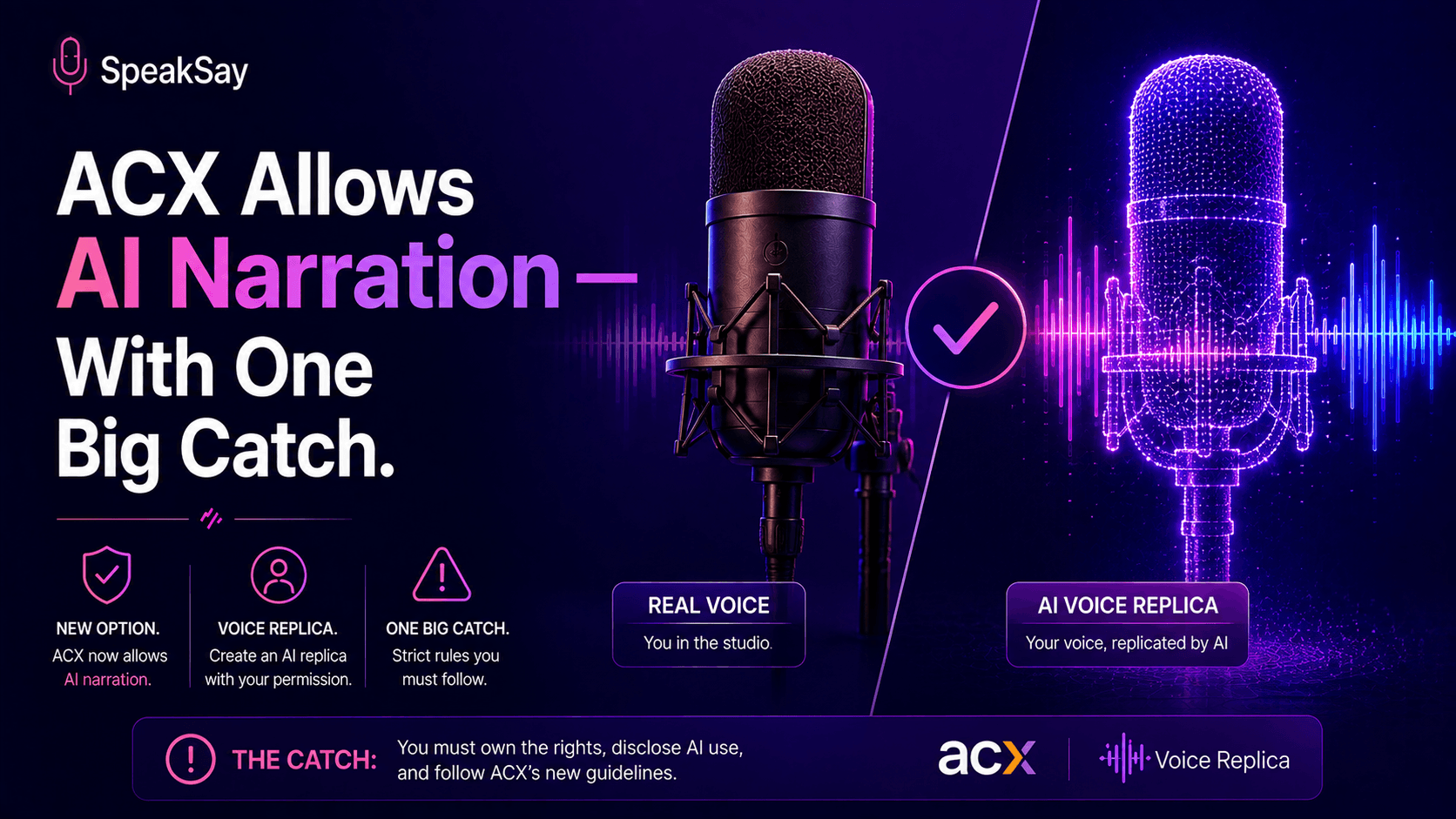
ACX's 2026 rules still ban unauthorized AI narration — but its new Voice Replica program lets narrators use authorized clones of their own voices. Here's what's legal where, and the decision map for authors and narrators.
The 2026 ACX Rules in Plain English
ACX updated its submission requirements on April 15, 2026. The core rule survived: an audiobook submitted through ACX must be human-narrated unless otherwise authorized, and the prohibited list still explicitly names unauthorized text-to-speech, AI and automated recordings. Upload a generic AI narration through the standard ACX pipeline and you risk rejection — or a catalog takedown later.
The two words doing all the work are "unless otherwise authorized." That carve-out is where 2026's changes live:
- Voice Replica (ACX pilot): participating narrators create computer-generated replicas of their own voices, choose which projects to use them on, review the generated production, and edit the final result.
- Audible Virtual Voice: Audible's own computer-generated narration program, which produces and lists titles under its own label and eligibility rules — separate from ACX.
- Aggregator distribution: AI-narrated audiobooks submitted via distributors (Spotify for Authors/INaudio, Author's Republic, Kobo Writing Life) can reach Audible's catalog through commercial paths that don't run through ACX's human-narration rule.
So the accurate 2026 answer to "does ACX allow AI narration?" is: yes, but only authorized voice replicas of real narrators — everything else still needs a different door.
What ACX Voice Replica Actually Is
Voice Replica is best understood as a licensing arrangement, not a text-to-speech feature. The design has three properties that matter:
- Consent is built in. The replica is built from recordings the narrator made for that purpose. Nobody's voice is used without a signed agreement — a direct response to the voice-provenance lawsuits that defined 2026.
- The narrator stays in the loop. They pick projects, review the generated audio, and can correct pronunciations and performances before delivery. It's supervised production, not a render button.
- The economics shift, not vanish. Narrators effectively license their voice at a lower per-finished-hour rate than live recording, in exchange for taking on far more titles than a booth schedule allows.
For authors, that means Voice Replica titles still involve hiring a narrator — you're buying their replica's time instead of their studio time. It's cheaper and faster than traditional production, but it is not the $0 self-serve route some coverage implied.
Voice Replica vs Audible Virtual Voice vs Everything Else
| ACX Voice Replica | Audible Virtual Voice | Own cloned voice via aggregators | |
|---|---|---|---|
| Whose voice | A professional narrator's authorized clone | Audible's stock synthetic voices | YOUR voice (or a licensed AI voice) |
| Who controls production | Narrator reviews/edits | Audible's automated pipeline | You, end to end |
| Access | Pilot — limited participants | Invitation/eligibility-based (mainly KDP ebooks) | Open to everyone today |
| Reaches Audible? | Yes, via ACX | Yes, Audible-only ecosystem | Yes, via aggregator catalog paths |
| Also reaches Spotify, Apple, Kobo, libraries? | Per ACX distribution terms | No — locked to Audible | Yes — full wide distribution |
| Cost structure | Narrator licensing fee | Free to produce, revenue share | Your production cost only |
The pattern to notice: the platform-controlled routes (Voice Replica, Virtual Voice) trade control and ownership for convenience. The self-produced route trades a little setup work for full ownership of your files, your voice, and your distribution list.
If You're a Narrator: The Replica Opportunity
The narrators who win in the replica era are the ones who treat their voice as licensable inventory. A booth narrator can record maybe 3–4 finished hours a day; a supervised replica pipeline can deliver several titles in parallel while you record premium projects live. If you're not in the ACX pilot, you don't have to wait: clone your own voice with a platform that gives you commercial rights, and offer "replica-grade" narration directly to indie authors — same supervised workflow, your own client list, no gatekeeper.
Your voice, your license, your rates
SpeakSay's voice cloning builds a studio-quality replica from your own recordings — with commercial rights, pronunciation control, and per-project consistency. Scale your narration business without waiting for a pilot invitation.
The Go-Wide Route: Your Own Cloned Voice, Every Platform
The own-voice workflow, condensed:
- Record 30–60 minutes of clean source audio reading varied material — the input quality determines everything downstream.
- Build your clone with SpeakSay voice cloning and lock the voice settings so chapter 1 and chapter 30 match.
- Narrate chapter by chapter with text to speech, fixing names and pronunciations in text instead of re-recording sessions.
- Master to spec — retail platforms expect consistent loudness (roughly -18 to -23 LUFS RMS territory), room-tone head/tail, and clean chapter files.
- Distribute wide with disclosure — label the narration as digital-voice where required (Spotify prepends the disclosure automatically) and submit through your aggregator of choice.
A 60,000-word book is roughly 6.5 finished hours. Traditionally that's $1,300–$2,600 in narration fees; with a cloned voice it's a weekend of supervised production.
One payment, your whole backlist
Converting 5–20 titles? SpeakSay's lifetime plan means the second book — and the twentieth — costs nothing extra to narrate.
Compliance Mistakes That Get Audiobooks Rejected
- Submitting generic AI narration through standard ACX. Still prohibited. The Voice Replica carve-out doesn't cover your own TTS files uploaded through the classic pipeline.
- Skipping the disclosure. Major platforms now require AI-narration labels in metadata. Undisclosed titles risk takedowns and account flags — disclosure costs you far less than discovery does.
- Using a voice you don't have commercial rights to. Free-tier voices often exclude commercial audiobook use. Check the license before you produce 6 hours of audio, not after — our guide to AI voice ownership rules covers what survives a cancelled subscription.
- Assuming Audible exclusivity still pays best. Run the royalty math against wide distribution before locking a 7-year exclusivity term on an AI-narrated title.
FAQ
Does ACX allow AI narration in 2026?Only in authorized form. ACX's April 2026 rules require human narration and prohibit unauthorized TTS/AI recordings, but the Voice Replica pilot lets participating narrators deliver audiobooks using approved AI clones of their own voices.
What's the difference between Voice Replica and Virtual Voice?Voice Replica is an ACX program using authorized clones of professional narrators' voices, with the narrator supervising production. Virtual Voice is Audible's own stock synthetic narration for eligible KDP titles, produced by Audible's automated pipeline and confined to Audible's ecosystem.
Can an AI-narrated audiobook still get onto Audible without ACX?Yes. Aggregators such as Spotify for Authors/INaudio, Author's Republic and Kobo Writing Life accept AI-narrated titles and distribute them into Audible's catalog through separate commercial paths, alongside wide distribution to other stores.
Can I clone my own voice to narrate my own book?Yes — cloning your own voice with your own consent is the cleanest rights situation in audio. Use a platform that grants commercial rights, disclose the digital narration where platforms require it, and distribute via routes that accept AI narration.
Will listeners reject an AI-narrated audiobook?Disclosure labels haven't measurably hurt well-produced titles in nonfiction and backlist categories. Quality and voice consistency matter far more than the production method — flat, drifting narration gets refunded whether a human or a machine made it.