AI Pirates Are Uploading Stolen Audiobooks to YouTube: How Indie Authors Fight Back in 2026 (Takedowns + the Own-Voice Advantage)
A New York Times exposé revealed AI-enabled audiobook piracy at massive scale on YouTube — from literary fiction to Harry Potter. Here's the indie author's 2026 defense playbook: the takedown workflow that works, why your own cloned voice is a moat pirates can't fake, and how going wide fast leaves no vacuum for thieves to fill.
1. What's Actually Happening: Piracy at Industrial Scale
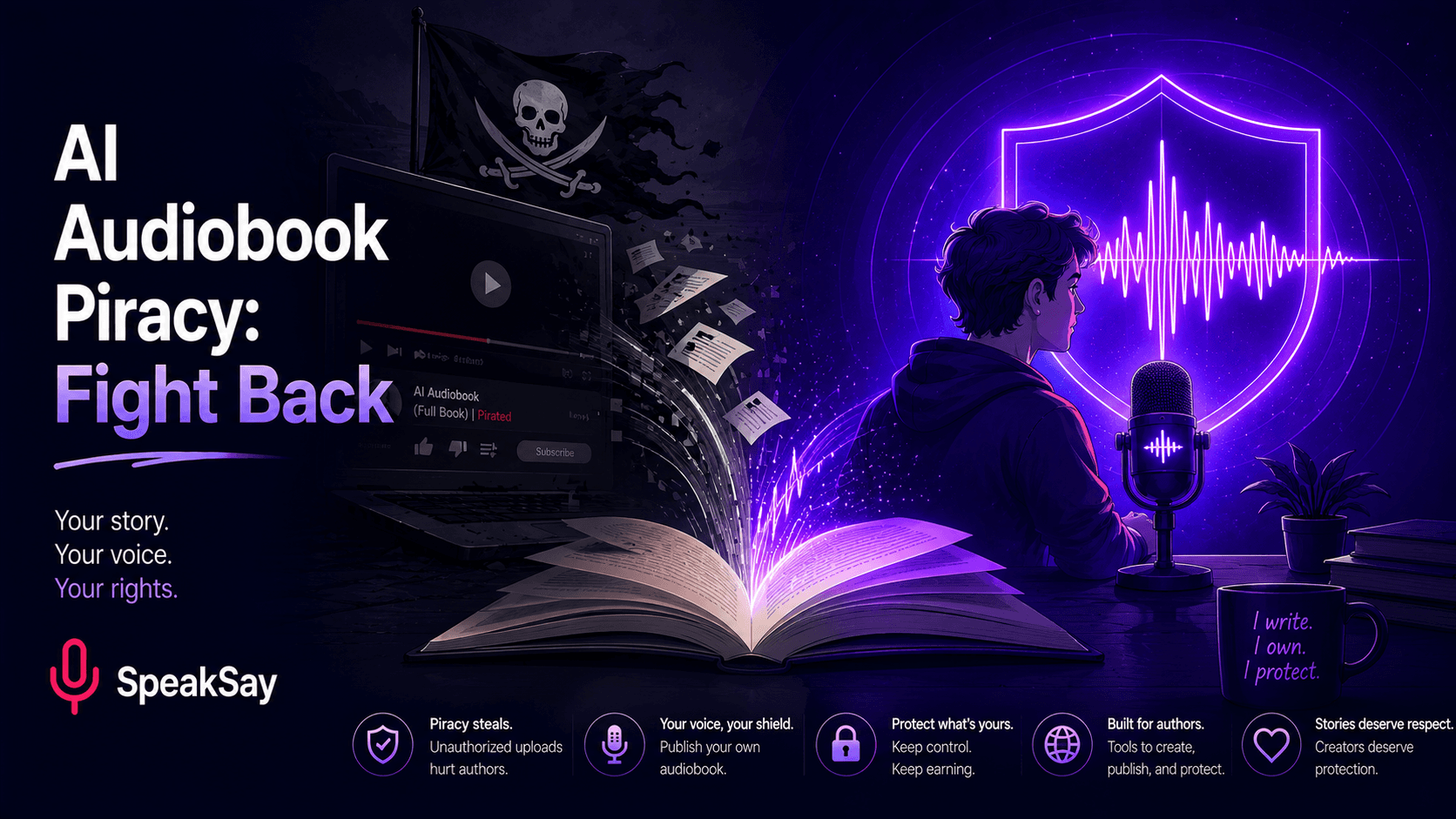
The new piracy model is simple and industrial. Pirates scrape ebooks — bought once, borrowed, or torrented — run the text through cheap AI narration, and upload the result to YouTube as "free audiobook" content, monetized with ads or funneling viewers to scam sites. The Times investigation found versions of essentially every commercially meaningful category: literary fiction, business bestsellers, genre fiction, children's books.
Three things changed to make this explode in 2025–2026:
- Narration cost collapsed to near zero. What once required a $2,000+ human narration now takes an afternoon and pocket change.
- YouTube rewards long-form audio. A 9-hour "audiobook" video generates enormous watch time, and sleep/background listening means ads run for hours.
- Detection lags. An AI narration of your book doesn't match any existing audio fingerprint — if you never made an audiobook, there's nothing in Content ID to match against.
Note that last point. It's the core strategic insight of this entire guide, and we'll come back to it.
2. Why Indie Authors Are the Softest Target
Big publishers have legal teams, Content ID relationships, and anti-piracy vendors. Indie authors have none of that — and pirates know it. You're disproportionately exposed if:
- You have no official audiobook. The pirate version isn't competing with your audio edition; it IS the only audio edition. Every listen is a sale you never had the chance to make.
- You're in a high-demand audio genre. Romance, fantasy, self-help, and business titles are pirated first because audio demand outstrips supply.
- You've never searched YouTube for your own book. Most authors discover piracy months late, after the pirate upload has accumulated search ranking for "your title audiobook."
3. The Takedown Workflow That Works
You own the copyright to your text; an unauthorized AI narration is a derivative work and plainly infringing. YouTube's DMCA process is your primary weapon:
- Document first. Screenshot the video page, channel, view count, and URL. Note upload date. Don't comment on the video or alert the channel.
- File through YouTube's copyright removal form (youtube.com/copyright_complaint). Identify yourself as the rights holder, cite the specific work, list every infringing URL. One form can cover multiple URLs from the same channel.
- Claim the audio too. The narration is derived entirely from your text — your claim covers the whole video, not just "the story."
- Escalate repeat infringers. Three valid strikes terminates a channel. Pirates operate networks of channels, so expect whack-a-mole — which is why section 5 matters more than this section.
- For scale, consider an anti-piracy service once takedowns become a weekly chore; several handle bulk YouTube DMCA filings for indie authors at reasonable monthly rates. A lawyer is rarely needed for straightforward DMCA volume.
What not to do: don't file against legitimate reviews, summaries, or commentary (fair use, and misfires damage your standing), and never file false claims — the counter-notification process exposes you to liability.
4. Set Up Monitoring So You Find Theft in Days, Not Months
Ten minutes of setup, ongoing detection forever:
- Google Alerts for "[your title] audiobook" and "[your title] full audiobook" with YouTube results included.
- A monthly manual YouTube search for your title plus "audiobook," "full," and "free" — sorted by upload date.
- Check your also-boughts. Pirate channels batch-upload by genre; if a channel has your comp titles, your book is likely queued.
5. The Strategic Defense: Never Leave a Vacuum
Here's the uncomfortable truth about takedowns: they're necessary but reactive. You'll never out-file an industrial pirate network. The durable defense is economic — pirates thrive where official supply doesn't exist.
If your book has no audiobook, the pirate version faces zero competition: it ranks for your title's audio searches, captures your audio-first readers, and trains them that your work is free. If an official audiobook exists everywhere — Spotify, Apple, Google Play, Kobo, library apps — at a fair price, the pirate version becomes the worst option: lower quality, sketchy source, no support for an author the reader likes.
And remember the Content ID point from section 1: once your official audiobook exists, its audio becomes a reference asset. Distributors feeding YouTube's Content ID give future pirate re-narrations of your exact text something to be matched and claimed against. Publishing audio isn't just revenue — it's registering your book in the immune system.
The best takedown is a better official version
SpeakSay turns your manuscript into a complete, professional audiobook in your own cloned voice — ready for every platform pirates can't follow you onto.
6. The Own-Voice Advantage: A Moat Pirates Can't Fake
Any pirate can generate an AI narration of your book. None of them can generate your narration. That difference is worth building your audio strategy around:
- Authenticity as product. "Narrated by the author, in the author's own voice" is a marketing line pirates can't copy. Readers — especially in memoir, self-help, and author-brand-driven fiction — actively prefer it. Estates understand this too: Barbara Cartland's estate authorized cloning her voice for exactly this reason.
- Recognizability. Your readers know your voice from your videos, podcast interviews, or previous books. A pirate upload with a generic stock voice is instantly identifiable as fake by your own audience — who will report it for you.
- Consent and control. Cloning your own voice with SpeakSay Voice Cloning means full commercial rights, no narrator contract, and the ability to fix a mispronounced name by retyping the line instead of rebooking a studio.
- Scale without cost-per-book. Once your voice is cloned, every backlist title and every new release narrates at the same flat cost — which is what makes the go-wide plan below feasible for an indie.
7. Go Wide Fast: The 30-Day Everywhere Plan
The goal: official audio on every major surface before (or immediately after) piracy appears.
- Week 1 — Produce. Clone your voice, run your manuscript through SpeakSay chapter by chapter, and proof-listen at 1.5x. Fix errors by editing text and regenerating lines.
- Week 2 — Master and package. Export platform-spec audio, commission or adapt your audiobook cover, write retail copy that leads with "narrated in the author's own voice."
- Week 3 — Distribute wide. Upload via your distributor(s) to Spotify, Apple Books, Google Play, Kobo, and library channels. Wide distribution beats exclusivity for anti-piracy: every storefront you're absent from is a vacuum.
- Week 4 — Occupy YouTube yourself. Post the first chapter free on your own channel with buy links — it ranks for "your title audiobook," intercepts the searches pirates monetize, and gives fans a legitimate free taste.
Then point your monitoring (section 4) at the result, and file takedowns (section 3) from a position where the pirate is competing with a superior official product on every platform. For the platform-by-platform publishing rules, see our guides to AI audiobook platform rules and pricing and positioning an AI-narrated audiobook.
Narrate your whole backlist for one flat price
SpeakSay's lifetime plan means every title you've ever written — and every one you'll write — gets an official audiobook in your voice without a subscription meter running.
8. FAQ
Someone uploaded an AI version of my audiobook to YouTube. Is that legal?No. An AI narration of your text is a derivative work of your copyrighted book. You can file a DMCA takedown through YouTube's copyright removal form regardless of whether you have an official audiobook.
Do I need a lawyer to file YouTube takedowns?No. YouTube's copyright complaint form is free and designed for rights holders to use directly. Consider a bulk anti-piracy service if filings become a weekly chore; reserve lawyers for repeat large-scale infringers or counter-notifications.
Does publishing my own audiobook actually reduce piracy?It changes the economics. Official audio on every platform removes the vacuum pirates monetize, outranks them for your title's audio searches, and — once fingerprinted by Content ID via distribution — gives future pirate uploads something to be automatically matched against.
Why narrate in my own cloned voice instead of a stock AI voice?A stock voice narration can be replicated by anyone, including pirates. Your cloned voice is unique, marketable ("narrated by the author"), instantly recognizable to your readers, and fully under your commercial control.
Should I put any of my audiobook on YouTube myself?Yes — a free first chapter with buy links. It occupies the search results pirates target and converts searchers into customers instead of ad revenue for thieves.