AI Celebrity Voices Are a Copyright Strike Waiting to Happen: Build an Original Parody Character Instead (2026)
Searching for an AI celebrity voice generator? Read this first. Between the NO FAKES Act, platform bans, and estate lawsuits, celebrity voice clones are 2026's fastest route to strikes and takedowns. Here's the legal landscape — and how to build an original parody character with the same comedic punch.
1. Why Everyone Wants Celebrity AI Voices (and What They're Really After)
Be honest about the appeal: a famous voice is a pre-loaded joke. The audience recognizes it instantly, the contrast between the voice and the script does the comedic work, and recognition drives shares. Creators searching for celebrity voice generators usually want one of three things: reaction/meme content, "what if X narrated Y" skits, or a distinctive narrator that stops the scroll.
Here's the thing — recognition is the asset, and recognition can be built. Every iconic cartoon voice, every viral character account, every distinctive narrator proves that audiences attach to consistent, exaggerated character voices whether or not they belong to a real person. The difference is that an original character compounds into your brand instead of borrowing someone else's likeness on borrowed time.
2. The 2026 Legal Reality: Voice Is Now Protected Identity
The legal picture in 2026 is much clearer than it was even two years ago, and it's uniformly bad news for celebrity cloning:
- Right of publicity. Most US states protect a person's voice as part of their identity for commercial purposes. Classic cases (Midler, Waits) established this for sound-alike human impressions decades ago; AI clones are a stronger version of the same violation.
- The NO FAKES Act. The federal push to protect voice and likeness from unauthorized digital replicas has kept advancing, with broad industry backing. Whatever its final shape, platforms already behave as if it's law.
- Consent enforcement is real money now. The July 2026 Fish Audio settlement over non-consensual voice models put a nine-figure number on cloning people without permission. Estates are also monetizing legitimately — Netflix licensed Gene Wilder's voice from his estate through a formal deal. Translation: the legal system now treats voices as licensable property, and you don't have a license.
- The EU AI Act adds disclosure obligations and outright prohibitions on undisclosed synthetic media in several contexts, which matters the moment your content crosses the Atlantic.
None of this requires a celebrity to personally sue you. Their labels, studios, and estates run automated enforcement at scale.
3. What Platforms Actually Do: Strikes, Bans and Auto-Detection
In practice, platform enforcement hits long before a courtroom does:
- YouTube lets individuals and rights-holders request removal of content that simulates an identifiable person's voice, runs automatic AI-content labeling, and treats synthetic impersonation as grounds for strikes. Monetized impersonation is the fastest flag of all.
- TikTok bans synthetic media that impersonates real people without clear parody labeling — and bans some AI voice content in commercial contexts entirely.
- Music platforms aggressively pull AI vocal impersonations after the label-driven takedown waves of the last two years.
The pattern that kills channels: an impersonation channel grows for months, gets one viral hit, the visibility triggers rights-holder attention, and the entire back catalog gets struck at once. You're not risking one video; you're risking the account.
4. "But Parody Is Protected!" — What Parody Does and Doesn't Cover
Parody is a real and important protection — for expression. It protects your right to mock, comment on, and exaggerate. It does not automatically license someone's identity as your product. Rough guide:
| Scenario | Risk level |
|---|---|
| Human comedian doing an impression in a sketch | Long-protected tradition, low risk |
| AI clone of a celebrity in clearly-labeled commentary/critique of that celebrity | Contested gray zone — platforms often remove anyway |
| AI celebrity voice as your channel's recurring narrator or product | High risk — commercial use of identity, parody defense weak |
| AI celebrity voice in ads, sponsorships, or monetized shorts farms | Highest risk — this is exactly what the new laws target |
Even where you might ultimately win the legal argument, you lose the practical one: strikes, demonetization, and takedowns happen first, and appeals take months. Building on an impersonation is building on land you don't own.
5. The Alternative: Original Characters Beat Impressions
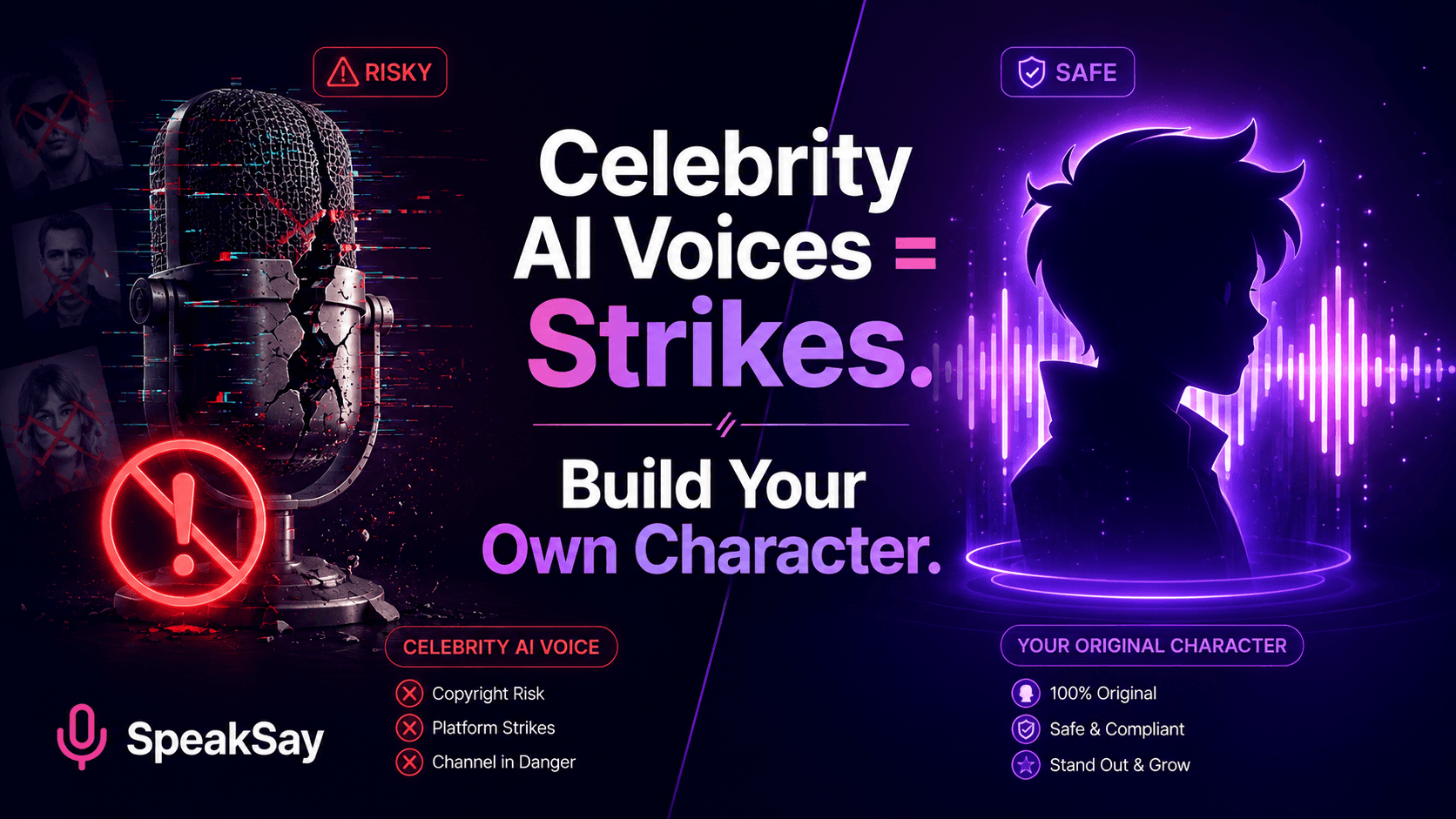
The creators winning the character-voice game in 2026 aren't cloning celebrities — they're building archetypes. Not Morgan Freeman, but "the world-weary cosmic narrator." Not a specific action star, but "the unhinged movie-trailer guy." The archetype delivers the same comedic contrast, and it comes with three structural advantages:
- You own it. No strikes, no takedowns, no estate letters. You can merchandise it, license it, and put it in sponsorships — try doing that with a cloned celebrity.
- It's consistent forever. A voice you designed can narrate every video for years, becoming the thing audiences recognize you by.
- It's differentiated. A thousand channels use the same celebrity soundboard voices. Your character exists exactly once.
Design a voice nobody can strike
Remix pitch, texture, age, and delivery into an original character voice — try it free, no celebrity required.
6. How to Build a Parody Character Voice in an Afternoon
- Define the archetype in one sentence. "A too-intense documentary narrator who takes trivial things deadly seriously." The comedy lives in that sentence, not in any real person.
- Pick a base voice. Start in SpeakSay's voice library with something adjacent to your archetype — deep and grave, bright and chirpy, dry and flat.
- Remix it into a character. Use Voice Remix to push it away from "stock" and toward "cartoon": shift pitch, add gravel or silk, exaggerate pacing. You want a voice that sounds designed, the way animation voices do.
- Give it verbal tics. Catchphrases, a signature sign-off, a way of mispronouncing one recurring word. Tics are what audiences quote — and quoting is sharing.
- Test on real scripts. Run the same 30-second script through 3 variants and post the best to Shorts. Let retention data pick your character. A free SpeakSay tool pass keeps the audio clean before upload.
- Lock and reuse. Save the exact settings. The entire value of a character voice is that it's identical in every video.
7. 5 Character Archetypes That Print Views Without a Celebrity
- The Overqualified Narrator — nature-documentary gravitas applied to your cat, your fridge, your commute. (Pairs with the trending self-documentary format.)
- The Ancient Being — a thousand-year-old voice explaining modern problems with cosmic disappointment. Perfect for history and mythology angles.
- The Corporate Android — polite, dead-flat customer-service cadence saying increasingly unhinged things. Deadpan robot delivery is actively viral on TikTok.
- The Hype Goblin — a small, fast, over-caffeinated voice that treats everything like a title fight. Built for gaming clips and reaction content.
- The Noir Detective — gravel, cynicism, rain-soaked metaphors, applied to grocery runs and group-chat drama.
Each of these delivers the "famous voice contrast" effect — a recognizable persona colliding with mundane content — with zero legal surface area.
Your character, your channel, your IP
Build a signature character voice once and use it across every video, ad, and platform — no takedown risk, no borrowed likeness.
8. FAQ
Is there any legal way to use a celebrity AI voice?Yes — with a license from the person or their estate, which is how Netflix used Gene Wilder's voice. Without a license, assume commercial or recurring use of an identifiable celebrity voice is unsafe in 2026, regardless of disclaimers.
Does saying "parody" in the title protect me?No. Labels help with disclosure rules but don't convert an impersonation into licensed use. Parody protects your commentary, not your use of someone's identity as a product.
What about voices that just sound similar by accident?Coincidental resemblance isn't impersonation. Risk comes from marketing or presenting a voice as a specific person, or deliberately cloning them. Design your character on its own terms and describe it that way.
Can I clone my own voice for parody content?Yes — your voice is yours. Many creators clone themselves and then remix the clone into characters. See SpeakSay's voice cloning.
Do original character voices actually perform as well?The consistent evidence from character-driven channels is that recognition — not celebrity — drives retention and shares. Audiences attach to any distinctive voice they hear repeatedly; the advantage of celebrity voices is only that recognition is pre-built, and it fades as your own character accrues it.