Nobody Writes In to a Robot: How to Build a Listener Community Around an AI-Made Podcast (2026)
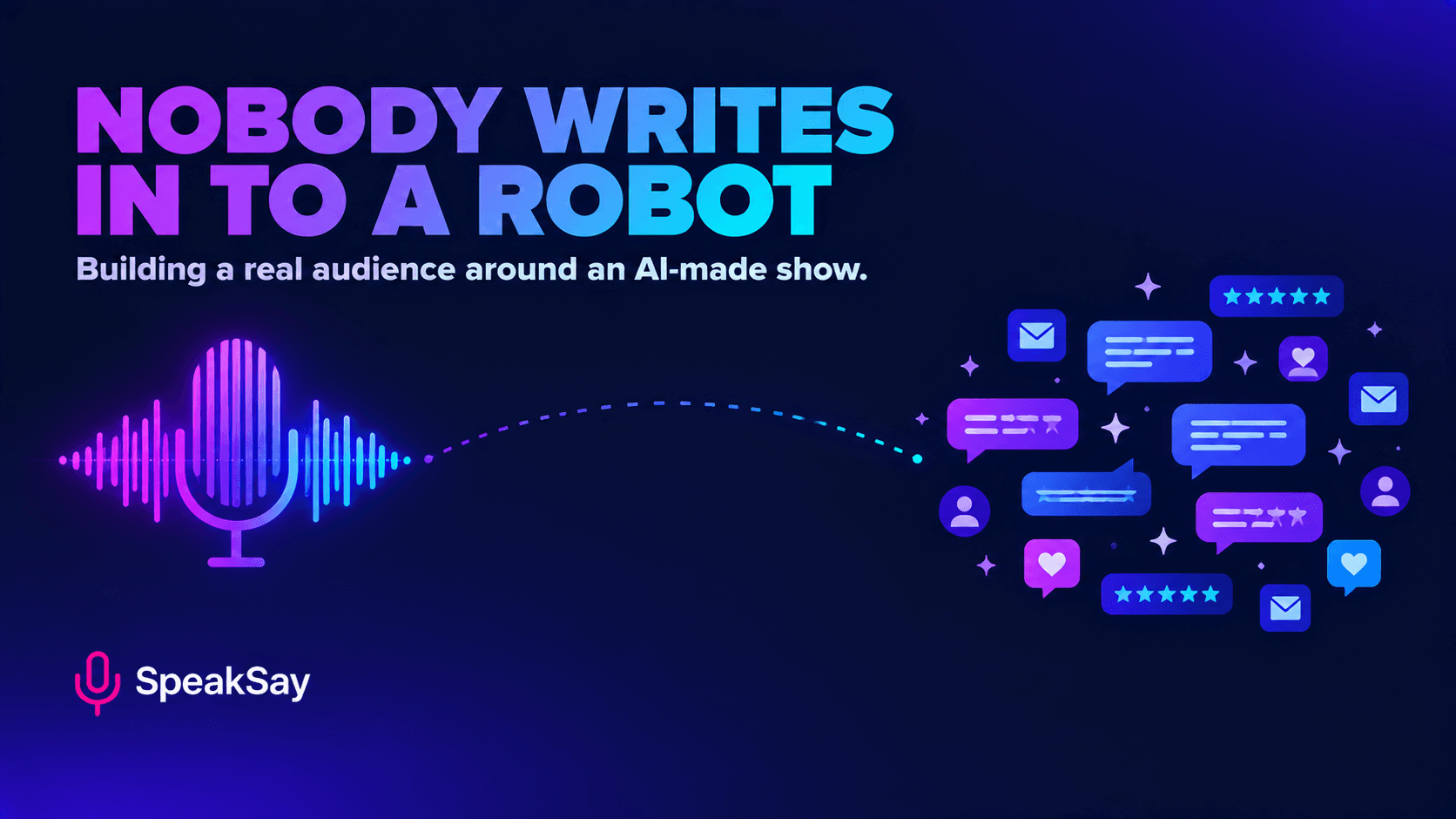
AI-produced shows solve production and then stall at about 200 listeners, because the growth levers that work in podcasting — reviews, listener mail, mailbag episodes, a host people feel they know — all assume a human at the microphone. They do not. Here is how to run the community loop on a synthetic show without pretending.
1. Why AI-made shows stall at 200 listeners
Podcast growth beyond the first few hundred listeners comes from four places, and three of them are social.
- Ratings and reviews, which feed app-level surfacing and are almost entirely driven by hosts asking for them.
- Word of mouth, which happens when a listener feels ownership over a show and recommends it as a small act of identity.
- Listener contributions — questions, corrections, story submissions — which give a show material nobody else has.
- Search and directory discovery, the only genuinely mechanical lever, and the one AI shows usually over-index on.
An AI-produced show typically does the fourth well and none of the first three at all, for an understandable reason: the person running it feels awkward asking listeners to review something they did not personally perform, and feels stranger still having a synthetic host say "we'd love to hear from you." So the ask never gets made, no inbound channel exists, and the show has no material that could not have been generated by anybody else.
The awkwardness is worth taking seriously rather than dismissing — but the answer is not to skip the community loop. It is to run it as yourself.
2. Decide who is talking: the three honest positions
Before any of this works you have to settle a question most AI podcasters leave deliberately vague: who is the listener in a relationship with? There are three honest answers and one dishonest one.
| Position | How it is presented | Community loop runs through | Best for |
|---|---|---|---|
| Producer-forward | A named human makes the show; synthetic voices present it. The producer signs the newsletter and answers the mail. | The producer, by name | Curated, research and news shows. The most robust option. |
| Author-voiced | The host voice is a clone of the producer's own voice, disclosed as synthesised delivery of their own words. | The same person, whose voice it is | Solo expert shows, newsletter audio, personal-brand shows. |
| Declared character | The host is openly a designed character with a name, and the audience is in on it. | The character publicly, a human behind the scenes | Fiction, comedy, genre and format shows with a strong premise. |
| Implied human (avoid) | A synthetic host presented as though it were a person, with an invented backstory. | Nothing — it collapses the moment someone asks a real question | Nothing. This is the position that turns a growing show into a credibility incident. |
Pick one and put it in your show description in a single sentence. Not a legal disclaimer — a positioning statement. "Researched and written by [name]; narrated with a synthetic voice" does more for trust than three paragraphs of hedging, and it makes every subsequent ask legible: the listener knows exactly who they would be talking to.
3. The ask: how to request reviews when the host is synthetic
The standard review ask — "if you're enjoying the show, leave us a five-star review" — sounds hollow in a generated voice because it is a request for a personal favour from something impersonal. Rewrite it so the beneficiary is legible and the reason is specific.
Weak (do not use): "If you love the show, please leave us a five-star review. It really helps."
Producer-forward version: "This show is researched and written by one person. Reviews are the main way new listeners find it, so if this episode was useful, a rating in your podcast app does more for it than anything else."
Author-voiced version: "I write these and record them with a synthetic version of my own voice, which is the only reason they come out weekly. If it's earning its place in your feed, a review helps me keep going."
Declared-character version: "[Host] is not going to pretend to have feelings about this. But the humans who build the show do read every review, and they are the reason it exists."
Placement matters as much as wording:
- Not in the first sixty seconds. You have not earned it yet and it costs you the listeners deciding whether to stay.
- Best position: immediately after the strongest moment of the episode, not at the end. Ask when the value has just landed.
- One ask per episode, twenty seconds maximum. Two asks reads as automation.
- Rotate the wording. Identical review asks episode after episode is one of the clearest automation signatures a listener can hear, and it makes them tune out the ask entirely.
4. Building an inbound surface people will actually use
A listener who wants to respond to your show needs somewhere obvious to go, and "reply to this podcast" is not a thing. Give them exactly one destination and repeat it identically every episode.
| Surface | Effort for listener | What it is good for | Watch out for |
|---|---|---|---|
| A single short email address | Low | Questions, corrections, longer stories | Must be sayable out loud — no hyphens, no numbers, no ambiguous spelling |
| A one-field web form | Lowest | Question submissions, mailbag fuel | Any form with more than two fields halves submissions |
| Voice memo upload | Medium | Real human audio in your episodes — enormously valuable on a synthetic show | Needs a clear consent line at the point of upload |
| A newsletter reply | Low | Ongoing conversation, the strongest retention tool | Requires you to actually reply |
| Platform comments / community tab | Low | Public social proof | Fragmented across apps; treat as secondary |
Two constraints specific to synthetic hosts. First, the destination has to be pronounceable — a generated voice reading an email address with a hyphen in it will lose half the listeners at that moment, so pick something a voice can say cleanly in one breath. Second, put it in the show notes and the episode description in text, every episode, in the same position. People do not write down addresses they hear; they look them up later.
Give listeners a real voice to reply to
If you are running the producer-forward or author-voiced position, having your own cloned voice available for the personal segments — the ask, the mailbag intro, the correction — makes the human in the loop audible rather than theoretical.
5. The mailbag episode, adapted for a synthetic host
Mailbag episodes are the highest-leverage format in podcasting: they are cheap to make, they reward the people who wrote in, and they demonstrate to every other listener that writing in produces a result. On an AI-made show they do something extra — they inject material that provably came from real people, which is the exact thing your show is otherwise short of.
A workable structure for a 15–20 minute mailbag:
- Open with the count. "Fourteen of you wrote in about last week's episode." Specific numbers are credibility.
- Lead with a correction. If a listener caught an error, that goes first, unhedged. Nothing builds trust in a synthetic show faster than it visibly being wrong and fixing it.
- Three to five questions, grouped by theme, not in the order they arrived. Grouping is editing, and editing is the signal that a human is involved.
- Attribute by first name and location, with permission. "Priya in Manchester asks..." Real names anchor the episode in reality.
- Use listener voice memos where you have them. A real human voice inside a synthetic show is a striking contrast and listeners respond to it strongly. Introduce it clearly.
- Close with the next prompt. Ask one specific question for next time. "What's the worst advice you've been given about X?" beats "let us know what you think" by an order of magnitude.
Cadence: monthly is enough. Weekly mailbags on a small show run out of mail and start padding, which is the failure mode listeners detect fastest.
6. Reading listener words in a generated voice: the rules
This is the part that goes wrong, so be deliberate about it.
- Ask permission at the point of collection. One line on the form: "We may read your message on the show. Tell us if you'd rather we didn't use your name." Consent given once, in writing, at submission.
- Never generate a voice to represent the listener. Do not assign a synthetic "listener voice" that implies you are hearing from them directly. The host reads the message and says so: "Priya writes..." One voice, clear attribution. Anything else is putting words in a real person's mouth in a fabricated voice.
- Quote, do not paraphrase into the host's voice. If you compress a message, say you are summarising.
- Do not read out identifying details — full names, employers, locations more specific than a city — even if the listener included them.
- Handle criticism straight. Read the negative message as written, at the same rate as everything else. A generated voice softening a complaint sounds like evasion because the delivery flattens exactly where a human would tense up.
- Give the listener the last word occasionally. End a mailbag on a listener's point you did not rebut. It signals the show is a conversation rather than a broadcast.
7. The 30-day community loop
Run this as a repeating cycle rather than a launch push.
| Week | Action | Time cost |
|---|---|---|
| 1 | Rotate the review ask; place it after the episode's strongest moment. Post one specific question to your social surface and to the newsletter. | 20 min |
| 2 | Reply personally to every inbound message. Every one, no exceptions, from a real human account. This is the entire engine. | 30–45 min |
| 3 | Collect and group the month's messages. Identify the correction, the best question and any voice memos. | 30 min |
| 4 | Publish the mailbag. Thank contributors by name in the show notes with links where relevant. Close with next month's prompt. | Normal episode cost |
The week-two line is the one people skip and it is the one that works. A personal reply from a named human to a listener who wrote to an AI-made show is disproportionately memorable — it is the moment the show stops being a feed and becomes a project someone is running.
Keep the production cost low enough that you have time for the audience
The whole argument for an AI-produced show is that the hours you save on recording and editing go somewhere better. Community is where they should go.
8. What to measure instead of downloads
Downloads on a small show are noisy and demoralising. These four move earlier and tell you whether the loop is working.
- Inbound messages per 100 listeners. The single best health metric for this strategy. Below 1 means your ask or your surface is broken. Above 3 is a genuinely engaged audience.
- Reviews per month. Track against ask changes. If you rotated the wording and the rate moved, that is a result you can act on.
- Repeat contributors. The count of people who have written in more than once. This is your actual community, and it is usually smaller and more important than you expect.
- Mailbag episode completion rate versus your normal episodes. If mailbags retain better, the audience is telling you to do more of them.
One caution: none of this fixes a show nobody wants. If the inbound rate stays at zero after three honest months of asking, the problem is upstream — the show's premise, its usefulness or its distinctiveness — and no amount of community mechanics will substitute for it.
9. FAQ
Should I tell listeners the podcast uses AI voices?Yes, in one plain sentence in the show description, and treat it as positioning rather than a disclaimer. Disclosure is what makes the rest of the community loop possible: once listeners know who is actually behind the show, they know who they would be writing to.
Can an AI host ask for reviews without sounding hollow?Only if the ask names a real beneficiary and gives a specific reason. Generic "leave us a five-star review, it really helps" delivered by a synthetic voice is asking for a favour on behalf of nobody. Name the person the review helps.
Is it acceptable to generate a voice for a listener's message?No. Do not create a synthetic voice that stands in for a real person's message — it implies you are hearing from them when you are quoting them. Have the host read the message with clear attribution, or use the listener's own voice memo with their permission.
How often should I run a mailbag episode?Monthly for most shows. Weekly mailbags on a small audience run dry and start padding, which is both a retention problem and one of the clearer automation signatures listeners pick up on.
What if nobody writes in at all?Check three things in order: whether you actually made an ask, whether the destination is pronounceable and repeated in the notes, and whether the ask was placed after the value rather than at the very end. If all three are right and three months produce nothing, the issue is the show's premise rather than its community mechanics.
Does a declared AI character work as a host?It works when the audience is in on it from the start and the premise supports it — fiction, comedy and format shows especially. What does not work is an implied human: a synthetic host with an invented personal history, which collapses the first time a listener asks a direct question.