Instant Unsub — AI Voice": Why Viewers Flag Your Narration in 3 Seconds, and How to Fix It in 2026
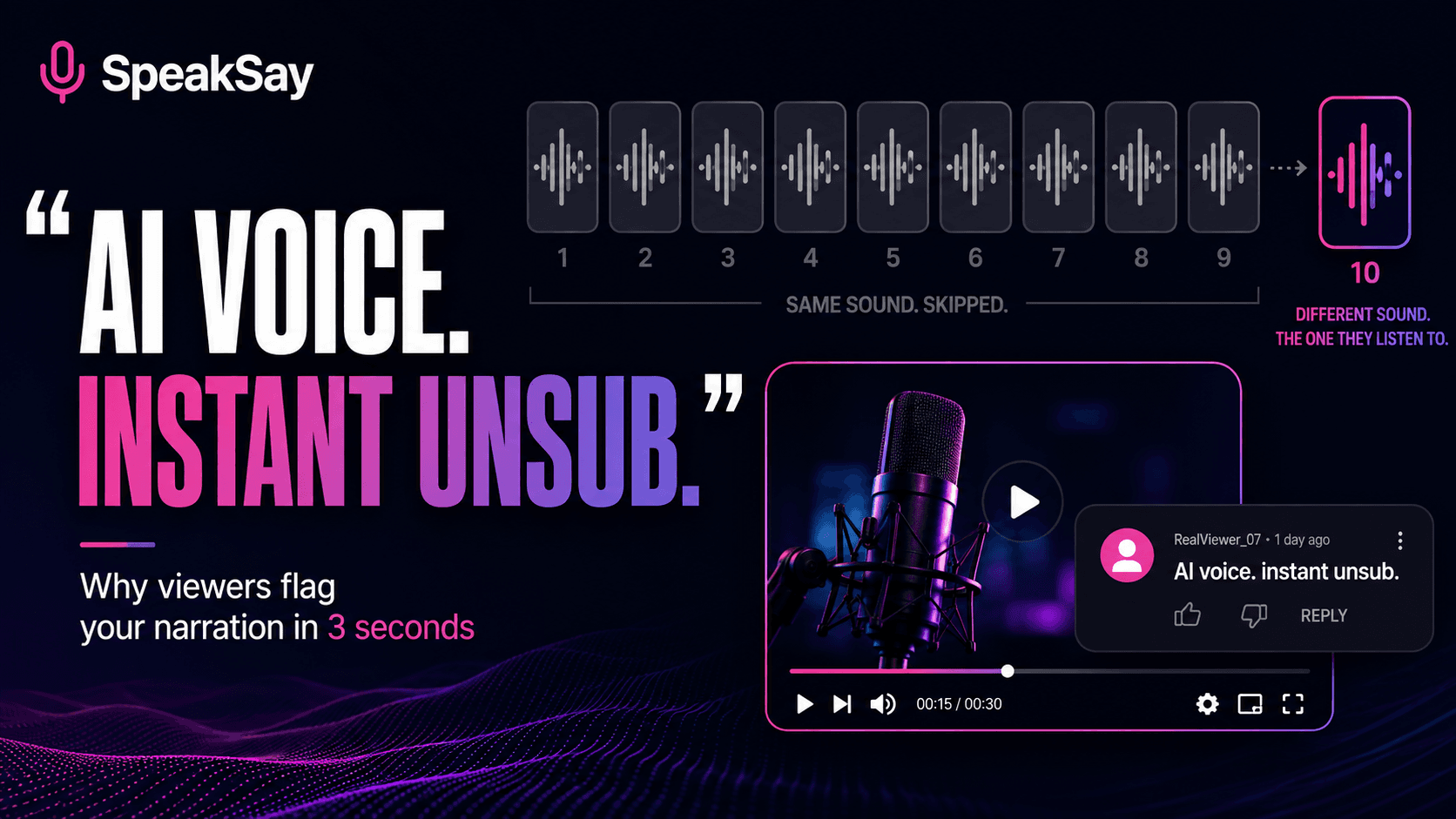
Viewers aren't detecting that your voice is synthetic. They're recognising it — the same handful of default voices narrate thousands of channels. A 2026 Nielsen finding puts long-exposure irritation 28% higher with unchanging AI narration. Here's what actually triggers the backlash and the five fixes that stop it.
1. It isn't quality — it's recognition
Here is the test that settles it. Take a comment thread complaining about an AI voice and read what people actually say. Very rarely is it "the audio sounds compressed" or "the intonation is wrong." Overwhelmingly it is a variant of: "this is the same voice as every other channel."
That is a recognition complaint, not a quality complaint, and the difference matters because it changes the fix entirely:
- If the problem were quality, upgrading models would solve it. Creators upgrade models constantly and keep getting the comment.
- If the problem is recognition, the only fix is to use a voice the audience has not heard elsewhere — regardless of how good the popular one sounds.
The mechanism is straightforward. A small number of default library voices are shipped by default, sound good out of the box, and consequently narrate an enormous share of faceless content. Your viewer's exposure to that voice is not one video — it is dozens across months. Familiarity plus context mismatch produces the reaction: this isn't a channel, it's a content farm.
Which is also why the comment hurts disproportionately: it is not really about the audio. It is an accusation that nobody made this.
2. The 20-minute fatigue effect
There is a second, quieter mechanism that shows up in retention rather than comments. A 2026 Nielsen study found that viewers exposed to the same AI voice for more than twenty minutes reported roughly 28% higher irritation than with human-narrated content.
The cause is invariance. A human narrator varies constantly without trying — micro-changes in breath, energy, pitch and pace as they get tired, get interested, or reach a point they care about. Unvaried delivery is initially fine and progressively grating, because the ear stops receiving new information and starts noticing the pattern.
This is why the problem is worst in exactly the formats creators most want to make with AI: long-form documentaries, deep dives, sleep and study content, audiobooks. Short-form largely escapes it — thirty seconds is not long enough for invariance to register.
| Format | Recognition risk | Fatigue risk | Priority fix |
|---|---|---|---|
| Shorts / Reels (under 90s) | High | Low | Unique voice |
| Mid-form (5–12 min) | High | Medium | Unique voice + register variation |
| Long-form (20 min+) | Medium | High | Register variation + pacing |
| Audiobook / sleep (1 hr+) | Low | Very high | Pacing, breath, chapter-level variation |
3. The five tells that trigger the comment
In rough order of how quickly viewers react:
- A recognised default voice. Identified in under three seconds by anyone who watches this kind of content. Nothing else you do matters until this is fixed.
- Wrong word stress. The emphasis lands on the wrong word in a sentence — "we have to consider the cost" instead of "we have to consider the cost." A June 2026 Goodcall benchmark found around 87% of test sentences carried incorrect keyword stress even on leading platforms. One clanger per minute is enough to break the spell.
- Uniform sentence rhythm. Every sentence takes about the same time and lands with the same shape. Humans vary wildly; sameness reads as machine.
- No breath, no hesitation, no room. Perfectly clean audio with zero space is unnatural at length. Silence is information.
- Written-not-spoken phrasing. "Additionally, it is important to note that…" — nobody says this out loud. Any voice reading essay prose sounds synthetic because the words are.
Note that only one of the five is about the voice engine. Four are about how you use it.
4. Fix 1: stop using a voice other channels have
Highest impact, lowest effort, one-time. Three routes:
- Remix an existing voice into your own timbre. Shift the character of a voice — weight, texture, age, warmth — until it is recognisably not the stock version. Best option if you want a distinctive channel voice without using your own. See Voice Remix.
- Clone your own voice. Strongest possible answer to the "nobody made this" accusation, because somebody did and that is their voice. You type; it narrates. See voice cloning.
- Design one from a description. Specify age, register, pace, warmth and get something the library doesn't ship. Start from the voice library and push it somewhere specific.
Whichever route: pick one and keep it. A channel voice is a brand asset and it only compounds if it is consistent. Changing narrator every few uploads produces its own version of "nobody owns this channel."
Make a voice that exists on exactly one channel
Remix a voice until it's unrecognisable as anything stock — then use it on everything you publish. Free to try before you commit.
5. Fix 2: vary register across the video
This is the fatigue fix and it costs nothing but planning. You are not changing voices — you are changing how the same voice delivers different parts of the script.
A workable pattern for a 15-minute video:
| Section | Pace | Energy | Purpose |
|---|---|---|---|
| Hook (0:00–0:15) | Slightly fast | Elevated | Earn the next 30 seconds |
| Setup (0:15–2:00) | Default | Contained | Orient the viewer |
| Body blocks | Default, with one slower block every ~4 min | Even | Carry information |
| Turn / key reveal | Slow, long pauses | Lower pitch | Mark the moment |
| Close | Slightly slower | Warmer | Land it |
Rules of thumb: change something audible at least every three to four minutes; never run more than about ninety seconds at identical pace and energy; and put your biggest change at your worst retention dip — check analytics and place a register shift thirty seconds before it.
6. Fix 3: fix the stress, not the voice
Wrong emphasis is the most fixable of the tells and the one creators most often mistake for a model problem.
- Find the operative word in each key sentence and mark it for emphasis. Usually a noun or a contrast word — not the verb.
- Rewrite sentences that keep failing. If a line won't stress correctly after two attempts, the sentence structure is the problem. Move the important word closer to the end; most delivery naturally lands weight there.
- Spell out numbers and units the way you'd say them. "twenty twenty-six," "four point seven billion," "US dollars." Numerals are a top source of clangers.
- Fix names once, globally. Build a pronunciation list per channel for the terms and names you use constantly.
- Punctuate for breath. Commas and full stops are pacing instructions. Long unpunctuated sentences are where delivery falls apart.
Budget ten minutes per script for a stress pass. It is the highest ratio of perceived quality to time spent in the entire pipeline.
7. Fix 4: write for the mouth
A large share of "sounds like AI" is actually "reads like a document." Test: read your script out loud. Every place you stumble, run out of breath, or feel silly is a place the audio will sound wrong.
| Written | Spoken |
|---|---|
| "Additionally, it is important to note that…" | "And here's the part people miss." |
| "This resulted in a significant decline in revenue." | "Revenue fell off a cliff." |
| "There are several factors to consider." | "Three things matter. Here's the first." |
| A 45-word sentence with two clauses | Three short sentences. One idea each. |
Also: use contractions, start the occasional sentence with "and" or "but," and allow deliberate fragments. Formal register is the single strongest synthetic cue in a script, whoever reads it.
8. Fix 5: win the first eight seconds
The verdict is delivered early. If a viewer's first impression is "recognised voice, generic opening line," you lose them before your content has a chance.
- Open with a specific, concrete sentence, not a greeting or a channel intro. Specificity reads as human because generic openings are what templated content produces.
- Put your most varied delivery at the front. Pace change within the first fifteen seconds signals a performance rather than a read.
- Add a half-second of silence before your first word. Audio that starts instantly at full level feels machine-triggered.
- Get the mix right. Music too loud under narration is read as low-effort. Voice clearly above the bed, always.
Clean up levels, remove noise and check your timing with SpeakSay's free tools before you publish.
Fix the voice once, keep the fix forever
Text-to-speech, cloning, Voice Remix and podcasts on a single plan — so building a signature channel voice doesn't mean stacking four subscriptions.
9. How to tell whether it worked
Don't judge by whether the comments stop — a handful of viewers dislike any synthetic narration regardless. Judge by these instead:
- Retention at 30 seconds. The recognition verdict lands here. A unique voice usually shows up as a measurable lift in the first-30 curve.
- Retention at the 40–60% mark. This is where fatigue shows. If register variation is working, the mid-video slump flattens.
- Comment composition. Track the ratio of voice comments to content comments across ten uploads. The goal is not zero voice comments; it is voice comments becoming a rounding error next to comments about what you said.
- Returning viewers. The slowest and most meaningful signal. A recognisable, owned voice is what makes a channel feel like a show worth coming back to.
Change one thing at a time across at least five uploads. Changing voice, pacing and script style simultaneously tells you nothing about which one mattered.
10. FAQ
Can viewers actually tell a voice is AI?Increasingly less from audio quality alone, and increasingly more from recognition — hearing the same default voice across many channels — plus emphasis errors and unvarying rhythm. That is why a unique voice with a stress pass often reads as human even when a technically better default voice does not.
Does a more expensive model fix this?Only partly. It can improve intonation, but it does nothing about recognition — if anything, the most popular high-end voices are the most recognised. Uniqueness and delivery variation matter more than model tier.
Should I just use my real voice instead?If you want to and can record consistently, that is a fine answer. Many creators can't — time, environment, language, health, or a preference for anonymity. A cloned or remixed voice gets you the consistency and the uniqueness without the recording session.
Is voice fatigue really a 20-minute threshold?Treat it as a rough marker rather than a cliff. The 2026 Nielsen finding measured elevated irritation past that point with unchanging AI narration, but the underlying driver is invariance — vary the delivery and the effect weakens well before and after any particular timestamp.
Will changing my channel voice confuse existing subscribers?Some will notice. Say so once, in a pinned comment or a line at the top of the video, and move on. A single acknowledged change is far less damaging than months of drifting between voices.
What if my niche audience is fine with AI voices?Some are — tutorials and utility content in particular. Even there, recognition costs you brand distinctiveness, and the fatigue effect is format-driven rather than niche-driven. If your videos are long, the fix is worth it regardless of how tolerant your audience is.