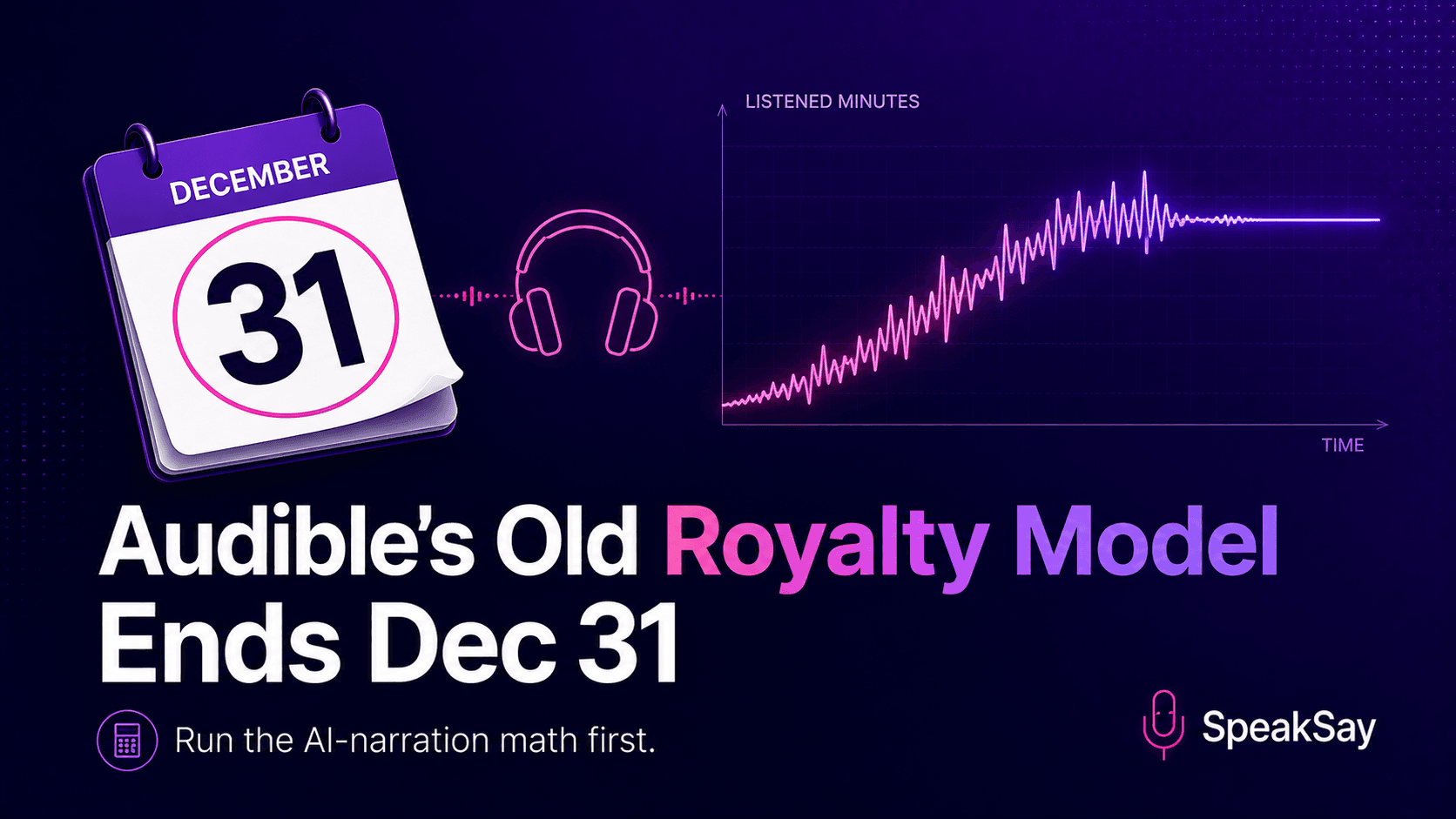
Audible's Old Royalty Model Dies December 31, 2026: The AI-Narration Math Indie Authors Need to Run Before Then
Audible's legacy royalty model is being retired at the end of 2026 and the replacement pays on listened minutes, not sales. That changes which books are worth producing, how long they should be, and whether AI narration still pencils out. Here's the math.
1. What actually changed, in plain language
The old audiobook royalty world was straightforward: a listener acquires your title, you earn a percentage of a price or a fixed per-credit amount, and what happens after that is between them and their commute. Whether they finished the book was your problem emotionally and nobody's problem financially.
An engagement-based, pooled model works differently. Revenue from a subscription pool is distributed according to how much of each title members actually consume. Your share of the pool is a function of your listened minutes relative to everyone else's listened minutes. The mechanics of any specific programme are set by the platform and worth reading in full in your account dashboard — but the direction of travel is unambiguous, and it's the same direction music and video went years ago.
Three consequences follow immediately:
- Abandonment now costs you money directly. A listener who quits at 22% earns you roughly a fifth of what a listener who finishes earns you.
- Length is no longer free upside. A long book has more billable minutes only if people listen to them. A 16-hour book finished by a third of its listeners can underperform a 6-hour book finished by four fifths.
- Narration quality moved from "nice to have" to "revenue input." Whatever makes someone stop listening at chapter three is now a line item.
Alongside this, the wider distribution landscape reshuffled in 2026: Findaway Voices was rebranded as Voices by INaudio following Spotify's acquisition, with Spotify for Authors operating as a separate direct-upload route. Your "where do I distribute" decision and your "which royalty model" decision are now tangled together, and both have 2026 deadlines attached.
2. Why "listened minutes" breaks your old spreadsheet
Most indie audiobook spreadsheets have three inputs: units, price, royalty rate. Multiply, subtract production cost, done.
Under engagement-based payouts, you need at least five:
- Listeners who start the title
- Finished hours (the actual audio runtime of your book)
- Average completion rate
- Effective pool rate per listened hour
- Production cost, amortised over the title's life
The variable that most authors have never measured — and that now drives everything — is completion rate. Industry conversations in 2026 put average audiobook completion somewhere in a broad band that varies enormously by genre and length: tightly plotted commercial fiction and short nonfiction skew high; sprawling literary works and 15-hour nonfiction skew much lower. You should treat any single published figure with suspicion and instead measure your own from platform analytics where available.
The point isn't the exact number. It's that completion rate is now a multiplier on your revenue, and until this year almost nobody was optimising for it.
3. The math: three books, same catalogue, very different outcomes
Here's the worked comparison. The pool rate below is a placeholder for illustration only — plug in your own from your dashboard once you have real data. What matters is the shape of the result, not the absolute figures.
Assume: 1,000 listeners start each title, and an illustrative pool rate of $0.55 per listened hour.
| Title | Finished hours | Completion rate | Listened hours (1,000 starts) | Illustrative revenue |
|---|---|---|---|---|
| A — Epic fantasy | 14.0 | 38% | 5,320 | $2,926 |
| B — Commercial thriller | 9.0 | 62% | 5,580 | $3,069 |
| C — Short nonfiction | 4.5 | 81% | 3,645 | $2,005 |
Read that carefully. Book A is 56% longer than Book B and earns less. All that extra runtime — and all that extra production cost — bought nothing, because more than 60% of listeners never reached it.
Now hold length constant and move only completion:
| Scenario (9-hour title, 1,000 starts) | Completion | Listened hours | Illustrative revenue | Change |
|---|---|---|---|---|
| Poor narration, no sample optimisation | 44% | 3,960 | $2,178 | baseline |
| Solid narration, decent pacing | 62% | 5,580 | $3,069 | +41% |
| Strong narration, tight chapters | 74% | 6,660 | $3,663 | +68% |
A 30-percentage-point swing in completion is a 68% swing in revenue on identical content. That is the entire argument of this article. Under the old model, that swing was worth approximately zero on the day of sale.
The break-even question
If you are choosing between a $2,000 human narration and a $200 AI-narrated production, the old comparison was purely about upfront cost against unit sales. The new comparison is:
Does the more expensive production raise completion rate enough, over the life of the title, to recover the difference?
At the illustrative pool rate above, a 9-hour title needs roughly 3,270 extra listened hours to recover an $1,800 production gap. At 1,000 starts, that's a completion improvement of about 36 percentage points — a lot. At 10,000 starts, it's 3.6 points — trivially achievable.
Which tells you the real rule: production budget should scale with expected audience, not with authorial affection for the book. A debut with no list behind it and a backlist title with 40 reviews are different financial objects.
Model your own numbers before the deadline
Whatever you decide about the royalty model, the production side is where you have the most control. A lifetime plan removes per-title narration cost from the equation entirely — which matters most when you're producing several books.
4. Where completion rate actually comes from
If completion is now the revenue lever, it's worth knowing what moves it. From listener behaviour research and author-reported analytics, the drivers rank roughly as follows.
4.1 The first fifteen minutes
Most abandonment is front-loaded. Listeners who reach the 20% mark usually finish. That makes your opening chapter, and specifically your sample, disproportionately important. Many authors upload a sample from the very start of the book, which for nonfiction often means a listener's first experience is acknowledgements and front matter. Fix that.
4.2 Narration consistency
Voice drift — where the tone, pace or timbre shifts noticeably between chapters recorded at different times — is one of the most-cited reasons listeners report "something felt off." It's a particular risk with AI narration produced in sessions across weeks, and it's entirely preventable with locked settings and a single voice profile.
4.3 Pace
Audiobook listeners increasingly play at 1.2–1.5×. A narration already delivered fast becomes unintelligible when sped up; one delivered slightly slow becomes ideal. Erring slow is the safer choice, and it also gives listeners headroom to use the speed control they already prefer.
4.4 Chapter length
Long chapters reduce natural stopping points, which sounds like it should increase listening but in practice increases abandonment — people stop mid-chapter and don't come back. Sub-chapter markers every 8–15 minutes give listeners clean re-entry points.
4.5 Pronunciation errors
One mispronounced character name in chapter one, repeated three hundred times, is a completion killer in fiction. Build a name lexicon before you generate anything.
4.6 Audio quality basics
Inconsistent loudness between chapters, audible artefacts at splice points, and background noise all correlate with drop-off. Normalise the whole book to a consistent loudness target as a final step rather than chapter by chapter.
5. The narration-cost side of the equation
Traditional narration costs are usually quoted per finished hour, and a professional narrator with studio time typically lands somewhere in the low hundreds per finished hour — meaning a 10-hour book is a four-figure investment before marketing. Royalty-share arrangements shift that cost into future revenue rather than removing it.
AI narration collapses the marginal cost, but it introduces different costs that authors routinely underestimate:
- Preparation time. Cleaning a manuscript for narration — removing formatting artefacts, expanding abbreviations, marking emphasis, building a pronunciation list — is real work, typically 2–5 hours for a full-length book the first time you do it.
- Proofing time. You must listen to the whole thing. There is no shortcut. Budget roughly 1.2× the runtime.
- Revision cycles. Every mispronunciation found in proofing is a regeneration and a splice.
- Platform compliance. Some retailers require specific disclosure or metadata for AI-narrated titles; getting this wrong causes rejection and delay.
The honest comparison, then, isn't "$2,000 versus free." It's "$2,000 versus a few hundred dollars plus fifteen to twenty hours of your own time" — and the time cost drops sharply on your second and third titles as your lexicon and process mature. This is exactly why backlist conversion is where AI narration makes the most financial sense: the per-title overhead is amortised across many books.
Narrate in your own voice, not a stock one
A cloned author voice gives you the cost profile of AI narration with an identity no other title on the platform can duplicate — and for nonfiction especially, listeners consistently prefer hearing the author.
6. Platform-by-platform: who accepts AI narration in 2026
This landscape has moved several times in the last eighteen months, so verify current terms in each dashboard before you commit — but as of August 2026 the broad picture is:
| Platform | AI narration | Notes |
|---|---|---|
| ACX / Audible (standard route) | Restricted | Historically required human narration; a voice-replica pathway has been piloted for approved narrators. Check current terms — this is the most-changed policy in the space. |
| Voices by INaudio | Accepted | Accepts both human and AI-narrated titles; the rebranded successor to Findaway Voices distribution. |
| Spotify for Authors | Accepted | Separate direct-upload portal; disclosure requirements apply. |
| Google Play Books | Accepted | Offers its own auto-narration pipeline alongside uploaded audio. |
| Kobo Writing Life | Accepted | Requires AI narration to be tagged in metadata. |
| Amazon KDP Virtual Voice | Accepted (own voices only) | Uses Amazon's voices; title is labelled AI-narrated. You don't control the voice. |
The strategic read: the exclusive-to-Audible path is the one with the tightest AI-narration constraints and the royalty model that's changing. Going wide has never been more attractive for AI-narrated titles — but wide requires you to actually market, which is a different skill from producing.
7. A decision framework for the deadline
Work through these in order.
- Pull your actual numbers. Units, revenue, and any completion or listened-minutes data available in your dashboard for the last twelve months. Do this first; everything else is guesswork without it.
- Segment your catalogue by length and genre. Short, high-completion titles behave completely differently from long ones under engagement pricing.
- Model both structures on your three best-selling titles. If your titles are long and completion is weak, engagement-based payouts will hurt; if they're tight and finished, you may come out ahead.
- Decide exclusivity separately from royalty structure. These are two questions, and conflating them is the most common error. Wide distribution with AI narration is a coherent strategy; so is exclusive with human narration. Mixing the assumptions is what produces bad decisions.
- Check your production pipeline against the deadline. If a decision implies re-producing titles, a 10-book backlist is not a December project. Start in September.
- Write down what would make you reverse the decision. Set a review date in Q2 2027 and a metric that triggers a rethink.
8. Producing (or re-producing) a title that survives the new math
- Manuscript prep. Strip page numbers, headers, footnote markers and any formatting that will be read aloud. Expand abbreviations. Decide how to handle footnotes — either read them inline, gather them at chapter end, or drop them with a note in the front matter.
- Name and term lexicon. Every character, place and invented term with a phonetic respelling. Test it as a standalone audio file before generating a single chapter.
- Voice lock. One voice, one set of settings, recorded in your production notes. Never adjust mid-book. If you must change, re-generate everything.
- Generate in chapter-sized blocks. Small enough to regenerate cheaply, large enough to keep prosody natural across paragraph boundaries.
- Front-matter and sample strategy. Produce your retail sample deliberately — the strongest three minutes of chapter one, not the copyright page.
- Full proof listen. At 1× speed, with the manuscript open. Mark timestamps; fix in one batch.
- Loudness normalisation across the whole book. Consistent perceived volume chapter to chapter, with a final check on headphones and on a phone speaker.
- Metadata and disclosure. Tag AI narration where the platform requires it. Non-disclosure risks removal and is not worth the marginal sale.
9. Six mistakes to avoid before 31 December
- Deciding by vibe. "Engagement models are bad for creators" is a reasonable instinct and a terrible substitute for running your own numbers. Some catalogues genuinely do better.
- Assuming longer is better. Under engagement payouts, unfinished runtime is dead weight that cost you money to produce.
- Ignoring the sample. It's the highest-leverage 180 seconds of the entire project and most authors never think about it.
- Producing the whole backlist before testing one title. Do one, measure completion, then scale.
- Changing the voice mid-catalogue. Series listeners notice immediately, and it reads as carelessness.
- Missing the deadline by default. Not deciding is a decision, and it may not be the one you'd have chosen.
None of this is financial or legal advice, and specific programme terms are set by the platforms and change — read the current terms in your own dashboard and, if the numbers are large enough to matter, talk to an accountant who works with authors.
10. FAQ
What is Audible's new royalty model?It's an engagement-based, pooled structure: revenue is distributed according to how much of each title subscribers actually listen to, rather than per acquisition. Enrolment opened in May 2026 and the legacy model is scheduled for discontinuation at the end of 2026. Exact mechanics are set by the platform — read the current terms in your dashboard.
Does this make AI narration more or less attractive?Both, in different directions. It lowers the value of simply having a title available (production volume alone earns less), and raises the value of narration that keeps people listening. AI narration becomes more attractive for backlist volume and for titles with modest audiences; higher-investment narration becomes easier to justify for titles with large audiences where a small completion gain multiplies across many listeners.
How do I find my audiobook's completion rate?Check the analytics section of each retailer dashboard. Availability varies — some platforms expose listened-minutes or completion data, others don't. Where it isn't available, use review sentiment and your own sample-listen as proxies, and prioritise platforms that do report it.
Should I go wide instead of exclusive?It's a separate question from the royalty model, and it depends on whether you can market. Wide distribution offers more AI-narration-friendly platforms and no dependence on a single programme's terms, but you own discovery entirely. Exclusive offers built-in discovery mechanics at the cost of flexibility.
Do I have to disclose that a book is AI-narrated?On most platforms, yes — usually via a metadata tag rather than a disclaimer in the audio. Requirements differ by retailer and are enforced. Check each platform's current terms; non-disclosure risks takedown.
Is it too late to re-produce my backlist before the deadline?For one or two titles, no. For ten, it's tight but feasible if you start now and your manuscripts are clean — the first title takes the longest because that's when you build your lexicon and process. Prioritise the titles with the most existing readers.