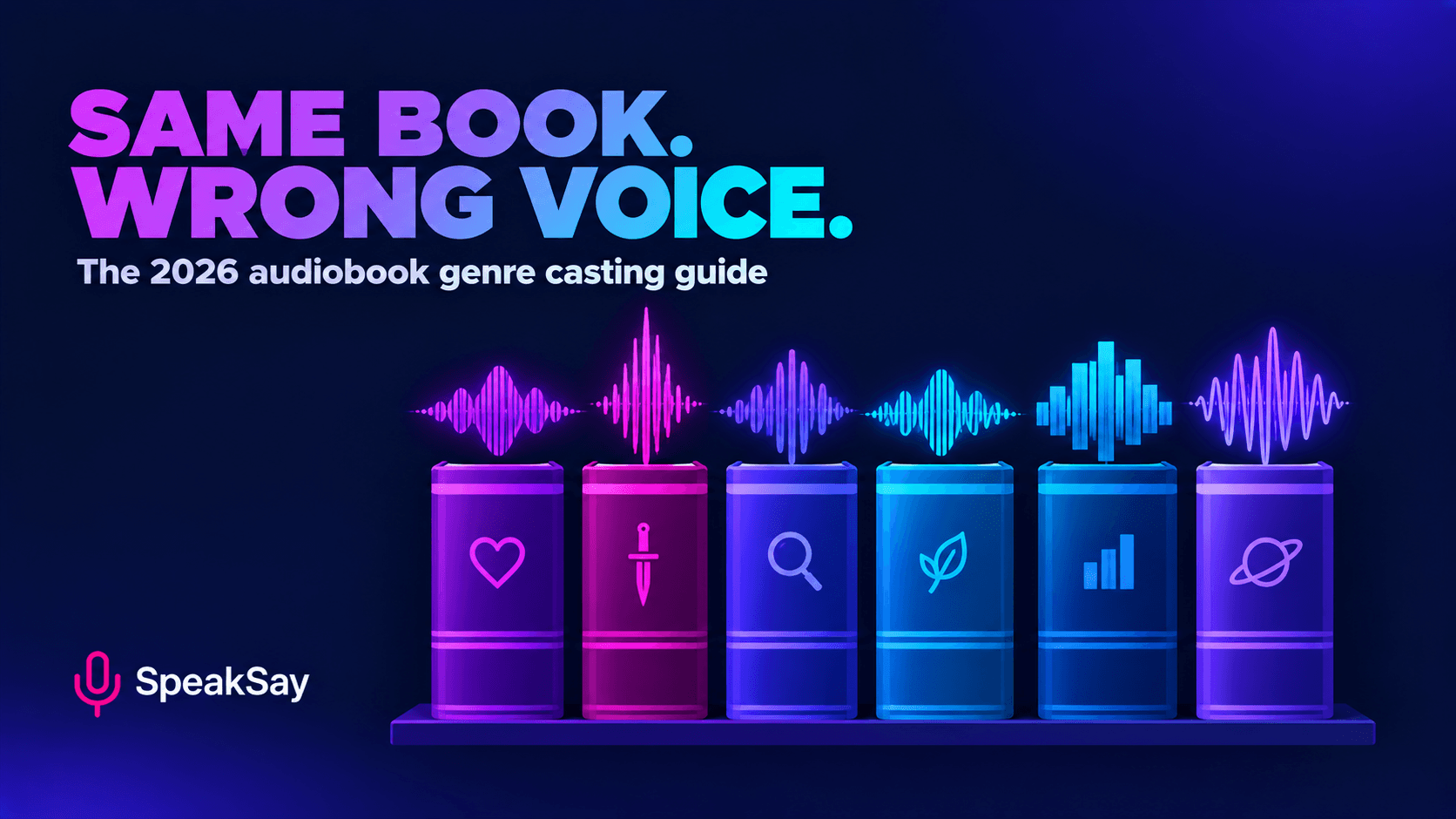
Apple Shipped Romance-Tuned AI Voices. Here Is the 2026 Genre Casting Guide for AI Audiobook Narration
Production stopped being the bottleneck for indie audiobooks. Casting became it. Retailers now ship genre-tuned narration voices, but the choice is still yours to get wrong — and a thriller read in a memoir voice will not sell. Here is the genre-by-genre casting spec, with rate, warmth, register and sample-test protocol.
1. Production stopped being the bottleneck. Casting became it.
Three years ago the question for an indie author was whether an audiobook was affordable at all. That question is settled. Between retailer-supplied narration and independent AI narration tools, the cost of turning a finished manuscript into a finished audiobook has collapsed to the point where the production decision is trivial for most authors.
What has not collapsed is the risk of getting the voice wrong, and the market has become more sensitive to it, not less. Reporting through 2026 has consistently shown two things happening at once: general listener enthusiasm for AI narration has cooled, while listener interest in multi-voice and well-cast AI audiobooks has held up or grown. Read those two findings together and the conclusion is not "listeners reject AI narration." It is "listeners reject badly cast narration, and AI made bad casting cheap and abundant."
Which means the leverage moved. The author who spends four hours on casting and twenty minutes on production will beat the author who does the reverse, every time, because the sample is what sells the book and the sample is nothing but casting.
2. The four axes that actually decide a narrator fit
Most authors audition voices by asking "does this sound good?" Every professional voice on every platform sounds good. That question cannot separate them. These four can.
- Distance. How close does the narrator feel to the listener's ear? Intimate narration feels like someone speaking to you alone; presentational narration feels like someone addressing a room. Romance and memoir want intimate. Epic fantasy and history want presentational. This is the single biggest genre discriminator and it is mostly a function of breathiness, mic proximity character and rate.
- Effort. How hard does the voice sound like it is working? High-effort delivery — pushed, energised, projecting — suits thrillers and self-help. Low-effort delivery suits literary fiction and cosy mystery. Mismatched effort is why an audiobook can feel exhausting after fifteen minutes.
- Judgement. Does the narrator sound like they have opinions about the story? A narrator with audible judgement is an asset in satire, memoir and business writing, and a liability in thriller and literary fiction where the reader wants to arrive at their own conclusions.
- Age impression. Not the character's age — the narrator's. A twenty-something narrator telling a story about a marriage of thirty years produces a mismatch listeners feel without being able to name.
Before you audition anything, write down your book's target on all four. If you cannot, the problem is the book's positioning, not the voice library.
3. The genre casting table
Starting points, not laws. Deviate deliberately.
| Genre | Distance | Rate | Effort / warmth | Casting note |
|---|---|---|---|---|
| Contemporary romance | Intimate | 145–155 wpm | Low effort, high warmth | The narrator must sound like they like these people. Restraint on the emotional peaks — the writing does that work; a narrator that pushes it becomes parody. |
| Thriller / suspense | Mid | 155–170 wpm | High effort, low warmth | Pace is the genre. Cast a voice that sounds controlled at speed, not one that sounds urgent — urgency for nine hours is unbearable. |
| Cosy mystery | Close-mid | 140–150 wpm | Low effort, high warmth, audible judgement | The narrator is a companion who finds this all mildly amusing. The one genre where a slightly older, wry voice outperforms a neutral one. |
| Epic fantasy / sci-fi | Presentational | 140–150 wpm | Mid effort, mid warmth | Needs headroom for names and invented terms. Build the pronunciation lexicon before casting — some voices handle constructed words far better than others. |
| LitRPG / progression | Mid | 150–160 wpm | Mid-high effort | Stat blocks and system messages need a distinct treatment. Decide early whether they get a second voice or a processed version of the main one. |
| Young adult | Close | 150–160 wpm | Mid effort, high warmth | Age impression must sit near the protagonist's without doing a "teen voice". The commonest error in the category. |
| Literary fiction | Mid | 135–145 wpm | Low effort, low judgement | The narrator gets out of the way. Anything performative fights the prose. |
| Memoir | Intimate | 135–145 wpm | Low effort, high warmth, high judgement | The strongest case for cloning the author's own voice in the whole catalogue. If it is not the author's voice, it must at least be plausible as their voice. |
| Self-help / motivation | Close-mid | 145–155 wpm | High effort, high warmth | Second person is everywhere in this genre. The voice must sound like it is addressing the listener, not reading about them. |
| Business / nonfiction | Presentational | 145–155 wpm | Mid effort, mid warmth, high clarity | Clarity beats character. Numbers, terms and structure land or they do not; see the visual-apparatus problem before you record. |
| History / narrative nonfiction | Presentational | 140–150 wpm | Mid effort, restrained warmth | Chronicler register. Confidence on the record, hedging on the interpretation. |
| Horror | Close | 135–145 wpm | Low effort, low warmth | Counterintuitive but reliable: calm delivery of terrible things outperforms performed dread by a wide margin. |
Audition your genre spec across a full voice library
Take one 300-word scene, generate it at your genre's rate across several candidate voices, and listen back-to-back. This is the entire casting process and it takes about twenty minutes.
4. Fiction: point of view decides the voice before genre does
Genre gets the headline, but in fiction the point of view constrains casting harder than the genre does.
- First person. The narrator is the protagonist. Age, gender, class and region of the voice all have to be plausible for that character. A first-person romance narrated by a voice fifteen years older than the heroine will feel wrong for nine hours and the listener will never articulate why.
- Close third. The narrator sits just behind the character's shoulder. You have latitude on age and gender but not on temperament — a wry voice over an earnest character creates a running irony you did not write.
- Omniscient third. Full freedom. This is where the presentational, chronicler-style voices belong, and where a genuinely neutral narrator is a strength rather than a blandness.
- Multiple POV. Decide up front: one narrator handling all POVs, or a voice per POV character. Full-cast production is the direction listener interest has been running, but it doubles your consistency work. If you go multi-voice, the contrast between voices needs to be obvious in the first sentence of each chapter, not subtle.
Dialogue handling is a separate decision from casting. A single narrator can differentiate characters through slight rate and register shifts rather than impressions. Attempted "character voices" from a single generated narrator are where AI fiction narration most reliably falls apart — the shift lands as a glitch rather than a performance. If a book needs distinct character voices, cast distinct voices.
5. Nonfiction: authority versus companionship
Nonfiction casting splits along a single question: is the listener being taught, or accompanied?
| Authority mode | Companion mode | |
|---|---|---|
| Suits | Business, history, science, reference | Memoir, self-help, wellness, personal essay |
| Distance | Presentational | Intimate |
| Sentence landing | Firm falls | Softer, sometimes unresolved |
| Second person | Rare | Constant — voice must address, not describe |
| Author's own voice? | Optional | Strongly preferred |
| Failure mode | Sounds like a corporate training module | Sounds like a stranger pretending to know you |
The author's-own-voice question is the one worth most money. For memoir, personal-brand nonfiction and anything where the book's proposition is "this person's experience", a clone of the author's voice is not a cost-saving measure — it is the correct casting decision, and it is one the retailer's stock voices structurally cannot make for you. For reference and business nonfiction, a clear professional voice usually beats an author who is not a comfortable reader.
If the book is about you, the voice should be yours
Clone your own voice once and narrate your whole catalogue with it — memoir, podcast, course audio and future books all in the same recognisable voice.
6. Retailer voices versus your own: what you gain and give up
Retailer-supplied narration is genuinely useful and it is free at the point of use. It also comes with constraints worth naming before you commit a title to it.
| Retailer-supplied narration | Independently produced narration | |
|---|---|---|
| Cost | Typically none upfront, taken in terms | Production cost you control |
| Voice choice | Fixed roster, genre-tuned but shared | Any voice, including your own cloned voice |
| Distribution | Often tied to that retailer's ecosystem | You hold the master file and can go wide |
| Differentiation | Your book shares a voice with thousands of others | Voice can be unique to your catalogue |
| Revision control | Re-run within the retailer's system | Re-generate and re-upload anywhere |
| Best for | Backlist tests, low-stakes titles, quick coverage | Series, flagship titles, author-brand books |
The decision rule most authors land on after a few titles: use retailer narration to test whether a title has an audio audience at all, and produce independently for the ones that do — because once a series has listeners, the voice becomes part of the product and you want to own it.
7. The blind sample test that settles it in 20 minutes
Do not decide by listening to voice demos. Demos are read from copy chosen to flatter the voice. Test on your own text, blind.
- Pick two passages, not one. One quiet passage (description, interiority) and one high-energy passage (action, argument, emotional peak). Around 250 words each. Most voices are fine on one and fall apart on the other.
- Generate all candidates at identical settings — same rate, same everything. Any difference you hear is then the voice, not the configuration.
- Strip the labels. Rename the files A, B, C. You will unconsciously favour the voice you were already leaning toward otherwise.
- Listen on the listener's hardware. Phone speaker and cheap earbuds, not studio monitors. That is where audiobooks are consumed and it flattens differences you agonised over on good headphones.
- Score against your four-axis target from section 2, not against "which is nicest".
- Run the fatigue check. Take the top two and listen to a full fifteen minutes of each. Casting errors almost never show up in 250 words; they show up at minute twelve, as a mannerism you now cannot stop hearing.
- Then test the retail sample. Whatever you cast has to work on the first five minutes of the book, because that clip is what converts browsers into buyers.
Two people is enough for a second opinion, and they should be readers of the genre rather than friends. The question to ask them is not "do you like this voice?" It is "would you buy nine hours of this?"
8. Series and catalogue consistency
Listeners notice a narrator change between book two and book three of a series more than almost any other production choice, and they comment about it in reviews. If you are writing a series, treat the voice as a fixed asset from book one.
- Write down the full settings profile — voice, rate, any style or stability parameters, output specs. Not "the warm female one". The exact configuration.
- Keep a reference clip. Ninety seconds from book one, stored with the profile. Before generating book three, generate the same ninety seconds again and compare. If the platform has updated its model underneath you, you want to know before you produce nine hours.
- Keep the character cast sheet if you are multi-voice: character, voice, settings, first appearance. Recurring side characters must sound the same in book four.
- Decide your migration trigger in advance. If a tool shuts down or a voice is withdrawn, your plan is: match, do not upgrade. Recreate the old sound as closely as possible at a natural series break, and tell your listeners rather than hoping they will not notice.
- Standalone titles can differ. A catalogue does not need one voice; a series does. Cast each standalone to its genre.
Produce a whole catalogue on one plan
Series consistency, full-cast fiction and author-voice memoir all draw on the same production budget. A one-time plan makes the maths on a ten-book backlist very different from per-title pricing.
9. FAQ
Does the narrator's gender need to match the protagonist's?In first person, usually yes — the narrator is the character, and a mismatch is audible for the whole book. In third person it matters far less, and in omniscient narration it barely matters at all. Cast to point of view before you cast to genre.
Should I use the free narration my retailer offers?It is a reasonable way to test whether a title has an audio audience, particularly for backlist. For a series or a flagship title, producing independently gives you a voice you own, a master file you can distribute anywhere, and differentiation from every other book using the same shared roster.
What speed should an audiobook be narrated at?Roughly 135 to 170 words per minute depending on genre — literary fiction and memoir at the slow end, thriller and suspense at the fast end. Listeners adjust playback speed themselves, so err slightly slow rather than fast; speeding up a slow read works, slowing down a rushed one does not.
Is multi-voice worth the extra work?Listener interest has held up better for multi-voice and full-cast AI audiobooks than for single-voice ones, so for dialogue-heavy fiction it is often the difference between a sample that converts and one that does not. The cost is consistency management: you now need a cast sheet and per-character settings maintained across the whole series.
How do I know if I have cast it wrong?Listen to fifteen unbroken minutes. Casting errors rarely show up in a short sample — they show up as a mannerism or a mismatch of energy that becomes unbearable somewhere around minute twelve. If you find yourself wanting it to stop, so will the listener.
Can I change the narrator between books in a series?You can, but expect it in the reviews. If you must — because a tool shut down or a voice was withdrawn — change at a natural break, match the old voice rather than upgrading to a "better" one, and say so in the description. Listeners forgive a disclosed change far more readily than an unexplained one.