Biography and Life Story Faceless Channels in 2026: The Chronicler AI Narrator Playbook (and the Impersonation Line You Must Not Cross)
Biography channels tell one person's whole life in twelve minutes — and the narrator has to sound like a chronicler, not a fan, not a tabloid and never like the subject. Here is the voice casting spec, the lifespan pacing map, the name pronunciation workflow and the impersonation boundary that keeps the channel monetised.
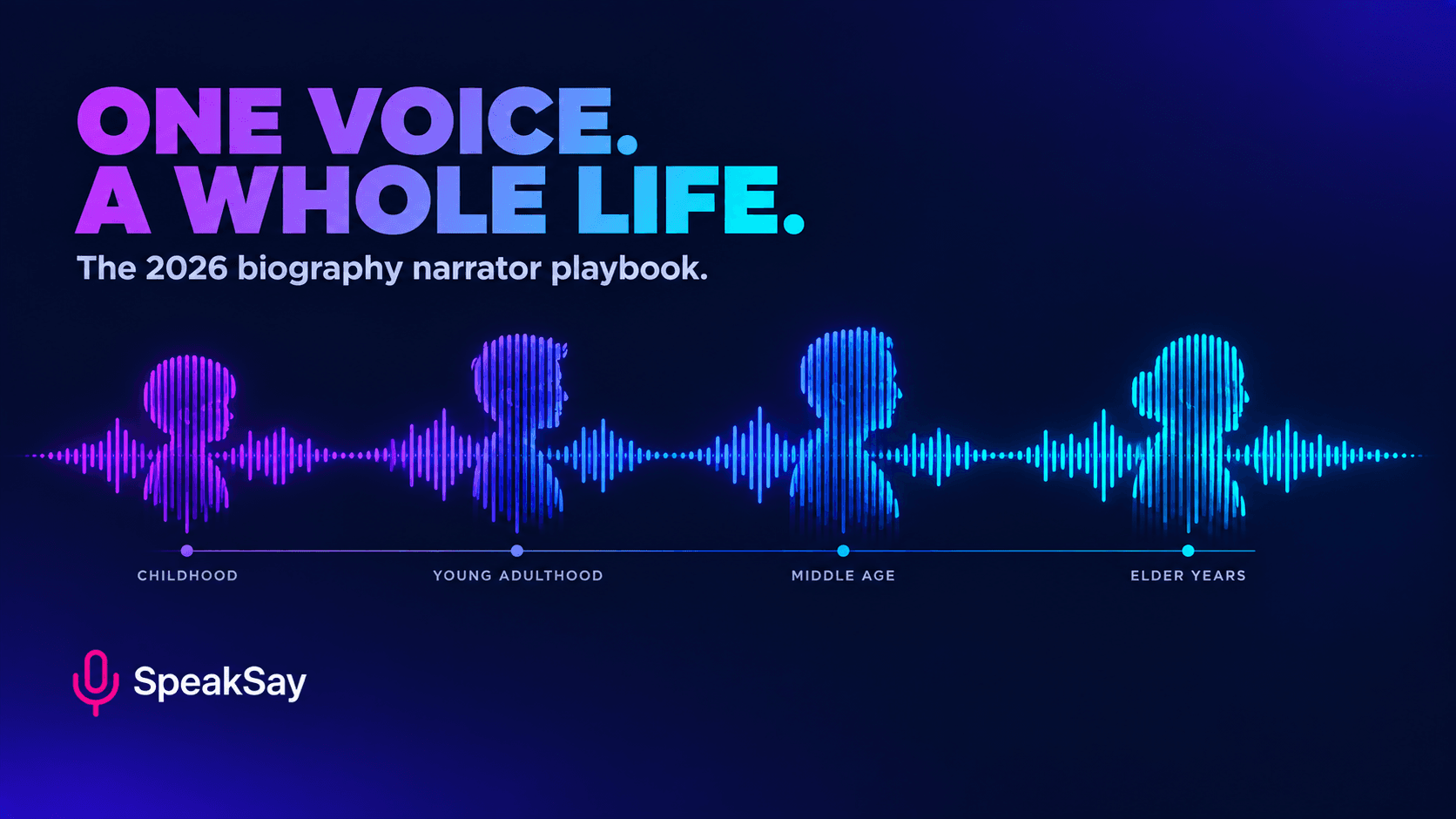
1. Why biography is still an open niche in 2026
Most faceless niches are crowded because they are easy. Listicles, facts channels and reaction formats can be assembled in an afternoon. Biography cannot. A good biography video needs a real arc — origin, turn, peak, cost, ending — and that structural demand has kept the barrier high enough that the niche never saturated the way trivia and motivation did.
Three things make it commercially attractive:
- Evergreen shelf life. A well-made life story does not expire. A video about a person who died in 1994 is as watchable in 2029 as it is today, which means the back catalogue keeps earning while you publish.
- Long average view duration. Biography viewers arrive wanting the ending. That intent alone pulls retention past the point where most faceless formats bleed out.
- Search plus suggested, not just suggested. People type names into YouTube. That gives biography channels a searchable demand floor that trend-dependent formats do not have.
The catch is that biography is a trust niche. Viewers are being told facts about a real person, often one they already have feelings about. The narrator is the only thing standing between "this is a documentary" and "this is a content farm reading a Wikipedia page." That is a voice problem before it is a script problem.
2. The chronicler voice: what you are actually casting for
The default mistake is to cast the trailer voice — deep, slow, portentous, the one every faceless channel reaches for. It is wrong here for a specific reason: a trailer voice is selling. A biography narrator is recounting. The moment the voice sounds like it is building to a reveal, the viewer stops believing the facts and starts hearing a pitch.
What you want is the chronicler: someone who has read everything, is not surprised by any of it, and is telling you what happened because you asked. Calm authority without gravel.
| Attribute | Target | Why |
|---|---|---|
| Age impression | 40–60 | Needs to sound like it has outlived the subject's era. A 25-year-old timbre narrating a 1950s childhood reads as a summary, not a memory. |
| Pitch | Mid, not bottom-of-range | Deep-and-breathy signals mystery content. Biography is not a mystery; you are telling the audience what happened. |
| Base rate | 135–145 wpm | Fast enough to cover a life, slow enough to let dates land. Below 130 becomes a eulogy. |
| Warmth | Present but restrained | The subject is a real person. Zero warmth sounds like a court record. Too much sounds like you knew them. |
| Emphasis density | Low | Emphasis is editorial. Every stressed word is an opinion about which fact matters. Use it four or five times a video, deliberately. |
| Accent | Neutral to the audience, not to the subject | Do not give an Irish narrator to an Irish subject. It reads as costume. Cast for the viewer. |
Run a quick disqualifying test before you commit to a preset: generate a single line — "He was forty-one years old." If the voice makes it sound ominous, it is a thriller voice, not a chronicler. Try another.
Audition a chronicler voice in about two minutes
Paste one paragraph of your script into SpeakSay and generate it across several voices at the same settings. Casting is a comparison exercise, and it is much faster when you hear the same sentence six ways.
3. The lifespan pacing map: how to narrate 80 years in 12 minutes
Biography scripts fail in a predictable way: the first twenty years get four minutes and the last forty get three. The childhood is over-narrated because it is the part where the writer had the most research and the least pressure, and by the time the video reaches the years people actually clicked for, it is sprinting.
Fix it at the outline stage with a time budget. A workable default for a 12-minute video about a full life:
| Segment | Runtime | Narration rate | Function |
|---|---|---|---|
| Cold open (the moment they are known for) | 0:00–0:40 | 140 wpm | Tell the viewer why this life is worth 12 minutes. Never start at birth. |
| Origin | 0:40–2:30 | 145 wpm | Only the details that explain the later turn. Cut the rest. |
| The turn | 2:30–5:00 | 140 wpm | The decision or event that made the life different. Slowest full section. |
| The climb | 5:00–8:00 | 150 wpm | Compression zone. Montage energy. Faster read, shorter sentences. |
| The cost | 8:00–10:30 | 135 wpm | Where retention is won. Drop the rate, lengthen the pauses. |
| Ending and legacy | 10:30–12:00 | 130 wpm | Slowest read of the video. Do not add music swell on top of a slowed voice — pick one. |
Two rules that matter more than the numbers:
- Vary the rate by section, not by sentence. Generate each section separately at its own setting rather than trying to shape pace line by line. Section-level generation is also what gives you clean chapter offsets later.
- Never speed through a death. If the subject died, the sentence stating it gets its own generation, its own preceding pause of roughly 900–1200 ms, and no music underneath. This is the single most-commented-on moment in every biography video.
4. Two registers, one narrator: account versus assessment
Biography scripts contain two kinds of sentence and they need different deliveries from the same voice.
Account is what happened: dates, places, decisions, documented events. Deliver these flat and even. Confidence is appropriate because you are stating a record.
Assessment is what it meant: motives, feelings, "he never recovered", "she had always believed". These are interpretations, and if you deliver them at the same certainty as the account, you are asserting things about a real person's inner life as fact.
| Account register | Assessment register | |
|---|---|---|
| Rate | 140–145 wpm | 130–135 wpm |
| Pitch contour | Level, falling at the full stop | Slightly wider, softer landing |
| Pause before | 250 ms | 450–600 ms |
| Emphasis | On the number or the name | On the hedge word, not the claim |
| Script markers | None needed | "By most accounts", "friends later said", "the record suggests" |
That last row is where the craft lives. If your script says "He resented his brother for the rest of his life," your narrator is making a psychological diagnosis of a real person. Rewrite it as "Friends from that period described a resentment that never fully went away," and put the emphasis on described. Same information, sourced, and the delivery now carries the uncertainty instead of hiding it.
5. The name and place pronunciation lexicon (the thing that gets you flamed)
Every biography video is dense with proper nouns: names, towns, institutions, titles. A generated voice will confidently mispronounce a family name and your comment section will be about nothing else. In this niche, one wrong name costs more credibility than a whole minute of thin script, because it proves nobody who knew the subject was involved.
Build a lexicon per video. It takes about fifteen minutes and it is reusable across a series.
- Extract. Run a pass over the finished script and pull every capitalised word that is not a sentence opener. Put them in a two-column list: term, ruling.
- Decide. For each, find how the person or their family said it — interviews, archive news reports, documentary footage. Where sources disagree, pick the subject's own pronunciation and note it.
- Apply. Respell phonetically in the script text for the generator, or use the pronunciation controls if your tool has them. Keep the original spelling in your on-screen captions.
- Version. Save the lexicon in the series document. Book two of a five-part series must say the surname the same way book one did.
- Regression-check. Generate a 20-second clip containing every term in the lexicon before you generate the full script. Cheaper to catch it there.
| Trap | Example type | Fix |
|---|---|---|
| Anglicised versus native | European surnames in an English-language video | Use the version the subject used publicly; state it once and stay consistent. |
| Historic place names | Cities renamed since the subject lived there | Say the period name, add the modern one on screen. |
| Initials and titles | Ranks, honours, post-nominals | Spell out on first use, abbreviate after; check the generator does not read a full stop as a pause. |
| Dates read as decimals | Years, ranges, "1936–2011" | Write ranges as "nineteen thirty-six to twenty eleven" in the generation text. |
| Numbers in old currency or units | Historic sums, imperial measures | Write them out longhand; never trust default numeral handling. |
6. The impersonation line you must not cross
Here is the boundary that separates a biography channel from a liability. You are making content about a real, identifiable person. Voice cloning technology makes it trivially possible to generate that person saying words they never said. Do not do it, and do not get close to it.
The rules, stated plainly:
- Never clone or approximate the subject's voice. Not for a quote, not for a "what they might have said", not with a disclaimer. Cloning an identifiable person without documented consent is an impersonation problem regardless of whether the person is living or dead, and platform enforcement in 2026 treats synthetic likeness of real people as a policy matter, not a stylistic one.
- Quotes get read by the narrator, attributed out loud. "In a 1978 interview, he said, quote..." Read it in the narrator's own voice. This is what documentaries have always done and viewers accept it completely.
- Archive audio is the only real voice in your video. If you have licensed or fair-dealing-eligible archive of the person speaking, use the real clip. Label it on screen. Real archive is a credibility asset; a synthetic version of the same thing is a credibility bomb.
- Do not build a narrator that sounds like a famous narrator either. Casting a voice deliberately close to a well-known documentary presenter invites the same right-of-publicity problem from a different direction, and it makes your channel derivative on top of it.
- Disclose the narration. Where the platform provides an AI disclosure control, use it, and keep a short line in your description stating that narration is synthesised and no real person's voice has been recreated. It costs you nothing and it is the sentence you will be glad exists if a video ever gets reported.
The upside of the boundary is that it makes your channel distinctive. A biography channel with one consistent original narrator voice and honest archive handling reads as a production. One that puts words in dead people's mouths reads as a farm — to viewers first and to enforcement second.
Build one original narrator you own, not an imitation of someone else's
Design a signature narrator voice from a description, or clone your own voice with documented consent, and keep it identical across every episode in the series.
7. Sourcing, defamation and the living-subject rules
This section is general information, not legal advice, and the rules differ by country. Treat it as a production standard rather than a legal opinion.
Biography content about living people carries risk that content about historical figures does not. A confident narrator stating an unproven allegation about someone alive is the fastest way to turn a channel into a problem. Practical guardrails:
- Keep a source ledger per video. One row per factual claim: claim, source, link, date accessed. If a claim has one source and that source is another YouTube video, it does not go in the script.
- Allegations stay allegations in the audio. "Was charged with" is a fact. "Did" is a verdict. The narrator's certainty must match the record's certainty, and that is a delivery decision as much as a wording one.
- Separate the public record from the private life. Career, public statements and documented events are fair territory. Health, family conflict and sexuality are not, unless the subject made them public themselves.
- Prefer subjects with a settled record. People who died more than a decade ago, or whose careers are documented in mainstream archives, give you better sourcing and lower risk. It is also why "historical figure" biographies outperform "current celebrity" ones on shelf life.
- Footage and stills need their own ledger. Public-domain archives, licensed libraries and your own generated visuals. Do not scrape a documentary for b-roll and assume commentary covers it.
8. The production workflow, start to upload
- Pick the subject by arc, not by fame. If you cannot state the turn in one sentence, the video will not hold. "Famous person, then a list of achievements" is not an arc.
- Outline to the time budget from section 3 before writing a word of prose. Assign minutes to sections, then write into them.
- Write the script with the two registers marked. Tag each paragraph A (account) or S (assessment). It takes two minutes and it drives your generation settings.
- Build the pronunciation lexicon and run the 20-second regression clip.
- Generate section by section at the per-section rate. Keep the same voice and identical settings within a register so the sections stitch invisibly.
- Assemble with deliberate silence. Section joins get 700–900 ms. The death or ending sentence gets its own space with no bed underneath.
- Level the whole file to your platform target before mixing music, then sit the bed well under the voice — biography is a listening format and viewers will comment if the score fights the narrator.
- Fill in disclosure and description. AI narration label, source list, archive credits.
- Log the voice and settings in your series document. Episode 30 must sound like episode 1, and the only way that happens is if the settings are written down.
One narrator, one settings profile, thirty episodes
Series consistency is the whole game in this niche. Lock your voice and settings once and generate every episode against the same profile.
9. FAQ
Can I use an AI voice that sounds like the person the video is about?No. Recreating an identifiable person's voice without documented consent is an impersonation issue and platforms treat synthetic likeness of real people as a policy matter. Read quotes in your narrator's voice with clear attribution, and use licensed archive audio when you want to hear the real person.
What is the best voice type for biography narration?A mid-pitched, 40–60-sounding voice with restrained warmth, running at roughly 135–145 words per minute. Avoid the deep trailer voice — it makes factual statements sound like teasers and undermines the documentary framing the niche depends on.
How long should a biography video be?Ten to fifteen minutes is the workhorse length for a full life. Shorter than eight and you cannot build an arc; longer than twenty and you need either a genuinely eventful subject or a multi-part structure with a clear break point.
Do I have to disclose that the narration is AI?Use the platform's AI disclosure control where one exists and add a line to your description. In a trust niche the disclosure helps you: it separates "synthesised narrator reading sourced facts" from "synthetic voice of a real person", which is the accusation you actually want to pre-empt.
How do I stop the narrator mispronouncing names?Build a per-video lexicon: extract every proper noun, decide the ruling from archive sources, respell phonetically in the generation text, save it to the series document, and test all terms in one short clip before generating the full script.
Is biography a monetisable faceless niche in 2026?It has the two properties that matter — search demand from people typing names, and back-catalogue durability, since a life story does not go out of date. The constraint is production quality: it is a trust niche, so thin scripts and generic narration underperform badly compared with other faceless formats.