Geopolitics & World Affairs Faceless Channels in 2026: The Neutral-Authority AI Narrator Playbook (and the Emphasis Bias Nobody Talks About)
Geopolitics explainers are one of 2026's biggest faceless niches - and one of the easiest to get wrong at the microphone. This playbook gives you a neutral-authority casting spec, an emphasis bias table, a hedging script layer, a rapid-response split, and a monetization-safe voice policy.
1. Why This Niche Rewards Voice More Than Any Other
The geopolitics explainer format - animated maps, dated timelines, a calm narrator walking you through why a corridor matters - is one of the most durable templates on YouTube. Niche round-ups in 2026 consistently place it in the large-audience, strong-watch-time, moderate-RPM tier: it does not pay like personal finance or legal, but it holds attention for eight, twelve, twenty minutes at a stretch, and that session behavior is what the recommendation system actually optimizes for.
Here is what makes it structurally different from every other faceless niche. In a "top 10 facts" channel, the voice is a delivery mechanism. In a geopolitics explainer, the voice is the credibility layer. You are not on camera. You have no institutional masthead. You have no byline the viewer recognizes. The only signal a first-time viewer has that you are analyzing rather than advocating is how you sound saying it.
That cuts both ways. Cast well and an unknown channel reads as a research desk. Cast badly and the identical script reads as a partisan podcast, and the comment section splits along political lines within the first forty seconds - which is exactly the engagement pattern that attracts the wrong kind of attention from both the audience and the ad system.
Two 2026 realities shape everything below:
- YMYL and sensitive-topic treatment. World affairs sits in the zone where a narrator that sounds like advocacy is evaluated differently from one that sounds like analysis. Tone is not cosmetic here; it changes the category your video is read as.
- Low-human-input enforcement. The 2026 environment penalizes mass-produced, thin content. A channel that generates a script and a voice track with no editorial layer on top is exactly the profile under pressure. Everything in this playbook is designed to be visible human editorial work - because it is.
Add a third: explainers covering live conflict run into advertiser-friendliness limits on graphic or war-related material. Your voice choices interact with that. A narrator who sounds breathless and dramatic over conflict footage reads as sensational; a narrator who sounds like a briefing reads as informational. Same words. Different bucket.
| Niche factor | Geopolitics explainer | What it means for voice |
|---|---|---|
| Audience size | Very large, global, English-second-language heavy | Articulation and pace matter more than accent character |
| RPM tier | Reported mid-range in round-ups - below finance/legal, above entertainment (reported ranges, not a guarantee) | Volume and watch time carry the model; retention is voice-dependent |
| Average view duration | Long-form, 8–20 min typical | Fatigue-resistant timbre beats a striking one |
| Topic sensitivity | High - YMYL-adjacent, sensitive-topic zone | Neutral read is a compliance asset, not a style preference |
| Competitive moat | Research depth + consistent narrator identity | Voice consistency across 100+ videos is the brand |
2. The Neutral-Authority Casting Spec
"Neutral authority" is a specific sound, not an absence of character. It is the voice of someone who has read the file, has no stake in the outcome, and expects you to follow. Think institutional briefing rather than broadcast news, and definitely not movie trailer.
Here is the spec I would hand to anyone auditioning voices in a library like SpeakSay's voice catalog. Test every candidate against all six rows with the same 90-second sample paragraph.
| Parameter | Target for map-and-graphics explainers | Why |
|---|---|---|
| Pitch center | Mid to mid-low, stable. Avoid the bottom of the range. | Very low pitch reads as gravitas/performance. Mid-low reads as competence. |
| Pace | 135–155 wpm for dense geography and numbers; 155–170 wpm for narrative history segments | Below 135 sounds ponderous over static maps; above 170 outruns on-screen labels |
| Timbre weight | Medium. Some chest resonance, minimal rasp, no breathiness. | Breathy reads as intimate/opinionated. Heavy rasp reads as documentary drama. |
| Warmth | Low-to-moderate. Present but not friendly. | Warmth invites agreement. You want the listener evaluating, not bonding. |
| Articulation | Crisp consonants, full final syllables, no clipped word endings | Large ESL audience; place names must survive at 1.5x playback |
| Dynamic range | Narrow. Roughly flat energy from sentence to sentence. | Wide dynamics = the narrator is reacting. Reaction reads as position. |
| Pause discipline | Uniform. Same beat before every proper noun. | See section 3 - variable pausing is the single biggest bias tell |
And the three failure modes, which are so common they deserve names:
| Anti-pattern | How it sounds | What the viewer hears |
|---|---|---|
| Trailer-voice gravitas | Very low pitch, long dramatic pauses, descending final syllables | "This channel is selling me doom." Retention spikes then collapses. |
| News-anchor urgency | Fast, forward-leaning, rising energy at clause starts | "This is breaking news." Sets an accuracy expectation you cannot meet. |
| Podcast-buddy casual | Warm, uptalk, conversational fillers, uneven pace | "This is a guy with opinions." Fatal in the sensitive-topic zone. |
| Documentary-hush | Breathy, slow, heavy reverb | "This is a mood piece." Kills clarity on numbers and dates. |
Audition before you commit to 100 videos
Run the same 90-second neutral paragraph through five candidate voices and listen back-to-back. The wrong narrator is obvious in the A/B and invisible in isolation. Start free in the browser - no card, no install.
One practical note on the audition paragraph: write it with at least four proper nouns, two numbers, one date range, and one contested claim. A voice that handles smooth narrative prose beautifully can fall apart on "the 1994 accord, ratified by seven of the eleven signatory states."
3. The Emphasis Bias Table (The Part Nobody Covers)
This is the section that matters most, and I have not seen it addressed anywhere in the faceless-narration literature.
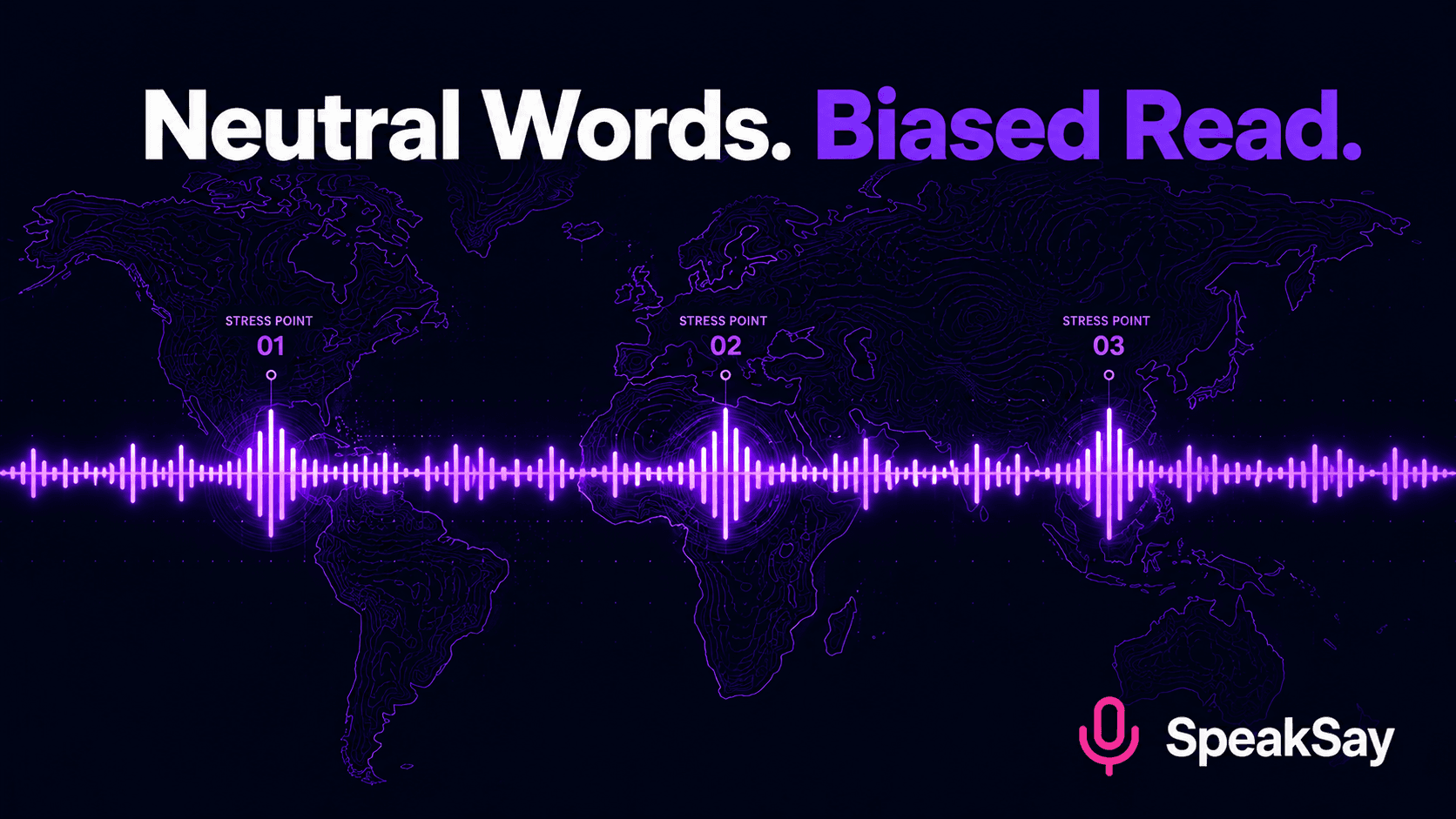
Emphasis carries editorial position. In an explainer, the words on the page can be scrupulously neutral while the read is not. Where the narrator puts stress, how long they pause before a name, whether a clause rises or falls at the end - all of it is decoded by a listener who already holds a view, and it is decoded as a stance. You did not write a stance. The performance supplied one.
Below, four generic sentences about an invented dispute. Same words every time. The stressed word is marked with bold. Read each row aloud with that stress and notice how the meaning moves.
| Sentence (identical wording) | Stress placement | What the listener hears |
|---|---|---|
| The smaller state says the corridor was always under its administration. | On the reporting verb | Doubt. "Says" stressed implies the claim is disputed or weak. |
| The smaller state says the corridor was always under its administration. | On the temporal claim | Endorsement of continuity. The claim sounds established. |
| The smaller state says the corridor was always under its administration. | On the size adjective | Sympathy frame. Underdog against a larger power. |
| Both governments have described the other's deployment as provocative. | On the symmetry word | Even-handed. Explicitly frames it as mirror-image behavior. |
| Both governments have described the other's deployment as provocative. | On the possessive | Faintly mocking. Suggests hypocrisy on both sides. |
| Both governments have described the other's deployment as provocative. | On the loaded adjective | Escalation frame. The word itself becomes the headline. |
| The agreement collapsed after eleven months. | On the verb | Dramatic failure. Implies blame exists and will be assigned. |
| The agreement collapsed after eleven months. | On the duration | Analytical. The point is the timeline, not the drama. |
| The agreement collapsed after eleven months. [with a pause after "The"] | Pre-noun pause | Significance-loading. Signals this agreement was special or doomed. |
| Observers in the region have questioned the timing of the announcement. | On the qualifier | Localizes and slightly diminishes the criticism. |
| Observers in the region have questioned the timing of the announcement. | On the verb | Amplifies the criticism into a finding. |
| Observers in the region have questioned the timing of the announcement. | On the specific object | Neutral-analytical. Narrows to a factual dimension. |
The rule that falls out of this: in geopolitics narration, stress belongs on information, not on evaluation. Numbers, dates, place names, and structural nouns get the emphasis. Verbs of judgment, adjectives of character, and reporting verbs stay flat.
Four operational habits that implement it:
- Flat reporting verbs. "Says," "claims," "alleges," "denies," "argues" - never stressed, never paused around. Stressing a reporting verb is the fastest way to signal disbelief.
- Uniform pre-noun pause. Decide on one beat length before every proper noun and hold it across the whole channel. A longer pause before one actor's name than another's is read as weighting, and audiences catch it faster than you would believe.
- Falling terminals on contested claims. A rising terminal on a disputed statement turns it into a question the narrator is implicitly answering. Keep contested sentences flat-to-falling.
- Symmetry pass. Before rendering, find every sentence pair that describes both parties and check that the stress pattern is structurally identical. If Actor A gets "moved forces into the zone" with stress on "zone" and Actor B gets "moved forces into the zone," you have written a position.
The practical advantage of a synthetic narrator here is enormous and underrated: you can control emphasis deterministically. A human read has micro-variation you cannot audit. With a text-to-speech pipeline you can mark emphasis explicitly, diff two renders, and enforce the symmetry pass mechanically. Render both versions in the TTS workspace, listen back-to-back, and pick the flatter one. That is a real editorial control, and it is one you simply do not get from a voice actor working from a PDF.
The emphasis QA pass, as a checklist
- No stress on any reporting verb in the script.
- No stress on adjectives describing intent or character ("aggressive," "defensive," "reckless," "restrained").
- Every proper noun preceded by the same pause length.
- Every actor's actions described with parallel stress structure.
- Contested claims end flat or falling, never rising.
- Numbers, dates and place names carry the emphasis load.
- Listen at 1.0x and 1.5x - bias tells get louder at speed.
4. The Hedging-Language Script Layer
Emphasis is the audio layer. Word choice is the layer beneath it, and they compound: a loaded verb read with stress is twice the problem. Build a house style sheet and apply it as a find-and-replace pass before the script ever reaches the voice engine.
| Loaded (avoid) | Softer (situational) | Neutral default |
|---|---|---|
| Seized | Took control of | Moved into / assumed administration of |
| Regime | Administration | Government |
| Invaded | Entered | Crossed into (with date and source) |
| Militants / terrorists | Armed group | Armed group, named as designated by [source] |
| Puppet state | Client state | Aligned government |
| Crackdown | Security operation | Enforcement action reported on [date] |
| Illegally occupied | Disputed territory | Territory administered by X and claimed by Y |
| Refused | Declined | Did not agree to |
| Admitted | Acknowledged | Stated |
| Warned | Cautioned | Said in a statement that |
| Escalation | Increase in activity | A rise in reported incidents from N to M |
| Collapsed | Ended | Lapsed after [duration] |
The right-hand column is longer. That is the trade: neutrality costs you syllables, and syllables cost you pacing. Budget for it - a neutral script runs roughly 10–15% longer than a punchy one (illustrative, based on my own rewrites; measure your own). Recover the time by cutting adjectives, not by cutting attribution.
Sourcing phrases you read aloud
The single rule that protects a world-affairs channel more than any other: every contested claim gets an attributed source, spoken in the narration, not buried in the description. On-screen citations are good. Spoken citations are what a listener half-watching actually receives.
- "According to [organization], as of [date] …"
- "[Organization] reported in [month year] that …"
- "Figures published by [source] put the number at …"
- "Both governments dispute this figure. The range reported across sources runs from N to M."
- "As of the date of this recording, [date], no independent confirmation has been published."
- "This section reflects the position stated by [party]. The opposing position is covered at [timestamp]."
That last one is a structural device worth adopting: explicitly signposting where the other side's case is made. It reads as editorial confidence, and it kills the "you didn't cover X" comment before it is written.
Add a dated stamp to every video's cold open - "This video reflects reporting available as of [date]" - and put the same line in the first paragraph of the description. It ages your content honestly, which is what keeps evergreen library videos from becoming liabilities.
5. Evergreen vs Rapid-Response: The Production Split
Geopolitics channels that survive run two production lines with completely different rules. Mixing them is what burns people out and produces the sloppy, under-sourced video that damages a channel's standing.
| Dimension | Evergreen (batch) | Rapid-response (48 hours) |
|---|---|---|
| Typical topics | Geography, history, treaty structures, chokepoints, resource maps, "why does X border look like that" | A named development, a summit outcome, a new agreement, a policy change |
| Target turnaround | 3–6 weeks from research to publish; batch 6–10 at a time | 24–48 hours from trigger to publish |
| Script rigor | Full source bibliography, two-pass fact check, map accuracy review | Primary sources only, minimum three independent outlets, explicit "as of" stamp |
| Hedging level | Standard house style | Maximum - assume details will change |
| Voice settings | Locked channel preset, no deviation | Identical preset. Never a different voice for "urgent" content. |
| Pace | 135–155 wpm | 135–155 wpm. Do not speed up to signal urgency. |
| Length | 10–20 minutes | 5–9 minutes |
| Share of upload slate | 70–80% | 20–30% |
| Ad-friendliness risk | Low | Elevated - live conflict coverage runs into graphic/war-content limits |
| Correction likelihood | Rare | Plan for it. Build the patch workflow before you need it. |
The voice row is the one people get wrong. There is a strong instinct to make breaking coverage sound breaking - faster, tighter, more energy. Resist it completely. Your narrator identity is the channel's brand and its neutrality signal simultaneously. The moment the voice changes register for a live story, you have told the audience this one is different, which is precisely the sensationalism cue you are trying to avoid. Lock one preset in your voice library and treat it as immutable.
The batching advantage is real and it is where synthetic narration pays for itself. Six evergreen scripts finalized on a Monday can be rendered, patched, and mixed the same afternoon. That capacity is what lets you keep 30% of your slate free for fast turnarounds without hiring a second person. Explore the wider production kit at SpeakSay's tools if you are stitching chapters, normalizing loudness, or generating multi-segment audio.
The 48-hour rapid-response runbook
- Hours 0–4: Verify the trigger against three independent sources. If you cannot, do not make the video.
- Hours 4–10: Write to the hedging style sheet. Every claim gets a spoken attribution and a date.
- Hours 10–12: Emphasis QA pass (section 3 checklist). Symmetry check on both parties.
- Hours 12–14: Pronunciation extraction and lexicon update for any new names.
- Hours 14–16: Render with the locked preset. Spot-check the new names against the lexicon.
- Hours 16–30: Visuals, maps, timeline graphics.
- Hours 30–40: Full watch-through by a human. This is your low-human-input defense and it is not optional.
- Hours 40–48: Publish with the "as of" stamp in the cold open, title, and description.
6. A Sensitive-Topic Voice Policy That Stays Monetizable
Write this down as an actual document, publish a version of it on an "About" page or a pinned community post, and follow it. In 2026 the difference between a channel that survives a review and one that does not is frequently whether it can demonstrate a policy and a human process behind it.
| Policy area | The rule | How you evidence it |
|---|---|---|
| Narrator identity | One voice, one preset, across the entire library. Changes only at planned, announced version boundaries. | Documented preset settings and a dated changelog |
| Synthetic disclosure | State in every description that narration is AI-generated and scripts are human-written and human-reviewed. Use the platform's synthetic-media disclosure field where applicable. | Description template + platform disclosure toggle |
| No political figure cloning | Never clone or imitate the voice of any real political figure, living or dead. No exceptions, not even for illustration. | Written prohibition in the policy doc |
| No news-org impersonation | No voice, sting, music bed, or branding that suggests affiliation with a news organization. No "breaking news" audio conventions. | Brand kit with explicit exclusions |
| Archival audio | Real speech clips used only with clear on-screen attribution and date. Never synthesized to fill a gap. | Per-video source log |
| Correction protocol | Factual error → pinned correction comment within 24h → re-generated audio patch → re-upload or annotated correction card. Log every correction publicly. | Public corrections page or playlist |
| Human editorial layer | Named human reviewer signs off on every script and watches every render before publish. | Sign-off log with dates and initials |
| Graphic content | No graphic conflict footage. Maps, data visualization and stills only. Descriptive language stays clinical. | Asset sourcing rules in the policy doc |
The correction protocol deserves a closer look because it is where synthetic narration is genuinely superior to a human recording. If you find a factual error at 9:42 in a published video, you do not book a studio and re-record a session. You fix the line in the script, render that single sentence with the identical locked preset, and splice it in. The patch is seamless because the voice is deterministic - the same preset produces the same timbre in December that it produced in March.
Three requirements make patching work:
- Preset lock. Save the exact voice, speed, and any stability parameters as a named channel preset. Never adjust them per-video.
- Sentence-level source files. Keep the script as a numbered, sentence-per-line file so a patch maps to a known index.
- Loudness match. Normalize every render to the same target so a spliced sentence does not jump in level.
If your channel needs a distinctive narrator that is not in any public library - a signature sound competitors cannot copy - voice cloning lets you build it from a consenting speaker's recordings. Clone your own voice, or a voice talent who has given written permission. Never a public figure. That line is not a style preference; it is what keeps you inside 2026 AI-persona guidance.
Lock your narrator, then never think about it again
Pick one voice, save it as your channel preset, and every video for the next three years sounds like the same research desk. Consistency is the cheapest credibility you will ever buy.
7. The Pronunciation Lexicon Workflow
Mispronouncing a place name is not a small error to this audience. To a viewer from that region, it is read as a signal that you did not care enough to check - and by extension that you have not checked anything else either. One botched city name in the first minute can cost you the whole video's credibility with exactly the segment that would otherwise have shared it.
So build a lexicon and treat it as a versioned asset, the same way you would treat a codebase.
| Stage | Action | Output |
|---|---|---|
| 1. Extract | Pull every proper noun from the script - places, people, organizations, treaty names, currencies, military units | Flat list, deduplicated against the master lexicon |
| 2. Decide | For each new term choose an endonym or an established English exonym, and record the reason | One decision per term with a source link |
| 3. Encode | Write the phonetic respelling that your engine actually renders correctly. Test it - do not assume. | Term → respelling map |
| 4. Apply | Substitute respellings into the render copy while keeping the display script human-readable | Two script files: display and render |
| 5. Version | Date-stamp every lexicon change with the reason. Never silently overwrite. | Lexicon v1.4, v1.5 … with changelog |
| 6. Regress | Maintain a single clip that reads all high-frequency terms in sequence. Re-render after any voice or engine change. | Regression clip, dated, archived |
The regression clip is the piece people skip and later regret. When you update a voice preset or the engine changes, you need one 60-second render that speaks your fifty most-used names so you can confirm nothing broke. Without it you discover the problem when a commenter finds it in a published video.
Practical encoding rules
- Keep two files. The display script (for subtitles, descriptions, and your own reading) stays clean. The render script carries respellings. Never ship respellings into your captions.
- Prefer respellings over IPA unless your engine explicitly supports phonetic markup. "boo-kha-REST" is more reliable than a symbol set that may be ignored.
- Handle the exonym question once, publicly. Put a line in your About page: "We use the most widely recognized English form of place names, with the local form given on screen at first mention." Then be consistent. Inconsistency is what reads as a position.
- Stress the name the same way every time. Section 3 applies here too - a name emphasized more heavily in one video than another is a pattern viewers notice across a library.
- Log the hard ones. Any term that took more than two attempts to render correctly goes in a "watch list" that gets checked on every engine update.
A useful side effect: your lexicon becomes a real editorial artifact. If you are ever asked to demonstrate human editorial input behind an AI-narrated channel, a dated, sourced, versioned pronunciation lexicon with a decision log is close to ideal evidence. It is the opposite of mass-produced.
8. Your 30-Day Build: Stack, Workflow and Costs
Here is how the whole thing assembles. The assumption is one person, part-time, aiming for two videos a week by day 30.
| Week | Focus | Deliverable |
|---|---|---|
| Week 1 | Narrator casting | Five voices auditioned on the same 90-second paragraph, one chosen, preset locked and documented |
| Week 2 | Editorial system | Hedging style sheet, sourcing phrase bank, emphasis QA checklist, voice policy doc published |
| Week 3 | Evergreen batch | Four structural explainers scripted, lexicon v1.0 built, all four rendered and regression clip archived |
| Week 4 | Rapid-response drill | One 48-hour turnaround executed end to end, correction protocol tested with a deliberate patch |
On cost, the honest structure is this: research time dominates, and audio is the cheapest line in the budget. A twelve-minute explainer runs roughly 1,700–1,900 words of narration. At two videos a week that is around 15,000 words of audio a month, which sits comfortably inside a standard creator plan. The economics only change if you scale to daily uploads or multi-language versions - at which point per-word pricing starts to matter and a lifetime plan becomes the obvious move over a rolling subscription. Compare the tiers on the pricing page against your actual monthly word count rather than your ambition.
Two extensions worth planning for from day one:
- Multi-language. World affairs is inherently global. The same locked-neutral script rendered in three languages triples reach without tripling research cost. Keep the neutrality rules identical across languages - loaded verbs do not translate neutrally by default.
- Companion audio. A geopolitics library is close to a podcast already. Repackaging your evergreen batch as an audio series through an AI podcast workflow costs almost nothing incremental and reaches an audience that will never watch a map animation.
If you ever want to test a second narrator identity - a companion channel, a different language market, a shorts vertical - remixing voices lets you develop a distinct-but-related sound without starting the casting process from scratch. Keep the same neutrality spec; change only the character.
Ready to build the library?
Two videos a week is roughly 15,000 words of narration a month. Check that against the plan tiers before you commit - and if you are publishing daily or in multiple languages, the lifetime option usually wins on total cost.
Frequently Asked Questions
Can a geopolitics channel with an AI narrator get monetized in 2026?Yes, provided the channel demonstrates real human editorial input. The 2026 enforcement environment targets mass-produced, low-human-input content rather than synthetic narration as such. Your defenses are a documented research process, a published voice policy, human sign-off on every script, spoken source attributions, and a versioned pronunciation lexicon. All of those are visible evidence of editorial work.
What is the best AI voice for explainer videos in this niche?Mid to mid-low pitch, medium timbre weight, low-to-moderate warmth, crisp articulation and a narrow dynamic range, delivered at 135–155 words per minute. Avoid trailer-voice gravitas, news-anchor urgency and podcast-buddy casualness. The specific voice matters less than the fit against that spec - audition several candidates on the same paragraph and pick the one that sounds like a briefing rather than a broadcast.
How do I stop my narration from sounding biased when my script is neutral?Control emphasis. Stress information - numbers, dates, place names, structural nouns - and keep evaluation flat: never stress reporting verbs like "says" or "claims," never stress intent adjectives, use the same pause length before every proper noun, and end contested claims on a flat or falling tone. Then run a symmetry pass so both parties' actions are described with parallel stress structure.
Should I use a different voice for breaking news versus evergreen videos?No. Voice consistency is your channel's brand and its neutrality signal at the same time. Changing register for live coverage tells the audience this story is different, which reads as sensationalism in a niche where that is expensive. Keep the same locked preset and the same pace band across both production lines; let the script and the "as of" date stamp carry the urgency.
How much do geopolitics channels earn?Round-ups generally place the niche in a mid-range RPM tier - below finance and legal, above broad entertainment - with long watch times partly compensating. Treat any specific figure you see as a reported range rather than a promise; actual rates vary heavily by audience geography, video length, ad-friendliness of individual videos, and season. Coverage of live conflict in particular can hit advertiser-friendliness limits.
How do I fix a factual error in an already-published video?Pin a correction comment within 24 hours, then re-render the affected sentence using the identical locked voice preset and splice the patch into the audio. Because a synthetic narrator is deterministic, the patch matches the surrounding audio exactly - something a re-recorded human line rarely does. Keep scripts as numbered sentence-per-line files so a correction maps cleanly to an index, and log every correction publicly.
Is it acceptable to clone a political figure's voice for illustration?No. Do not clone or imitate the voice of any real political figure under any circumstances, and do not synthesize speech to fill gaps in archival audio. Use real clips only with clear on-screen attribution and date. Cloning is appropriate for your own voice or a voice talent who has given written consent - build a signature narrator that way instead.