How Much Does a Voiceover Cost in 2026? Real Rate-Card Numbers (and What Changes When You Use AI)
Non-union voiceover rates rose 12–18% across the board in the 2026 GVAA update, and most buyers are still budgeting from three-year-old blog posts. Here are the real numbers by project type, how usage and buyouts work, and an honest breakdown of where AI wins and where a human is still worth every cent.
1. The 2026 rate card by project type
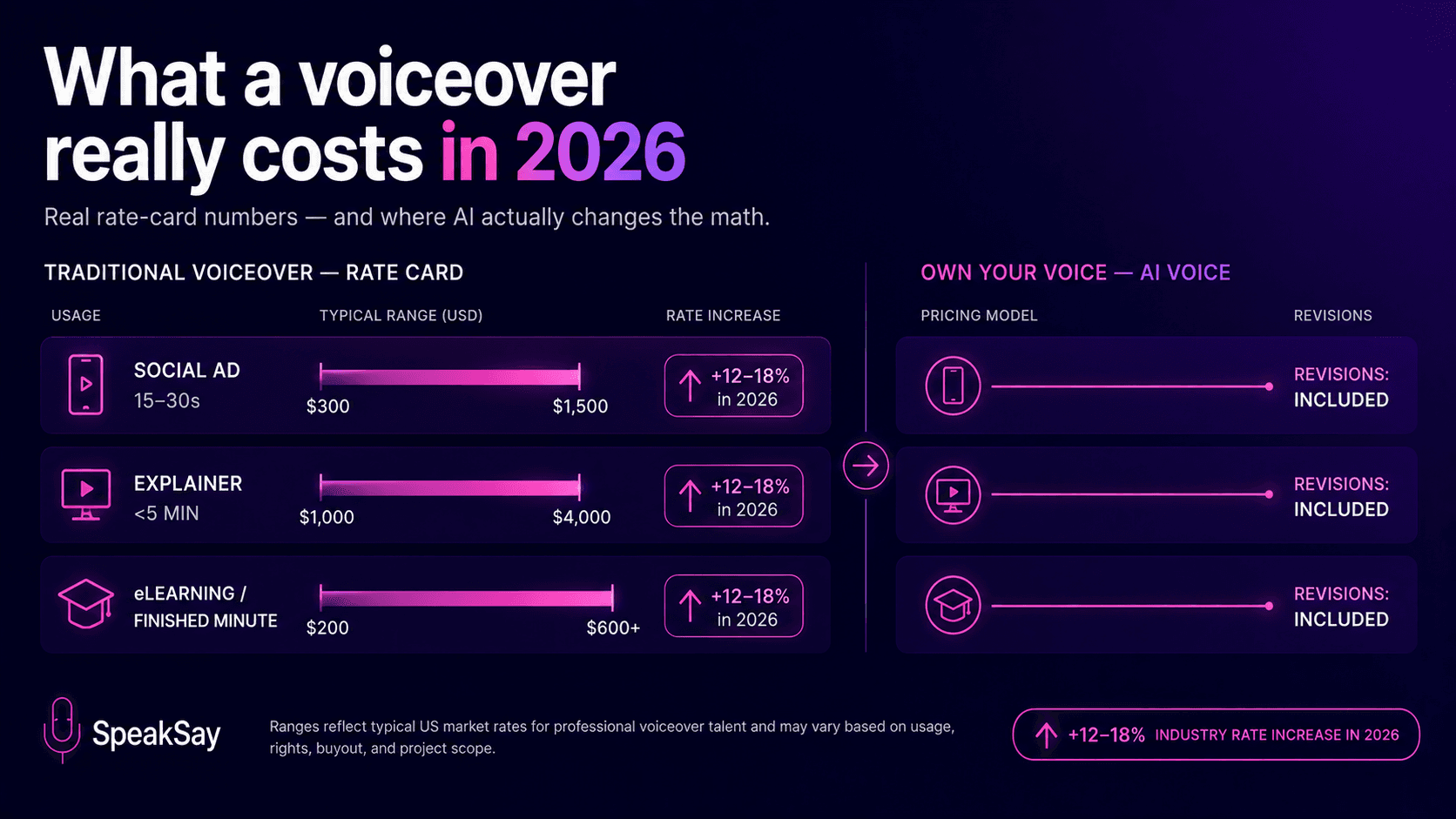
These are non-union market ranges as of the 2026 update to the most widely cited independent rate guide, which roughly two-thirds of freelance voice talent use as their pricing reference. Union work, celebrity talent and agency-brokered deals sit above these numbers, often considerably. Regional markets outside the US sit below.
| Project type | 2026 typical range | How it's priced |
|---|---|---|
| Social media ad, 15–30 sec | $80–$300 | Per spot, usage-limited |
| Explainer / vlog, under 5 min | $50–$180 | Per finished piece |
| Corporate / non-broadcast narration | $30–$55 per finished minute, with a $350–$450 project minimum | Per finished minute |
| eLearning | $180–$250 per finished minute (up from roughly $160–$220) | Per finished minute |
| Digital / streaming commercial | ≈$375 for an 8-week buy (up around 25%) | Base fee plus term |
| National TV commercial, 20–60 sec | From ≈$650 base; commonly $800+, top tier well past $5,000 | Session fee plus usage |
| IVR / phone system | $150–$400 for a small prompt set | Per prompt or per bundle |
| Audiobook narration | $150–$400+ per finished hour | Per finished hour, or royalty share |
| Video game / character work | $250–$500+ per session hour | Per session, often with buyout |
Two things to note before you use this table in a negotiation. First, "finished minute" means minutes of delivered audio, not minutes of studio time — a ten-minute eLearning module might take ninety minutes to record and it is still priced as ten. Second, these are talent fees. Direction, editing, mixing and mastering may or may not be included, and the difference is often 20–40% of the total.
2. What changed in 2026 and why
The 2026 rate-guide update lifted non-union rates by roughly 12–18% across essentially every category. eLearning per finished minute moved up a band. Digital streaming buys rose about a quarter. National TV base moved up meaningfully.
The reasoning behind the increase is worth understanding, because it tells you where prices go next. Professional voice talent has spent two years absorbing downward pressure from synthetic voices at the commodity end of the market — the internal videos, the placeholder reads, the low-budget explainers. The response has not been to compete on price. It has been to reprice upward around the work that requires a person: performance, brand association, direction in the room, and legal certainty about who owns the voice.
The practical consequence for buyers: the middle of the market is hollowing out. Cheap human reads are getting rarer, not cheaper. You are increasingly choosing between a synthetic voice and a genuinely professional one, rather than between a professional and a budget human. Budget accordingly, in both directions.
3. Usage and buyouts: the part that doubles your invoice
This is where most first-time buyers get blindsided. The quoted fee is frequently a session fee — payment for the performance. Permission to actually use the recording, where and for how long, is priced separately.
Usage is priced along four axes:
- Media — internal only, web, social, paid digital, broadcast, cinema. Each step up multiplies.
- Territory — one city, one country, a region, worldwide.
- Term — 8 weeks, 6 months, 1 year, in perpetuity.
- Exclusivity — whether the talent can voice a competitor during the term.
A read quoted at $400 for internal use can reach several thousand for a one-year worldwide paid-media buy with category exclusivity. Neither number is dishonest; they are different products. What is unreasonable is a brief that says "we'll just use it wherever" and expects the internal price.
Ask for the quote broken into session fee + usage, always. It makes comparison possible and it tells you immediately whether a cheap quote is cheap or just narrowly scoped.
A "buyout" means paying once for broad, long-term rights. It is more expensive up front and almost always cheaper than renewing usage on a campaign that keeps running. If the asset will live longer than a year, price the buyout.
5. Where AI narration actually changes the math
Being straight about this: AI does not simply make voiceover cheaper. It changes which costs exist at all.
| Cost driver | Human talent | AI narration |
|---|---|---|
| First delivery | Fee per project, 2–5 days | Included in plan, minutes |
| Revision after stakeholder feedback | 25–50% surcharge, plus turnaround | Edit the text, re-render the line |
| Price or product name change six months later | Pickup session, often at minimum | Change one word |
| Twelve language versions | Twelve talents, twelve fees | Same workflow, same plan |
| Usage expansion (web → paid social) | Renegotiate, pay again | Covered by your licence terms — read them |
| Consistency across 200 assets over two years | Depends on talent availability | Identical voice indefinitely |
| Emotional range and interpretation | The reason you hire a person | Improving fast, still not equivalent at the top end |
| Brand association with a known voice | Available | Not available unless you build it yourself over time |
The honest summary: for a single high-stakes 30-second brand spot, the human fee is a small fraction of the media spend and the performance difference is worth it. For 40 explainer modules that will be revised twice a year and localised into six languages, the human route costs more than the rest of the project and the AI route is not a compromise — it is the correct tool.
Price your script before you brief anyone
Paste your script into SpeakSay's free tools to get an exact word count and spoken duration, so you know whether you are buying two finished minutes or eleven before a quote lands.
6. When to hire a human anyway
A rate-card article that ends with "just use AI" would be selling you something rather than helping you decide. Here is where a professional is still the right purchase, unambiguously:
- Broadcast brand campaigns. When media spend is in six figures, the read is the cheapest line item and the one with the most leverage. Hire the person.
- Performance-led work. Character acting, comedy timing, emotionally difficult copy, anything where interpretation is the product rather than the delivery mechanism.
- Union and broadcast-cleared requirements. Some buyers and some markets require it. This is a contractual question, not an aesthetic one.
- Long-form fiction narration at the premium end. Listeners are demonstrably more sensitive here than in nonfiction or corporate contexts.
- When the voice is the brand. A recognisable human voice associated with a company over years is an asset that synthetic narration cannot retroactively replicate.
- When you want direction. The ability to say "again, but drier" and get it in ten seconds is worth real money on work that matters.
And the hybrid that most sophisticated buyers land on: a human for the hero assets, a consistent synthetic voice for the long tail of modules, updates, localisations and internal content. That combination usually costs less than the all-human route and produces better hero assets than the all-AI route, because the budget goes where it counts.
7. The break-even calculation
Run this before you decide. It takes five minutes and it is more useful than any general advice.
- Count your finished minutes for the year. Not projects — minutes of delivered audio across everything: ads, explainers, modules, updates, internal video.
- Multiply by the relevant per-finished-minute rate. Use $30–$55 for corporate narration or $180–$250 for eLearning.
- Add revisions. Assume 1.5 rounds per asset at 35% of the original fee. Be honest — you know your stakeholders.
- Add pickups. Count how many assets will need a word changed within twelve months. Multiply by a session minimum.
- Multiply by languages. If you localise, multiply the whole total by the number of languages.
- Add usage. If anything runs as paid media, add the usage fee per asset per term.
- Compare to an annual platform cost that covers unlimited revisions, all languages and consistent voices.
Most teams find the crossover point arrives faster than they expect, and that it is driven almost entirely by steps three, four and five rather than by step two. It is never the first render that breaks a voiceover budget. It is the eleventh revision, in the fourth language, eight months later.
Unlimited revisions, one predictable bill
SpeakSay covers text-to-speech, voice cloning, remix and AI podcasts on one plan — including a one-time lifetime option — so a script change costs a re-render instead of a pickup session.
8. How to brief either one properly
Whichever route you take, a bad brief costs more than a high rate. Include all seven of these:
- Final script, locked. Not a draft. Word count and estimated spoken duration.
- Usage in full. Media, territory, term, exclusivity. Vagueness here always gets priced as risk.
- Reference audio. Two examples of what you want, and — this is the useful one — one example of what you do not want.
- Pronunciation list. Names, brands, acronyms, technical terms, with phonetic respellings. This single item removes most revision rounds.
- Pace and target duration. "Must land in 28 seconds" is a real constraint that changes the read.
- Deliverable spec. File format, sample rate, whether you want it processed or raw, split by section or as one file.
- Deadline, with the real one. Rush fees are avoidable when the timeline is honest from the start.
A brief with a locked script and a pronunciation list routinely halves the revision cycle. That is the cheapest saving available in this entire article, and it costs you twenty minutes.
9. FAQ
How much does a 30-second voiceover cost?For a social media ad, roughly $80–$300 non-union in 2026 depending on usage. For a national TV spot of similar length, base rates start around $650 and commonly exceed $800, rising well past $5,000 at the top tier once usage and exclusivity are priced in. The length matters much less than where and how long the audio will run.
What does "per finished minute" mean?It means minutes of delivered audio, not studio time. A ten-minute eLearning module is billed as ten finished minutes even if it took ninety minutes to record and edit. eLearning sits at roughly $180–$250 per finished minute after the 2026 update; general corporate narration runs about $30–$55 with a $350–$450 project minimum.
Why did voiceover rates go up in 2026?The 2026 update to the most widely used non-union rate guide raised rates roughly 12–18% across categories. The market has responded to synthetic voices not by competing on price at the commodity end, but by repricing upward around work that requires a person — performance, brand association, direction and rights certainty.
What is a voiceover buyout?A one-off payment for broad, long-term usage rights rather than a limited term. It costs more up front and is usually cheaper than renewing usage on any campaign that runs beyond a year. Always ask for quotes split into session fee plus usage so you can see which you are being offered.
Is AI voiceover cheaper than hiring a voice actor?For first delivery of a single short asset the gap is smaller than people assume. The difference compounds on revisions, pickups and localisation: a word change six months later costs a session minimum with a human and a re-render with AI, and twelve languages means twelve fees versus the same workflow. Run the break-even on your annual finished minutes including revisions and languages, not on one project.
When should I still hire a human voice actor?Broadcast brand campaigns where media spend dwarfs the fee, performance-led work such as character acting and comedy, union or broadcast-cleared requirements, premium long-form fiction narration, and any situation where a recognisable human voice is itself part of the brand. Many teams use a human for hero assets and a consistent synthetic voice for the long tail.