Kids Bedtime Story Channels in 2026: Massive Watch Time, $1–3 RPM — the AI Voice + Monetization Playbook That Makes the Math Work
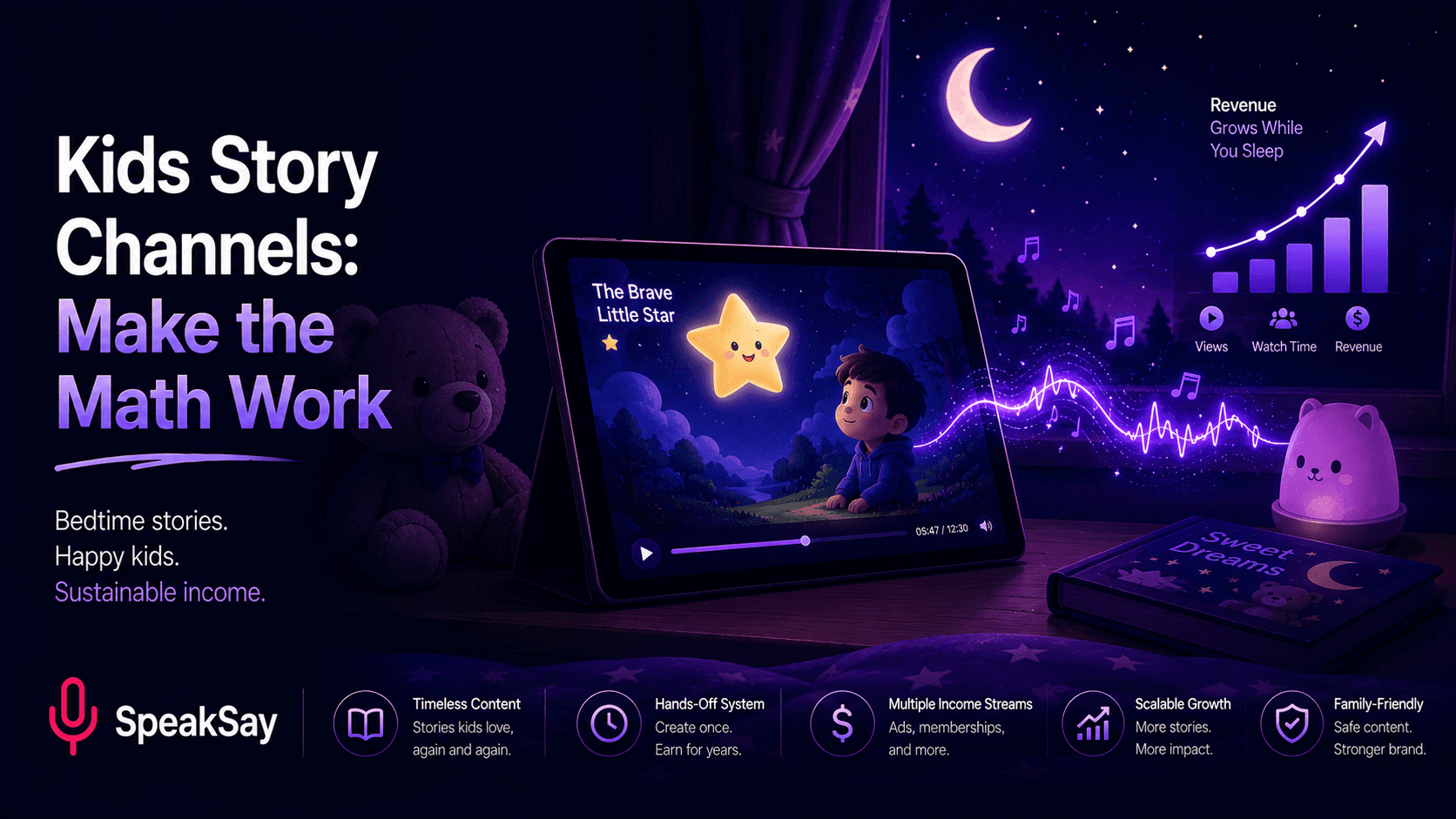
Kids bedtime story channels get evergreen demand, obsessive rewatches, and brand-safe content — and then made-for-kids rules crush RPM to $1–3. Here's the honest math, the AI narrator voice that builds trust with kids and parents, and the revenue streams beyond AdSense that make this niche genuinely work in 2026.
1. The Honest Math: What Made-for-Kids Actually Does to Revenue
Under COPPA-driven rules, videos designated "made for kids" run only limited, non-personalized ads. The features you lose are not minor:
| Feature | General content | Made for kids |
|---|---|---|
| Personalized ads | Yes | No — contextual only |
| Typical RPM | $5–15 | ~$1–3 |
| Comments | Yes | Disabled |
| End screens & cards | Yes | Disabled |
| Memberships, Super Thanks | Yes | Disabled |
| Notification bell | Yes | Limited |
And no, you can't just not mark it. Misclassifying kids content as general-audience is a federal compliance issue, not a growth hack — YouTube also auto-detects kids content and overrides your designation.
So the AdSense ceiling is real. Plan for it: a kids channel doing 2 million monthly views might earn $2,000–6,000 from ads where a finance channel would earn ten times that. The niche only makes sense if you build for the revenue streams in section 6 — with ads as the floor, not the business.
2. Why the Niche Still Works Anyway
Four structural advantages no other faceless niche has:
- Rewatch loops. Kids watch the same video ten, twenty, fifty times. Every rewatch feeds the algorithm watch-time signals that adult content can't match.
- Parents save and share. A bedtime video that reliably settles a toddler gets bookmarked, playlisted, and sent to other parents — unusually strong ranking signals.
- Evergreen, global, daily demand. Bedtime happens every night in every timezone. No news cycle, no seasonality collapse, no trend decay.
- Brand safety. Calm story content avoids every advertiser blacklist. Your limited ads at least always fill.
Add the production reality — five-minute soft-animation stories with a calm voice and ambient music are among the cheapest quality content you can make with AI tools — and the niche rewards patient operators who structure revenue correctly.
3. The 2026 Risk: AI Kids Content Is Under a Microscope
Be clear-eyed about this: advocacy groups have spent 2025–2026 pressuring YouTube to crack down on low-quality AI content aimed at children, and YouTube's July 2026 "inauthentic content" monetization policy plus its AI-labeling systems give it the tools to act. Channels pumping out surreal, templated, nonsense AI content for kids are exactly what regulators and journalists cite.
That pressure is a moat for you, not just a threat. The channels that get terminated are mass-produced slop. A channel with original stories, consistent characters, a warm human-sounding narrator, and parental trust is what the platform wants to exist. In this niche more than any other, quality is the compliance strategy.
4. The Narrator Voice: Your Single Biggest Trust Asset
Parents choose bedtime content by sound before story. The voice has to do two jobs at once: soothe a child toward sleep and reassure an adult that this channel is safe. What that means in practice:
- Warm, low-to-mid pitch, unhurried. Think librarian at story hour, not TV announcer. Target roughly 120–140 words per minute — slower than any other YouTube niche.
- Consistent across every video. The same voice every night becomes part of a child's routine. Voice consistency is retention. A cloned or designed voice you own guarantees episode 200 sounds exactly like episode 1.
- Gentle dynamics, no startles. Soft emphasis for character moments, a slight slowdown for the final page. Avoid sudden volume or pitch spikes — one jolt undoes the entire wind-down.
- Character voices in moderation. A slightly different tone per character keeps engagement without turning bedtime into a cartoon. SpeakSay's multi-voice support lets you assign each recurring character its own consistent voice.
With SpeakSay's voice library you can test warm narrator profiles free, then lock your favorite as the channel's permanent voice — or use voice cloning to make yourself the storyteller without recording at 11pm every night.
Find your storyteller voice free
Test SpeakSay's warm, calm narrator voices on your first story script — no signup required. When you find the one, it stays consistent across every story you ever publish.
5. The Weekly Production Workflow
A sustainable one-person cadence for three stories per week:
- Write original stories (2–3 hrs). Public-domain fairy tales retold in your own words are fine to start, but original recurring characters are what build a brand (and licensing value — see below). 500–700 words ≈ 5 minutes narrated at bedtime pace.
- Generate narration (30 min). Paste each script into SpeakSay TTS with your channel voice. Slow the pace, soften emphasis, and render. Fix any pronunciation quirks per name once, reuse forever.
- Visuals (2–4 hrs). Soft animation or gently-panning illustrated scenes. Consistent character designs across episodes matter more than animation complexity.
- Mix (30 min). Narration up front, ambient music 15–20 dB under, no sound effects sharper than a page turn.
- Package. Thumbnail with the recurring character, title parents search ("calm bedtime story for toddlers — The Sleepy Fox"), mark made-for-kids honestly.
6. Monetization Beyond AdSense: Where the Real Money Is
The biggest kids-channel earners in 2026 treat AdSense as the smallest line item:
- Brand deals with toy and edtech companies. Kids content with parental trust commands strong sponsorship rates precisely because inventory is scarce — most kids channels aren't brand-safe enough to sponsor.
- Content licensing. Streaming platforms and kids' apps license story libraries with consistent characters and clean audio. A 100-episode catalog with an owned narrator voice is a licensable asset; a channel narrated by a common stock voice is not (anyone can replicate it).
- 24/7 pre-recorded live streams. A looping "sleep stories" stream compounds watch time from your existing catalog with zero new production.
- Multilingual expansion. Bedtime demand is global and competition outside English is thin. Re-render your entire catalog in Spanish, Hindi, or Portuguese with the same voice character — this is where a lifetime plan beats per-character billing, because you're narrating every story several times over.
- Direct products. Printable storybooks, a private podcast feed of audio-only stories for car rides, character merch once the audience exists.
7. Passing the Originality Test
YouTube's inauthentic-content policy demonetizes mass-produced, templated content — and AI kids content gets the least benefit of the doubt of any category. Your checklist:
- Original scripts (or substantially transformed retellings), never regenerated variations of one template.
- Recurring original characters with names, designs, and story arcs.
- A consistent owned narrator voice — the clearest audio signal that this is a real show, not slop output.
- Human review of every video before upload. In kids content, one AI-glitched frame or garbled sentence is a trust catastrophe.
- Honest made-for-kids designation on every video.
8. FAQ
How much do kids story channels make per 1,000 views?Made-for-kids videos typically earn $1–3 RPM from limited, non-personalized ads — versus $5–15 for general content. Successful channels earn most revenue from brand deals, licensing, multilingual catalogs, and 24/7 streams rather than ads.
Can I use an AI voice for kids' stories on YouTube?Yes. AI narration is allowed and requires no AI disclosure label (it's not realistic synthetic depiction). What matters is originality: original stories and consistent production, not mass-produced templated output.
What's the best AI voice style for bedtime stories?Warm, low-to-mid pitch, around 120–140 words per minute, with gentle dynamics and no sudden emphasis. Consistency across episodes matters more than any single voice trait — kids bond with the same voice night after night.
Is the kids niche too risky with the 2026 AI crackdowns?Low-effort AI kids content is high-risk. Original characters, human-reviewed scripts, and a consistent owned voice put you in the category the platform wants to keep. The crackdown removes your worst competitors.
Should I mark my videos made-for-kids or leave it to YouTube?Mark them honestly yourself. YouTube auto-detects kids content and overrides misclassification, and deliberate mislabeling is a COPPA compliance issue, not a monetization strategy.