Motivation & Discipline Channels Pull Billions of Views: The Intense AI Narrator Playbook (2026)
Motivational and discipline content is one of 2026's fastest-growing faceless niches — but every channel uses the same recycled "hustle" voice, and a flat AI read kills the intensity that makes these clips shareable. Here's the voice craft, pacing curves and originality playbook for narration that actually hits.
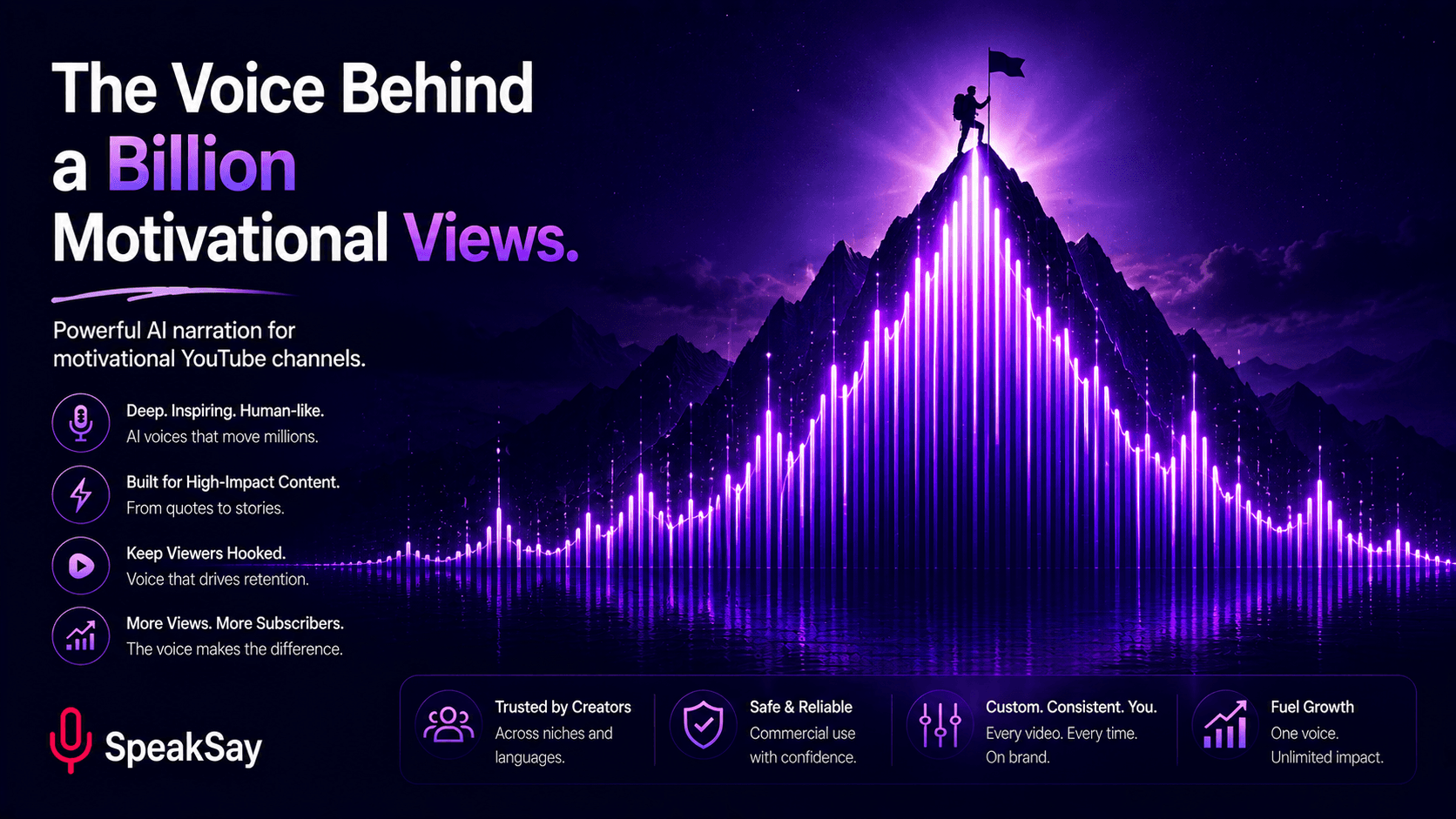
1. Why the Motivation Niche Still Works in 2026
Three structural advantages keep this niche alive while trends churn:
- Built-in shareability. Motivational clips are sent, not just watched — to a friend at the gym, a group chat before exams, a teammate after a loss. Shares are the cheapest distribution on every platform.
- Evergreen demand with daily consumption. Viewers return every morning. Playlists of your back catalog compound watch time the way news content never can.
- Faceless-native format. Voice over cinematic B-roll or dark gradients — no camera, no presenter, entirely producible with AI narration and stock or AI-generated footage.
The catch: low production barriers mean brutal sameness. Your differentiation is almost entirely in two places — the writing, and the voice.
2. The Niche's Voice Problem
Open ten motivation channels and you'll hear the same two failures:
- The clone army. Everyone grabbed the same handful of deep, gravelly stock presets. When your channel sounds identical to ten others, viewers can't form a habit around you — and platform originality policies increasingly punish content indistinguishable from the flood.
- The flat read. Motivational writing is performative by nature. An AI voice that delivers "GET UP AND FIGHT" at the same pitch and pace as "welcome back to the channel" doesn't just underperform — it's unintentionally funny, and comments will say so.
Both problems are solvable in an afternoon with the right voice setup.
3. Choosing Your Narrator: Beyond "Deep Male Voice #4"
Match the voice archetype to your sub-niche rather than defaulting to maximum gravel:
| Sub-niche | Voice archetype | Delivery character |
|---|---|---|
| Discipline / gym | Low, textured, commanding | Clipped sentences, hard consonants, drill-sergeant restraint (not shouting) |
| Purpose / life direction | Warm mid-range, weathered | Slower, conversational, "older mentor" intimacy |
| Heartbreak / comeback | Softer, close-mic feel | Quiet start, controlled build, emotional cracks allowed |
| Business / ambition | Crisp, confident, faster | Rhythmic momentum, statistics delivered like punches |
Audition candidates in the SpeakSay voice library with a paragraph of your script — never the demo text. Then make it yours: run your pick through Voice Remix to shift its texture into something no other channel has. A recognizable voice is this niche's only real moat, because the quotes themselves are public domain and the B-roll is everyone's.
4. The Pacing Curve: How Intensity Is Actually Built
Great motivational delivery isn't loud — it's shaped. The classic curve for a 60-second piece:
- 0–8s — The quiet hook. Slow, almost reluctant. "Nobody is coming to save you." Low energy forces the viewer to lean in.
- 8–35s — The build. Sentence length shortens. Pace rises from ~130 to ~155 wpm. Each line lands slightly harder than the last.
- 35–50s — The peak. Maximum intensity — but controlled. Short declaratives. This is where emphasis does its work.
- 50–60s — The release. Drop back to quiet for the final line. The contrast, not the volume, is what gives people chills — and what makes them replay.
Generate each phase deliberately: adjust speed settings per section rather than rendering the whole script at one pace. Two extra minutes of production, double the retention curve.
Find the voice your channel deserves
Browse hundreds of licensed narrators, audition them with your own script, and start free.
5. Emphasis, Pauses & Emotional Tags
- One emphasized word per sentence, maximum. "You are choosing comfort" hits; emphasizing every third word reads as malfunction.
- Pauses are your percussion. A full one-second pause before the thesis line ("So ask yourself… [pause] …what are you waiting for?") outperforms any volume trick. Write pauses into the script as punctuation rather than hoping the voice finds them.
- Use breaths and sighs sparingly. Modern TTS supports emotional inflections — a tired exhale before a comeback line adds humanity. One per video is seasoning; five is soup.
- Test the "eyes closed" rule. Play your render with the footage hidden. If it doesn't move you as pure audio, no gym montage will rescue it.
6. Script Beats That Survive the Originality Test
Recycled Stoic quotes over stock clips is precisely the mass-produced pattern platform policies now demonetize. Original structure protects you and performs better:
- Anchor each video in one specific scenario — the 5 AM alarm, the DM you're afraid to send, the third failed attempt — instead of generic "greatness" abstractions.
- Write your own thesis line. One original, quotable sentence per video is what gets clipped, screenshotted and reposted with your watermark.
- Structure: Scenario → Reframe → Cost of quitting → Command → Quiet close. Familiar enough to satisfy, specific enough to be yours.
- Series beat singles. "Day 47 of 365" formats convert casual viewers into subscribers because the frame itself is a habit.
7. Monetization & the "Inauthentic Content" Rules
Motivation channels monetize through AdSense, brand deals (supplements, apps, planners), and affiliate offers — but only if they clear YouTube's originality bar. The channels that stay monetized in 2026 share three habits: original scripts (not quote compilations), a distinctive narrator rather than a default preset, and visible creative input — custom pacing, recurring series, a consistent visual identity. AI narration itself is not the issue; indistinguishable mass production is.
Build a narrator nobody can copy
Remix a stock voice into your channel's signature sound — free to try, upgrade when you're ready to publish daily.
8. FAQ
What is the best AI voice for motivational videos?It depends on your sub-niche: commanding low voices suit discipline/gym content, warm weathered voices suit purpose and mentorship content, and softer close-mic voices suit comeback narratives. Audition with your own script, then remix your pick into a unique variant so your channel doesn't sound like everyone else's.
Can motivational channels with AI voices still be monetized in 2026?Yes. YouTube's policies target mass-produced, indistinguishable content — not AI narration. Original scripts, a distinctive voice and evident creative structure keep motivation channels fully monetizable.
How do I make an AI voice sound intense instead of flat?Shape it: generate sections at different speeds following a quiet-hook → build → peak → quiet-close curve, emphasize at most one word per sentence, and write explicit pauses before your biggest lines. Intensity comes from contrast, not loudness.
Is the motivation niche oversaturated?The generic middle is. Channels running recycled quotes with default voices struggle; channels with original scenario-based writing, a signature narrator and series formats keep growing because demand is daily and shares are built into the format.
What footage should I use with motivational narration?Licensed stock, original footage, or AI-generated clips all work. Keep the visual identity consistent (color grade, typography) and remember the narration carries retention — test every video as audio-only before publishing.