Your Nonfiction Book Has Tables, Footnotes and Charts: How to Narrate the Parts That Don't Read Aloud (2026 AI Audiobook Guide)
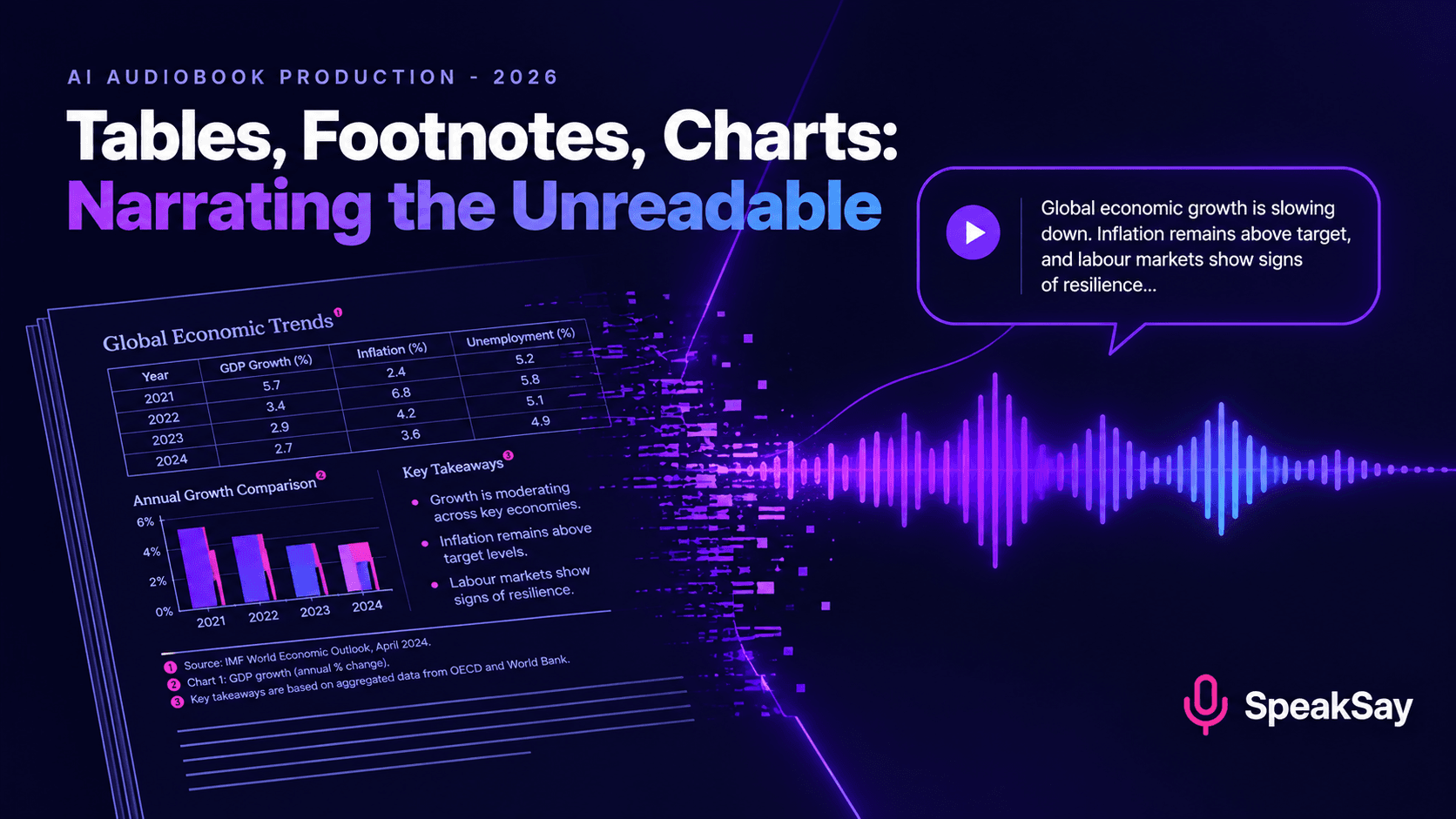
Fiction narrates straight through. Nonfiction stalls at the first table. Here is the element-by-element decision framework for footnotes, tables, charts, lists, URLs and cross-references - what to read, what to rewrite, what to summarise, and what belongs in the companion PDF
1. Why nonfiction stalls where fiction doesn't
A novel is already a sequence of sentences meant to be experienced in order. An audiobook of a novel is a format change, not a rewrite.
A nonfiction book is not a sequence. It is a sequence with an apparatus attached: footnotes hanging off the bottom of pages, tables that ask you to compare across two axes at once, charts that communicate a shape rather than a set of numbers, "see figure 3.2" cross-references that assume you can flip back, an index that only exists because the reader can jump. All of that apparatus depends on a reader who controls their own position on the page.
A listener has none of that. They are in a car. They cannot flip back, they cannot hold two columns in their head, and if you read them a superscript marker they will simply be confused.
So nonfiction audiobook production is genuinely an adaptation job, not a conversion job. The good news in 2026 is that the permission question has largely resolved - Spotify for Authors, Google Play, Kobo and the major aggregators accept AI-narrated titles with disclosure, while ACX still refuses direct AI submissions (per ScribeCount's 2026 platform comparison). Production cost has collapsed too. What is left standing between a nonfiction manuscript and a finished audiobook is craft: knowing what to do at each element.
2. The manuscript audit: do this before you generate a minute
The single most expensive mistake is generating a whole chapter and then discovering it needs restructuring. Audit first. It takes an afternoon for a typical 70,000-word nonfiction book.
- Search for every element class. Footnote and endnote markers, table environments, figure captions, bulleted and numbered lists, "see page", "as shown", "above", "below", "the following", URLs, email addresses, currency, percentages, dates, equations, abbreviations, and anything in parentheses longer than four words.
- Count them by chapter. You will find the density is wildly uneven - a methods chapter may contain forty elements and a narrative chapter none. Density tells you where the work is.
- Tag each one with a disposition using the decision table in the next section: READ, ADAPT, SUMMARISE, PDF, or CUT.
- Write the adapted text inline in a separate narration manuscript. Never edit your print manuscript. You are producing a second, parallel document - the script - and it will differ from the book. That is correct and expected.
- Flag the front matter. Dedication, epigraph, list of figures, acknowledgements, and the copyright page all need explicit decisions. A "list of figures" read aloud is dead air.
Keep the audit as a spreadsheet. It becomes your production checklist, your QA list, and - if you write a second book - your template.
3. The element decision table
This is the reference. Print it.
| Element | Default disposition | Spoken convention |
|---|---|---|
| Citation-only footnote | CUT from audio, keep in PDF/back matter | Silence. Note in front matter that sources are in the companion PDF. |
| Substantive footnote (adds an argument) | ADAPT into the body | Fold it into the sentence, or open a short aside: "It's worth a brief detour here..." |
| Aside/joke footnote | ADAPT or CUT | If it lands aloud, inline it. If it only works as a visual aside, cut it. |
| Small table (2 columns, under 6 rows) | ADAPT into sentences | Comparison sentences - see section 5. |
| Large table (3+ columns or 6+ rows) | SUMMARISE + PDF | State the finding, then point to the companion PDF. |
| Bar/line chart | SUMMARISE into a trend sentence | Direction, magnitude, turning point. See section 6. |
| Photograph, map, diagram | SUMMARISE (describe its function) + PDF | One sentence on what it shows and why it matters. |
| Bulleted list, under 5 items | READ with signposting | "There are four. First... second..." See section 7. |
| Bulleted list, 5+ items | ADAPT into prose or split | Group into named clusters of two or three. |
| Equation | ADAPT into words, or SUMMARISE + PDF | Say what it does before you say what it contains. |
| URL | ADAPT | Give a memorable short form or "the link is in the companion PDF." |
| Cross-reference ("see chapter 4") | ADAPT | Replace with content: "as we saw when we looked at X." |
| Index | CUT | Never narrated. |
| List of figures / list of tables | CUT | Never narrated. |
| Epigraph | READ with attribution | Quote, pause, then "...", author name. |
| Chapter heading | READ | "Chapter four. [Title]." Then a full pause. |
| Subheading | READ or CUT depending on density | If a chapter has more than about six, cut most and use pauses instead. |
Produce the whole book without a per-minute bill
Nonfiction means regenerating sections as you refine the adaptation. A plan that charges you every time you fix a table is the wrong plan for this job.
4. Footnotes and endnotes, by type
The mistake almost everyone makes is treating footnotes as one category. They are three.
Type 1: pure citation
"Smith, 2019, p. 143." These carry no information for a listener. Cut them from the audio entirely and say so once, in the front matter: "Full source citations for this book are in the companion PDF that accompanies this audiobook." That single line pre-empts every review complaining that sources were omitted.
Type 2: substantive
A footnote that qualifies the claim, adds a counter-argument or supplies a necessary caveat is part of the book's argument and must survive. Two ways to handle it:
- Inline it - rewrite the main sentence to absorb the qualification. Usually the better outcome, and often improves the print edition too.
- Signal it as an aside - "A quick note before we go on:" ... "Back to the main thread." Use this when inlining would make the sentence unwieldy. Keep asides under about thirty seconds and never nest one inside another.
Type 3: aside or joke
Some writers do their best work in footnotes. Test each one aloud. A joke that depends on the reader's eye dropping to the bottom of the page - the visual timing is the joke - will not survive and should be cut without regret. A joke that works as a spoken aside should be inlined and will often land better in audio than it did in print.
Never read superscript numbers aloud, and never read "footnote seventeen." It stops the sentence dead and tells the listener nothing.
5. Turning tables into comparison sentences
A table is a two-dimensional object. Speech is one-dimensional. Reading a table cell by cell converts a comparison into a list, which is exactly the information the table existed to prevent.
The technique: state the axis of comparison, then walk one axis, holding the other fixed.
Worked example
A table with columns Plan / Monthly cost / Included hours / Overage rate and three rows.
Cell-by-cell (wrong): "Basic. Nine dollars. Two hours. Four dollars an hour. Standard. Twenty-nine dollars. Ten hours. Three dollars an hour. Pro..." - by row three the listener has lost row one.
Comparison sentences (right): "There are three plans, and the thing that separates them is how the included hours scale against the price. Basic is nine dollars for two hours - so about four fifty an hour. Standard is twenty-nine for ten hours, which brings it under three. Pro is seventy-nine for forty, a little under two. The pattern is simple: every step up roughly halves your effective hourly cost, and the overage rate falls with it."
The second version is longer in words and vastly shorter in listener effort, because it supplies the finding rather than the raw data.
Rules for table adaptation
- Lead with the finding. What is this table for? Say that first.
- Round aggressively. "About four fifty" not "$4.4972". Precision belongs in the PDF.
- Three data points maximum per sentence.
- Never more than about five rows spoken. Beyond that, summarise the pattern and name only the extremes.
- Close the loop. End with the takeaway sentence, so a listener who drifted still gets the point.
6. Turning charts into trend sentences
A chart communicates a shape. Describe the shape, not the coordinates.
A trend sentence has four parts, in this order:
- What is being measured, over what range. "Between 2015 and 2025, average completion rates..."
- The direction and magnitude. "...fell by roughly a third."
- The turning point, if there is one. "Most of that drop happened in a single year, 2021."
- The interpretation. "Which is the year the platform changed how it counted a completed listen."
That is the whole chart. If a listener needs the underlying numbers, they are in the companion PDF.
For charts with multiple series, name at most two and describe the rest as a group: "the other four all sat flat across the whole period." For scatter plots, describe the cloud - tight, loose, clustered, with outliers - and name the outliers only if the argument depends on them.
7. Lists, headings and structural navigation
Lists are the one visual element that translates well, provided you supply the structure that bullets were supplying visually.
The count-first rule
Always announce the number before the list: "There are four reasons this happens." The listener can now allocate attention and knows when the list ends. Without the count, a list has no perceptible boundary and bleeds into the next paragraph.
Ordinals, not bullets
Use "first, second, third, and finally." Not "next, next, next" - and not silence, which is what a bullet becomes in audio. "Finally" is doing real work: it tells the listener to stop holding the list open.
Long lists get grouped
A nine-item list is unusable in audio. Group it: "These fall into three groups. The first group is about cost - that's X, Y and Z. The second is about time..." Grouping is a rewrite, and it usually reveals that the print list was under-structured too.
Headings
Read chapter headings, always, with a full pause after. Subheadings are a judgement call: in a dense reference chapter they give useful navigation; in a flowing argumentative chapter they interrupt. If you cut a subheading, replace it with a longer pause - roughly 1.5 to 2 seconds - so the structural break still exists in the audio even without the words.
8. URLs, symbols, numbers and the things generators read wrong
This is the section where AI narration specifically needs supervision, because a generator will confidently produce something unusable.
| In the manuscript | What generators often do | Write this instead |
|---|---|---|
| https://example.com/reports/2026-q3-summary.pdf | Reads the whole string, slashes and hyphens included | "You'll find that report linked in the companion PDF." |
| example.com | "example dot com" (usually fine) | Leave it, but say it once and never repeat it |
| $1.2M | "dollar one point two M" | "one point two million dollars" |
| 1975-1982 | "nineteen seventy five minus nineteen eighty two" | "from nineteen seventy-five to nineteen eighty-two" |
| c. 1840 | "c period eighteen forty" | "around eighteen forty" |
| i.e. / e.g. | "eye ee" / "ee gee" | "that is" / "for example" |
| Fig. 3.2 | "fig three point two" | Remove the reference; describe the figure instead |
| %, &, /, ~ | Inconsistent - sometimes read, sometimes skipped | Spell out: "percent", "and", "per", "roughly" |
| Dr. / St. / Mt. | Sometimes "dee arr", "saint" vs "street" confusion | Spell out the intended word |
| Acronyms (NASA vs N.A.S.A. vs FBI) | Unpredictable: spelled vs pronounced | Decide per acronym; use pronunciation controls or respelling |
Build this as a find-and-replace pass over your narration manuscript. Run it once per chapter and it becomes mechanical.
Narrate it in your own voice
For nonfiction - especially business, memoir-adjacent and expertise-led books - the author's own voice measurably outperforms a stock narrator. Clone yours once and use it for the whole catalogue.
9. The companion PDF: what goes in it and how to reference it
The companion PDF is the standard solution for everything that genuinely cannot be spoken, and most retail platforms support attaching one. Treat it as part of the product, not an afterthought.
What belongs in it
- All full-source citations and the bibliography
- Every table you summarised rather than read
- Every chart, map, diagram and photograph
- Every URL, as a clickable link
- Equations in their proper notation
- Any worksheet, template or checklist the book asks the reader to fill in
How to reference it in the audio
Three rules. Announce it once in the front matter - "This audiobook comes with a companion PDF containing the tables, charts and full source list; you'll find it wherever you downloaded the audio." Point to it specifically when you summarise something - "the full breakdown by region is in the companion PDF." Never make it load-bearing. The audiobook has to work completely for someone who never opens it. If a chapter is incomprehensible without the PDF, that chapter needs more adaptation, not a better pointer.
Design it for the format it will be read in
Most people who open a companion PDF open it on a phone, often while listening. Single column, large type, one element per page, and a header on each page saying which chapter it belongs to.
10. Where an AI-narrated nonfiction book can actually go
Briefly, because this changes and you should verify before you publish. As of 2026, ACX - the direct route into Audible - does not accept AI-narrated submissions and will reject them. Spotify for Authors, Google Play Books, Kobo, Apple Books (with disclosure) and the major aggregators do accept AI narration when it is properly disclosed, and several aggregators distribute onward into Audible's catalogue through commercial paths that are not ACX.
The practical consequences for a nonfiction producer:
- Disclose accurately and early. Every accepting platform has a digital-voice or AI-narration flag at upload. Use it. Non-disclosure is the fastest route to removal.
- Attach the companion PDF wherever the platform allows it, and check what happens on platforms that don't - you may need to host it yourself and give a short URL in the audio.
- Your metadata should mention the PDF. Buyers of nonfiction specifically look for whether the figures are included, and saying so in the description prevents refunds and one-star reviews.
None of this is legal or financial advice - platform terms change, and you should read the current terms of any platform before you publish.
11. FAQ
Should footnotes be read aloud in an audiobook?It depends on the type. Pure citation footnotes should be cut from the audio and placed in a companion PDF, with a single line in the front matter explaining where sources live. Substantive footnotes that carry part of the argument should be rewritten into the body text or delivered as a short signalled aside. Never read superscript numbers or say "footnote seventeen."
How do you narrate a table in an audiobook?Don't read it cell by cell. State what the table is for, then walk one axis while holding the other fixed, using comparison sentences with rounded numbers and no more than three data points per sentence. Small tables (two columns, under six rows) can be fully adapted this way; larger tables should be summarised to their finding, with the full table placed in the companion PDF.
What is a companion PDF and do I need one?It is a supplementary document distributed with the audiobook containing everything that cannot be spoken - tables, charts, images, equations, URLs and the full bibliography. For most nonfiction it is effectively required. Announce it once in the front matter, point to it when you summarise something, and make sure the audiobook still works completely for a listener who never opens it.
Why does my AI narrator read URLs and numbers wrong?Because generators normalise text inconsistently: a URL becomes a character-by-character string, "$1.2M" becomes "dollar one point two M", and a date range read with a hyphen becomes "minus". The fix is a find-and-replace pass over your narration manuscript before generating - spell out symbols, write dates and amounts in words, and remove bare URLs in favour of a pointer to the companion PDF.
Can I publish an AI-narrated nonfiction audiobook on Audible?Not through ACX, which rejects AI-narrated submissions directly. Spotify for Authors, Google Play Books, Kobo, Apple Books and the major aggregators accept AI narration with disclosure, and some aggregators distribute onward into Audible's catalogue through non-ACX commercial paths. Verify current terms before publishing - platform policies in this area change frequently.
How much does the narration script differ from the printed book?Substantially, in the apparatus and hardly at all in the prose. Expect to rewrite every table, chart, footnote, cross-reference and long list, and to cut the index and any list of figures. The narrative paragraphs usually survive untouched. Keep the narration manuscript as a separate document and never edit the print manuscript to match it.