Two AI Voices Arguing Is the Most Watchable Format on Shorts: Build a Debate/Dialogue Show With Voices You Control (2026)
Debate-style AI audio is everywhere — but stock two-host tools give you zero control over the voices or the takes. Here's how to design two original characters, script 45-second arguments, and produce a debate Shorts series people fight about in the comments.
Why Two Voices Beat One Narrator
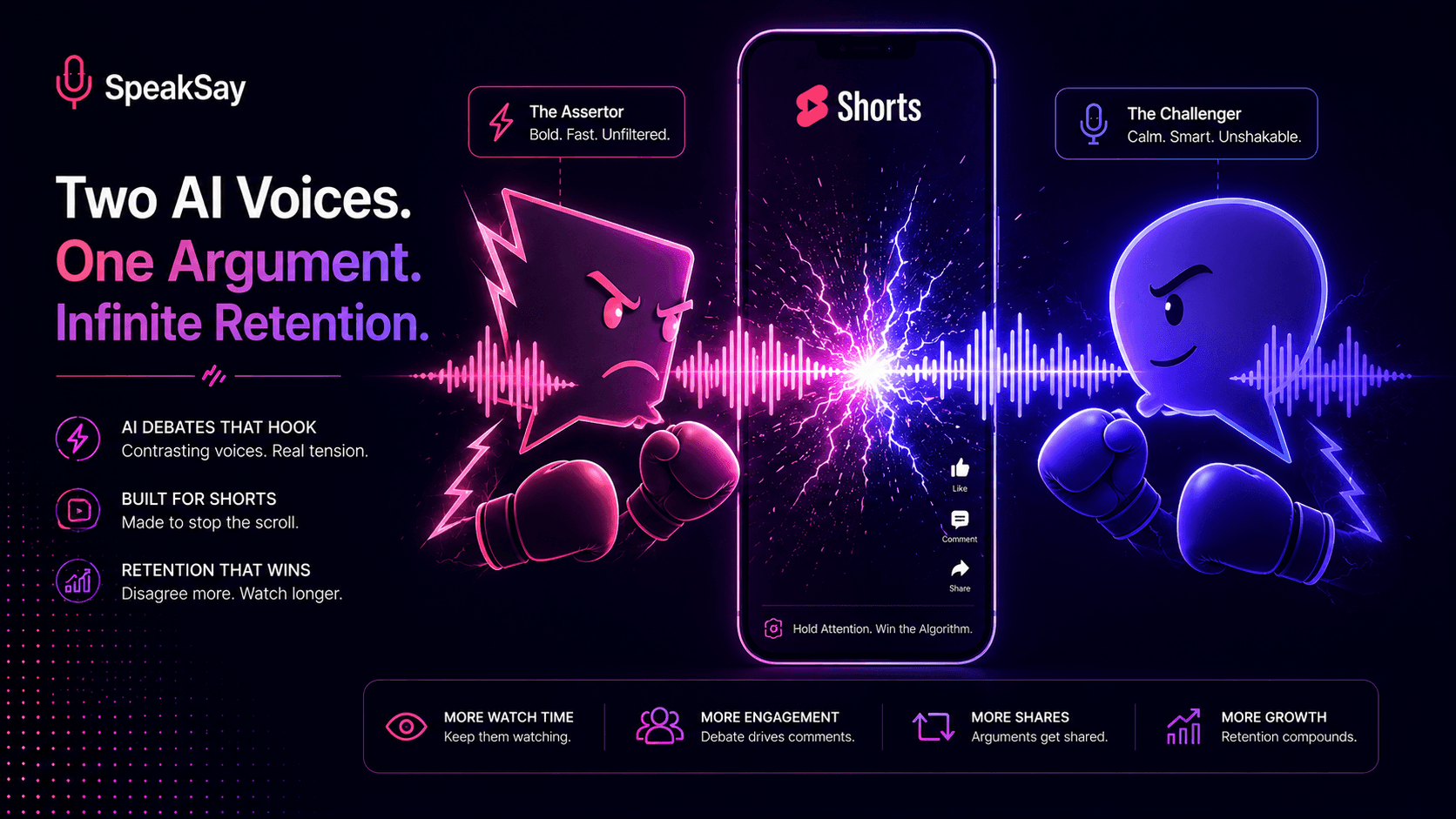
A single narrator delivers information. Two voices in disagreement deliver stakes — and stakes are what stop the scroll:
- Conflict structure creates open loops. The moment voice B says "that's completely wrong," the viewer needs resolution. That's retention you don't have to engineer with jump cuts.
- Disagreement recruits the audience. Viewers pick a side within seconds, and people who pick sides comment. Comment-bait built into the format beats "comment below!" every time.
- Two voices double the texture. Alternating tone, pitch and rhythm resets attention every few seconds — the same reason podcast dialogue outperforms monologue for most listeners. Modern AI voice models handle multi-speaker dialogue natively now, which is exactly why this format exploded in 2026.
- It's infinitely reusable. The characters stay; only the topic changes. That's a series engine, not a one-off video — and series are what algorithms reward with binge sessions.
The Problem With Stock Debate Tools
Gemini Notebook's debate-style Audio Overviews are a great proof of demand — AI voices debating your notes is genuinely compelling. But for creators building a channel, stock tools have three walls:
- You don't control the voices. Everyone gets the same two hosts. Your debate show sounds identical to ten thousand other uploads — the opposite of a brand.
- You don't control the takes. The AI decides the arguments, the emphasis, and what gets left out. When it's wrong or bland, your name is on it.
- You don't control the format. Fixed lengths and structures don't cut down to a punchy 45-second vertical clip with a hook in the first two seconds — which is where the views actually are.
The channels winning this format flip the stack: they write the argument, and AI performs it in voices designed to be theirs.
Design Two Characters Worth Listening To
Your two voices need to be instantly distinguishable with eyes closed and temperamentally opposed. Build each on three axes:
| Axis | Character A (example: "The Skeptic") | Character B (example: "The True Believer") |
|---|---|---|
| Voice texture | Lower pitch, dry, measured pace | Brighter, faster, energetic — leans into emphasis |
| Temperament | Demands evidence, deadpan one-liners | Enthusiastic, overcommits, occasionally right in surprising ways |
| Verbal tics | "Show me the data." / long pauses | "Okay but listen—" / rapid-fire lists |
Rules that keep the format alive for hundreds of episodes:
- Let each character win sometimes. If the skeptic always wins, you've made a lecture with extra steps. Genuine uncertainty about who'll land the better point is the rewatch driver.
- Make them original. Don't imitate real people's voices — celebrity sound-alikes are a copyright strike and platform-policy problem waiting to happen. Use a voice remixer to push two base voices in opposite directions until they're unmistakably custom characters.
- Name them. Named characters get fan art, inside jokes, and "Team Ray vs Team Iris" comment wars. Anonymous voices don't.
Script a 45-Second Argument (Beat Sheet Included)
Debate Shorts live or die in the writing. The proven beat sheet:
- 0–2s — Cold-open collision. Start mid-argument at peak disagreement: "You're telling me the pyramids were a jobs program?" Never start with introductions.
- 2–10s — Stake the claim. Character B states the bold position in one clean sentence. This is the thesis viewers will argue about.
- 10–30s — Three-exchange volley. Attack, counter, escalate. Each line under 3 seconds. Cut every word that doesn't fight.
- 30–40s — The twist. The strongest single fact lands — ideally the character who seemed to be losing plays it.
- 40–45s — Unresolved button. End on a question or a grudging concession: "…fine. But you're still wrong about the Bermuda Triangle." Tease the next episode, drive the comment war.
Write dialogue for the ear: contractions, interruptions, sentence fragments. Read it aloud once — anywhere you stumble, the AI will too. And keep a claims file: every factual statement checked before it ships, because confident wrong debate clips get community-noted into oblivion.
Build voices nobody else has
SpeakSay's Voice Remix lets you sculpt two completely original character voices — pitch, texture, energy, accent — and keep them consistent across every episode of your series.
Produce It: Voices, Pacing & the Vertical Edit
- Cast once, lock forever. Create both characters in SpeakSay, save the exact settings, and never regenerate them ad hoc — voice consistency across episodes is what turns viewers into fans.
- Generate as dialogue, not two monologues. Assign lines per speaker and generate the exchange so the pacing breathes like a real argument — slight overlaps in energy, no dead air between turns.
- Direct the performance. Use emphasis and emotion controls on the pivot lines: the twist should land harder, the concession should drop quieter. Two or three directed moments per clip is enough.
- Edit vertical with speaker cues. Simple visual identity per character — two colors, two shapes, or two caption styles synced to whoever's talking. Viewers follow debates with their eyes as much as their ears; captions are mandatory (most Shorts start muted).
- Batch a week per session. Five scripts, one generation session, five scheduled uploads. The format's efficiency is the moat — use it.
Five Debate Formats You Can Ship This Week
- Myth vs. Fact: the Believer pitches a popular myth, the Skeptic dismantles it — history, health claims (carefully), food science, "life hacks."
- Hot-Take Court: one voice "prosecutes" a spicy opinion (movies, sports, tech), the other defends. Verdict by comment vote — built-in engagement loop.
- Expert vs. Conspiracy: patient expert vs. increasingly creative theorist. Comedy with an educational spine.
- Coach vs. Rookie: beginner questions, expert answers with pushback — the format disguises a tutorial as an argument. Perfect for niche how-to channels.
- Past vs. Present: a character "from 1990" argues with one from 2026 about technology, prices, music. Nostalgia bait with endless topics.
All five run on the same two voices you designed once — which means your channel builds recognition with every upload, regardless of topic.
Try it free before you commit
Test voice ideas with SpeakSay's free tools, then upgrade for the full remix studio, dialogue generation and commercial rights when your series takes off.
FAQ
Is the two-AI-voice debate format allowed on YouTube and TikTok?Yes, with original characters and original scripts. It's synthetic audio, so follow each platform's AI disclosure rules, and avoid imitating real people's voices — that's where copyright and policy trouble lives. Original character voices you designed are yours.
How is this different from Gemini Notebook's debate mode?Debate mode generates arguments from your sources using Google's stock hosts, with no control over voices, takes or length. Building your own format means you write the argument, cast original voices, control the pacing, and cut to short-form specs — and your show doesn't sound like everyone else's.
Can one person really write daily debate scripts?A tight 45-second debate is 100–130 words. With the beat sheet, most creators write one in 20–30 minutes and batch a week in one sitting. The scarce ingredient is a genuinely interesting claim, not writing time.
Should the two voices be male and female?It helps instant distinguishability but isn't required. What matters is contrast on multiple axes — pitch, pace, energy, temperament. Two same-gender voices with strong contrast work fine; two similar voices with different names don't.
Does this work for long-form too?Yes — the same cast can host a full debate podcast episode (there's a whole format decision around solo/two-host/debate shows for podcasts). Most creators start with Shorts to find topics that spark, then expand winners into long-form.