Your Voice Clone Just Spoke Japanese and You Have No Idea If It Was Right: The 2026 QA Protocol for Languages You Don't Speak
Cross-lingual voice cloning lets your own voice speak languages you have never studied. The obvious problem is the one nobody plans for: you cannot hear the errors. Here is what actually goes wrong in cross-lingual synthesis, the four failure classes that native listeners notice first, and a review protocol you can run without speaking a word of the target language
1. The blind spot, stated plainly
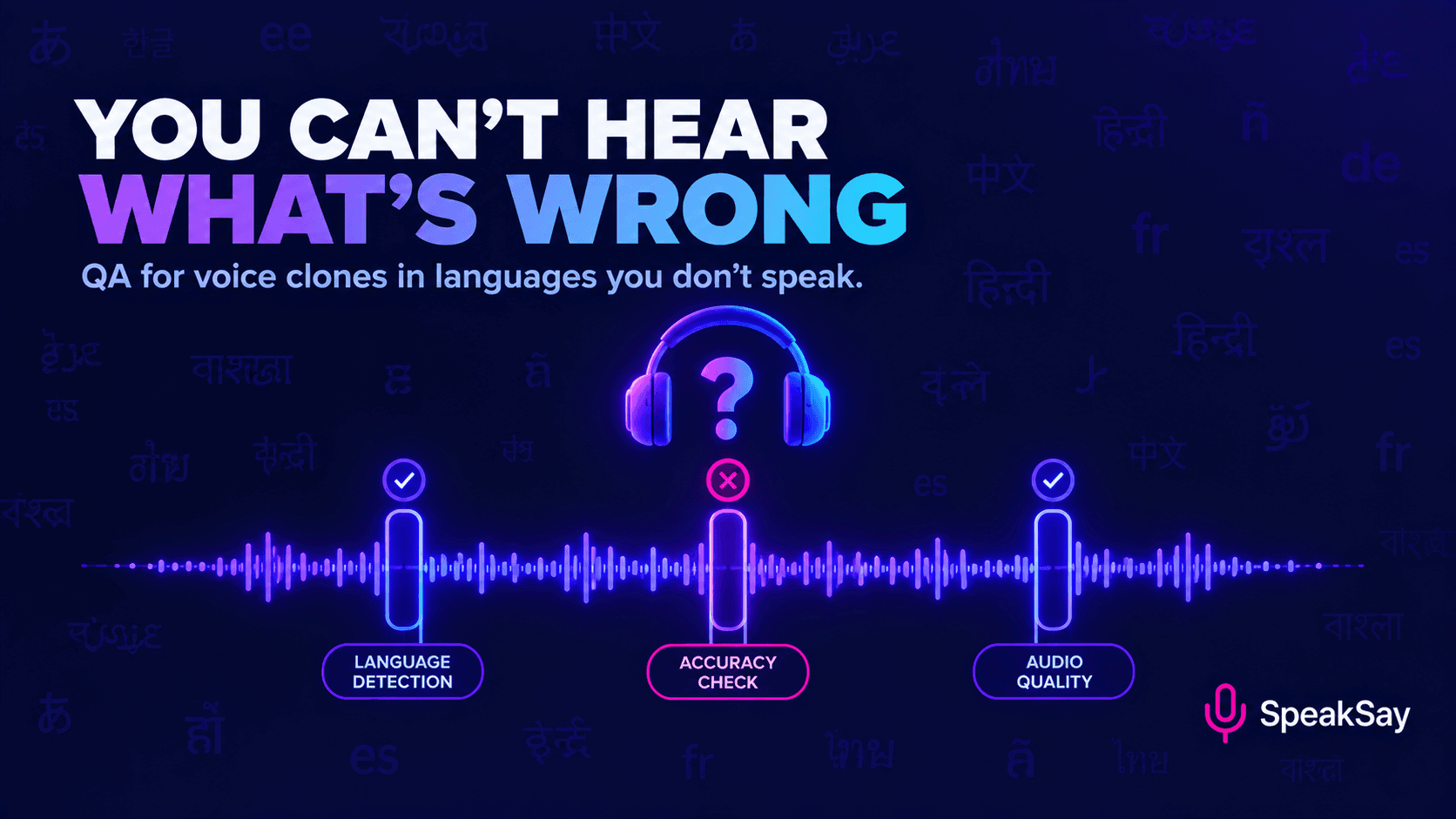
When you review audio in your own language, you are running an extraordinarily sensitive error detector without noticing. You catch a mispronounced name, a wrong emphasis, a sentence that parses oddly, a number read the wrong way, a tone that does not fit the content. You do it in real time, effortlessly, and you have never had to think about it.
In a language you do not speak, all of that is gone, and what remains is a very poor proxy: does it sound fluent? Fluency is precisely the thing modern systems are best at producing, including when the content is wrong. A confidently delivered mistake sounds better to you than a correct sentence with an unusual rhythm. Your instincts are not merely absent — they are actively misleading.
Three specific consequences follow, and they are worth naming because each one has burned a real creator:
- You will ship errors you would never have shipped in your own language, because the review step you rely on silently does nothing.
- You will not find out from your analytics. Viewers who hear an obvious error do not comment in your language — they leave, or they comment in theirs, in a thread you never read.
- The error is in your voice. That is the part that separates this from ordinary translation risk. A generic narrator making a mistake is a product flaw; your cloned voice making it reads as you being careless about that audience.
None of this is an argument against cross-lingual publishing. It is an argument for treating it as the only step in your pipeline with no built-in verification, and building one.
2. What actually degrades when a clone crosses languages
It helps to know what the system is actually struggling with, because the failure modes are technical and specific rather than random.
A cloned voice is, roughly, a compact representation of a speaker learned from reference audio. The difficulty is that this representation does not cleanly separate who is speaking from how that person's language works. Your reference audio in English carries your vocal identity and also your English pronunciation habits, entangled together. When the system generates Japanese with that representation, it has to keep the first and discard the second, and it does so imperfectly.
Research through 2026 on cross-lingual synthesis keeps surfacing the same effects:
- Accent leakage. The source language's pronunciation habits bleed into the target language, producing output that is intelligible but audibly foreign-accented. Explicit per-segment language tagging materially reduces this, which is why tools that let you declare the language of each block outperform ones that infer it.
- Worse behaviour on mixed-language text. When a sentence contains more than one language — a brand name, a technical term, a quoted phrase — models generating over the mixed sequence tend to flatten the embedded phrase into the surrounding language's accent, producing mispronunciation and audible distortion right around the switch.
- Compounding from synthetic sources. Cloning from audio that was itself generated compounds artefacts, and the degradation is most audible in cross-lingual output, where fine phonetic detail matters most. If your reference audio is a re-recording of a previous generation, expect the worst results here.
- Best results come from matched conditions. The consistent finding is that same-language cloning outperforms cross-lingual cloning. This does not mean cross-lingual is unusable — it means you should budget more review time for it, not less.
The practical translation of all that: quality is highest when your reference audio is clean and original, when you tag the language explicitly, and when each generated block is in one language. Sentences that mix languages are where it falls apart, and those are also the sentences you are least able to evaluate.
Start from a clean clone
Cross-lingual output is only ever as good as the reference underneath it, and artefacts in the source compound in the target language. Build the clone properly once and every language you publish in inherits the quality.
3. The four failure classes native listeners catch first
When you eventually get a native speaker to listen, these are what they will flag. Knowing them in advance lets you pre-empt most of them in the script rather than discovering them in review.
| Failure class | What it sounds like to a native listener | Where it comes from | Pre-empt it by |
|---|---|---|---|
| Proper nouns | Names of people, places, products read with foreign phonetics or stress | Names are rarely in the target language's normal vocabulary | Listing every proper noun and deciding its pronunciation before generating |
| Numbers, dates, currency | Decimal separators, date order, currency phrasing read by the wrong convention | Number normalisation follows locale rules that may not match your text | Writing numbers as words in the target language in the script |
| Prosody and stress | Right words, wrong music — emphasis in places that change or obscure meaning | Sentence-level rhythm transferring from the source language | Shorter sentences, explicit language tagging, and per-block generation |
| Register and formality | Content is correct but the politeness level is wrong for the audience | A translation issue, not a synthesis one — but it lands in the audio | Briefing the translator on audience and formality, not just accuracy |
The fourth class deserves emphasis because it is invisible to every technical check and it is the one that does the most reputational damage. Many languages encode formality and social distance grammatically. A translation that is word-perfect but pitched at the wrong register can read as rude, or childish, or bizarrely stiff, to every listener. No amount of audio QA catches this. It has to be handled at the translation brief.
Register also matters more than usual for cloned voices specifically, because the audience believes they are hearing you. A generic narrator being oddly formal is a production quirk; your own voice being oddly formal is a character judgement.
4. Checks you can run without speaking the language
You are not helpless before the native review. These checks catch a substantial share of errors and cost minutes.
- The duration check. Compare the runtime of the target-language audio against the source. Languages have characteristic expansion ratios relative to English — some run longer, some shorter, but each pairing is fairly consistent. What you are looking for is an outlier: a segment that is dramatically longer or shorter than its neighbours' pattern. That almost always means a chunk was dropped, duplicated, or something was read as a digit string instead of a word.
- Back-translation of the script. Run the translated script back into your language through a different engine than the one that produced it, and read the result. You are not checking elegance — you are checking that the meaning survived, that nothing was omitted, and that no sentence became an assertion you did not make. This catches dropped negations, which are the single most damaging translation error and are completely invisible in the audio.
- The proper-noun listen-through. You do not need the language to recognise your own brand name, your product names, your own name, or the place names in your content. Note the timestamp of every proper noun and listen to just those moments. You will hear whether "SpeakSay" came out as something else. This is often the highest-yield ten minutes in the whole process.
- The number listen-through. Same technique. You can recognise numbers by shape and length even in an unfamiliar language, and you know what the figure should be. A price, a percentage or a year read incorrectly is both common and consequential.
- The seam scan. Any place where your script switched languages mid-sentence — a brand name, an English technical term, a quoted phrase — is a high-probability defect site. Listen specifically at those points for distortion or an abrupt change in delivery.
- The identity check. Play thirty seconds of the target-language audio next to thirty seconds of your source-language audio. Does it still sound like the same person? Cross-lingual synthesis can shift timbre noticeably. You are uniquely qualified for this one check — it is your voice.
- The silence scan. Look at the waveform for unexpected gaps or truncations. A sentence that stops short is obvious visually and easy to miss aurally when you cannot follow the meaning.
Run these before you send anything to a native reviewer. Every error you catch here is one you are not paying someone else to find.
One voice, every market you publish in
If you are localising a catalogue rather than a single video, the per-language cost is what decides whether the project happens at all. A one-time plan makes the fifth language cost the same as the first.
5. The native review: how to buy the right thirty minutes
At some point a native speaker has to listen. The good news is that this is much cheaper than people assume, because you are buying a review rather than a translation — and because a well-briefed reviewer working from a structured checklist finds more in thirty minutes than an unbriefed one finds in three hours.
What to send: the audio, the target-language script, and a short brief. The brief is the part everyone skips and it is the part that determines whether the review is useful.
A brief that works:
- Who the audience is — country, rough age, and context (a professional watching at work reads very differently from a teenager on a phone).
- The formality level you intend, in one sentence.
- An explicit list of your proper nouns with the pronunciation you want, so the reviewer confirms rather than guesses at your intent.
- The instruction that matters most: "Tell me anything that sounds wrong, not just anything that is wrong." Reviewers default to checking correctness. You need them checking naturalness, because grammatically correct output with foreign prosody is the characteristic cross-lingual failure.
- A request for timestamps on every note, so you can fix specific segments rather than regenerating everything.
Ask them to answer four questions:
- Is there anything a native speaker would not say this way?
- Is the formality level right for this audience?
- Are any names, numbers or dates wrong?
- Does this sound like a native speaker or like a foreigner speaking well? (And if the latter — where, specifically?)
How much to review: for your first video or chapter in a new language, all of it. Once you have established that the pipeline is sound for that language pairing, you can move to spot-checking — the opening two minutes, one middle segment, the closing, plus every proper-noun and number timestamp. The opening matters disproportionately because that is where a listener decides whether to trust the audio at all.
Find reviewers among your existing audience where you can. A listener from that market who already knows your content is a better reviewer than a generalist freelancer, because they can tell you whether it sounds like you in their language — which is the actual question.
6. Not all target languages are equally risky
Risk varies enormously by pairing, and it is worth sequencing your expansion accordingly rather than starting with the hardest market.
| Characteristic | Why it raises risk | Extra review it deserves |
|---|---|---|
| Tonal languages | Pitch carries lexical meaning, so a prosody error can change the word itself — and phonetic respelling tricks that work elsewhere do not work here | Full native review, every time, for longer |
| Grammatical formality systems | Register errors are structural and pervasive rather than isolated | Translator briefed on audience; reviewer asked about register explicitly |
| Non-Latin scripts | Number, date and abbreviation normalisation is more likely to diverge from your assumptions | Full number and date pass |
| Right-to-left scripts | Mixed-direction text with embedded Latin terms is a known defect site | Seam scan on every embedded term |
| Languages with heavy regional variation | A single "correct" version may sound foreign to half your target audience | Decide the regional variety explicitly before translating |
| Close relatives of your source language | Lowest risk — but complacency errors cluster here | Standard spot-check |
The regional-variation row catches people out repeatedly. Choosing "Spanish" or "Portuguese" or "Arabic" without choosing a variety is a decision made by default, and it will be the wrong one for a large part of your audience. Pick the variety that matches your largest market, say so in the brief, and hire a reviewer from that market specifically.
7. The publish-safe pipeline
- Start from clean, original reference audio — not a re-recording of previously generated speech.
- Translate with a brief, covering audience, formality and regional variety. Accuracy alone is not a brief.
- Prepare the script for synthesis: numbers, dates and currency written as words in the target language; a decided pronunciation for every proper noun; no symbols left in the text.
- Split by language. One language per generated block. Where a foreign term must appear, generate it separately and join, rather than asking one pass to switch mid-sentence.
- Tag the language explicitly wherever your tool allows it, rather than relying on inference.
- Generate, then run the seven self-checks from section 4 before anyone else hears it.
- Native review — full for the first asset in a new language, spot-check thereafter.
- Fix by segment, not by regeneration. Re-render only the flagged segments so the rest of the audio stays exactly as reviewed.
- Keep a per-language lexicon of every proper noun, number convention and pronunciation decision. This is the asset that makes video fifty cheaper than video one, and it is the reason to keep the same reviewer where you can.
- Watch the comments in that language for the first few pieces, translated. Your audience will do QA for free, and rather bluntly.
Step 9 is the one that compounds. Every localisation project that becomes sustainable does so because someone kept the lexicon; every one that stalls does so because each new video restarts the same review from zero.
8. FAQ
Can my voice clone actually speak a language I don't speak?Yes. Cross-lingual synthesis generates target-language speech using your voice identity from reference audio in another language. Quality is generally best when the reference and output language match, so cross-lingual output deserves more review time rather than less — not because it is unusable, but because you cannot review it yourself.
Why does my clone sound foreign in the target language?Accent leakage: the pronunciation habits of your source language are entangled with your voice identity in the reference audio and partly transfer to the output. Explicit per-segment language tagging and generating one language per block both reduce it measurably.
How do I check audio in a language I don't speak?Run the duration check for outlier segments, back-translate the script through a different engine to confirm meaning survived, listen specifically at every proper-noun and number timestamp, scan the seams where languages switch, and compare timbre against your source-language audio. Then get a native speaker to review with a written brief.
How much native review do I actually need?Full review for the first asset in each new language pairing. After the pipeline is proven for that pairing, spot-check the opening two minutes, one middle segment, the close, and every proper-noun and number timestamp.
Which languages are riskiest to publish in without review?Tonal languages, because pitch carries lexical meaning and prosody errors change words. Languages with grammatical formality systems, because register errors are pervasive. And any language with strong regional variation, where picking the variety by default is itself an error.
Should I use my cloned voice or a native narrator for other languages?A native narrator will generally sound more natural; your cloned voice carries recognition and continuity across your catalogue. Many creators use their clone for markets where they have an existing audience and a native voice for cold markets. Either way, the review protocol is the same — the risk comes from your inability to check, not from which voice you chose.
What is the single most damaging error to miss?A dropped or reversed negation in translation, because it produces a confident, fluent statement of the opposite of what you meant. It is completely inaudible to you and it is exactly what the back-translation check exists to catch.