Horror Storytelling YouTube Channels: The Best AI Narrator Voices for Creepy Stories (2026 Playbook)
Horror storytelling exploded into 2026's hottest faceless niche — but a flat stock voice kills the dread. Here's how to choose, design, and direct an AI narrator that keeps viewers in the dark until the last second.
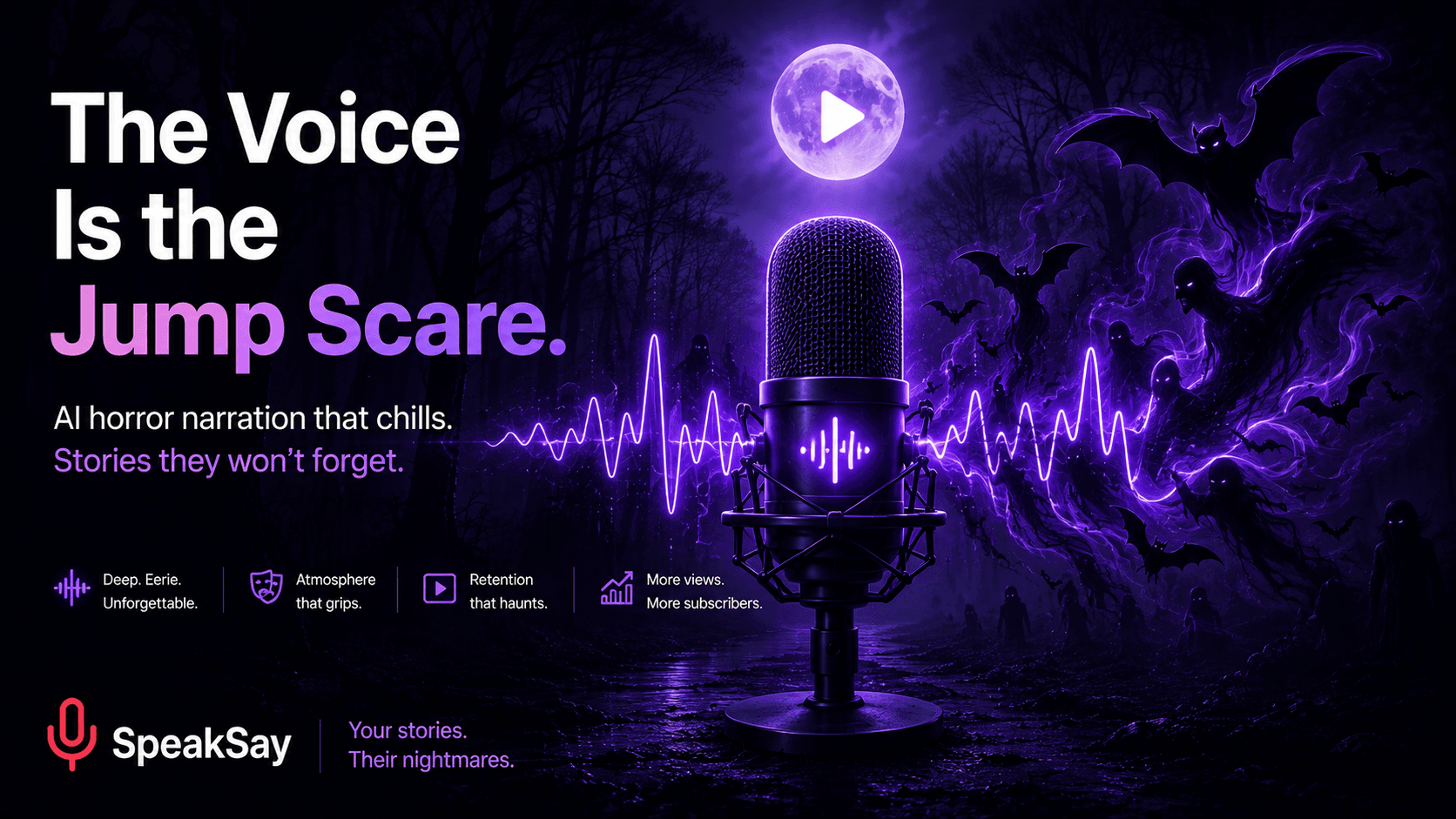
1. Why Horror Is 2026's Opportunity Niche
Niche roundups tracking faceless channel performance through 2026 consistently list horror storytelling and true-crime narration among the fastest-growing categories. The economics explain why: horror audiences binge (long watch sessions, high session time), episodes are cheap to produce (a script, a narrator, ambient visuals), and the format is infinitely repeatable — original stories, folklore retellings, "true scary stories" compilations, analog horror, sleep-adjacent creepypasta reads.
Unlike finance or tech niches where authority takes months to build, horror rewards atmosphere from video one. And unlike list-format content, narrative horror aligns with the retention shift YouTube has favored since 2025: story arcs hold viewers 40–60% longer than list videos. The catch: with low production barriers comes a flood of identical-sounding channels — which makes the narrator voice the only real moat.
2. Why Stock TTS Voices Kill Horror Retention
Horror works through tension accumulation: the listener's imagination does the scaring, and the narrator's job is to feed it at exactly the right rate. Default TTS voices fail this in four specific ways:
- Uniform pacing. Dread requires deceleration into key moments. Stock voices read the reveal at the same tempo as the grocery list.
- Upbeat prosody. Most default voices are tuned for explainer content — bright, helpful, slightly smiling. That tone actively neutralizes menace.
- No silence. The scariest tool in audio horror is the pause. Engines that rush through punctuation flatten every beat.
- Recognition fatigue. Viewers have heard the same six stock voices on thousands of Reddit-story channels. Familiarity is the opposite of unease.
Listeners bail in the first 30 seconds when the voice signals "content farm" instead of "campfire." In a niche where the algorithm rewards binge sessions, that first impression compounds across your whole catalog.
3. The 5 Horror Narrator Archetypes (and When to Use Each)
| Archetype | Sound profile | Best for |
|---|---|---|
| The Witness | Mid-deep, slightly shaken, conversational | First-person "true story" and Reddit-style reads — sounds like someone who was there |
| The Documentarian | Measured, neutral, cold authority | True crime, case-file horror, analog horror lore videos |
| The Storyteller | Deep, gravelly, slow, warm-then-dark | Folklore, campfire tales, long-form original fiction |
| The Unreliable | Soft, intimate, slightly off-kilter | Psychological horror, found-footage companion narration |
| The Archivist | Older-sounding, formal, faintly antique | Victorian/gothic horror, SCP-style containment fiction |
Start by auditioning deep and gravelly presets from SpeakSay's voice library against a fixed 60-second test passage — the same text every time, so you're comparing voices, not scripts. If no preset nails your channel's identity, design a custom narrator from a text prompt ("a tired night-shift radio host in his 50s, low, close-mic, unhurried") so your voice literally cannot be found on another channel.
Audition your horror narrator free
Paste your creepiest paragraph into SpeakSay and hear it in a dozen dark, cinematic voices — before you commit to one for the whole series.
4. Directing Dread: Pacing, Pauses & Emphasis
Treat your script like a musical score. The techniques that matter most, in order of impact:
- Engineer the pause. Insert deliberate breaks before every reveal — an ellipsis or explicit pause mark before the sentence that lands the scare. One full second of silence before "and then the knocking stopped" does more than any sound effect.
- Decelerate into fear. Mark the two sentences before each key moment for slower delivery. Speed back up during aftermath passages to reset tension.
- Drop, don't raise. Amateur horror narration gets louder at scares; effective horror gets quieter. Use emphasis controls to soften and lower the most frightening lines.
- Vary sentence energy. Alternate long hypnotic sentences with abrupt short ones. The rhythm change itself unsettles.
- Keep one "tell." Give your narrator a recurring verbal habit — a specific way of saying "listen" or a signature opening line — that fans learn to dread.
SpeakSay's pacing and emphasis controls in the TTS studio let you mark all of this in the text itself, so direction is repeatable across episodes instead of a lucky take.
5. One Narrator, One Hundred Episodes: Consistency as a Brand
Horror channels live on returning viewers, and returning viewers come back for the narrator as much as the stories. That means the voice must be identical in episode 1 and episode 100 — same timbre, same pace baseline, same closeness. Two practical rules:
- Lock the voice settings. Save your narrator as a named voice preset with fixed stability and pacing settings. Never regenerate "to taste" per episode — drift in settings reads as a different person over a season.
- Lock the format. Same cold open structure, same sign-off. Predictable frame, unpredictable contents — that's the genre contract.
If you run multiple horror channels (or a horror channel plus another niche), give each its own designed voice. A shared narrator across channels re-creates the "content farm" fingerprint you're trying to escape.
6. The Full Production Workflow
- Source stories: original scripts, licensed creepypasta (get written permission), public-domain folklore, or your own retellings of documented cases. Never narrate someone's story verbatim without rights.
- Score the script: add pause marks, deceleration notes, and softened-emphasis lines as covered above.
- Generate narration in your locked preset voice; regenerate only flagged lines, not whole sections.
- Bed the audio: low ambient drone, sparse sound design. Keep narration 6–10 dB above the bed — horror audiences listen at night at low volume.
- Visuals: slow zooms on atmospheric stills, subtle animation, or minimal footage. In this niche, restrained visuals outperform busy ones.
- Disclose AI use in YouTube's synthetic-media toggle — horror channels do fine under disclosure; the audience cares about the story, not the tooling.
Produce a full season in a weekend
SpeakSay generates hours of consistent, directed horror narration from your marked-up scripts — one narrator identity, every episode, no studio.
7. Monetization & Copyright Notes for Horror Channels
Horror RPMs typically run $6–13 — mid-tier, but the binge behavior multiplies session revenue, and the niche stacks well with mid-roll ads on 15–25 minute episodes. Three cautions: first, "true scary stories" scraped from Reddit without permission is both a copyright risk and an originality risk under YouTube's 2026 mass-produced content rules — transform or license. Second, avoid real-tragedy exploitation; ad suitability for graphic true crime tightened in 2026. Third, disclose AI narration; disclosed original horror is explicitly monetizable, and the labels have not been shown to hurt horror-niche reach.
8. FAQ
What is the best AI voice for horror narration?A deep, slow, close-mic voice with controllable pausing — the "Storyteller" archetype — is the safest default for story channels. The best choice is a custom-designed voice unique to your channel, so listeners associate the sound exclusively with you.
Can AI voices really do scary pacing?Yes — if you direct them. Modern engines respect pause marks, pacing controls, and emphasis settings. Flat results almost always mean an undirected script, not an incapable voice.
Is the horror niche oversaturated in 2026?Low-effort Reddit-read channels are saturated. Directed, original-story channels with a signature narrator remain undersupplied relative to demand — the growth data covers exactly this gap.
Do I need to disclose AI narration on a horror channel?Yes. YouTube's 2026 rules require synthetic-media disclosure. Horror audiences have shown no measurable aversion to labeled AI narration when the storytelling is good.
Can I use the same voice for my horror channel and my other channels?Avoid it. A shared voice across channels is a mass-production fingerprint and dilutes the narrator-as-brand effect that drives horror subscriptions.