Your SOP Is a 40-Page PDF Nobody Opens in the Field: Turning Procedures Into Point-of-Work Audio (2026)
Audio training for frontline employees fails when it is built like a podcast. Retention-critical audio has to be reference material — pulled at the moment of work, one task per file, identical every time it is played, and never the system of record on its own. Here is the format spec, the governance detail that decides whether the library survives, and the honest cost.
1. Start here: what never goes into audio
You have been pitched audio microlearning before, and the pitch led with benefits. Wrong order: the exclusions decide whether the project is safe. Do not put a task into audio if it involves any of the following.
- A number the worker must record, verify or compare. Torque values, dosages, temperatures, meter readings, tolerances, part numbers. There is no glancing back at a spoken number; numbers belong on a checklist.
- Anything legally attested or signed. Permits, isolation certificates, controlled-substance records, competency sign-offs. Audio may describe the process; it must never be the artefact.
- Anything depending on a diagram, wiring order, colour code or spatial layout. "Blue to the left terminal" is not audio content, it is a picture. The failure mode is a confident worker doing the wrong thing.
- Anything where a mistake is irreversible and the worker is alone. Energised systems, confined space entry, structural cuts. The control you need there is a second person or a hard stop; a voice in one ear can create a false sense of supervision.
- Anything that changes faster than you can re-publish. If a procedure is revised monthly and your rewrite-and-render cycle is six weeks, an audio library guarantees stale instructions in the field.
Then say this to every stakeholder who will ask: audio is an additional channel, never a replacement for the document. The written SOP remains the controlled document and the system of record; audio is a retrieval layer on top of it. Anyone implying otherwise is creating a compliance problem for you, and framing it this way is what gets the project through risk review.
What survives is still substantial: setup and shutdown, handovers, changeover and cleaning, inspection walk-rounds, customer-facing scripts, first-week orientation, and every task where the worker needs the order confirmed.
2. Broadcast versus lookup: the opposite format
We have written separately about turning all-hands content into a weekly internal audio briefing, and the advice there is close to the inverse of the advice here. That inversion is the central idea of this article.
| Dimension | Internal briefing (broadcast) | Procedure file (lookup) |
|---|---|---|
| Delivery | Pushed on a schedule | Pulled at the moment of need |
| Lifespan | Disposable — one week | Until the procedure changes |
| Plays | Once | Dozens, by the same person |
| Unit | A week of topics | One task |
| Variety and personality | Desirable | Harmful |
| Two-host format | Sometimes works | Never |
| Success metric | Completion rate | First-time-right rate |
| Retention required | No — explicitly avoid it | Yes, so the shape must change |
The consequence is worth stating flatly: in reference audio, consistency is the feature. A worker who has played the same changeover file forty times needs the forty-first word-for-word identical to the fortieth, because that is what lets them skip to the ten seconds they actually needed. Re-record it with a fresh angle, a warmer intro or slightly different phrasing and you have destroyed the muscle memory that made it useful. Editorial freshness is a virtue in a broadcast and a defect in a lookup — which is why so many well-funded audio libraries feel dead on arrival: podcast instincts applied to material where none of them help.
3. The case, sized honestly
The structural argument is a mismatch 2026 frontline-training research keeps restating: roughly 2.7 billion people worldwide — about 80% of the global workforce — work without a desk, while around 83% of corporate training technology is designed for desktop users. Hence the default frontline training experience: a laminated sheet, a supervisor's voice note, or nothing.
The format argument is about length. 2026 microlearning reports put completion for micro-courses at roughly 80–90% against something closer to 20–30% for long-form eLearning, alongside materially better reported retention and engagement, and by 2026 a large majority of learners say they prefer short formats. Treat the completion figures as the reliable part and the retention numbers as directional.
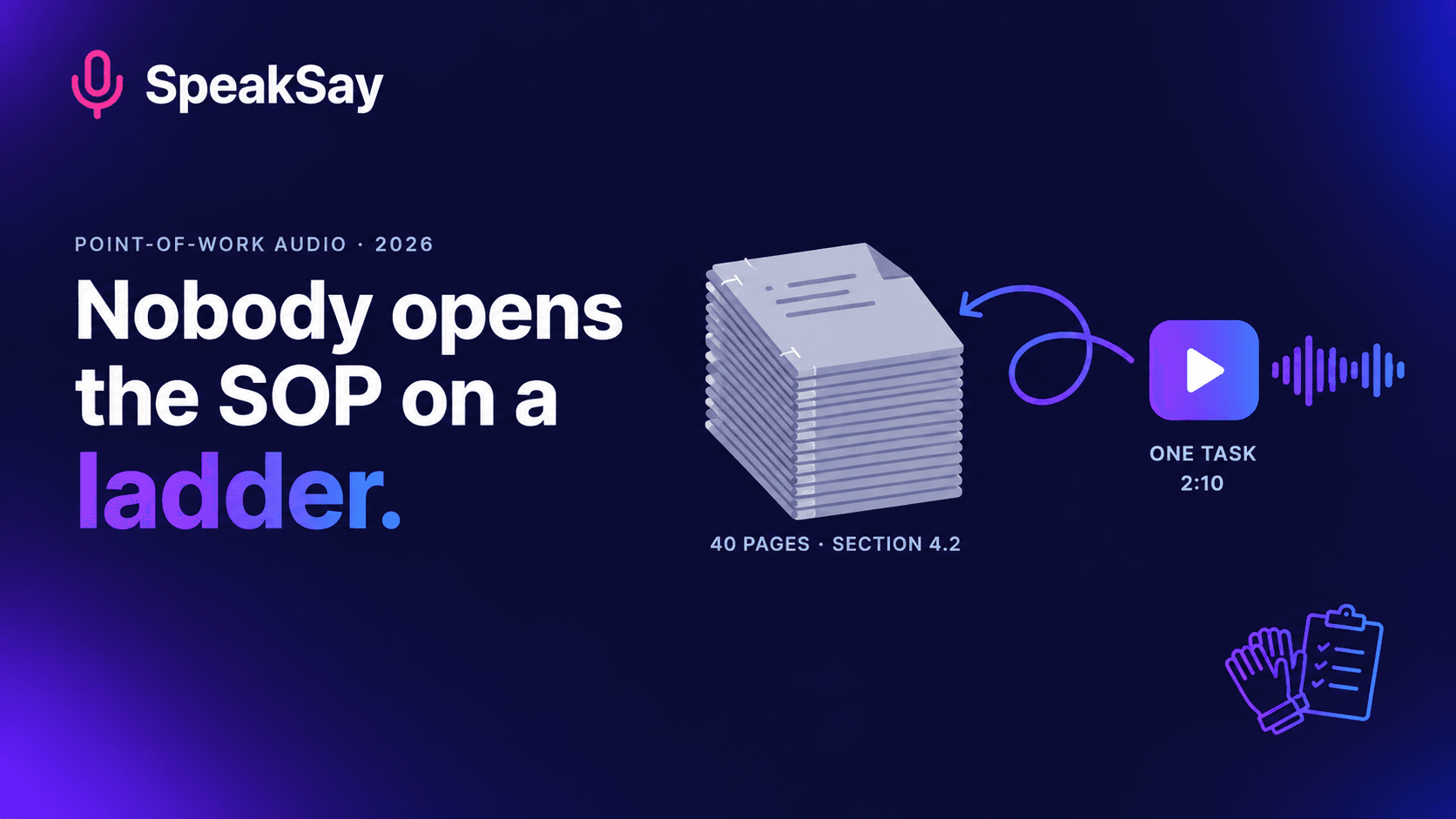
Three benefits, in descending order of defensibility. Hands-and-eyes availability is the whole thing: a worker on a ladder, in a vehicle or wearing gloves has no free hands and often no free eyes, and no responsive design fixes a PDF for someone who cannot hold a phone. Time-to-answer: the real alternative to a 90-second file is not reading section 4.2, it is asking whoever is nearest — which costs their time, propagates what they believe rather than what the SOP says, and fails on a night shift. Onboarding compression: onboarding audio training moves the explanations a supervisor repeats every intake into a library the new starter controls.
What it does not do: prove competence, replace supervision, or fix a wrong procedure. Narrating an inaccurate SOP is an accelerant.
Render one task file and put it in front of a crew this week
SpeakSay turns a locked script into a clean, consistent narrated file in minutes — same voice, same wording, every re-render. No studio, no booking, no editing pass.
4. The format spec: one task, fixed opening
This is a specification, not a style guide. Allow no local variation: variation is what breaks retrieval.
| Element | Specification | Why it is fixed |
|---|---|---|
| Length | 90 seconds to 3 minutes | Under 90 seconds it is a checklist line. Over 3 minutes the worker cannot hold the sequence. |
| Scope | One task per file. Never a topic. | "Cleaning" is a topic; "clean and reset the slicer after a changeover" is a task. Topics cannot be retrieved. |
| Opening 1 — the task | "This file covers [task], on [equipment or location]." | Confirms in three seconds that the right file is open. |
| Opening 2 — the prerequisite | "Before you start this, [what must already be true]." | The commonest field failure is the right procedure at the wrong point. |
| Opening 3 — the version date, spoken | "This version is dated [month, year]. If today is more than twelve months after that, check the written procedure." | Makes the file self-identifying — see section 5. |
| Opening 4 — the stop condition | "Stop and escalate if [specific observable condition]." | Before the steps, because the worker needs it before they are committed. |
| Voice | Single voice, same voice library-wide | A voice change reads as a different authority and slows recognition. |
| Music | None. No sting, no bed, no outro. | Costs seconds on every play and there is nothing to brand. |
| Two hosts | Never | Adds length, makes content unscannable, cannot be reproduced identically on revision. |
| Wording on re-render | Identical unless the procedure changed | If step four changed, only step four's wording changes. |
| Pace | Moderate, stable, same library-wide | Comprehension for non-native listeners falls off with pace. |
The four-part opening costs about twenty seconds and it is the most valuable twenty seconds in the file, because it prevents the wrong file being used confidently. Write it as a template with slots; reference audio should be boring to write.
5. Why the version date must be spoken inside the file
If you take one operational detail from this article, take this one. An audio file has no visible header, no revision block and no footer. Played from a phone, a current file and one superseded three revisions ago sound identical. There is no equivalent of noticing that the document in your hand is the 2023 edition.
It gets worse when you consider how these files travel. A worker downloads the changeover file because the signal in the loading bay is poor. That copy now lives on their phone and outlives every version you publish. They send it to a colleague covering the shift, who sends it to a new starter. Two revisions later, a retired file is still authoritative instruction in the field — and your content system shows a clean, current library, because from its point of view it is.
- State the version date aloud, inside the audio, in the opening. Month and year is enough. It cannot be stripped, it survives download and forwarding, and it is audible to the person relying on it.
- Add the expiry instruction in the same breath — "if today is more than twelve months after that date, check the written procedure" — a decision rule rather than a fact to interpret.
- Re-render the whole file when the procedure changes, and change the spoken date. Never splice a new segment into old audio: a spliced file has two effective dates.
- Keep a register: file, task, spoken date, source SOP version, reviewer. One row per file, and it is the artefact an auditor asks for.
Make the file self-identifying, because you will lose control of where copies live. Every other control you put around an audio library assumes the file stays inside your systems. Spoken dating is the only one that keeps working when it does not.
6. Findability: the reason these libraries die
These libraries rarely fail on content quality. They fail because a worker with sixty files and forty seconds cannot find the right one, tries twice, and never tries again.
The 20-second rule. If a worker cannot get from "I need to know this" to the right file playing in under twenty seconds, the library does not exist. Not "is inconvenient" — does not exist. Test it with a stopwatch and a real worker, not the person who built it.
Name by task verb + object + version date: Purge-line-after-allergen-run-Line3-Mar2026.mp3. Not the SOP number, because nobody in the field knows SOP numbers; not a topic like Hygiene-training.mp3, because a topic has no moment of use; not a module number, which assumes the worker goes in order. A worker scanning a list looks for the verb.
Ship two more things alongside that convention. A spoken index file: two to three minutes reading the library aloud, grouped by shift phase — "for start-up, there are four files; the first is…" It serves the worker who does not know what the task is called — most new starters — and it is the cheapest file to produce and the most often skipped. And grouping by when, not by what: L&D groups by topic, workers retrieve by moment — start of shift, changeover, fault, handover.
Keep the library flat, make every file downloadable for poor connectivity, and put it where the worker already is — your frontline app, a chat channel, or a QR code on the machine, which removes search entirely.
7. The six-step build from your existing SOPs
You already own the content. What you do not own is a version that survives being spoken.
- Pick one task family, not one department. Eight to twelve related tasks in a single area: a family gives you a coherent pilot, a department gives you scope creep.
- Extract the task list and filter it against the never-audio list. Expect to lose a third of the candidates, and write down what you excluded and why — that document is what you show your safety lead.
- Do the document-to-ear rewrite pass (below). This is the actual work, and the step people underestimate by a factor of three.
- Have one named reviewer who does the job sign the script, not the audio. Text review is faster and its corrections are unambiguous.
- Lock the script, then render. Store the approved script as the master; the audio is an output you can regenerate with text-to-speech using your library's fixed voice and settings. Locking first makes the file reproducible.
- Publish the trio and register the file — audio, transcript, one-page checklist. Never publish a file missing one of the three.
The document-to-ear rewrite pass
Written procedures assume a reader who can scan, re-read and jump around. A listener can do none of those.
- Break numbered lists into a spoken sequence with explicit signposting. A listener cannot see that a list has five items or where they are in it, so say "step three of five" before each step. It is the biggest comprehension gain in the pass: it tells the worker how much is left.
- Replace every cross-reference with the content itself. "See section 4.2" is worthless in audio. If 4.2 says isolate the supply first, the audio says isolate the supply first. If the content is too long to inline, the task was scoped too broadly.
- Convert passive compliance language into direct instruction. "Personal protective equipment must be worn at all times" becomes "Put your gloves and eye protection on now." Procedures use the passive voice to be defensible; spoken, it fails to say who does what.
- Spell out every acronym on first use, in every file. Not once per library — once per file. Files are heard in isolation and in no fixed order, so there is no "first time" library-wide.
- Read the finished script aloud yourself, once. Every place you stumble is a place the listener loses the thread.
Same locked script, every language, every revision
Once the script is approved, rendering it — again, and in other languages — is the cheap part. That is what makes a maintained library viable rather than a one-off project.
8. The multilingual case
This is the section that usually moves a budget, and it is rarely why people start looking. On a great many frontline sites — construction, agriculture, food production, logistics, cleaning, hospitality — the crew does not share a first language. The SOP exists in the head-office language, everyone knows this is a risk, and the reason nothing is done is arithmetic. Human re-recording costs a session per language, multiplied by every revision, forever. Twelve files in six languages is seventy-two recordings, and seventy-two again next March. No operations budget survives that, so translations either never happen or happen once and rot — which is worse, because nobody knows which version is current.
Rendering a locked script into six languages changes the arithmetic. The expensive inputs — the rewrite pass and reviewer sign-off — happen once, in the source language. Per-language cost becomes translation plus review plus a render, and the render is near-zero. A revision means updating one paragraph and re-rendering the set.
The caution, which is not optional for safety-critical content. A machine pass is adequate for orientation content and inadequate wherever a mistranslated verb changes what someone does with their hands.
- A native-speaker reviewer for every safety-critical language version, ideally someone who does the job in that language rather than a translator alone. Site and equipment terms are where generic translation fails, and they are the words that matter most.
- Review the translated script, not the audio, and do not machine-translate the stop condition — have it written natively and checked. It is the one sentence that prevents harm.
- The spoken version date in every language version, in that language. A dated English file beside an undated Polish one is a trap.
For mixed-language crews this is frequently the entire business case, because it is the only part of this that was previously impossible at any realistic cost.
9. The pairing rule: audio, transcript, checklist
Every audio file ships with a transcript and a one-page checklist. No exceptions. The division of labour is precise: audio for the walkthrough, checklist for the sign-off, transcript for the record.
Audio alone fails the moment precision is required, and it is invisible to every search system you own. A checklist alone assumes the worker already knows how — false for new starters and infrequent tasks. A transcript alone is what you have now, and nobody opens it in the field. Together, each covers the others' failure mode: numbers and signatures live on the checklist, search and translation live in the transcript, sequence lives in the audio.
Why an auditor accepts it: the audit question is not whether training was engaging but whether the instruction was controlled, current and evidenced. The trio answers all three — the transcript shows what was said, the spoken date and register show which revision was live, and the completed checklist evidences that the task was performed and by whom. That also disposes of the standard compliance objection that audio "cannot be evidenced." Correct, and irrelevant: the checklist is the evidence.
10. Measurement and the 90-day pilot
Do not measure plays or listens. A file played twice because the worker learned the sequence is a success; one played two hundred times may mean the procedure is confusing. Treating plays as a KPI also pushes your team toward producing engaging content — the wrong direction for reference audio.
| Metric | Why it is the right one | Source |
|---|---|---|
| Task completion time | Reflects whether the worker knew the sequence | Existing shift records; sample it |
| First-time-right rate | The core claim of point-of-work guidance | Checklists with no correction entry |
| Error and rework rate | The financial case, in your ops director's language | Existing quality and rework logs |
| Near-miss reports | Leading safety indicator — expect a rise early, which usually means reporting improved | Existing safety reporting |
| Time-to-competence | Where onboarding audio training pays back fastest | Days to unsupervised sign-off |
The 90-day pilot design
- Scope: one task family, eight to twelve files, one site or shift pattern.
- Control group: a comparable crew on the same tasks without the library. Without one you will attribute every seasonal shift to the pilot — and so will your sceptics.
- Baseline: four weeks of the metrics above before launch. If you cannot baseline a metric, drop it rather than estimate it.
- Weeks 1–2 retrieval only, fixing naming and the spoken index before judging content; weeks 3–12 normal operation with no additions and no format experiments, because changing the library mid-pilot destroys the comparison.
- Day 90: extend, revise, or stop.
State the kill criterion before launch, in writing. For example: if at day 90 the pilot crew shows no improvement in first-time-right rate versus control, and fewer than half the crew have used the library in the previous two weeks, we stop and publish why. Agreeing that in advance stops a dead library being maintained out of sunk cost — and it is what gets a pilot approved in a risk-averse organisation.
11. What it actually costs
The rendering is not the cost. Here is where the hours go for a first library of ten files, assuming the SOPs already exist.
| Activity | First 10 files | Per revised file | Who |
|---|---|---|---|
| Task selection and never-audio filtering | 3–4 hrs once | — | L&D with safety lead |
| Document-to-ear rewrite pass | 1.5–2.5 hrs per file — the main cost | 20–40 min | L&D or writer |
| Reviewer sign-off on script | 20–30 min per file — the main constraint | 10–15 min | Supervisor or operator |
| Render | Minutes per file | Minutes | Anyone |
| Listen-through QA | 5–10 min per file | 5 min | Script author |
| Checklist and transcript packaging | 15–20 min per file | 10 min | L&D |
| Naming, spoken index, register | 3–5 hrs once | 5 min | L&D |
| Each additional language | Translation + native review per file | Translation + review; render near-zero | Native reviewer |
Ten files is realistically 30 to 40 hours across two or three people, and the two things that decide whether it lands on time are both human: the rewrite pass and reviewer availability. Book the reviewer's slots before you write anything: a finished script waiting three weeks for a supervisor is how these projects stall — calendar difficulty, not technical difficulty.
The ongoing cost decides whether it survives, and nobody forecasts it. Assume each file is revisited when its SOP changes, plus an annual review of the spoken date; for a 40-file library, budget a half-day a month. If you cannot commit that, build twenty files. A stale library with authoritative-sounding narration is a liability.
Beside our other guidance: the case for avoiding re-recording on every compliance update is the cost argument for voice cloning in corporate training — revision economics, not retrieval. The weekly internal briefing is the broadcast shape this article inverts. Our public-sector accessibility and school-district family communications pieces address external audiences, where the constraints are legal obligation and reach.
12. FAQ
Is audio training for frontline employees a replacement for our written SOPs?No, and presenting it that way will get the project rejected. The written SOP stays the controlled document and system of record. Audio is a retrieval layer, shipped with a transcript and a checklist so sign-off and evidence stay attached to text.
Why not use a two-host conversational format to make procedure audio more engaging?Because engagement is not the goal and conversation harms retrieval. A worker who has played a file forty times needs the forty-first identical, so they can skip to the ten seconds they want. Two hosts cannot be reproduced identically on revision.
How do we stop workers using an out-of-date audio file?Speak the version date inside the audio, in the opening, with an expiry instruction: "if today is more than twelve months after that date, check the written procedure." Audio has no visible revision block, and a copy downloaded to a phone outlives every version you publish. Spoken dating is the only control that survives forwarding.
What is the most common reason an audio microlearning library fails?Findability. A sixty-file library with poor naming is unusable — a worker who cannot reach the right file in under twenty seconds tries twice and never again. Ship a naming convention of task verb plus object plus version date, a spoken index file, and grouping by moment of use rather than topic.
Can we produce these in multiple languages for a mixed-language crew?Yes, and for many sites that is the whole business case, because re-recording per language per revision is why it was never done. Do the rewrite and sign-off once in the source language, then translate and render it. For safety-critical content use a native-speaker reviewer, not a machine pass, and give every language version its own spoken date.
What should we measure, if not plays?Task completion time, first-time-right rate, error and rework rate, near-miss reports and time-to-competence. Plays measure retrieval behaviour, not outcomes. Run a 90-day pilot on one task family with a control crew, and write down the kill criterion before launch.