Will Readers Actually Buy an AI-Narrated Audiobook? The 2026 Pricing, Disclosure & Positioning Playbook
Producing an AI audiobook is now the easy part. Selling it is where authors get burned. Honest 2026 data on where AI narration sells (and where it flops), how to price against $0.99 human-read deals, and the disclosure wording that builds trust instead of killing sales.
1. The Honest Data: Where Listener Resistance Is Real
Start with the uncomfortable findings, because your strategy has to survive them:
- Price resistance is real. Listener surveys and community polling repeatedly find that many audiobook buyers won't pay full retail for AI narration when human-read titles are available for $0.99–$1.99 on deal platforms like Chirp or via Audible sales. The comparison point isn't "AI vs. nothing" — it's "AI at $14.99 vs. a beloved human narrator at $1.99."
- Reviewers punish undisclosed AI. Listeners who discover mid-book that narration is synthetic — without having been told — leave reviews that hurt more than the narration itself. The felt offense is deception, not technology.
- Brand spillover is a real risk. Author-community veterans warn that a poorly received AI audiobook can drag perception of your ebook and print editions down with it. Your worst format sets your brand floor.
None of this says "don't." It says: the authors who win with AI narration are the ones who respect these constraints instead of pretending they don't exist.
2. Where AI Narration Sells in 2026 (and Where It Doesn't)
| Segment | AI narration viability | Why |
|---|---|---|
| Nonfiction (how-to, business, self-help) | Strong | Listeners optimize for information, not performance; clear delivery is the product |
| Backlist titles with no audio edition | Strong | The alternative is no audiobook at all; incremental revenue at near-zero risk |
| Long series backlists | Strong | Economics of human narration never worked for 10-book series at indie sales volumes |
| Library & subscription channels | Strong | Borrowing removes purchase-price resistance entirely |
| Genre fiction (romance, fantasy) front-list | Weak-to-moderate | Performance-driven listeners; narrator fandoms drive purchases |
| Literary fiction, full-cast expectations | Weak | Narration is the art; resistance is highest here |
The pattern: AI narration sells where listeners buy information or access, and struggles where they buy performance. If you write fiction, the calculus is harder but not hopeless — see our companion piece on where AI fiction narration fails and the multi-voice workflow that works.
3. Pricing: Don't Compete With $0.99 Human-Read Deals Head-On
The core mistake is pricing an AI-narrated audiobook like a studio production. Strategies that survive contact with the market:
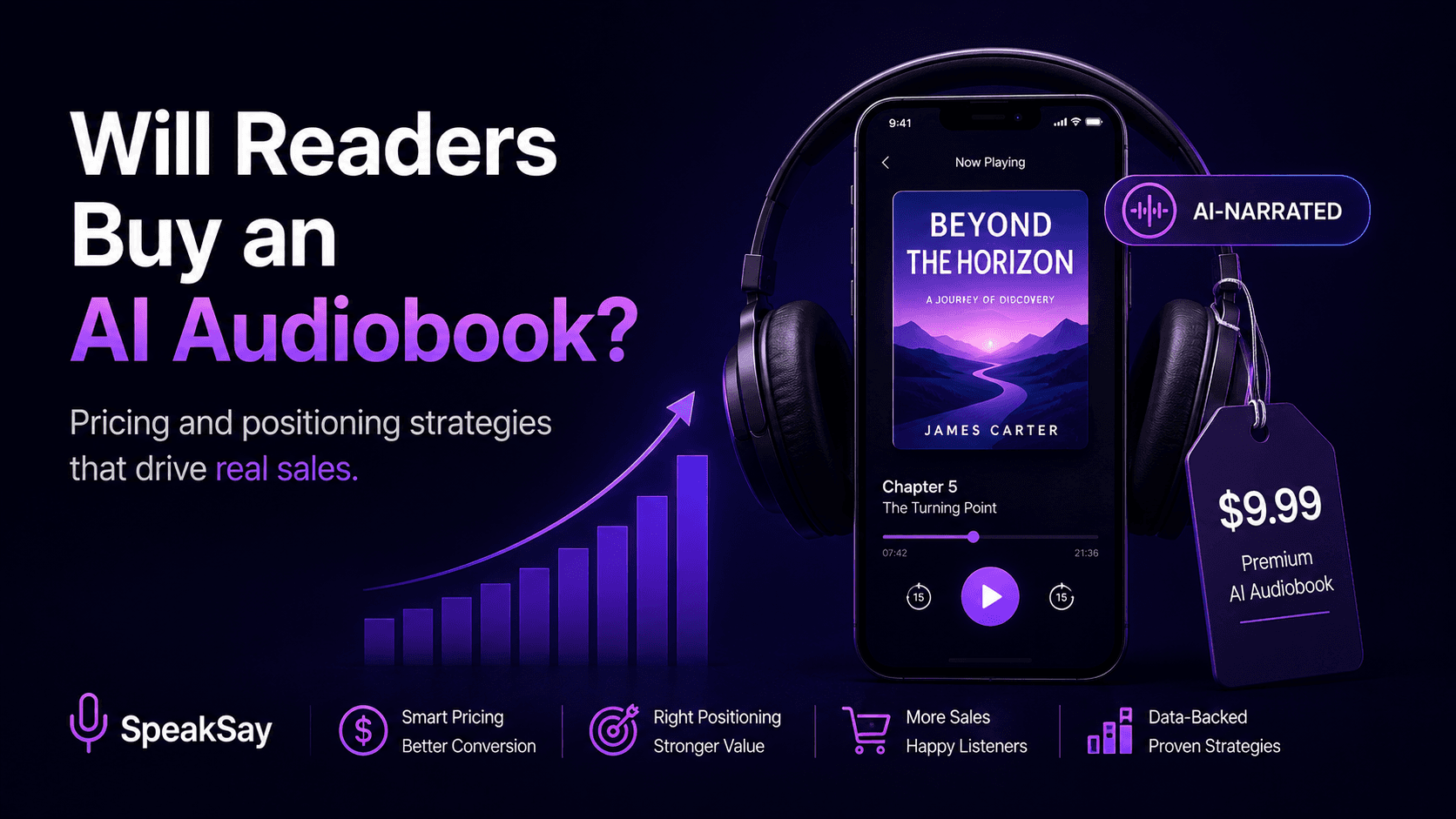
- Price below the human-narrated median, visibly. If comparable human-read titles in your genre retail at $14.99–$19.99, an AI-narrated edition at $4.99–$7.99 tells a coherent story: "modern production, passed on as savings." Listeners accept AI narration at a price that acknowledges the difference.
- Bundle it. Ebook + audiobook bundles at a small premium over the ebook alone convert readers who would never buy the audio separately — and sidestep direct comparison with human-read pricing.
- Let libraries pay instead of listeners. Library licensing (via wide distributors) monetizes exactly the audience that refuses to purchase — cost-sensitive, volume listeners.
- Use promo pricing to seed reviews. A launch window at $1.99–$2.99 gets honest early reviews of the narration itself, which de-risks the purchase for full-price buyers later.
Run your own numbers first — our AI vs. human narration cost math breaks down per-finished-hour economics so you know your actual break-even.
4. Disclosure: The Wording That Builds Trust Instead of Killing Sales
Disclosure is both increasingly mandatory (most major platforms require flagging AI narration) and strategically underrated. The difference is in the wording:
- Weak: "This audiobook uses AI narration." — reads as a warning label.
- Better: "Narrated with premium digital voice technology, making this audiobook possible at a price every reader can afford." — states the trade honestly and frames the benefit.
- Best (when true): "Narrated in the author's own voice, digitally produced." — this is the one framing that converts disclosure from a liability into a selling point. Readers don't want a robot; but many actively want the author reading their book.
Wherever you disclose, do it before purchase (product description, retailer AI-narration filter, opening credit). Post-purchase discovery is the scenario that generates angry reviews. Include a 5-minute sample prominently — samples convert skeptics better than any copy.
Make "read by the author" your differentiator
Clone your own voice with SpeakSay and narrate your audiobook yourself — without spending six weeks in a recording booth.
5. Positioning: The "Author's Own Voice" Advantage
Generic synthetic narration competes on price alone. An audiobook narrated by a clone of your voice competes on something no discounted human-read title can offer: authorial intimacy.
- Nonfiction: "the author explains their own framework" is the natural format — it's why author-read business books outsell studio-read ones. A voice clone gives you that positioning at AI production costs.
- Memoir and personal writing: the author's actual voice isn't a compromise, it's the point.
- Marketing asset: "read by the author" is a phrase readers already trust from traditional publishing. You inherit its credibility — legitimately, since it is your voice, your emphasis choices, your pronunciation of every character name.
Record a proper voice clone once (input quality matters — see the recording mistakes that ruin clones), and every future book, updated edition, and translated version can carry your voice. That includes foreign-language editions in your own cloned voice.
6. Channel Strategy: Wide, Libraries and Direct
Platform rules for AI narration differ, and channel choice changes your sales ceiling:
- Go wide by default. Wide distributors deliver to dozens of retailers and thousands of libraries, most of which accept properly disclosed AI narration. Exclusivity buys you nothing an AI-narrated title needs.
- Libraries are the sleeper channel. Borrow-based revenue has no purchase-price resistance — the listener pays nothing, so the AI-vs-human price comparison never happens.
- Direct sales maximize margin. Selling from your own site keeps most of the revenue and lets you bundle ebook + audio freely. Your list already trusts you — resistance is lowest there.
- Platform-by-platform rules move fast. Check current acceptance policies before committing; our platform guides on Audible's AI narration rules and KDP Virtual Voice stay updated.
7. The Quality Bar That Makes All of This Possible
Every strategy above collapses if the narration itself is bad. The 2026 minimum bar:
- Consistency across hours. Voice drift over a 10-hour book is the most-cited quality complaint; generate in controlled segments and QC chapter transitions. (Full guide: keeping AI audiobook voices consistent.)
- Pronunciation pass. Character names, places and technical terms — build the glossary before generating chapter one, not after a reviewer catches it.
- Human listen-through. Someone must hear every finished hour before publication. Spot-checking is how "chapter 14 repeats a paragraph" reviews happen.
- Retail audio specs. Meet the technical requirements (RMS levels, noise floor, room tone spacing) of your strictest target platform so one master serves all channels.
8. Managing Brand Risk: Protecting Your Print and Ebook Sales
The spillover risk — a bad audiobook denting your whole catalog — is managed, not eliminated:
- Test on backlist first. Debut your AI audio on an older title with an established review base, not your flagship new release.
- Watch the review stream. Narration complaints in the first 20 reviews are actionable: regenerate the flagged chapters and re-upload. AI narration's superpower is that fixes cost hours, not studio re-bookings.
- Keep editions honest. If the AI edition underperforms in a genre, pull it there and keep it in the channels where it works (libraries, bundles, direct). Distribution is reversible.
9. The Decision Framework: Should Your Next Book Get AI Narration?
Answer four questions:
- Genre: information-driven or performance-driven? (Information → proceed; performance → test carefully.)
- Economics: would this title ever justify human narration costs at your realistic sales volume? (No → AI narration is found money.)
- Voice: can you position it as author-voiced? (Yes → your disclosure becomes your marketing.)
- Channels: are libraries, bundles and direct part of your plan, or are you betting everything on full-price retail? (The former is the winning pattern.)
Three or four favorable answers: produce it. One or two: start with your backlist and let the data decide.
Turn your backlist into an audiobook catalog
One lifetime payment, unlimited narration across every book you've written — in premium voices or your own clone.
10. FAQ
Do AI-narrated audiobooks actually sell in 2026?Yes — in the right segments. Nonfiction, backlist titles, series catalogs, library channels and author-direct bundles show consistent revenue. Full-price front-list genre fiction remains the hardest segment, where narrator performance drives purchases.
Do I have to disclose AI narration?Most major platforms require it, and undisclosed AI narration is the single biggest driver of hostile reviews. Disclose before purchase, provide a generous sample, and frame the disclosure around the benefit (affordability, author's own voice) rather than as a warning.
How should I price an AI-narrated audiobook?Visibly below comparable human-narrated titles — typically $4.99–$7.99 where human-read equivalents run $14.99+ — or bundled with the ebook. Competing at full studio-production prices invites a comparison you lose.
Will a bad AI audiobook hurt my ebook sales?It can — readers generalize quality across formats. Mitigate by testing on backlist first, monitoring early reviews, and fixing flagged chapters immediately (regeneration takes hours, not weeks).
Is "read by the author" honest if it's my voice clone?Use precise wording such as "narrated in the author's own voice, digitally produced." It's truthful — the voice, pronunciation choices and approval are yours — while meeting platform synthetic-media disclosure rules.