Should You Clone the Voice of Someone Who Has Died? Consent, Family and What to Decide First (2026)
It's now technically possible to rebuild a late parent's or partner's voice from voicemails and home videos. Whether you should is a different question, and it has more to do with consent, family agreement and what you'll actually use it for than with the technology. A practical, honest decision guide.
1. Start with the question, not the tool
People usually arrive at this idea for one of a few reasons: they want their children to know what a grandparent sounded like; they want to hear a familiar voice read a favourite story; they have a recording too damaged to enjoy; or they simply miss the sound of someone. Those are different goals, and they lead to different answers.
Before you open any app, write down in one sentence what you would do with the result. "Play the restored wedding speech at the anniversary" is a clear, bounded purpose. "Have Dad say things" is not, and it's the version that most often goes wrong.
It's also worth saying plainly: there is no right timeline here. Many people find it easier to decide months or years after a loss than in the first weeks. Nothing about the recordings will expire if you wait, as long as you keep them safe (see section 6).
2. What consent means when the person can't give it
Responsible voice cloning rests on consent from the person whose voice it is. When that person has died, consent becomes something you have to reconstruct rather than ask for. Three sources help:
- What they said. Did they ever express a view on AI voices, deepfakes, or being "brought back"? Some people have strong feelings. A few now leave explicit wishes, and some legacy services capture voices only with the living person's documented consent (example).
- Who speaks for them now. Legally and ethically, that's usually the executor or the closest family. For public figures and performers, it can be an estate with formal rights.
- Who they were. A private person who disliked being recorded is a different case from someone who loved telling stories on tape.
A useful public example: after the death of the narrator of the video game series Darkest Dungeon, the developers chose not to use an AI reproduction of his voice — even though, by their account, he had given permission (background). Permission made it possible. It didn't make it the right choice for them. That distinction is the heart of this whole decision.
3. Agree as a family before anyone builds anything
The most common source of hurt isn't the technology; it's one relative surprising others with it. A sibling who plays a cloned voice at a holiday dinner may mean it as a gift and land it as a shock.
A short family conversation should settle four things:
- Whether. Does everyone closest agree it's acceptable at all? A single strong objection from a spouse or child is usually a reason to stop.
- What for. The specific purpose, in one sentence each.
- Who holds it. One person keeps the recordings and any voice model; nobody copies or shares it without asking.
- What's off limits. Agree the "never" list now, while it's calm (section 4 has a starting point).
Write it down. It sounds formal, but a one-paragraph note in a shared folder prevents most later disagreements.
4. Uses that tend to help, and uses that tend to hurt
| Tends to help | Tends to hurt or cause problems |
|---|---|
| Cleaning up and restoring real recordings so they're easier to listen to | Making the voice say personal messages they never said ("I'm proud of you", "I forgive you") |
| Reading words they actually wrote — letters, recipes, a diary — clearly labelled as a recreation | Interactive "chat with Mum" setups used daily as a substitute for grieving |
| A short, bounded project for a specific occasion, shared with agreement | Any use that could make others think the person is alive or endorsing something |
| Keeping a private archive for grandchildren with context about who they were | Posting the voice publicly, in ads, or on social media for views |
The pattern on the left: the words are theirs, the purpose is bounded, and everyone knows it's a recreation. The pattern on the right: new words put in their mouth, open-ended use, or an audience that might be misled. Some grief researchers and clinicians have raised concerns that ongoing interactive recreations can complicate grieving for some people. If you notice a recreation is making things harder rather than easier, it's okay to stop, and it can help to talk it through with someone you trust or a grief counsellor.
5. The legal picture in 2026 (briefly)
For private, family use, the main legal questions are usually about who owns the recordings and who controls the person's estate. The law becomes much more specific when a voice is used publicly or commercially:
- Post-mortem rights. Several US states protect a person's voice and likeness after death. California's AB 1836, for example, requires estate consent for digital replicas of deceased performers in many commercial uses, and Tennessee's ELVIS Act treats voice as a protected property right (overview).
- Impersonation and fraud. Using a cloned voice to mislead anyone — including relatives, banks or institutions — is unlawful in most places, whatever the family agreed.
- Platform terms. Most voice-cloning services, SpeakSay included, require you to have the right to use the voice you upload. Read the terms before you start, and keep a note of the family agreement as your record.
We're not lawyers, and this isn't legal advice. If you plan any public or commercial use, speak to a lawyer in your jurisdiction and the executor of the estate first.
6. The option most families overlook: preserve, don't generate
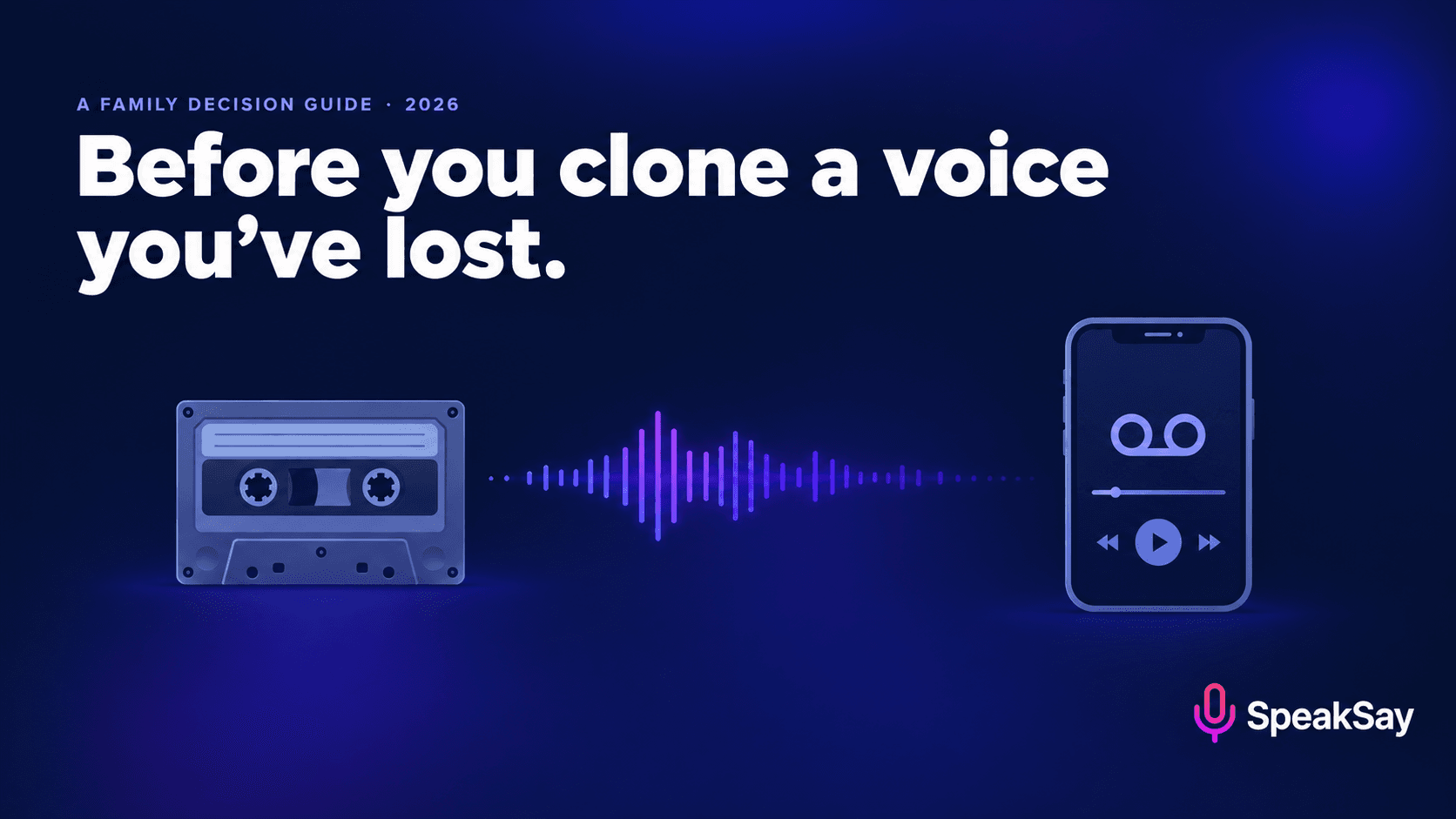
Many families who start out wanting a clone end up deciding they mainly want the real recordings saved and made listenable. That's a smaller, safer project, and it's worth doing whether or not you ever build a voice model:
- Find everything. Voicemails (export them before a phone is reset or a carrier deletes them), home videos, wedding and birthday videos, cassette tapes, video calls, and anything posted online.
- Make copies. Keep originals untouched and store copies in two places. Voicemails are the most fragile source; save them first.
- Clean them up. Reduce hiss, hum and background noise so the voice is easier to hear. Free tools like a noise remover or audio enhancer handle most of this.
- Label them. Date, place, who's speaking, what was happening. Ten years from now, the context is as precious as the audio.
If your recordings are rough — phone audio, old tapes, compressed video calls — our guide to working with old and damaged recordings explains what can and can't be recovered. And if you want to capture the stories of relatives who are still with you, a family history podcast is a gentle place to start.
Start by saving the real recordings
Clean up voicemails, tapes and home-video audio with SpeakSay's free tools, so the voice you have is easier to hear — no voice model required.
7. If you go ahead: how to do it carefully
If your family has agreed, and the purpose is clear and bounded, these steps keep the project respectful:
- Use only clean, clearly identified speech. Choose segments where only that person is speaking. Mixed voices produce a model that sounds like no one in particular.
- Prefer their own words. Letters, recipes and stories they wrote are the most defensible things to have the voice read.
- Label it. Begin every file with a short spoken or written note: "This is an AI recreation of [name]'s voice, made by the family in 2026, reading their own letter."
- Keep it private. Store the voice model in one account controlled by the agreed person; don't share the model itself, only finished files.
- Decide its end. Agree whether the model will be kept, archived or deleted once the project is done. Deleting the model while keeping the finished recordings is a reasonable default.
Voice cloning works best with a few minutes of clean audio; less, or noisier, audio gives a rougher result. That's sometimes a feature here: a recreation that sounds close but not perfect is harder to mistake for the real person.
A private, bounded voice project
If your family has agreed on a clear purpose, SpeakSay's voice cloning lets you build a voice from clean recordings and keep it in one private account.
8. FAQ
Is it legal to clone the voice of a family member who has died?Private, non-commercial family use is generally treated differently from public or commercial use, but rules vary by country and state. Several US states protect a deceased person's voice in commercial contexts, and impersonation or fraud is unlawful everywhere. This isn't legal advice; check with a lawyer and the estate's executor for anything beyond private use.
How much audio do I need to recreate someone's voice?A few minutes of clean speech from that person alone gives a usable result. Voicemails, speeches and home videos are common sources. More audio and cleaner audio give a closer match.
Is it healthy to recreate a loved one's voice?It depends on the person and the use. Bounded projects using their own words, agreed by the family, are generally the gentlest. Open-ended interactive use, or having the voice say new personal things, is where people more often report it making grief harder. If it's not helping, it's fine to stop and to talk to someone you trust.
What should I do with old voicemails of someone who died?Export and back them up as soon as possible, since phone resets and carrier policies can delete them. Keep untouched originals in two places, then make cleaned-up copies for listening.
Should we ever post a recreated voice online?As a rule, no. Public posting raises consent, legal and misuse risks, and it can be distressing for others who knew the person. Keep recreations private and shared only with the family who agreed to them.