Clone Your Own Voice or Use a Stock AI Voice? The 2026 Decision Guide (and the Emotional Range Trade-Off Nobody Mentions)
Most advice says clone your voice because it's "authentic". That skips the actual trade-off: a clone of an average speaker usually has less usable expressive range than a professionally-built stock voice. Here's the honest decision framework.
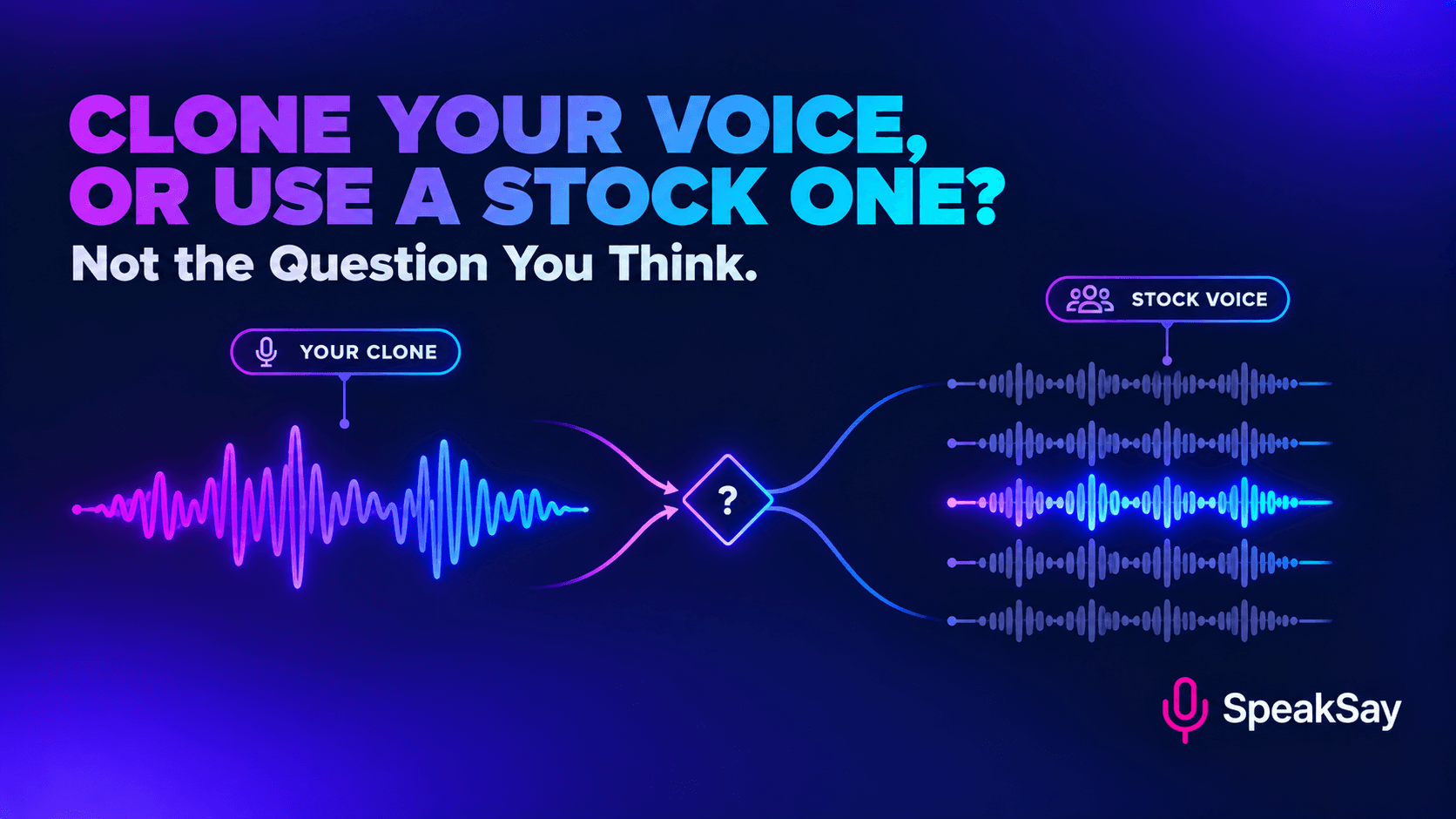
1. Why "which sounds better" is the wrong question
Put a good clone and a good stock voice side by side reading the same neutral paragraph and most listeners cannot reliably say which is which, let alone which is better. Both sound like a person reading a paragraph. The comparison tells you nothing because a neutral paragraph is the one condition where every voice performs.
The differences appear at the edges — and the edges are where your content actually lives:
- The line that has to land as a joke.
- The three-second hook that has to sound urgent without sounding hysterical.
- The sentence that shifts from explanation to warning.
- Hour four of a ten-hour audiobook, when the listener is tired.
- The reveal in a Short, at second twenty-eight, that has to feel like a reveal.
So the question to ask isn't "which sounds better". It's "which one can do the things my content needs, and does it matter that it's me?" Those are two separate questions, and answering them in that order gets you to a decision quickly.
Test both before you decide
Audition the stock library and build a clone, then run the same script through each. The comparison takes an afternoon and settles the question for years.
2. The emotional range trade-off, explained
A cloned voice is built from your recordings. Whatever prosodic territory those recordings cover is roughly the territory the clone can operate in — and it extrapolates outside that territory poorly, because it has no examples to extrapolate from.
Now consider what most people's source material looks like. Twenty to sixty minutes, recorded in one sitting, reading prepared text at a steady pace in a steady mood, deliberately trying to sound clear and consistent because every cloning guide tells them to. That produces an excellent clone of one specific mode: you, being careful.
A commercial stock voice starts from a different place. It's built from a trained speaker recorded across a designed range — warm and cold, fast and slow, excited and grave, whispered and projected — precisely so the model has examples at the edges. That's why a stock voice can take an instruction to sound urgent and actually do something with it.
| Capability | Typical clone from 20–60 min of careful reading | Well-built stock voice |
|---|---|---|
| Neutral narration | Excellent | Excellent |
| Recognisable as a specific person | Yes — the whole point | No |
| Strong emphasis / excitement | Often flattens or distorts | Reliable |
| Whisper / intimate register | Usually unavailable | Often available |
| Wide rate variation | Degrades outside your natural pace | Holds up |
| Comedic timing / sarcasm | Weak unless the source had it | Better, still needs script work |
| Long-form stability (hours) | Drift risk over long sessions | Generally stable |
| Cross-lingual output | Variable, hard to verify | Usually purpose-built per language |
| Character work / multiple voices | One voice only | Whole library available |
Read the two middle columns and the shape is clear. Cloning buys you one thing — identity — and spends range to get it. If identity is worth more than range for your format, clone. If it isn't, don't.
One important corollary: a clone's weaknesses are not a quality problem you can fix with a better platform. They're a data problem. Section 7 covers what to do about it.
3. Where a clone clearly wins
- You are already the brand. If your audience knows your voice — from video, a podcast, a course, a stage — a stock voice is a downgrade regardless of its technical quality. The mismatch is jarring in a way listeners notice immediately even when they can't name it.
- Memoir and first-person nonfiction. An author reading their own life story is the strongest own-voice case there is. Range matters less than provenance; the listener came for the person.
- Scale and consistency for one person's output. Newsletter audio editions, course modules, internal comms, sales outreach — anywhere the value is "this specific person said this" and the volume makes recording impractical.
- Fixing and extending existing recordings. A flubbed line, a changed statistic, an updated intro. Only your clone can patch your own audio.
- Localisation of your own content. Speaking to a new market in something recognisably your voice is a genuine differentiator — with the caveat that cross-lingual output needs a verification process, because you can't review a language you don't speak.
- Preserving a voice. Family archives, professional voice users facing change, legacy recordings. Nothing else does this job.
4. Where a stock voice clearly wins
- Faceless channels where you were never the point. If the audience has no relationship with you personally, your voice carries no equity — it's just a voice, and probably a less expressive one than the alternatives.
- Anything needing multiple voices. Two-host podcasts, character work, dialogue, crowd texture, contrast between narrator and quotation. A clone gives you one voice; a library gives you a cast.
- Formats built on delivery extremes. Game-show energy, horror intimacy, meditation calm, hype hooks. These live at the edges of the range, which is exactly where a narrow clone fails.
- You don't like your own voice. This is a legitimate reason and it's dismissed too easily. If hearing yourself makes you avoid publishing, the tool that gets content made is the right tool.
- Genre casting matters more than identity. Fiction narration, ad reads, category-typical formats where the audience has strong expectations about what this kind of content should sound like.
- Privacy or anonymity is the requirement. Some creators specifically need their real voice not to be in the output.
- You're testing a new channel or format. Don't spend the setup cost of cloning on something that may not survive its first ten videos.
A library is cheaper than a decision you regret
Browse and audition the full voice catalogue free before committing a channel to any single voice.
5. The decision table by format
| Format | Recommendation | Why |
|---|---|---|
| Faceless documentary / niche channel | Stock | No personal equity; genre casting beats identity |
| Personal brand channel or podcast | Clone | Voice is already the brand |
| Memoir audiobook | Clone | Provenance is the product |
| Fiction audiobook | Stock (often several) | Casting and range; single-narrator clones can't do characters |
| Nonfiction audiobook, author-brand | Clone, tested at length | Check hour-four stability before committing |
| Two-host AI podcast | Stock, or clone + stock | You need contrast, which one voice can't provide |
| Short-form hooks / viral formats | Stock | Delivery extremes; range dominates |
| Course and e-learning modules | Clone if you teach live too | Consistency with your live presence |
| Ads and UGC-style variations | Stock | You need many different reads, fast |
| Multilingual dubbing of your own content | Clone, with verification | Identity travels; accuracy needs a native check |
| Business voice: IVR, phone agent, outreach | Clone (owner's voice) | The person is the trust signal |
| Character-led series or micro-drama | Stock / designed voices | A cast, not a narrator |
6. The hybrid approach most professionals actually use
Framing this as one-or-the-other is a false choice, and the people producing the most content don't make it. The common pattern is a role split: the clone handles the parts where being you matters, and stock voices handle the parts where range matters.
| Role | Voice | Reasoning |
|---|---|---|
| Main narration / analysis | Your clone | Continuity and identity across the catalogue |
| Cold-open hook | Stock, high-energy | The one place delivery extremes pay |
| Quotations and sources | Contrasting stock voice | Removes ambiguity about who's speaking |
| Show tag / announcer lines | Contrasting stock voice | Gives your voice a clean entrance |
| Characters, dialogue, re-enactment | Stock cast | Range and variety |
| Ad reads | Your clone | Host-read carries a premium precisely because it's the host |
One caution. A hybrid works when the roles are clearly separated and stay separated. What doesn't work is switching voices mid-narration for variety — listeners read that as an error rather than a choice. Assign roles once, write them down, keep them.
7. If you're going to clone, widen the range first
The narrow-clone problem is a source-material problem, so it has a source-material fix. Before you record your cloning input, plan for range rather than for cleanliness alone.
- Record modes, not minutes. Instead of thirty minutes of even reading, record six five-minute blocks in deliberately different modes: neutral explanation, enthusiastic, serious/grave, fast and conversational, quiet and close, and warm/amused. You'll get more usable range from the same total time.
- Include unscripted speech. Read-aloud text and natural speech have different rhythm. A portion of genuinely unscripted material — you explaining something to a friend — captures the timing that makes the clone sound like you talking rather than you reading.
- Cover your actual content. If your channel says numbers, names, technical terms or a second language, get those into the source. Extrapolation is where clones fail.
- Keep the conditions identical. One mic, one room, one distance, one session. Varying the performance helps; varying the acoustics hurts.
- Don't over-clean it. Aggressive noise reduction and heavy processing strip the rasp, breath and texture that make you recognisable. Fix the room, not the voice.
- Keep the source recordings. Platforms change, models improve, and re-cloning from good archived audio is trivial while re-recording from scratch is not.
Two boundaries worth stating plainly: clone your own voice, or a voice you have documented written permission to clone. Cloning someone else's voice without consent creates legal exposure and is against the terms of every major platform. And if you publish under a cloned voice, be straightforward about it where the context calls for it. This is general information rather than legal advice, and the rules differ by country.
Build a clone with room to grow
Record for range, clone once, and keep the settings so you can re-render or re-clone as your channel evolves.
8. The 30-minute test before you commit
Don't decide from a paragraph of neutral copy. Build a stress script — five lines, each targeting a different edge — and run it through your clone and through two or three stock candidates.
- The hook line. Eight words that have to sound urgent. "Nobody told you this, and it costs you money."
- The technical line. Loaded with the numbers, units and proper nouns your content actually uses.
- The quiet line. Something that should land soft and close, not loud.
- The pivot. Two sentences where the tone has to change halfway — explanation into warning, or setup into punchline.
- The endurance sample. Three minutes of ordinary narration. Listen to all of it, on phone speakers, doing something else.
Score each voice on those five lines rather than on overall impression. Then ask the one question that decides it: on the lines where the clone lost, does it matter for what I make? If your format never needs the quiet line or the hook line, the clone's weakness there is theoretical and identity wins. If your format is built out of hook lines, you have your answer.
Finally, whichever you choose, write the decision and the settings down. Six months from now, "which voice and which settings did I use for episode one" is a question you will need answered, and the version of you who knows is the one reading this.
9. FAQ
Is a cloned voice better quality than a stock AI voice?Not inherently. On neutral narration they're usually comparable. A clone is more recognisable; a well-built stock voice generally has more expressive range because it was recorded from a trained speaker across designed emotional territory. Which is "better" depends on whether your content needs identity or range.
Why does my voice clone sound flat when I ask it to be excited?Because it has no examples of you being excited. A clone inherits the prosodic range of its source recordings, and most cloning input is a single careful reading session. Re-record source material in several deliberately different modes — enthusiastic, grave, fast, quiet — and re-clone.
Can I use both a cloned voice and stock voices on the same channel?Yes, and it's what most experienced producers do. Assign fixed roles — clone for narration and ad reads, stock voices for hooks, quotations, characters and announcer lines — and keep those roles consistent. What doesn't work is swapping voices mid-narration for variety; listeners read that as a mistake.
How much audio do I need to clone my voice properly?Modern systems can produce a usable clone from very little, but usable and good are different standards. For a voice you'll build a catalogue on, aim for thirty to sixty minutes recorded in consistent acoustic conditions but across several different delivery modes, including some genuinely unscripted speech.
Does using a stock voice make my channel look like AI slop?Not by itself — but using one of the handful of most overexposed presets does contribute to that impression, because listeners have heard it on a hundred other channels. Whether you clone or not, the goal is a voice that isn't interchangeable. A designed voice, an unusual pick from the library, or your own clone all solve that; the default preset doesn't.
Should I clone my voice if I hate how I sound?Probably not. Your discomfort with your own voice is real and it will affect how much you publish. Unless your audience already knows your voice, a stock voice you enjoy listening to is the better production decision — the content you actually ship beats the content you avoid making.