Etymology & Word Origins Faceless Channels in 2026: The AI Narrator Playbook for a Niche Where Pronunciation IS the Content
Every faceless niche has a pronunciation problem. Etymology channels have a pronunciation *product* — the whole video is the narrator saying words that no living person speaks. Here's the casting spec, the reconstructed-form workflow, and the credibility rules for 2026.
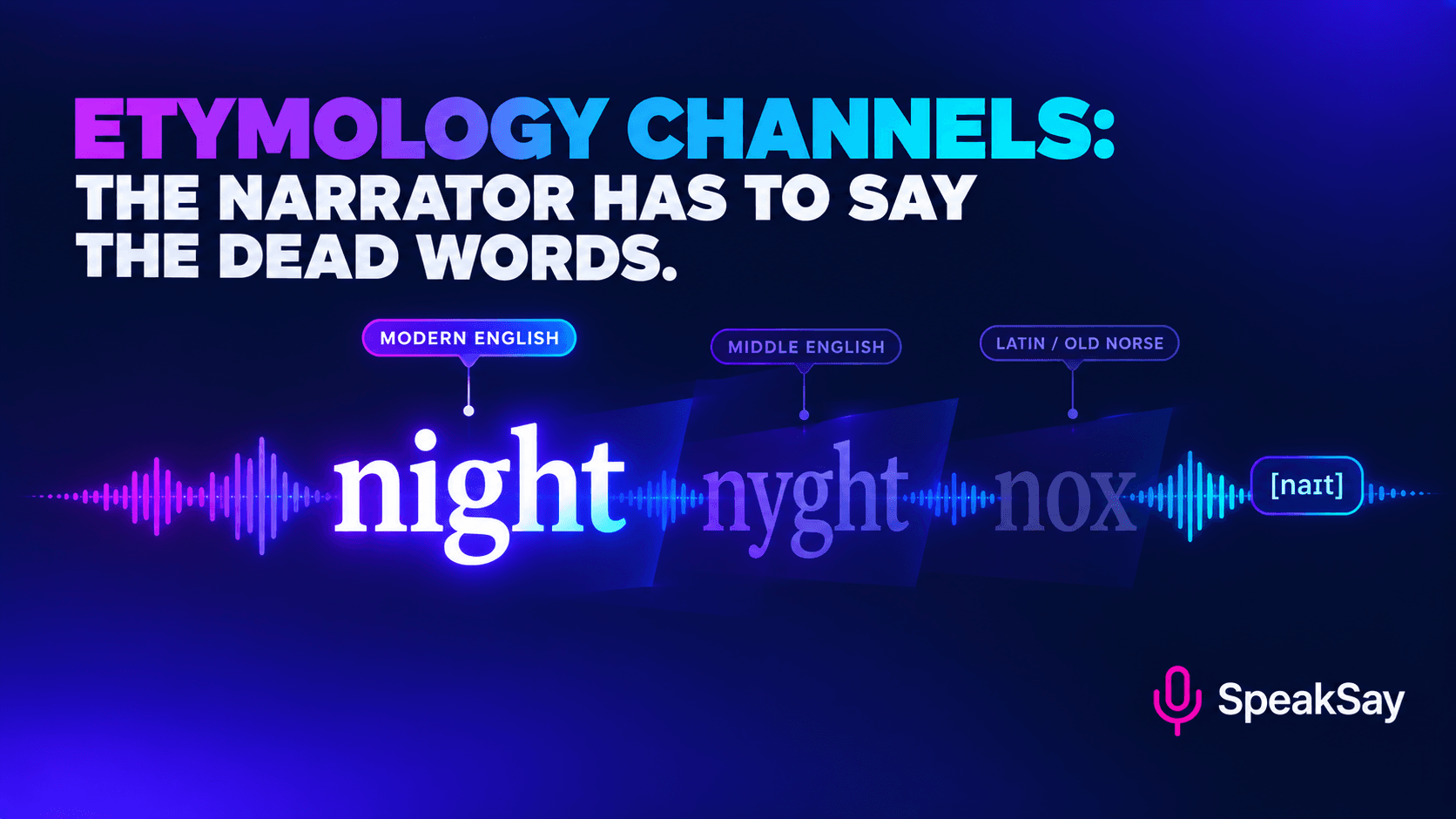
1. Why etymology is an unusually good faceless niche in 2026
Word-origin content has three structural advantages that most faceless niches don't:
- Infinite, cheap, evergreen inventory. English has roughly a quarter of a million words in current use. Each one has a story. Nothing you publish expires, and the research is public-domain reference work rather than licensed footage.
- Genuinely low visual demand. The subject is words. Typography, maps, manuscript scans and simple motion carry the whole thing. This is one of the few niches where "no face" is not a compromise the viewer notices.
- An audience that shares. "The word salary comes from salt" is a fact people repeat at dinner. Etymology travels through word of mouth in a way that, say, product reviews do not.
It also sits in the safest part of the 2026 monetisation landscape. The platform enforcement wave of the last eighteen months has been aimed at content with no research, no perspective and no editorial work behind it. Etymology is the opposite: the value is entirely in the sourcing and the synthesis. If you cite your references, you are on the right side of every "inauthentic content" rule currently written.
The catch is the one thing that makes it hard, which is also the thing nobody covers.
2. The real problem: your narrator has to say dead words
Here is the sentence a typical etymology video contains, roughly once a minute:
Our word "daughter" descends from Old English dohtor, from Proto-Germanic *duhtēr, and ultimately from Proto-Indo-European *dhugh₂tḗr.
Paste that into any text-to-speech engine, including a good one, and four separate failures happen at once:
| What's in the text | What the engine does | Why |
|---|---|---|
dohtor | Reads it as English orthography — "dock-tor" | The model has one letter-to-sound system and it is modern English |
*duhtēr (asterisk) | Silently drops it, or says "asterisk" | Prose-trained models perform punctuation as prosody, not as characters |
ē, ā, ǣ (macrons) | Ignores the length mark, or garbles the whole word | Diacritics outside the training distribution collapse to their base letter — or worse |
h₂ (subscript numeral) | "H two", or nothing | Subscripts are numerals to a normaliser, not laryngeals |
Three of those four failures are silent. You will not hear an error; you will hear a confident, fluent, wrong reading. That is the defining hazard of this niche: fluency is not accuracy, and the audience for etymology is disproportionately made of people who will notice.
Everything below exists to solve that.
Test a narrator on the hard words first
Before you commit a voice to a channel, run your three worst reconstructed forms through it. SpeakSay's voice library is free to audition, so the test costs nothing but five minutes.
3. Casting the curious-scholar register (not the documentary voice)
The default instinct is to reach for the deep, slow, authoritative documentary narrator — the same voice every history channel uses. In etymology that voice actively hurts you, for a specific reason: the emotional core of the genre is surprise, and gravity kills surprise. "Salary comes from salt" is a delightful fact. Delivered in a trailer voice it becomes a portentous fact, and the viewer's reaction shifts from huh! to okay, and?
Cast for a curious colleague explaining something they find genuinely fun. Concretely:
| Axis | Target | Why |
|---|---|---|
| Pitch | Mid range, not bottom-of-range | Low pitch reads as solemn; you need light |
| Base rate | 145–160 wpm for the story sections | Conversational pace; this is not a memorial |
| Rate on the forms | Drop to 100–115 wpm for any historical word | The word is the payload — give it room |
| Warmth | Medium-high | Cold precision reads as pedantic, the genre's worst failure mode |
| Emphasis density | Low overall, high on the reveal | Contrast is what makes the punchline land |
| Age impression | 30–50 | Old enough to be credible, young enough to sound delighted |
The audition line. Don't audition a voice on generic copy. Use this, and reject anything that fails it:
"The word disaster literally means bad star — from the Italian disastro. When your life fell apart, the ancients thought your star had gone wrong."
You're listening for three things: does disastro come out as Italian or as English mush; does the voice land "bad star" as a small revelation or as another clause; and does the last sentence get a slight softening rather than more volume. A voice that fails any of the three will fail every video you make.
4. The reconstructed-form workflow: getting old sounds out of a modern engine
You cannot make a modern English voice model "speak Old English". You can, however, make it produce the right sequence of sounds, because it is a sound generator and English orthography is only one way to address it. The technique is respelling: you write the historical word the way you want it pronounced, using modern English spelling conventions, and you keep the real spelling on screen.
This is the core split of the entire niche:
- The screen carries the spelling. The viewer sees dohtor, *dhugh₂tḗr, the macrons, the asterisk, the manuscript form.
- The voice carries the sound. The script the engine receives contains DOKH-tor — never the raw form.
A working respelling convention, which you should write down once and never change:
| Target sound | Respell as | Example |
|---|---|---|
| Long vowels (macron) | Doubled or diphthong spelling | hūs → hooss |
| Velar fricative /x/ (the ch in loch) | kh | niht → nikht |
| Initial hr-, hn-, hl- clusters | Split with a hyphen | hring → h-ring |
| Word-initial kn-, gn- (pronounced) | Split with a hyphen | knight → k-nikht |
| Rolled or tapped r | Don't try — use plain r | Engines cannot produce it; a fake sounds worse than none |
| Stress placement | Capitalise the stressed syllable | disastro → dee-ZAH-stro |
| Asterisk (reconstructed) | Delete from the audio script entirely | Say "the reconstructed form" in words instead |
Two rules that save you an enormous amount of grief:
- Hyphens are your main tool. The single most reliable way to stop an engine from applying English letter-to-sound rules to a syllable is to force a word boundary.
k-nikhtworks because the model can no longer see a familiar kn- onset. - Generate historical forms as separate clips. Don't bury the reconstructed word inside a long paragraph generation. Generate the sentence, generate the word alone, and stitch them with a 200–300 ms gap either side. You get to iterate on the hard word without re-rolling three minutes of good narration, and the small gap reads to the listener as the deliberate pause a human scholar would take anyway.
Accept the ceiling honestly. Some sounds are simply not in an English voice model's repertoire — pharyngeals, clicks, most tone contours, the Old Norse and Welsh consonants that make the internet argue. For those, the professional move is to say so on screen ("approximate reconstruction") rather than to ship a confident wrong noise.
Keep one narrator across 300 videos
Etymology is a subscribe-and-binge niche, which makes voice continuity a growth lever rather than a detail. Clone one voice — yours or a designed one — and use it for the whole catalogue.
5. What to do with IPA on screen and in the script
International Phonetic Alphabet notation is the genre's badge of seriousness and its biggest audio trap. /ˈdɔːtər/ pasted into a script produces garbage — sometimes silence, sometimes a spelled-out mess, occasionally a long pause the model interprets from the slashes.
The rule is simple and absolute: IPA is a visual element only. It never enters the audio script.
- Put the IPA on screen, at the moment the narrator says the word, and hold it for at least 1.5 seconds.
- In the script, the narrator says the respelled form, then optionally names the notable symbol in words: "that middle symbol is a schwa — the vowel in the second syllable of sofa."
- Never write "slash daughter slash". Strip every slash, bracket and stress mark from the audio script in a dedicated pass.
Explaining one IPA symbol per video in plain English is, incidentally, one of the highest-retention things this niche can do. It gives the audience a small permanent skill, which is exactly the payload that converts a viewer into a subscriber.
6. Certainty is a claim: the hedging layer
Etymology has a reputation problem online, and it is deserved. A large share of popular word-origin content repeats debunked folk etymologies — the acronym stories, the "posh means port out starboard home" family, the ones that are too neat to be true. If your channel repeats them, the comment section will tell you, and the algorithm will read the resulting engagement pattern as a quality signal you don't want.
The defence is a hedging layer: a scripted distinction between three tiers of claim, each with its own delivery.
| Tier | Script language | Delivery |
|---|---|---|
| Attested and settled | "comes from", "is recorded in" | Full confidence, normal emphasis |
| Reconstructed / probable | "is reconstructed as", "most likely", "linguists propose" | Stress the hedge word, not the claim |
| Folk etymology / disputed | "you'll often hear that… but the evidence doesn't support it" | Flat, unexcited on the myth; energy on the correction |
That middle row is the technique most creators miss. If your narrator says "most likely from Proto-Germanic" with the stress on Proto-Germanic, the hedge disappears acoustically and you have made a confident claim you didn't intend to make. Stress the hedge. It's the same sentence with a different meaning.
Two more practices that cost nothing and buy a lot:
- Name your sources in the audio, not just the description. "The OED dates it to 1387" is one second of script and it changes how everything around it is heard.
- Run a debunk segment. A recurring 30-second "myth of the week" is the cheapest credibility asset in the niche, and it reliably outperforms the main segment on shares.
7. Formats that work, and the two that don't
| Format | Length | Why it works |
|---|---|---|
| Single-word deep dive | 6–10 min | One word, full descent, one surprise per 90 seconds |
| "Ten words that come from X" | 8–14 min | Family structure (Norse, Arabic, Sanskrit) makes a satisfying whole |
| Semantic drift stories | 7–12 min | Nice meant ignorant; awful meant awe-inspiring — the narrative arc is built in |
| Myth debunk | 4–8 min | Highest share rate; strongest credibility signal |
| Shorts: one word, one reveal | 25–40 sec | Hook is the payoff itself; put the surprise at second three |
| Sound-change explainers | 10–15 min | The Great Vowel Shift; heavy respelling work but high authority |
The two that don't:
- Full readings of historical texts. Beowulf in Old English is the most requested thing in your comments and the one thing a modern voice model genuinely cannot do. A minute of respelled Old English is a stunt; ten minutes is an endurance test that will get picked apart. Use short quoted passages, clearly labelled as approximations.
- Live pronunciation coaching. "Repeat after me" formats put the narrator's accuracy under a microscope for the entire runtime, with the viewer's own mouth as the comparison. The risk-to-reward is terrible.
8. Build the channel lexicon before video one
Every niche playbook ends here for the same reason: consistency across the catalogue is what separates a channel from a pile of videos. In etymology it matters more than anywhere else, because you will say the same twenty roots hundreds of times, and a viewer who hears Proto-Indo-European pronounced two different ways in two videos will trust you less without being able to say why.
Your lexicon is a single spreadsheet with five columns:
- Form as written (what appears on screen)
- Respelling (what goes into the audio script)
- Source (which reference you took the pronunciation from)
- Confidence (attested / reconstructed / approximate)
- First used in (video and timestamp, so you can re-listen)
Seed it before you publish anything with the fixed vocabulary you'll use constantly: the language names (Proto-Indo-European, Old Norse, Anglo-Norman, Koine Greek), the reference works you cite, and the twenty most common roots in English. That's an afternoon of work that pays out for the life of the channel.
Then add a script-prep step to your process: before generating, search the script for asterisks, macrons, subscripts, slashes and any non-ASCII character, and replace each one according to the lexicon. This single pass eliminates the majority of the silent failures described in section 2.
Get the whole workflow on one plan
Narration, a cloned host voice, remixed character reads for quoted passages and unlimited iteration on the hard words — without per-word credit anxiety.
9. FAQ
Can an AI voice actually pronounce Old English or Latin correctly?Not from the raw text, no. It can produce a close approximation if you respell the word phonetically using modern English spelling conventions and generate it as a separate short clip. Sounds outside English's inventory — rolled r, pharyngeals, some Old Norse and Welsh consonants — are beyond current models, and the honest approach is to label those as approximations on screen.
Why does my narrator skip the asterisk in reconstructed forms?Because prose-trained voice models learned to perform punctuation as prosody rather than say it as a character. Asterisks, macrons and subscript numerals are outside the normal distribution, so they get dropped, flattened or mangled. Remove them from the audio script and say "the reconstructed form" in words, keeping the real notation on screen.
Is an etymology channel safe under YouTube's 2026 inauthentic content rules?It's one of the safer faceless formats, because the value is in research and synthesis rather than in volume. The rules target mass-produced content with no original perspective. Cite your sources on screen, add commentary and structure, and vary your uploads — that is exactly what the policies ask for. This is general information, not legal advice, and platform policies change.
Should I use IPA in my videos at all?Yes, on screen — it signals seriousness and your core audience expects it. Never in the audio script, where it produces garbage. Show the notation, say the respelled form, and explain one symbol per video in plain English.
How long should an etymology video be?Six to ten minutes for a single-word deep dive, eight to fourteen for a themed list. The binding constraint is surprises per minute, not runtime: if you cannot deliver a genuine "huh" roughly every ninety seconds, the video is too long for the material you have.
Do I need a different voice for quoted historical passages?A second, contrasting voice for quotations is one of the highest-value additions in this niche. It removes ambiguity about who is speaking, and it lets you use a slower, plainer read for the quotation without disturbing the narrator's established pace. Contrast on rate and register, not just pitch.


