The EAA Fines Have Started (Up to €900K): How to Add Audio & TTS Accessibility to Your Website, Courses and Docs in 2026
EAA enforcement is live — the first lawsuits were filed in late 2025 and fines range from €60K to roughly €900K. Here's how audio versions and text-to-speech make your website, courses and documents accessible fast, without an agency-sized budget.
1. What the EAA Is — and Who It Actually Covers
The European Accessibility Act (Directive (EU) 2019/882) requires a wide range of products and services sold in the EU to be accessible to people with disabilities. Unlike earlier rules that mostly targeted the public sector, the EAA squarely covers private businesses, including:
- E-commerce websites and apps (any site selling to EU consumers)
- Banking and financial services
- E-books and dedicated reading software
- Audiovisual media services and their apps
- Telecoms, transport ticketing and self-service terminals
Two details catch companies off guard. First, the reach is extraterritorial: a US or UK company selling to EU consumers is in scope, no EU office required. Second, the microenterprise exemption for services (fewer than 10 employees and under €2M turnover) is narrower than most people assume — and it does not exempt products.
2. Enforcement in 2026: Lawsuits, Fines and Who's Being Targeted
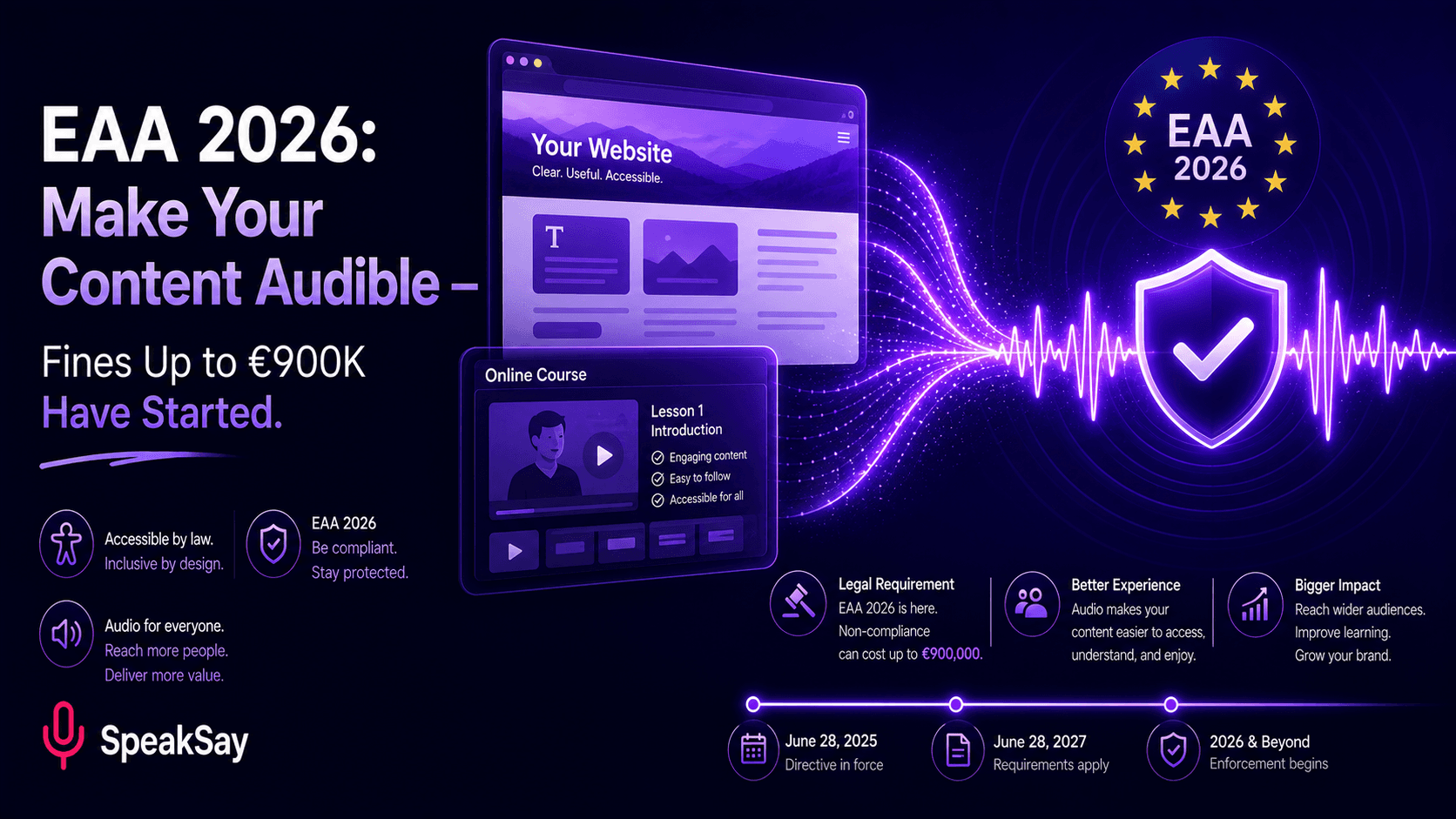
The obligation to comply began June 28, 2025. Through the second half of 2025, most national authorities focused on building enforcement capacity. That grace period is ending:
- The first EAA lawsuits were filed in France in November 2025.
- The Netherlands and several other member states have announced active enforcement programs for 2026.
- Penalties vary by country — from €60,000 in Ireland to approximately €900,000 in Sweden — and authorities can also order products withdrawn, require audits, and publicly name non-compliant organizations.
Being named publicly may sting more than the fine. Accessibility complaints are consumer-driven: any EU customer who can't use your checkout, read your e-book or follow your course can trigger a complaint to their national authority.
3. Where Audio and TTS Fit Into EAA Compliance
The EAA doesn't prescribe a single technology — it requires that information be perceivable through more than one sensory channel. In practice, standards bodies and auditors map this to EN 301 549 and WCAG. Audio shows up in several concrete requirements:
| Content type | What the EAA effectively requires | Audio/TTS solution |
|---|---|---|
| E-books | Must support text-to-speech; content can't block read-aloud | Provide TTS-friendly files or a narrated audio edition |
| Web content & product docs | Perceivable by users with visual impairments or reading disabilities | Audio versions of key pages, guides and FAQs |
| E-learning & instructional video | Alternatives for text-heavy material; captioned and narrated media | Narrated modules, audio summaries of slides and PDFs |
| Customer communications | Accessible support and service information | Spoken versions of onboarding emails, policies, help articles |
Audio is also the accessibility upgrade your other customers will notice. Dyslexic readers, low-vision users, older customers and people who simply prefer listening all benefit — which is why "audio version available" increasingly appears on product pages that have nothing to do with compliance.
Hear what your pages sound like — free
Paste any page, policy or product description into SpeakSay's free text-to-speech tools and hear a natural, human-sounding audio version in seconds. No signup needed to test.
4. Step 1: Audit Your Content for Audio Gaps
Before generating anything, list what an auditor (or a frustrated customer) would actually touch:
- Transactional path: product pages, checkout instructions, shipping and returns policies. These are the pages EAA complaints cite first because they block purchases.
- Legal and support content: terms, privacy policy, warranty info, help-center articles.
- Documents: PDFs, manuals, onboarding guides — the least accessible format on most sites.
- Learning content: course modules, slide decks, workbooks, e-books.
Rank by traffic and by transaction impact. A narrated returns policy protects you more than a narrated blog post from 2019.
5. Step 2: The Audio Remediation Workflow (Website, Courses, PDFs, E-books)
Here's the workflow teams are using to clear an audio backlog in days rather than months:
- Pick one or two consistent voices. Choose a clear, moderately paced voice from SpeakSay's voice library and use it everywhere. Consistency matters for users who rely on audio daily — a familiar voice is easier to process.
- Batch-convert your priority list. Feed each page or document through SpeakSay TTS. Break long documents into chapters so users can navigate by section, mirroring your headings.
- Fix pronunciation once. Brand names, product SKUs and legal terms often need a pronunciation tweak — correct them in the script so every future regeneration inherits the fix.
- Embed with an accessible player. Use a standard HTML audio element near the top of the page with a descriptive label ("Listen to this page"). Screen-reader users should find it in the first tab stops.
- Log everything. Keep a simple register of which pages have audio, generation dates, and voice used. If an authority ever asks, documented effort is your best defense.
For e-learning, narrate at module level and add short audio summaries for each downloadable PDF. For e-books, generate a narrated edition — it doubles as a new sales format on audio marketplaces.
6. Step 3: Don't Forget Multilingual — the EU Has 24 Official Languages
If you sell into multiple EU markets, an English-only audio layer only half-solves the problem. A German customer with low vision needs the German returns policy read in natural German — not a robotic accent pass. SpeakSay's multilingual voices cover the major EU markets, so the same workflow produces native-quality French, German, Spanish, Italian, Polish and Dutch audio from your translated pages. Localize the top transactional pages first; expand from there.
7. Agency vs DIY: What Audio Remediation Actually Costs
Accessibility agencies quote audio narration by the finished minute or per document, and EAA demand has pushed prices up. Rough 2026 market math for a 200-page remediation:
| Approach | Typical cost | Turnaround | Updates when content changes |
|---|---|---|---|
| Human narration via agency | $40–$150 per finished minute; five figures for a full site | Weeks to months | Re-book and re-pay |
| Per-page accessibility vendor add-on | Recurring per-page fees, forever | Days | Included, but costs compound |
| DIY with SpeakSay | One subscription — or a one-time lifetime plan | Hours | Regenerate the changed page in minutes |
The update column is the one that matters. Compliance isn't a one-off project: every policy change and product launch needs its audio refreshed. That recurring reality is why a flat-cost tool beats per-minute billing for most SMBs.
Make your whole site audible for one flat price
SpeakSay's lifetime plan gives you natural AI voices, multilingual output and unlimited regeneration when your content changes — one payment, no per-page fees while your plan's limits last a business lifetime.
8. FAQ
Does the EAA apply to my company if we're not based in the EU?If you sell covered products or services to EU consumers, yes. The EAA applies based on where your customers are, not where you're incorporated.
Is adding audio versions enough for full EAA compliance?No — audio is one layer. You still need the underlying basics (semantic HTML, alt text, keyboard navigation, captions). But audio and TTS support are explicitly relevant requirements, are highly visible to auditors and users, and are among the fastest gaps to close.
Do AI voices count, or does narration need to be human?The requirement is that content be perceivable and understandable — no rule mandates human narration. Clear, natural AI narration meets the need; robotic, hard-to-parse audio defeats the purpose, so voice quality genuinely matters.
What should I remediate first?The purchase path: product pages, checkout help, shipping/returns and support articles. Complaints and lawsuits cluster around content that blocks a transaction.
What are the actual penalties if I do nothing?Fines vary by member state — from €60,000 in Ireland up to roughly €900,000 in Sweden — plus orders to withdraw products, mandatory audits, and public naming. Enforcement activity is increasing through 2026.