Hook Voice vs Explainer Voice: Why the Same AI Voice Fails on Shorts and Long-Form (2026 Voice-Pairing Guide)
The voice that stops a scroll in 2 seconds will exhaust viewers over 10 minutes — and the voice that carries a documentary dies on Shorts. Here's the 2026 voice-pairing framework serious channels use.
1. The One-Voice Problem, Diagnosed
In 2026, YouTube treats Shorts and long-form as parallel monetization systems — separate revenue pools, separate discovery surfaces, and very different retention math. A Short lives or dies on whether the first two seconds stop a swipe; a long-form video lives on whether a viewer is still comfortable at minute eight, when mid-roll ads start paying.
Now consider what one voice has to do to serve both:
- If it's punchy and high-energy enough to survive Shorts, it becomes fatiguing across ten minutes — like being shouted at through an entire documentary.
- If it's a steady, warm narrator that carries long-form beautifully, it opens a Short with the vocal equivalent of "settle in, folks" — and the viewer is gone before the sentence ends.
Creators repurposing long-form into clips feel this most sharply: the exact voice that earned a 55% retention curve on the full video produces clips that die instantly. The fix isn't a "better" voice. It's two voices with defined jobs.
2. What a Hook Voice Does (the First 2 Seconds)
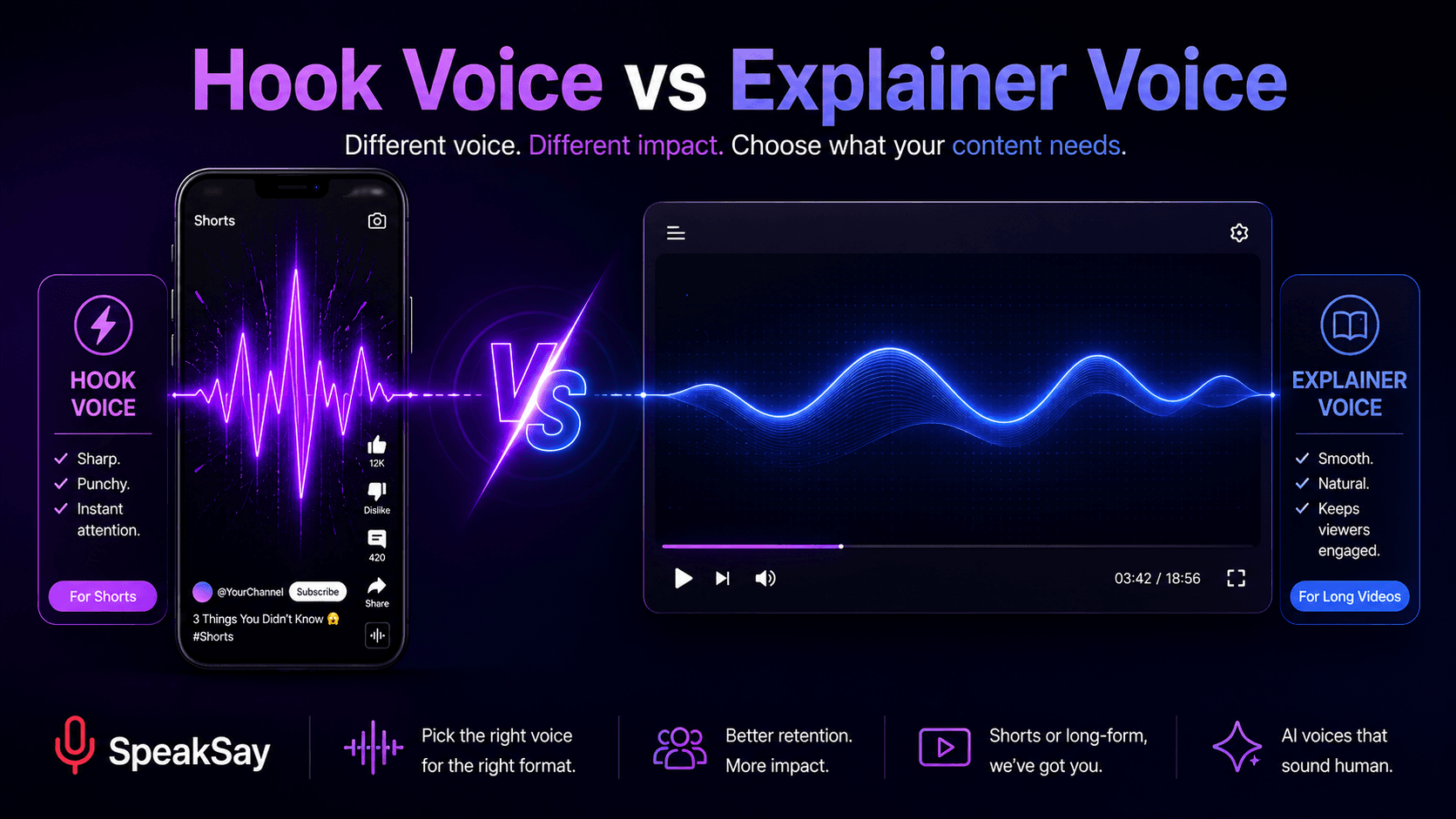
A hook voice is engineered for interruption. Its job is to make a scrolling thumb hesitate. The vocal characteristics that do it:
- High energy floor. Starts at 90% intensity — there is no warm-up sentence in a Short.
- Fast pace: roughly 170–200 words per minute; urgency reads as importance in short-form.
- Bright, forward tone. Higher-mid pitch cuts through phone speakers and ambient noise.
- Hard emphasis. Punches individual words ("This mistake costs you HALF your views") rather than shaping whole sentences.
- Rising inflections. Constantly implies "wait until you hear the next part."
Deployed over 30–60 seconds, this delivery is electric. Deployed over ten minutes, it's exhausting — which is precisely why it must stay in short-form.
3. What an Explainer Voice Does (Minutes 3 Through 15)
An explainer voice is engineered for comfort. Its job is to make continued listening effortless, because in long-form the enemy isn't the swipe — it's fatigue. The characteristics:
- Moderate pace: 140–160 wpm, with genuine pauses that give ideas room to land.
- Lower-mid pitch and warm texture — pleasant through TV speakers and headphones alike for extended sessions.
- Dynamic range in reserve. Mostly even delivery, saving emphasis for the moments that deserve it; contrast only works if there's a baseline.
- Falling inflections at section ends — the audible punctuation that makes a 15-minute video feel organized.
- Consistency over charisma. Across a 20-video binge session, viewers bond with reliability, not fireworks.
4. The Pairing Framework: One Table to Choose Both
| Attribute | Hook voice (Shorts/TikTok/Reels) | Explainer voice (long-form) |
|---|---|---|
| Job | Stop the swipe | Sustain the session |
| Pace | 170–200 wpm | 140–160 wpm |
| Pitch | Bright, higher-mid | Warm, lower-mid |
| Energy | Starts at 90% | Steady 60%, peaks reserved |
| Emphasis | Word-level punches | Sentence-level shaping |
| Failure mode if misused | Fatiguing in long-form | Invisible in short-form |
| Metric it moves | Swipe-through / 3-second hold | Average view duration / mid-roll revenue |
Selection workflow: browse the SpeakSay voice library twice — once explicitly shopping for a hook voice, once for an explainer. Shortlist two candidates per role. Generate the same 30-second script in all four and judge each pair against the table, not against your general taste. Your taste runs long-form; your Shorts audience's thumb doesn't.
Audition both roles free
Test hook and explainer candidates side by side with your own script in SpeakSay's library — before you build a single video.
5. Keeping One Brand Sound Across Two Voices
The obvious worry: won't two voices fracture the channel's identity? Not if they're related. Three ways to keep one brand sound:
- Same family, different register. Pick voices that share texture and accent — like the same host at a party versus at a fireside. Voice remix makes this direct: take one base voice and create a brightened, faster variant for Shorts and a warmed, steadier variant for long-form. Same DNA, two jobs.
- Shared verbal signature. Same catchphrases, same sign-off, same naming conventions across formats — identity lives in words as much as timbre.
- One-way handoff. Shorts end by pointing to long-form ("full breakdown on the channel"). The hook voice makes the promise; the explainer voice keeps it. Viewers experience the switch as "trailer voice vs feature voice" — a pattern film has trained audiences on for decades.
6. The 2-Week Testing Workflow
- Week 1 — Shorts A/B. Publish 6 Shorts: 3 with your current voice, 3 with the hook candidate, matched topics. Compare 3-second hold and swipe-through in analytics.
- Week 2 — Long-form check. Publish one long-form video with the explainer candidate. Look at the retention curve from minutes 2–8 — the fatigue zone — against your channel average.
- Read the right numbers. Hook voice success = higher 3-second hold. Explainer success = flatter mid-video retention. Ignore comments about the voice either way for two weeks; regulars always notice change before they accept it.
- Lock and document. Once a pair wins, save both as presets, note their settings, and stop tinkering — voice consistency compounds; voice churn resets viewer familiarity to zero.
7. Pairing Examples by Niche
| Niche | Hook voice | Explainer voice |
|---|---|---|
| Finance / business | Sharp, confident, fast — headline energy | Composed, credible, measured — advisor energy |
| True crime / mystery | Tense whisper-adjacent urgency | Low, deliberate documentary narrator |
| Tech & AI tutorials | Bright, enthusiastic "you have to see this" | Clear, patient walkthrough voice |
| History / education | Incredulous "nobody talks about this" energy | Warm storyteller with gravitas |
| Health & fitness | Punchy motivator | Calm, trustworthy coach |
Notice the pattern: the hook voice sells the click the way a movie trailer does; the explainer voice delivers the substance. Channels that nail the pair convert short-form reach into long-form watch time — which is where 2026's real ad revenue still lives.
Build your voice pair today
Pick a hook voice and an explainer voice, save them as your channel's presets, and run the 2-week test — a SpeakSay plan covers both formats at full volume.
8. FAQ
Can't I just speed up my long-form voice for Shorts?Time-stretching raises pace but not energy — you get a rushed narrator, not a hook voice. Emphasis pattern, pitch brightness, and inflection matter more than raw speed.
Will switching voices hurt the channel I've already built?Change one format at a time, starting with Shorts (lower switching risk, faster feedback). If your long-form voice already retains well, keep it — this framework often means adding a hook voice, not replacing anything.
Does this apply to TikTok and Reels too?Yes — the hook-voice column applies to all short-form. Instagram's 2026 emphasis on audio retention makes vocal energy in the first seconds even more decisive there.
What if my niche expects one iconic voice (e.g., sleep content)?Some niches are single-register by nature — sleep stories never need a hook voice at Short intensity. There, differentiate by intro pacing rather than voice: a slightly brighter first 5 seconds, then the signature delivery.