Completion Is Not Learning: How to Measure Whether Internal Audio Training Actually Worked (2026)
Audio training reports great completion numbers, and completion tells you almost nothing. Here is a four-level measurement ladder built for audio specifically — played, understood, used, changed — the signals to collect at each level, and the one experiment only cheap-to-regenerate audio makes possible.
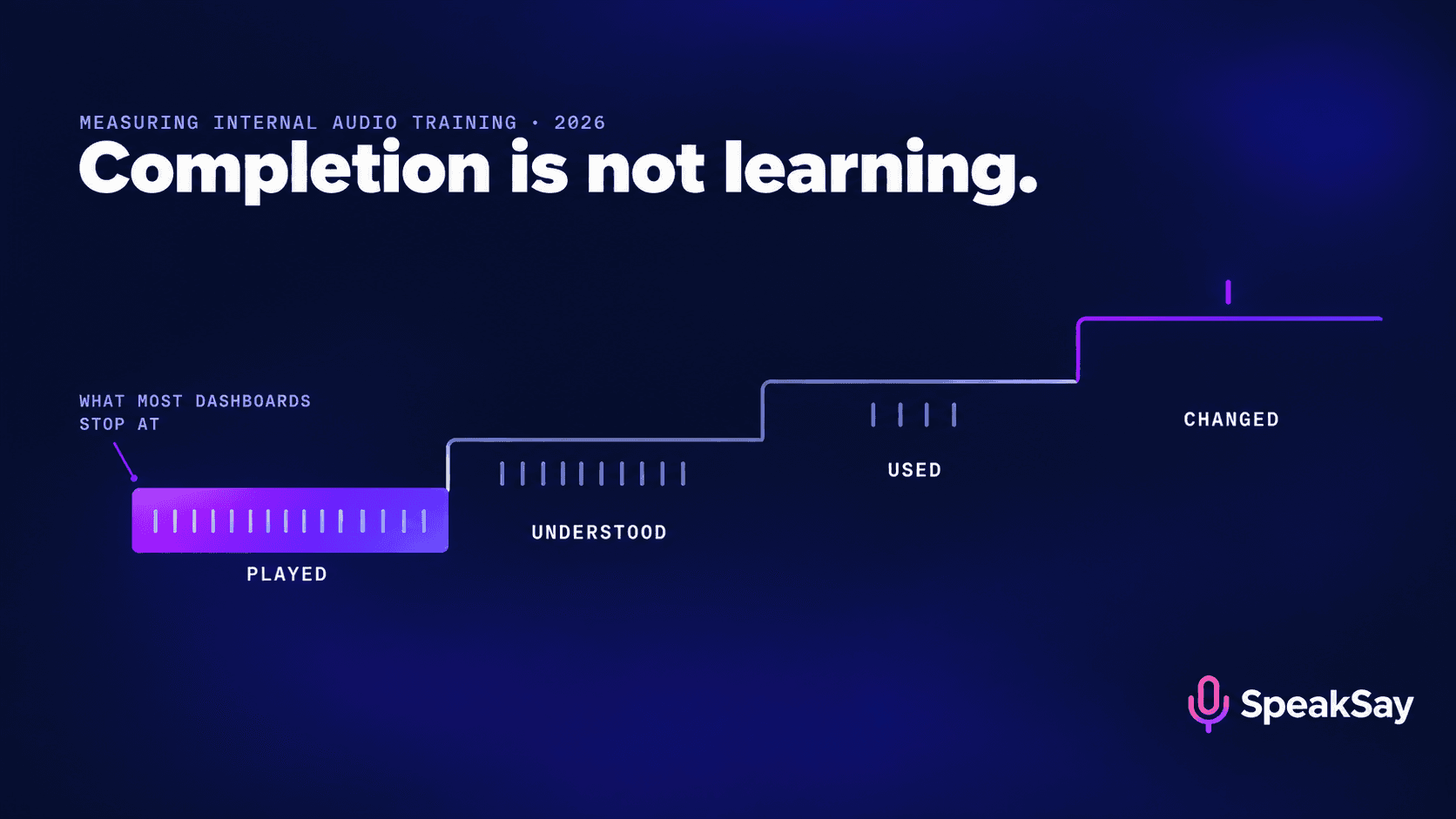
1. Why completion lies more for audio than for anything else
Microlearning vendors routinely quote completion rates of 80–90% for short modules against roughly 30% for long-form e-learning, and retention improvements of 25–60%. Those numbers get pasted into business cases. The problem is not that they're false; it's that completion is the easiest thing in the world to achieve with audio, for three reasons a slide deck doesn't share:
- Audio plays without attention. A video module at least needs eyes on the screen. An audio file finishes in a pocket during a commute.
- Speed controls hide skimming. A 2x listen "completes" in half the time and retains far less.
- Auto-advance inflates everything. Many players roll into the next episode, so completions arrive for content nobody chose to start.
Completion is still worth recording. It just belongs at the bottom of the ladder, not as the headline.
2. The four-level ladder: played, understood, used, changed
| Level | Question it answers | Signal | Cost to collect |
|---|---|---|---|
| 1. Played | Did it reach them? | Starts, drop-off point, playback speed, completion | Near zero (platform data) |
| 2. Understood | Did the key point land? | 2–3 scenario questions after listening | Low |
| 3. Used | Did they come back to it when it mattered? | Voluntary replays, searches, reference plays near the task | Low–medium |
| 4. Changed | Did work change? | An operational metric the episode was meant to move | Medium–high |
If this looks like the classic Kirkpatrick model, it's related, but tuned for audio: level 3 is where audio behaves most differently from other formats, because audio is often consumed at the point of work rather than in a training session.
3. Level 1 — Played: the signals worth keeping
Keep four numbers per episode and ignore the rest:
- Voluntary starts — starts that weren't triggered by auto-advance or a mandatory assignment.
- Drop-off point — the second at which the largest share of listeners stop. If it's in the first 30 seconds, your intro is the problem, not your content.
- Median playback speed — a high median on a safety or compliance episode is a warning, not a compliment.
- Completion — recorded, but reported last.
The drop-off point is the most actionable number at this level. Because regenerating an episode's opening takes minutes, you can rewrite a weak intro the same week you spot it.
4. Level 2 — Understood: questions that test listening, not memory
A quiz after an audio episode is only useful if it tests the thing the episode was for. Three rules:
- Ask scenarios, not recall. Not "What is the lockout procedure's third step?" but "You arrive at the machine and the tag is missing. What do you do first?"
- Two or three questions, no more. Longer quizzes measure patience.
- Write the questions before the script. If you can't write a scenario question for an episode, the episode doesn't have a clear point yet.
Watch for one audio-specific trap: questions that hinge on a number or name the narrator said once. Listeners can't glance back at audio. If a detail must be remembered, the script should say it twice and the episode's show notes should list it.
Turn a procedure document into a short audio episode
Paste the source, choose a voice, and regenerate any line in minutes when the procedure changes.
5. Level 3 — Used: replay and reference as the real signal
Guidance on podcast-based training increasingly points at voluntary replay frequency and long-term reference patterns as the signals that indicate sustained use rather than one-time consumption. This is the level most teams never measure, and it's the most informative.
What to look for:
- Replays weeks after release. A reference episode that's still being played in month three is doing its job.
- Plays clustered near the task. If episode plays spike on shift-start or right before a quarterly process, people are using it as a job aid.
- Search terms that land on the episode. If staff search your library for "refund exception" and pick episode 12, that's use.
- Partial replays of one segment. Repeated plays of a 40-second segment tell you exactly which part people rely on — and which part to lift into its own short file.
This level only works if the library is findable. If you haven't sorted that yet, start with our guide to governing an internal audio library at scale.
6. Level 4 — Changed: tying audio to an outcome
Pick one operational metric per episode or series, before you publish, that the audio is supposed to move. Examples:
| Episode purpose | Outcome metric |
|---|---|
| New returns policy | Returns processed with the wrong exception code |
| Safety procedure refresh | Near-miss reports citing that procedure |
| New-hire onboarding series | Days to first independent shift |
| Product launch briefing | Support tickets escalated for "didn't know about the feature" |
You won't get clean causality — other things change at the same time. What you will get is direction: if the metric doesn't move at all after a well-played, well-understood episode, the content was right but the process around it wasn't. That's a finding worth having.
7. A/B test the audio itself
This is the part that changes when narration stops being a studio booking. With a human narrator, each version of an episode is a new session, so nobody tests versions. With AI narration, a second version is a script edit and a regeneration. That makes a handful of genuinely useful experiments cheap:
- Length: a 3-minute version against a 6-minute version of the same procedure. Compare level 2 scores, not completion.
- Structure: "rule first, then example" against "story first, then rule".
- Voice: two voices from the voice library, one warmer, one more authoritative, on a safety topic.
- Repetition: key number said once against said twice.
Split by team or site, keep everything else constant, run for a few weeks, and keep the winner. Run one variable at a time. The point isn't statistical perfection; it's replacing opinion about "what works for our people" with evidence.
8. A one-page dashboard
Keep the report to one page per series, in this order — deliberately putting completion last:
- Outcome metric (level 4) and its trend since release.
- Voluntary replays and reference plays in the last 30 days (level 3).
- Scenario-question pass rate, per question (level 2).
- Drop-off point and median playback speed (level 1).
- Completion rate.
- Actions taken: what was rewritten, regenerated or retired this month.
Line six matters. A measurement system that never produces an edit is just reporting.
Rolling this out across teams?
Organisation-wide libraries need consistent voices and quick regeneration — compare plans for team use.
9. FAQ
Is completion rate a useful metric for audio training?It's useful as a reach check, but it's weak evidence of learning, because audio can play to the end without attention, at high speed, or via auto-advance. Report it alongside comprehension, reuse and an outcome metric.
How do you test comprehension after an audio lesson?Two or three scenario questions that ask what the listener would do in a realistic situation, written before the script. Avoid questions that hinge on a detail said only once.
What is the best signal that audio training is being used on the job?Voluntary replays long after release, especially clustered around the moment the task happens. That pattern means the audio is working as a job aid, not just as a one-off lesson.
Can you A/B test training audio?Yes, and AI narration makes it practical: a second version is a script edit and a regeneration. Test one variable — length, structure, voice or repetition — and compare comprehension and outcome metrics.
Where do I start if we have no measurement at all?Pick your most important series, write two scenario questions per episode, choose one outcome metric, and start logging replays. That's enough for a first monthly review.


