Nobody Reads the All-Hands Recap: Turning Internal Comms Into a Six-Minute AI Audio Briefing (2026)
Internal communications teams write thorough, accurate, well-structured updates that a minority of staff open and almost nobody finishes. The problem is not the writing. It is that the only container on offer requires sitting still and looking at a screen — the two things your deskless, commuting and back-to-back-meeting colleagues cannot do.
1. The case, stated honestly — including when not to do this
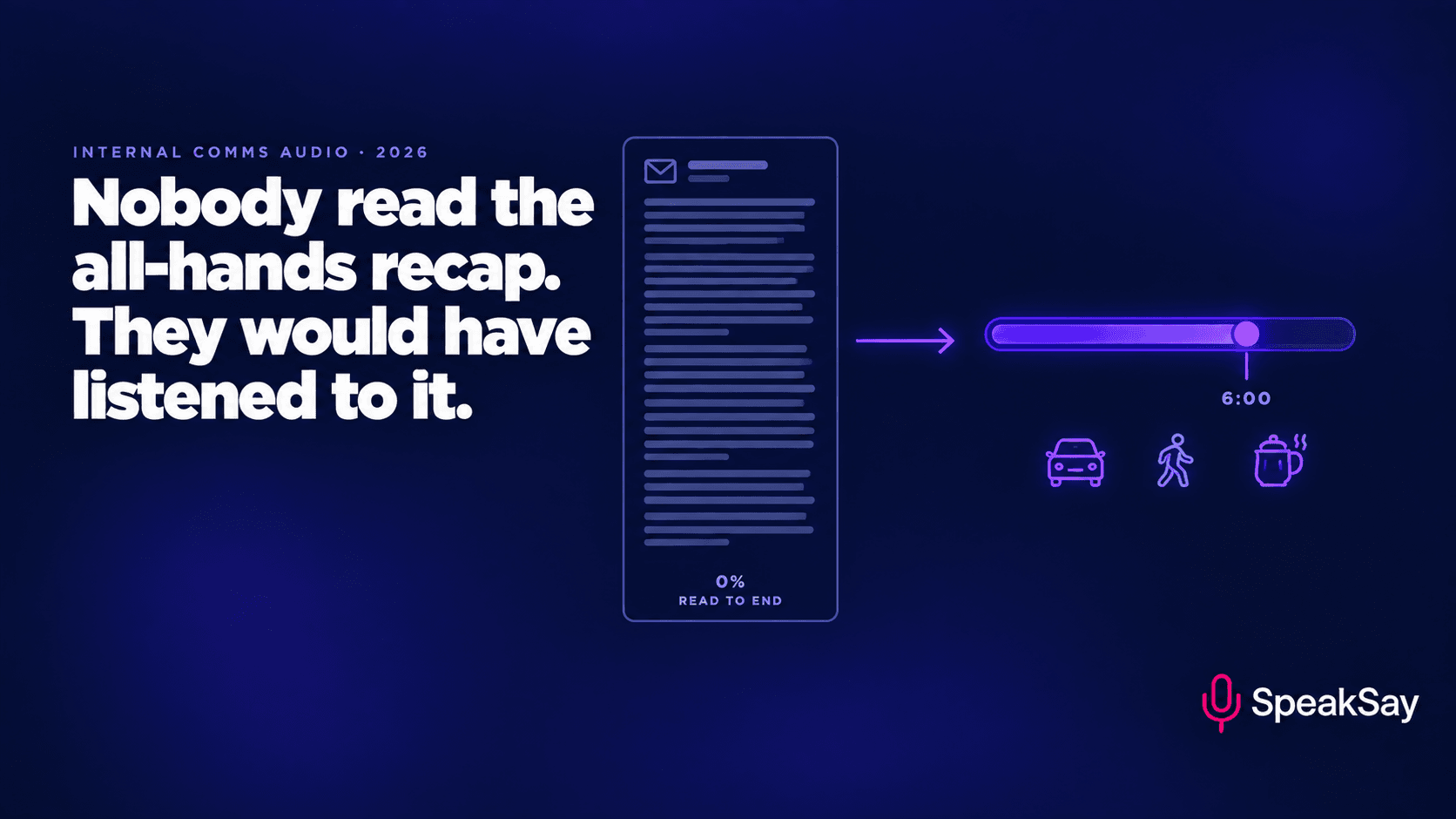
The argument for an internal audio briefing rests on one asymmetry: reading requires a free pair of eyes and a stationary body; listening requires neither. Every organisation has a meaningful population of employees whose working day supplies very little of the first and plenty of the second — field staff, drivers, clinical and retail floor staff, manufacturing, and the entire population of people with a commute.
Three real benefits, in order of how defensible they are:
- Reach into the deskless population. This is the strongest one and it is often the entire business case on its own. If 40% of your workforce does not have a company laptop, your intranet is not a communication channel for them.
- Completion instead of skimming. Audio is linear. A six-minute briefing that someone starts is largely a six-minute briefing they finish, which is a different relationship with the content than a scroll.
- Tone carries. Written internal comms flattens into corporate register because that is the safe default in text. Spoken material carries emphasis and pacing, which means a six-minute briefing can convey priority in a way a bulleted email cannot.
And when not to do it. Being straight about this will do more for your internal credibility than any pilot:
- Do not use audio for anything requiring precision the listener must retain. Policy detail, dates, numbers, entitlements, deadlines, anything actionable. Audio is a terrible reference medium. Point to the document.
- Do not use it for anything sensitive, personal, or bad news. Restructures, redundancies, individual performance matters. A synthetic voice delivering difficult news reads as an organisation that could not be bothered to show up, and it will be the only thing anyone talks about.
- Do not use it if you cannot sustain it. An internal channel that goes quiet after six episodes damages trust more than never starting. This is the most common failure and it is entirely predictable at the point of launch.
The right scope is orientation, not record: what happened, what it means, what is coming, where to read more. The document remains the source of truth. The briefing is the thing that makes people aware the document exists.
2. Format: six minutes, four segments, one voice
Constraints beat creativity here. A fixed structure means production is fast, listeners know where they are, and nobody has to make editorial decisions on a Thursday afternoon.
| Segment | Length | Content |
|---|---|---|
| Cold open | 15 sec | The single most important thing this week, stated as a sentence. No music sting first, no "welcome back to." |
| The three | 3 min | Exactly three items. Each one: what happened, why it matters to the listener, what (if anything) they need to do. One minute each. |
| Coming up | 1 min | Dates in the next two weeks. Always in this slot so people know where to find it. |
| One voice from the business | 1.5 min | A short written contribution from somebody who is not comms — a team, a site, a project. This is the segment that stops it feeling like a corporate feed. |
| Close | 15 sec | Where the detail lives, and how to send something in. Identical every week. |
Three rules that matter more than the structure:
- Six minutes is a ceiling, not a target. A four-minute week is a good week. Padding to a length is how internal podcasts die.
- Exactly three items. Not "three to five." The constraint forces prioritisation, and prioritisation is the actual service you are providing.
- One voice throughout. Resist a two-host conversational format. It doubles the scripting effort, adds nothing for a six-minute briefing, and in a synthetic production the manufactured banter is the first thing employees mock.
3. Writing for the ear when your source is a document
Your input is a written update. That text will not work read aloud, for reasons that are specific and fixable.
What breaks
- Bullet lists. A listener cannot see that a list started, so every item lands with the same weight and the list never resolves. Convert to prose with explicit ordinals: "There are three changes. The first is…"
- Acronyms and internal shorthand. Written comms leans on them heavily. Say the full form first, always, even if everybody supposedly knows it — the person who doesn't is exactly the person you are trying to include.
- Parentheses and subordinate clauses. A sentence with a parenthetical is a sentence with a hole in it when spoken. Split it in two.
- Numbers and dates. Write them as they are said, not as they are typed. "The fourteenth of October," not "14/10." Percentages, currency and large figures all need spelling out or they get mangled.
- Links. You cannot read a URL aloud. Every reference becomes "the full policy is on the intranet under People, Leave" — a navigational instruction, not an address.
The rewrite pass, in order
- Cut to three items. Everything else goes to the written update.
- Rewrite each item as: event, consequence for the listener, action or no action. Three sentences minimum, six maximum.
- Replace every list with a numbered spoken sequence.
- Expand every acronym on first use.
- Split every sentence over about twenty-five words.
- Read it aloud yourself once. Every place you stumble is a place the render will stumble.
That last step is not optional and it takes four minutes. It catches more problems than any amount of settings adjustment.
Turn the written update into a briefing without a studio
SpeakSay converts your rewritten script into a clean, consistent, broadcast-quality briefing in minutes — the same voice every week, with no booking, no recording day and no editing pass.
4. Choosing the voice, and the leadership question underneath it
There is a real decision here and it is more political than technical.
Option A — a neutral presenter voice
A cast voice that belongs to the briefing rather than to a person. This is the right default for most organisations. It is honest, it does not imply the CEO recorded anything, it is trivially sustainable, and it survives the presenter leaving the company. Cast for the organisation you actually are: a calm, mid-register, unhurried voice reads as institutional and trustworthy; an energetic broadcast-promo voice reads as marketing, which will undermine the content.
Option B — a cloned executive voice
Technically straightforward and organisationally fraught. If you go this way, three non-negotiables:
- Explicit, written, revocable consent from the person whose voice it is, specifying what it may be used for and who may trigger a render.
- Disclosure in every episode. One line, every time: this briefing uses a synthetic version of X's voice. Employees finding this out later is a trust incident, and it will be the story.
- A hard scope limit. Routine briefings only. Never for bad news, never for anything an employee could reasonably want to hear said by an actual human, never for anything with legal weight.
Honestly assessed, the cloned-executive route buys less than people expect and costs more. Employees rarely want their CEO's voice reading the parking arrangements; what they want is for the CEO to show up in person for the things that matter. A neutral presenter voice for the routine, and a real human for the significant, is the configuration that holds up.
Either way: lock the settings
Whatever you choose, record the voice, speed and settings in your runbook on day one and do not adjust them by feel. The consistency is the branding, and a briefing whose voice wanders month to month signals an unmaintained channel.
5. The weekly workflow: 45 minutes, start to publish
If this takes more than an hour a week it will not survive a busy quarter. Target 45 minutes.
| Step | Time | Who |
|---|---|---|
| Pull the three items from the week's written update | 5 min | Comms |
| Rewrite for the ear using the six-step pass | 15 min | Comms |
| Collect the "one voice from the business" contribution | 0 min this week | Standing request, collected two weeks ahead |
| Approval | 10 min | One named approver, not a committee |
| Render | 3 min | Comms |
| Listen to the whole thing once | 6 min | Comms — non-negotiable |
| Publish and post the link | 5 min | Comms |
Two things make or break this schedule:
- One approver. Multi-party approval on a weekly six-minute item is how the channel dies. Agree a standing scope with legal and comms leadership up front, then operate inside it with a single sign-off.
- Contributions collected two weeks ahead. Never chase a contribution in the production window. Run a rolling queue of three, and if the queue is empty, drop the segment that week rather than delaying.
Build a template script file with the fixed segments already written. You are filling in three slots, not writing from blank.
6. Distribution inside a company that has no podcast app
This is where most internal audio projects quietly fail. The content is fine; nobody can find it.
Ranked by what actually gets played:
- An audio file posted directly into the channel people already use. Your chat platform, your intranet homepage, your existing weekly email — inline, playable, no click-through to another system. Every extra click loses most of the audience.
- A private podcast feed for anyone who wants it in their podcast app. This serves your commuters, who are your highest-value listeners because they have six free minutes and nothing else to do with them. Private feeds with per-user links exist for exactly this and should be opt-in.
- A downloadable file. Matters more than it sounds. Field and deskless staff may have unreliable connectivity, and a streamed-only briefing excludes exactly the population you built this for.
- Embedded in the mobile employee app, if you have one.
Always publish the transcript alongside. Not as an accessibility afterthought — as a first-class deliverable. It is searchable, it is skimmable for the people who would rather read, it is the record, and it means the briefing shows up in intranet search. Audio that is not accompanied by text is invisible to every search system you own.
Publish on the same day and time every week. Habitual consumption is the entire mechanism. An irregular internal channel gets checked by nobody.
One script in, a briefing and a transcript out
Producing the audio and the text record from the same source in one pass is what keeps a weekly briefing under an hour of effort — and what keeps it findable in intranet search.
7. Governance: approvals, corrections, retention, confidentiality
Get this written down before episode one, not after the first problem. It is a one-page document.
- Scope. What this channel covers and — more importantly — what it never covers. Name the exclusions explicitly: individual performance, restructures, legal matters, anything market-sensitive, anything with a compliance deadline attached.
- Approval. One named approver plus one named deputy. A standing scope agreement means weekly items do not need legal review; anything outside scope does not go in the briefing at all.
- Corrections. Decide now what happens when something is wrong. The workable policy: correct it in text immediately, correct it verbally in the next episode, and only re-render and republish the audio if the error is materially misleading. Never silently replace a published file — note the change in the transcript.
- Confidentiality. Audio files get forwarded more easily than intranet pages, and a downloadable file can leave the organisation. Assume anything in the briefing may become external. This is a reason to keep the scope to orientation rather than detail, and it is another argument against putting an executive's cloned voice on it.
- Retention. How long episodes and transcripts stay available, and where. Treat the transcript as the record and the audio as a delivery format.
- Disclosure. State somewhere permanent and findable that the briefing is AI-narrated. Not in every episode if the voice is a neutral presenter voice, but in the channel description. If the voice is cloned from a real employee, in every episode.
This is general guidance on how to structure an internal channel, not legal or employment advice. Works councils, collective agreements and local employment law can all bear on voice recording and internal communications — check with your own advisers, particularly before cloning any employee's voice.
8. Accessibility is the reason this passes procurement
If you need a budget line, this is the strongest argument available, and it is not a rhetorical one.
An audio briefing with a published transcript improves access for several distinct groups simultaneously: colleagues with dyslexia or other reading differences; colleagues with low vision; colleagues whose first language is not the language of the update, who frequently find spoken material easier to follow than dense written text; and colleagues with no reliable screen access during the working day. The transcript covers deaf and hard-of-hearing colleagues and anyone who simply prefers text.
The combination — audio plus transcript — is what makes it defensible. Audio alone is a substitution, which trades one exclusion for another. Audio plus text is genuine multi-modality, and it is the standard your accessibility team will ask for.
Two practical requirements to include from the start:
- Consistent loudness across episodes, so nobody has to reach for the volume control each week.
- A moderate, stable speaking rate. Resist the temptation to speed up to hit six minutes — cut an item instead. Comprehension for non-native listeners falls off sharply with pace.
If you are in a public-sector body or a supplier to one, digital accessibility obligations may apply to internal communications as well as public-facing content. Worth confirming with your own accessibility lead — it frequently converts this from a nice-to-have into a funded requirement.
9. Measuring it properly, and the 90-day decision
Internal comms measurement is usually bad, and audio makes it easy to be bad in a new way. Two rules.
Rule one: plays are not the metric. Completion is. A six-minute briefing with 300 plays and a 20% completion rate is worse than one with 120 plays and 85% completion, because the second one means 100 people actually received the message. Track completion rate first, unique listeners second, plays never.
Rule two: measure the thing it was supposed to fix. You built this to reach people your written channel was not reaching. So the question is not "is engagement up" but "is engagement up in the deskless population." Segment by employee group or you will learn nothing.
A workable measurement set:
| Metric | Why | Target after 90 days |
|---|---|---|
| Completion rate | The only quality signal that matters | Above 70% — if lower, the format is too long or the items are wrong |
| Unique listeners as % of target population | Reach, honestly stated | Set your own baseline in month one; look for growth, not an absolute |
| Reach within deskless / non-desk groups | The actual business case | Materially higher than that group's email open rate |
| Drop-off timestamp | Tells you which segment loses people | Diagnostic, not a target — act on the pattern |
| Inbound contributions per month | Whether it has become a two-way channel | Any number above zero is a good sign |
The 90-day decision. Commit to twelve consecutive weekly episodes before evaluating, and say so publicly when you launch. Then make an actual decision: continue, change the format, or stop cleanly with an explanation. A channel that is formally ended is respected; one that fades out teaches employees that internal initiatives do not last, which is an expensive lesson to teach.
The drop-off timestamp is the most useful number on that list and the least used. If people consistently leave at 3:40, look at what is at 3:40. Usually it is the fourth item you added because it felt important, and the data is telling you it was not.
10. FAQ
Will employees find an AI-narrated internal briefing off-putting?Generally no, provided two conditions hold: the voice is a neutral presenter voice rather than a clone of a colleague, and the channel is used for routine orientation rather than for significant or personal news. What employees object to is an organisation using synthetic delivery for something that warranted a human — a restructure announcement, difficult news, anything about them individually. For "here are the three things that happened this week," the objection largely does not arise.
How long should an internal audio briefing be?Six minutes as a ceiling, and shorter is better. The binding constraint is the listener's available window — a commute leg, a walk between buildings, a coffee break. Anything over eight minutes competes with content they chose rather than content you sent, and it loses that competition.
Should we clone our CEO's voice for this?Usually not. It requires explicit written consent, per-episode disclosure and a hard scope limit, and even with all three it buys less than people expect — employees do not particularly want their CEO's voice reading routine updates, they want them present for the things that matter. A neutral presenter voice for the weekly briefing, and a real human for anything significant, is the configuration that holds up over time.
Do we need a transcript if we have the original written update?Yes, and it should be a transcript of the briefing rather than a link to the source document. The briefing is a different, shorter, reordered text, and accessibility, searchability and the correction record all attach to the thing that was actually published. It costs nothing to produce alongside the audio.
What is the single most common reason internal audio briefings fail?They stop. A channel that runs six episodes and goes quiet damages credibility more than never launching. Before episode one, confirm you can produce it in 45 minutes a week, that one named person owns it, and that you have a twelve-week commitment — then announce that commitment so the evaluation point is understood by everyone.
How do we distribute audio internally without a podcast platform?Post the playable file directly into the channel employees already open — chat, intranet homepage, or inline in the existing weekly email — and offer an opt-in private podcast feed for the commuters who want it in their own app. Make the file downloadable for staff with unreliable connectivity, and always publish the transcript so the content is findable in intranet search.