The Clue Is Talking: How to Make Scavenger Hunt Audio Clues for Kids With Original Character Voices (Birthdays and Christmas Morning, 2026)
Paper clues need a grown-up to read them, and the grown-up usually knows the answer. This guide shows how to write short clues, give them to an original character with a remixed voice, hide the audio around the house, and avoid the usual problems with volume and noise.
1) Why audio clues work
- Non-readers can play. A four-year-old cannot read "look under the thing that goes up and down," but can hear it.
- No adult in the middle. The grown-up does not have to read each clue, so the answer is not given away by a glance.
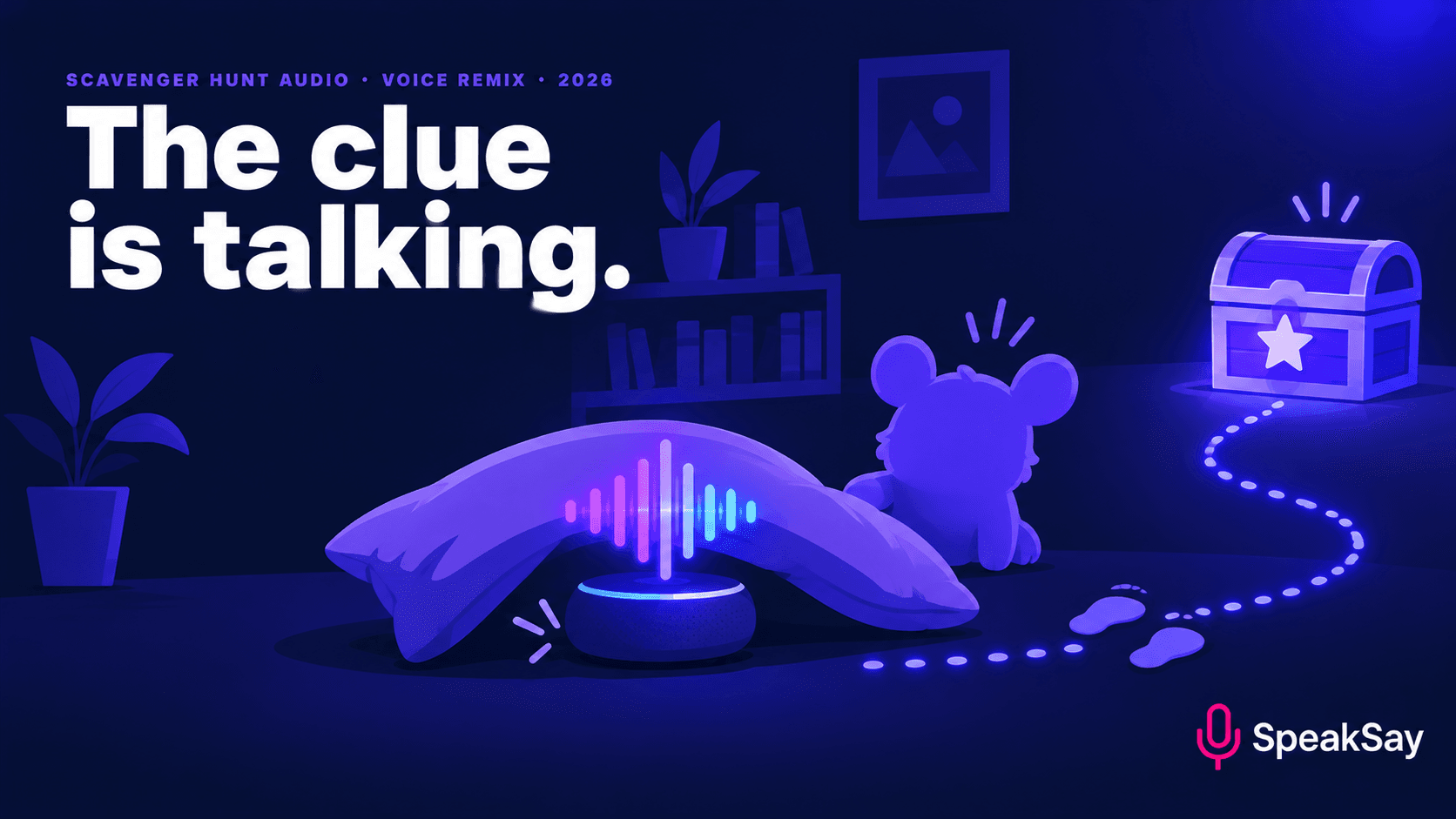
- The surprise is built in. A voice coming from a cushion or a cupboard is half the fun.
- One recording, many tries. Siblings can play the hunt again, or a cousin can play it at the next visit.
It also works for older children if you raise the difficulty. A riddle is harder to solve when it is spoken once than when it is on a card.
2) Invent the character, do not borrow one
Every hunt needs a guide, and children enjoy a character who is a bit silly. Make up your own. Do not use a licensed character or try to sound like a famous one. Beyond the legal and platform issues, an invented character is more fun because your children can help create it.
Give the character a short card:
- Name: Captain Pudding, Professor Mumble, Zibble the Cloud.
- Voice: deep and slow, tiny and fast, or sleepy.
- One habit: always says "Hmm-hmm!" before a clue, or counts to three.
- Goal: what the character wants. "Zibble lost the golden spoon and needs help."
Our birthday voicemail guide goes deeper on character cards.
3) Write clues a child can hear once
Spoken clues should be shorter and simpler than written ones, because a listener cannot reread.
- Two or three short sentences. One idea per sentence.
- Put the hint last. "I'm cold and I keep your milk. Look inside me." Children remember the last words.
- Repeat the key word once. "Look in the fridge. The fridge!"
- Avoid word play children will miss. Puns can work for older children but lose younger ones.
- Add a replay line. "Press the big button to hear me again." Or just let the audio loop once.
| Age | Number of stops | Clue style |
|---|---|---|
| 3 to 4 | 3 or 4 | Very direct: "Look in the bathtub." |
| 5 to 7 | 5 to 7 | Simple riddles and one-step hints |
| 8 and up | 7 to 10 | Two-step riddles and number puzzles |
These are rough guides. Adjust for the children you have.
4) Make the voice and the files
- Record yourself reading each clue, in a quiet room, with a phone. Speak a little more slowly than normal and over-pronounce.
- Open SpeakSay voice remix and turn your recording into your character's voice. Use the same settings for every clue, so the character is consistent.
- Remove any background hum with the free noise remover.
- Even out the volume with the free audio normalizer, so a clue does not shout in a quiet cupboard.
- Name the files in order:
01-start,02-fridge, and so on.
Only remix your own voice or a voice you have clear permission to use. Do not use a recording of someone else without asking them.
Turn your voice into a character
Record the clues, remix them into an invented character, and test them in minutes.
5) Hide the audio
You need a way to play each clue where the children find it. Options, from simplest to most elaborate:
- Old phones or tablets set to play one file on a loop at each stop.
- Small Bluetooth speakers, each paired to a phone that you control from another room.
- One phone you carry, playing the clue when the children arrive at each stop. Less magic, but no extra devices.
- QR codes on paper cards, linking to the audio. Older children can scan them; check that your phone can play the file offline in case the Wi-Fi is weak.
Hide devices where they cannot be knocked over or swallowed by a toddler. Keep batteries and chargers out of reach. Turn off notifications so a message does not interrupt the character.
6) Test it before the kids do
- Walk the hunt yourself with the volume you plan to use. A clue should be clear at arm's length and not audible from the next room.
- Check that each file starts quickly. Add one second of silence at the start if a speaker clips the first word.
- Listen for background noise: a fridge hum or a heater under a clue can hide the key word.
- Ask someone who has not heard the clues to solve them. If they need a second hint, rewrite.
- Have a plan B: a printed list of the answers, so you can steer the hunt if a speaker fails.
7) Two ready-to-use hunts
Christmas morning: "Zibble and the missing sleigh bell"
Five stops from the tree to the kitchen, ending at the stockings or a single bigger present. Zibble is a sleepy cloud who keeps losing things. Each clue ends with "Hmm, hmm, which way did I go?" The last clue says thank you and gives each child a job, such as passing out the presents.
Birthday: "Captain Pudding's cake mystery"
Four stops through the house and garden. Captain Pudding has hidden the candles, and each clue gives a letter. The letters spell the place of the cake. For older children, add a number puzzle at one stop.
For a mystery for adults, see the murder mystery party guide.
Make a hunt you can run every year
Compare plans, including a one-time lifetime option for families who make a new audio game each season.
8) FAQ
Can I use a famous cartoon character's voice?No. Invent your own character. A licensed character raises legal and platform problems, and your own creation is more fun.
Do I need special equipment?No. Old phones, tablets or small speakers work. One phone that you carry from stop to stop is the simplest.
How long should each clue be?Five to ten seconds for young children and up to fifteen for older ones. If a clue takes longer, split it into two stops.
Can children record their own clues?Yes, and it is a good way to involve them. Record their voices with a parent present and remix them into a character if they like.