Your Video Starts Muted: Writing and Casting AI Voiceover for Feeds Where Nobody Hears the First Five Seconds (2026)
Around 75% of mobile video views on Facebook, Instagram and LinkedIn happen with the sound off — and on Facebook it is higher still. Meanwhile 80% of TikTok viewing is sound-on. Cross-posting one edit to both is the mistake. Here is how to write a voiceover that survives being read, and rewards being unmuted.
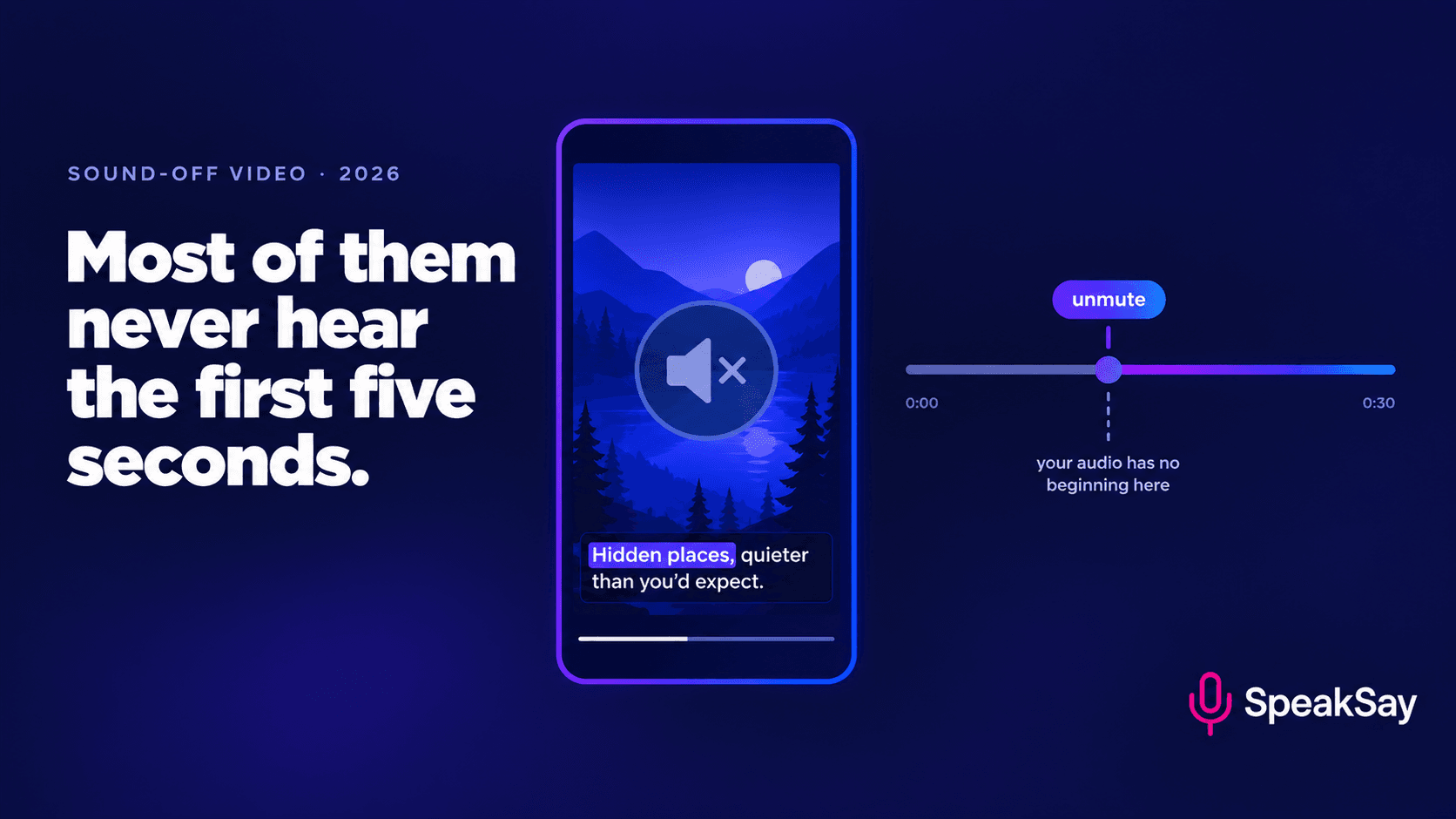
1. You have two audiences, not one
The standard framing is "design for sound-off." It is not wrong, but it quietly assumes a single audience with the sound off, and that assumption produces the two most common failures in social video.
What actually happens on a muted-autoplay platform is a funnel with a fork in it. Everybody arrives muted. Some fraction reads the captions, decides nothing further is required, and either watches to the end or leaves. A smaller fraction decides the thing is worth hearing and unmutes — usually several seconds in, mid-sentence, at whatever volume their phone happened to be set to.
Those are two different products consumed from one file. The muted viewer is reading. The unmuted viewer is listening, and they joined late. Advice that treats them as one audience produces videos where the voiceover simply narrates the captions, which is the failure mode worth naming precisely: if your audio says exactly what the text on screen says, unmuting adds nothing, and the viewer learns that unmuting your videos is not worth doing. That is a lesson they carry to your next video.
The numbers around captions are well established — captioned videos retain viewers around 31% longer, Facebook autoplay-muted video retains about 33% longer with captions added, and captions plus a music bed lands near 43%. Nobody needs convincing to add captions in 2026. The open question is what the audio is for once the captions are doing the informational work, and almost nothing written about sound-off video answers it.
2. The unmute moment: your audio has no beginning
Here is the structural fact that reorganises everything else. When someone unmutes, they do not restart the video. They tap the speaker icon and audio begins from wherever the playhead is — three seconds in, eleven seconds in, mid-clause, mid-word.
Every piece of voiceover craft you have ever read assumes a beginning. Hook in the first three seconds. Establish the premise. Set the tone early. None of that reaches the unmuting viewer, because for them your carefully built opening already happened in silence.
Three consequences follow, and they are not intuitive:
- Your script needs multiple entry points, not one. A listener arriving at second nine should be able to orient within one sentence. That means periodically restating the subject instead of relying on pronouns that point backwards to something they never heard.
- Orphan pronouns are the specific bug. "So that's why it matters" is meaningless to someone who arrived two seconds ago. "So that's why the shipping date matters" costs three words and works from a cold start.
- The moment of unmuting is itself an audio event. Whatever is playing when they tap is their first impression of your channel's sound. If that happens to be a low-energy connective phrase, you made your worst three seconds the ones they heard first.
The practical design move is to think of a 60-second script as three or four self-orienting segments rather than one continuous argument. This is not the same as making it choppy — the segments still flow for someone watching from the top. It just means no segment depends on having heard the one before it.
3. The script has to work as text and as speech
On a muted platform, your voiceover script is not primarily a voiceover script. It is the source text for your captions, which is what the majority of your audience actually consumes. And the two registers pull in opposite directions.
Good spoken writing is redundant on purpose. It restates, it uses connective filler to give the ear a moment ("so", "here's the thing", "now"), it prefers short clauses with breathing room. All of that is correct for listening and reads as padding on screen, where the eye takes a caption card in at a glance and immediately notices words doing no work.
Good written writing is dense and precise. It uses subordinate clauses, parentheticals and exact numbers. All of that is correct for reading and is difficult to follow by ear at conversational pace.
| Element | Works spoken | Works as captions | Resolution |
|---|---|---|---|
| Connective filler ("so", "now", "look") | Yes — gives the ear a beat | No — visible padding | Cut it from the caption file, keep it in the audio |
| Exact figures | Poorly — hard to hold by ear | Yes — easy to read | Say the rounded version, caption the precise one |
| Long subordinate clauses | No | Yes | Split into two sentences; both registers improve |
| Repetition of the subject | Yes — aids the late joiner | Tolerable | Keep it; this is the re-entry mechanism |
| Rhetorical questions | Yes | Weak — reads as filler | Use sparingly, and only where the answer is immediate |
| Lists | Three items maximum | Five or more fine | Speak three, show five on screen |
Read the resolution column and notice how many rows resolve to decouple the two. The default workflow — auto-generate captions directly from the voiceover, burn them in, publish — welds the two registers together and guarantees one of them is compromised. Generating captions from the audio is the right starting point; treating the result as final is not. Ten minutes editing the caption file so it reads well as text, while leaving the audio alone, is the single highest-return habit in this whole article.
Generate the voiceover, then tune the captions
Render narration from your script, pull a transcript, and edit the on-screen text separately so both versions land.
4. What audio adds that captions cannot
If the captions carry the information, the audio has to justify itself on something else. There are exactly five things it can offer, and knowing which one you are relying on tells you what to write.
- Attitude. Text is flat. Dry, warm, sceptical, amused, urgent — tone is carried almost entirely by voice and is the most common reason someone unmutes and stays.
- Emphasis. Which word in the sentence matters. Captions can bold a word; speech does it continuously and with far more gradation.
- Pace as meaning. Slowing before a number, speeding through a caveat, stopping dead before a reveal. Reading speed is controlled by the viewer; speaking speed is controlled by you, and it is a directing tool captions do not have.
- Everything that is not speech. Music, ambience, sound effects, silence. A well-placed sound effect is the strongest single argument for unmuting that exists, because it is instantly obvious the muted version was missing something.
- Identity. A consistent voice is channel recognition. Over repeated exposure, a recognisable narrator is how a feed viewer knows it is you before they read the handle.
Item 4 is under-exploited and cheap. If your muted viewer sees a visual beat land with no accompanying sound, and your unmuted viewer hears a crisp effect on the same frame, you have created a real, discoverable difference between the two versions — which is how you teach people that your videos are worth unmuting. That is a long-game asset and it compounds across a channel.
Item 1 is where the script actually changes. A narration written to convey information will be redundant against captions. A narration written to convey a position on the information will not be. "Shipping times went up 40%" is caption work. "Shipping times went up forty percent, which nobody is going to mention on the product page" is voice work.
5. The platform split, and why one edit fails both
The sound-off statistic is a platform property, not a general truth about humans, and the variance is enormous.
| Surface | Default audio state | Primary job of the voiceover | Biggest mistake |
|---|---|---|---|
| Facebook feed | Muted, and mostly stays muted (85%+) | Reward the minority who unmute; carry tone | Putting essential information only in audio |
| Instagram feed / Reels | Mixed — feed leans muted, Reels leans sound-on | Work either way; strong re-entry points | Assuming Reels behaves like the feed |
| Heavily muted — often watched at a desk in an office | Credibility and tone; captions do the work | Conversational filler that reads as padding on screen | |
| TikTok | Sound-on (around 80%) | Carry the whole thing; audio is the medium | Treating it as a muted platform and under-writing the audio |
| YouTube Shorts | Sound-on by default | Carry the whole thing | Burning in captions sized for a feed rather than a player |
| Embedded on a website | Muted by browser policy | Reward the click-to-unmute | A cold open that only makes sense with audio |
The cross-posting failure works in both directions and both are common. Sending a TikTok-native edit — audio-led, captions as decoration, jokes that live in the delivery — to Facebook produces a video that is incoherent to 85% of the people who see it. Sending a Facebook-native edit — self-sufficient captions, audio that merely narrates them — to TikTok produces a video that is redundant to an audience that is listening, and redundancy on TikTok reads as low effort.
The cheap fix is not two separate productions. It is one render of the voiceover plus two caption treatments and two openings: a caption-led opening for the muted surfaces, and an audio-led opening for the sound-on ones. Ten minutes, not two hours.
6. Casting a voice for a phone speaker at half volume
Two constraints stack here, and they push in the same direction.
The first is hardware: a phone speaker reproduces very little below roughly 400–600 Hz, so the deep, authoritative narrator voice that sounds magnificent on your monitoring headphones arrives thin and distant on the device your audience is actually holding. The second is the unmute context: people unmute at whatever volume their phone was already on, which is frequently low, and often in a room with other noise. Your voice has to be intelligible on its first syllable at low volume through a small transducer.
What that implies for casting:
- Prefer mid-range voices over deep ones for muted-first platforms. The character you lose is less than the intelligibility you gain.
- Prioritise consonant clarity over warmth. Warmth lives in frequencies the speaker will not reproduce; clarity lives in the 1–4 kHz band, which it will.
- Cast slightly more energetic than feels right on headphones. Small speakers at low volume flatten perceived energy, and a voice that is "pleasantly calm" in your edit is inert in a feed.
- Audition at arm's length, at 30% volume, with something else playing in the room. If you cannot follow it, your audience will not either.
- Keep one voice across the channel. Identity is one of the five things audio offers that captions cannot, and it only works through repetition.
Two production notes that matter more than voice choice. High-pass the narration and lift presence in the 2–4 kHz region — cutting bass genuinely makes a voice sound bigger on a phone, which is counterintuitive and reliably true. And carve your music bed rather than just lowering it: on a small speaker the music's remaining energy piles into the same narrow band the voice is using, so a bed that sits politely under the voice on headphones will mask it entirely on a phone.
Where a performed take beats a typed one here: the opening seconds on a sound-on platform, and any line where attitude is the whole point. If a line needs a specific delivery you can hear in your head, record it and convert it into your channel voice rather than trying to type your way to the timing.
Find a voice that survives a phone speaker
Audition SpeakSay voices at low volume on the device your audience actually uses — or record the delivery yourself and convert it into your channel's voice.
7. Building re-entry points into a 60-second script
Concretely, here is the structure. A 60-second script becomes four segments of roughly 15 seconds, each of which can be joined cold.
| Segment | Seconds | Job | Rule |
|---|---|---|---|
| Open | 0–12 | Hook the muted scroller with text and image; audio carries tone | Nothing essential exists only in audio |
| Re-entry 1 | 12–28 | Restate the subject in full; deliver the first substantive point | First sentence must contain the noun, not a pronoun |
| Re-entry 2 | 28–45 | The reason to care; the strongest sound design moment | Place your one sound effect or music change here |
| Close | 45–60 | Land the conclusion and the ask | Restate the subject once more before the CTA |
The rule doing most of the work is in the second row: each segment's first sentence names its subject rather than pointing at it. Written out, a segment opening reads "The shipping estimate is the part that changes" rather than "That's the part that changes." Two extra words, and it is the difference between orienting a late joiner and losing them.
The music or effect placement in row three is deliberate. Second 28–45 is roughly where an interested viewer has decided to stay and is most likely to unmute. Putting your one distinctive audio moment there maximises the chance it is heard, and it is the moment that teaches the viewer that your audio is worth having on.
8. The seven-minute pre-publish check
- Watch it muted, all the way through. Do you understand it? If any essential point is missing, it lives only in audio and needs to be on screen. (1 min)
- Read the caption file as text, separately from the video. Does it read like writing or like a transcript? Cut the connectives. (2 min)
- Unmute at three random points. At each, can you tell what the subject is within one sentence? Fix any orphan pronoun you find. (1 min)
- Play it at 30% volume at arm's length with background noise. Is the voice intelligible? (1 min)
- Check the audio-only difference. Name the thing an unmuted viewer gets that a muted one does not. If you cannot name it, your audio is redundant. (1 min)
- Confirm the caption treatment matches the destination. Muted-first platform gets caption-led opening; sound-on platform gets audio-led. (30 sec)
- Check caption position against the platform's own UI. Burned-in text hidden behind an interface element is the most avoidable failure in social video and it still happens constantly. (30 sec)
Step 5 is the one people skip and the one that matters. "What does unmuting get you?" is a question with a real answer or a real problem, and it takes fifteen seconds to ask.
9. The case against all of this
Three honest objections.
The sound-off statistic is a platform average, not your audience. Your analytics may look nothing like 75%. A channel whose audience is committed, subscribed and watching deliberately behaves very differently from the cold feed traffic those figures describe. Check your own retention curves against your caption-on and caption-off variants before restructuring anything.
Muted video is not free. Silent videos have been measured at around 28% lower engagement than sound-on equivalents. The correct conclusion from that is not "sound doesn't matter" — it is that the sound-on viewer is the more valuable one, and that designing everything for the muted majority risks optimising for the audience that engages least. The goal is to serve the muted viewer without making unmuting pointless.
You can over-engineer this. Four re-entry points in a 60-second script is a good default; eight would make it read like a robot restating its topic. Repetition is a tool with a dose, and past a certain point the person watching from the beginning — still the largest single group — starts noticing the scaffolding. If a technique is audible as a technique, it has gone too far.
10. FAQ
What percentage of videos are watched on mute?About 75% of mobile video views on Facebook, Instagram and LinkedIn happen with sound off, with Facebook running above 85%. TikTok is the opposite — roughly 80% of viewing there is sound-on. It is a platform property rather than a universal behaviour, so check your own analytics rather than applying the average.
If most people watch muted, why bother with a voiceover at all?Because the sound-on viewer is measurably the more engaged one — silent views run around 28% lower on engagement — and because audio carries five things captions cannot: attitude, emphasis, pace as a directing tool, non-speech sound, and channel identity. The aim is not to choose between the two audiences but to make sure unmuting is rewarded.
Should my captions be word-for-word from the voiceover?Generate them from the audio, then edit. Spoken writing uses connective filler that reads as padding on screen, and written text uses density that is hard to follow by ear. Cut the filler from the captions, keep it in the audio, and let each version be good at its own job. It is about ten minutes of work per video.
What is a re-entry point and why does my script need them?When someone unmutes, audio begins wherever the playhead already is — usually mid-sentence — so they never hear your opening. A re-entry point is a moment, roughly every 12–15 seconds, where the narration restates its subject by name instead of using a pronoun, so a late joiner can orient within one sentence.
Can I post the same edit to TikTok and Facebook?Not well. TikTok's audience is listening, so an edit where audio merely narrates the captions reads as low effort. Facebook's audience mostly is not, so an audio-led edit is incoherent to the majority. You do not need two productions — one voiceover render with two caption treatments and two openings covers it.
What kind of AI voice works best for muted-first platforms?Mid-range rather than deep, clarity over warmth, and slightly more energetic than sounds right on headphones. Phone speakers reproduce almost nothing below roughly 400–600 Hz, so a deep narrator loses exactly the body that made it impressive. Audition at arm's length at low volume with background noise before committing.
Do captions actually improve retention?Consistently, yes. Captioned video has been measured retaining viewers around 31% longer, autoplay-muted Facebook video around 33% longer with captions, and captions plus a music bed around 43%. The open question in 2026 is not whether to caption but what the audio should do once captions carry the information.
Where should I put my one sound effect?Around the 28–45 second mark of a 60-second video, which is roughly where an interested viewer has committed and is most likely to unmute. A distinct audio moment there is the clearest possible demonstration that the muted version was missing something, and that is what teaches people to unmute your next video.
One voice, every platform
Render narration once, keep the same channel voice across every surface, and re-cut the captions and openings per destination.


