You Translated the Audiobook. Now Price It: Per-Market Pricing and Promotion for Non-English AI-Narrated Editions (2026)
Producing a Spanish or German audiobook edition stopped being a pipe dream in 2026 — AI narration and AI-assisted translation collapsed the cost. Almost nobody then adjusts the price, the promotion or the launch sequence for the market they are selling into, and the edition underperforms for reasons that have nothing to do with the translation.
1. Why copy-pasting your US pricing abroad fails
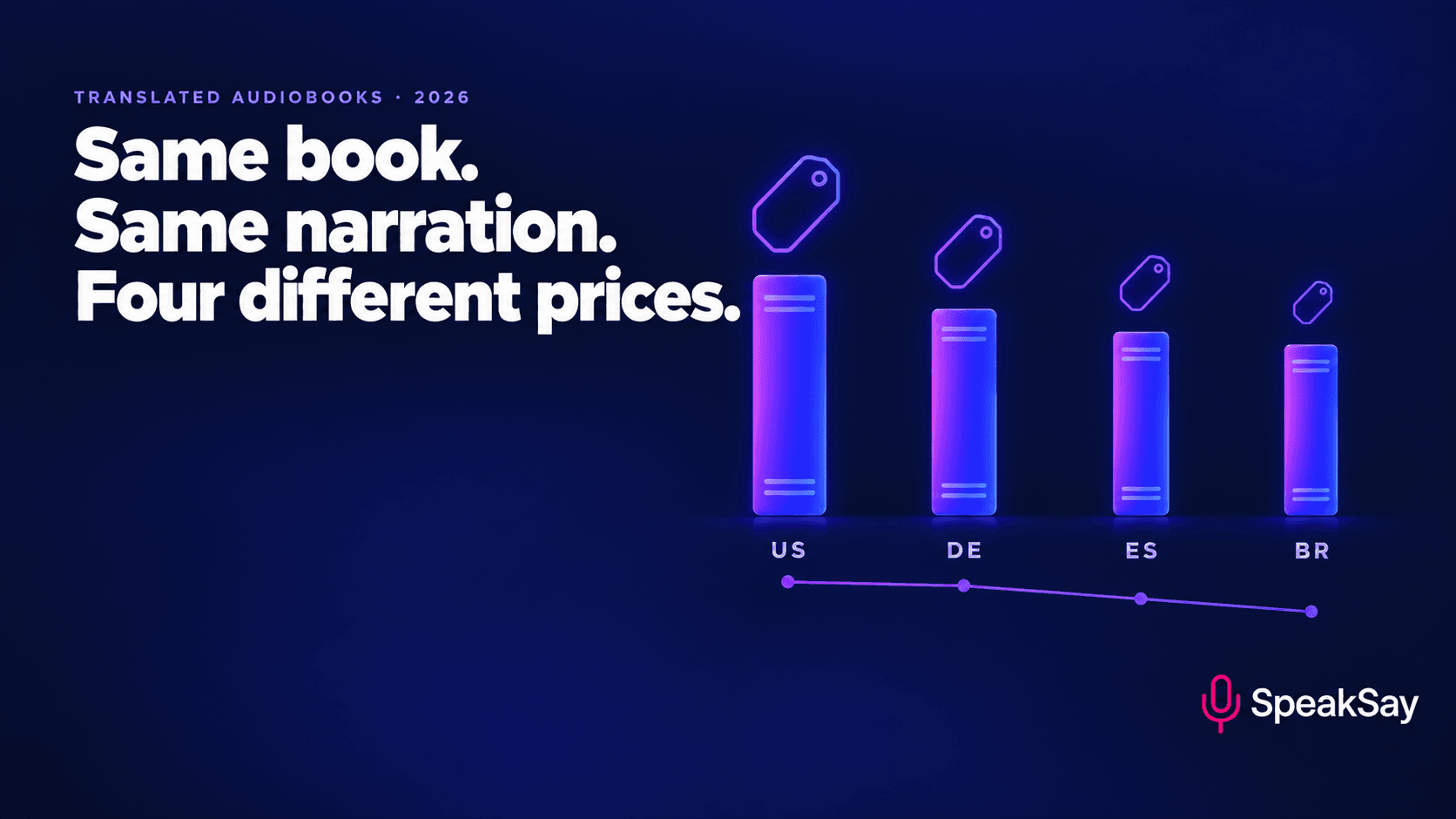
Most retailers will happily take your US list price and convert it. That is the default, it requires zero decisions, and it is wrong in most markets for three separate reasons.
Reason one: the reference price is different. A listener does not evaluate your price against a currency conversion. They evaluate it against the last three audiobooks they saw in that store. If the typical local comparable sits well below your converted price, you are not "premium" — you are mis-shelved.
Reason two: the psychological price points are different. A price that converts to €18.34 reads as a machine output. Every market has its own set of prices that read as prices, and they are not translations of each other.
Reason three: purchasing power is not uniform, and neither is audiobook maturity. A market where audiobooks are a five-year-old habit prices differently from one where they are a twenty-year-old habit, independently of income.
The underlying error is treating the translated edition as the same product sold elsewhere. It isn't. It is a new product, in a market you have no data on, competing against a catalogue you have never looked at.
2. The three questions that set the price
Before you look at a single competitor, answer these. They determine which of the pricing strategies below applies, and they are more important than any number in this article.
- Is this edition a profit centre or a discovery channel? If you are trying to earn out a translation cost, you price for margin. If you are trying to establish a readership in a market where nobody knows your name, you price for trial and earn later on the series. These pull in opposite directions and you cannot do both in the first edition.
- Is there a translated ebook or print edition already selling there? If yes, you have real demand data and a real price anchor, and the audiobook should sit in a known ratio to it. If no, the audiobook is doing the market-entry work alone, which is the harder job and argues for a lower entry price.
- Is the book time-sensitive? Nonfiction tied to a current moment has a short window and should be priced to move now. Fiction and evergreen nonfiction can be priced for the long tail, because the long tail is where translated editions actually earn.
Write the answers down. Most bad pricing decisions are a failure to have decided which of these you were optimising for.
Produce the edition before you agonise over the price
A translated audiobook you never make earns nothing at any price. SpeakSay's multilingual narration lets you produce a full-length non-English edition from your translated manuscript without hiring a narrator per market.
3. Market-by-market price anchors and how to find them yourself
Published figures go stale fast, and the number you need is not an industry average — it is the price of the ten books a listener sees next to yours. So the method matters more than any table. Here is the method, and it takes about twenty minutes per market.
The twenty-minute anchor exercise
- Open the retailer's local storefront, not the US one with a currency toggle. The catalogue and the merchandising are genuinely different.
- Find the category your book sits in. Not the one you wish it sat in — the one a browsing listener would reach it from.
- Note the list price of the ten bestsellers in that category, excluding anything by a globally famous name.
- Note the length of each in hours. Price-per-hour is the comparison listeners make implicitly, and it varies hugely by market.
- Note how many of the ten are included in the platform's subscription tier rather than sold outright. This is the single most useful number you will collect, and section 4 explains why.
You now have three things: a price band, a price-per-hour band, and a subscription-penetration figure. That is more market intelligence than most indie authors have for their home market.
The general shape of the answer
Without pretending to per-country precision that would be out of date by the time you read it, the recurring pattern across 2026 markets looks like this:
| Market type | Typical position vs your US price | Why |
|---|---|---|
| Mature, high-income, high audiobook penetration | At or slightly above | Established willingness to pay; strong local competition on quality, not price |
| Mature, high-income, subscription-dominated | List high, expect most revenue from subscription streams | List price is a signal, not a transaction, for most listeners |
| Growing market, mid-income | Meaningfully below | Category is still recruiting listeners; price is a trial barrier |
| Large-population, price-sensitive | Well below, priced for volume | Absolute price ceiling is low; a "reasonable" converted price reads as luxury |
Note what is not in that table: a formula. Anyone giving you "multiply by 0.8 for Europe" is selling you a shortcut that will cost more than it saves.
Price-per-hour is the number that travels
If you want one portable heuristic, use price-per-finished-hour rather than price. Listeners in every market intuitively value length, and a long book priced like a short one looks suspicious rather than generous. Calculate your local comparables' price-per-hour, then place yourself inside that band rather than at the edge of it — unless you are deliberately using price as a market-entry lever, in which case sit just below the bottom of the band, not at half.
4. Subscription versus à la carte: a different decision in every market
This is the decision that actually determines revenue, and it is the one most often made once and applied everywhere.
In a market where most listening happens inside a subscription, your list price barely functions as a price. It functions as a positioning signal, and your revenue comes from consumption-based payouts. In a market where à la carte purchase still dominates, the list price is the whole transaction.
The practical consequence: the same book can rationally be exclusive in one market and wide in another, and can rationally be priced high in a subscription-heavy market and low next door. Authors resist this because it feels inconsistent. It is not inconsistent; it is responsive.
Things to check per market before you decide:
- What share of your anchor-exercise bestsellers were subscription-included? Above roughly half, treat the market as subscription-first.
- Does the platform's subscription tier operate in that country at all? Availability is not uniform, and this changes more often than you would expect.
- Does exclusivity in that market cost you the local library channel? In several European markets, library lending is a genuinely significant discovery route and exclusivity closes it.
- Are there strong local-language platforms you have never heard of? Almost always yes. The dominant audiobook app in a given country is frequently not the one that dominates in English.
That last point is the one that costs authors the most. Distributing a Swedish, Polish or Brazilian edition only through the global storefronts you already use is like publishing an English book exclusively on a platform with eight percent market share.
5. Choosing which markets to enter, and in what order
Do not do four at once. Do one properly, learn the pattern, then repeat. Rank candidate markets on four signals, in this order of weight:
- Existing demand evidence. Where is your English edition already being bought by non-native speakers? Where does your site traffic come from? Where do you get emails asking for a translation? This beats every market-size statistic.
- Audiobook market maturity. A large country with a small audiobook habit is a worse first bet than a mid-sized country where audiobooks are normal.
- Genre fit. Genre preferences are not universal. Some categories travel effortlessly; others are culturally specific in ways that are invisible from inside your own market. Check whether your category has a visible bestseller list there at all.
- Your ability to support it. Can you answer a listener email in that language? Can you read your own reviews? If not, you are flying blind on the feedback that would tell you what to fix.
A reasonable first-year plan is two markets, six months apart. Not five markets in a quarter.
One manuscript, several language editions
Once you have the translated text, producing the audio should not be the bottleneck. Narrate each edition in a voice cast for that market rather than a generic multilingual default — it is the difference between a translated book and a local one.
6. Promotion: the four channels that do not transfer
Your English promotion stack is built on relationships and platforms that mostly do not exist in the new market. Here is what breaks, and the realistic substitute.
| What you rely on in English | Why it doesn't transfer | Substitute |
|---|---|---|
| Your newsletter list | Almost entirely English-speaking; the translated edition is irrelevant to 97% of it | One segmented send to subscribers with an IP or stated location in the target market, plus a permanent link in your footer. Do not mail the whole list twice. |
| Review/ARC networks | Reviewers read in English; a translated ARC has no distribution network attached | Local bookstagram and booktok accounts in the target language. Smaller, cheaper, far more responsive than their English equivalents, and genuinely underused by foreign authors. |
| Category/keyword ads | Your keyword research is in English and the translated keywords are not the same concepts | Redo keyword research natively. Translating your English keywords is the single most common wasted ad spend in this whole exercise. |
| Podcast guesting | You cannot guest in a language you do not speak | Written interviews and guest posts for local book blogs, which are still a live format in many non-English markets long after they faded in English. |
The one channel that does transfer: the retailer's own algorithmic surfaces. Categories, keywords, and the also-bought engine work the same way everywhere, which is why the metadata work matters more here than any promotion you can buy. If you have not done per-market metadata, do that before you spend anything on ads.
The sample is your advertisement
In a market where nobody knows your name, the retail sample is doing all the persuasion. Two rules:
- Do not let the sample default to the first five minutes if the first five minutes are front matter, a dedication, or a slow scene-setting opening. Choose the extract.
- Choose it with someone who speaks the language. A passage that lands in English can be flat in translation for reasons of rhythm that you cannot hear.
7. A 30-day launch sequence for a non-English edition
Compressed, sequential, and designed for an author with no local presence.
Days −14 to −1: before it is live
- Finish per-market metadata: title, subtitle, categories, keywords, description — written natively, not translated.
- Choose and cut the retail sample.
- Identify twenty local accounts (bookstagram, booktok, blogs, podcasts) in your genre. Follow them. Read what they post. Do not pitch yet.
- Set the list price from your anchor exercise. Write down why, so that in ninety days you can evaluate the decision rather than your memory of it.
Days 1–7: live, quiet
- Verify the listing renders correctly — accented characters, sort order, category placement, sample playback.
- Segmented newsletter send to the target market only.
- Pitch ten of your twenty accounts with a code, a short note in the local language, and no attachment.
- Do nothing else. Resist paid ads in week one; you have no conversion data to optimise against.
Days 8–21: the only window that matters
- Pitch the remaining ten accounts.
- Start a small keyword ad test — genuinely small, three to five natively-researched keyword groups, enough to learn which concepts convert.
- Ask your first few local reviewers one question: does anything about the narration sound foreign to you? This is the highest-value feedback you will get all year and it is free.
- Fix anything that comes back. A pronunciation issue in a proper noun is a two-hour fix in AI narration and an unfixable embarrassment in traditional production.
Days 22–30: adjust once
- Review conversion rate, not units. Units tell you about traffic; conversion tells you about price and sample.
- If traffic is decent and conversion is poor, the problem is the price, the sample or the description — in that order of likelihood.
- If traffic is poor, the problem is metadata and category, not price. Do not discount your way out of a discovery problem.
- Make one change. Not four. You cannot attribute four.
8. What to measure, and how long to wait before you judge
Translated editions have a slower, flatter curve than home-market launches, and authors routinely kill them before the curve arrives. The reason is structural: you have no existing readership there, so there is no launch spike, only accumulation.
Judge at ninety days, not thirty. And judge on these, in order:
- Conversion rate from listing view to purchase. The single cleanest signal about whether your price and sample are right.
- Completion rate, if the platform exposes it. In subscription markets this is the revenue driver. It is also the only honest verdict on the narration.
- Review sentiment, specifically about the voice. Not the star rating. Read the text. Complaints about narration in a translated edition cluster into three types — pronunciation of names, wrong register for the genre, and pacing — and all three are fixable.
- Revenue per finished hour produced. This is the number that tells you whether to do market three.
What not to measure in the first ninety days: rank, absolute units, and comparison to your English edition. All three will look bad and none of them are informative yet.
9. Six mistakes that look like a translation problem
- Pricing at the converted US price. Reads as expensive in most markets and as suspiciously cheap in one or two.
- Translating your keywords instead of researching them. Concepts do not map one-to-one. The word-for-word translation of your best English keyword is frequently a phrase nobody searches.
- Using one voice for every language. A multilingual model speaking passable Spanish with an English speaker's rhythm is the fastest way to sound like a foreign product. Cast per language.
- Letting the sample default. Free, five minutes of work, and routinely the difference between conversion and no conversion.
- Distributing only through the storefronts you already use. In many markets those are not where listening happens.
- Judging at thirty days and pulling the edition. You paid the production cost already. The marginal cost of leaving it live for a year is zero, and translated editions earn on the tail.
Notice that five of the six are decisions made in an afternoon, and none of them are about the quality of the translation. That is the point of the whole article.
Make the second and third editions cheap
The economics of translated editions only work if production cost falls with each market. A lifetime plan turns per-edition narration cost into a fixed one-time cost — which is exactly the structure this strategy needs.
10. FAQ
Should my translated audiobook cost the same as my English one?Usually not. Price against the local category's bestsellers and the local price-per-finished-hour band, not against a currency conversion of your home price. The listener compares you to the ten books next to you, which are local books at local prices.
Which language should I translate into first?The one with existing demand evidence — traffic, emails, non-native buyers of your English edition — rather than the one with the biggest population. Absent any evidence, prefer a market with a mature audiobook habit over a large market with a small one.
Is AI narration acceptable to non-English audiobook listeners?Acceptance varies by market and by genre, and it is moving. The consistent finding is that listeners object to bad narration rather than to synthetic narration as such, and that the objections in translated editions cluster around mispronounced proper nouns and wrong register rather than around the fact of AI. Both are fixable before launch if you get one native speaker to listen to the first chapter.
Should I go exclusive or wide in a new market?Decide per market, not globally. In subscription-dominated markets exclusivity can pay because most revenue comes through the subscription anyway. In markets where library lending or a strong local platform drives discovery, exclusivity closes your best channel. The anchor exercise in section 3 gives you the number to decide on.
How long before I know whether a translated edition worked?Ninety days minimum, and judge on conversion rate and completion rather than units or rank. Translated editions have no launch spike because you have no existing audience there — they accumulate instead, which looks like failure for the first six weeks.
Do I need a different cover for each market?You need a different title treatment at minimum — the translated title has to be legible at thumbnail size, and translated titles are frequently longer than the original, which breaks a cover designed around a short English phrase. Whether the imagery needs changing depends on genre conventions in that market, which your anchor exercise will show you.