Most of Your Listeners Are Driving: Writing an AI-Hosted Podcast for Divided Attention (2026)
Your drop-off isn't a content problem. A listener glanced at a junction, missed twenty seconds, and couldn't find their way back in — and a synthetic host, whose prosody is uniform by construction, gave them nothing to find their way back with. Here is how to build re-entry cues into a generated show.
1. Where listening actually happens
Almost every piece of podcast craft advice ever written implicitly assumes a listener who is listening. Sitting down, headphones on, attention available, hands free to scrub. That listener exists. They are a minority.
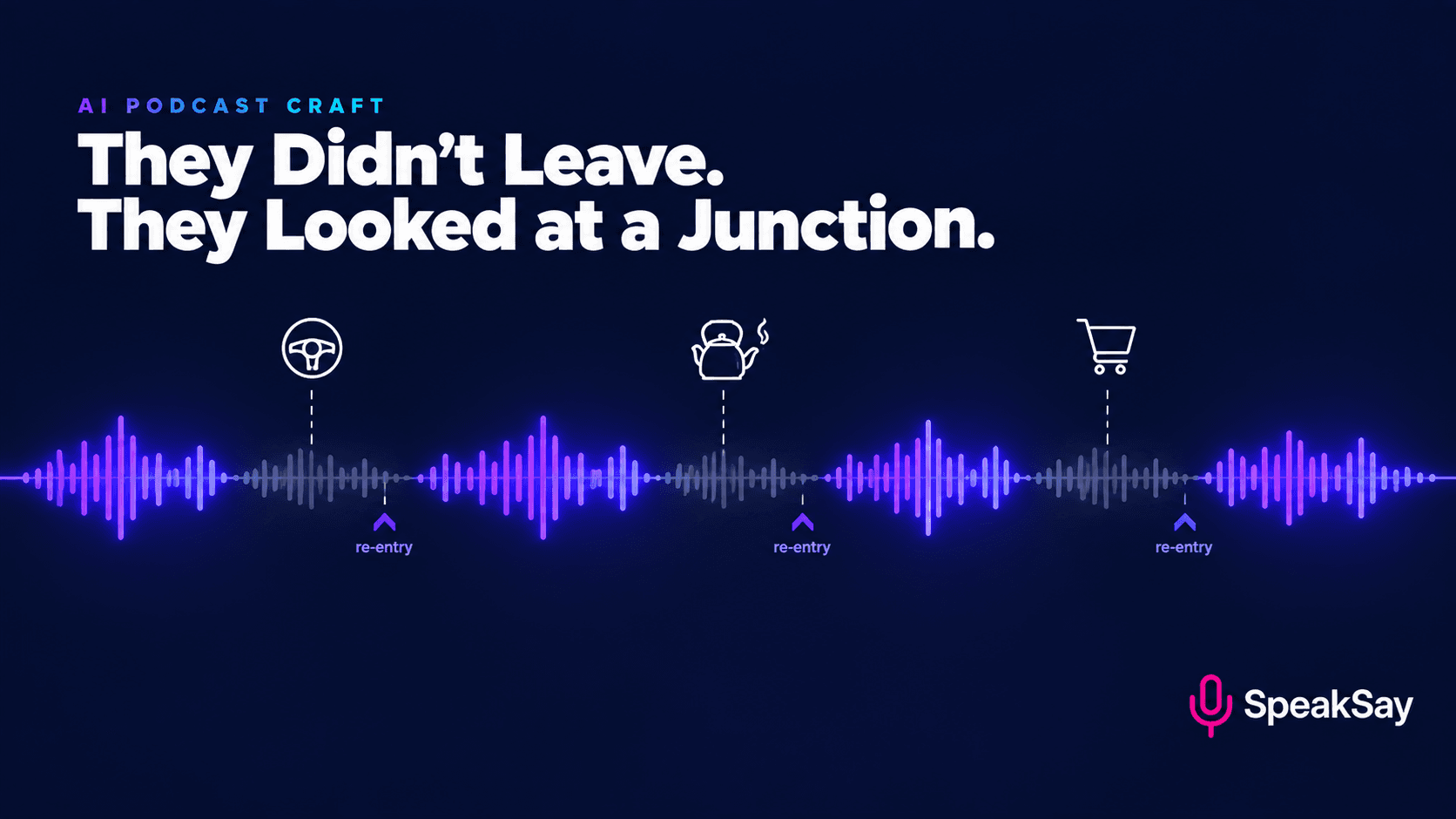
The dominant listening contexts are the car, the commute on foot or on transit, household chores, and exercise. What they have in common is not noise — it is that attention is on loan and can be recalled without warning. The listener does not choose to stop listening. A junction appears, a kettle boils, someone speaks to them, a set finishes. They are gone for five to forty seconds and then they are back.
That single fact reorganises the whole production problem. In particular:
- Retention is not an interest measurement. A listener can be interested and still leave, because they lost the thread and the cost of recovering it was higher than the cost of quitting.
- Scrubbing back is not available. In a car it is genuinely unsafe; on a run it means stopping; with wet hands it is impossible. Assume your listener cannot rewind, ever.
- Your episode is not consumed as one continuous thing. It is consumed as a sequence of segments separated by absences you cannot see and did not put there.
None of this is new. What is new is that a large share of shows are now hosted by generated voices, and generated voices are specifically bad at the one thing that fixes it.
2. The re-entry problem, and why synthetic hosts make it worse
When a human host moves from one idea to the next, they do a dozen things without deciding to. They take a breath in a particular way. Their energy resets. They lean back, which changes the timbre. There is a fractional hesitation before the new idea, and then a slight increase in effort as they launch it. None of this is scripted. All of it is audible.
These are re-entry cues. A returning listener does not need to understand the sentence they land on — they need to know where in the shape of the episode they are. The human host's unconscious signals answer that question continuously, so a listener who has been gone for twenty seconds can hear, within about two seconds, whether they are in the middle of something or at the start of something. That determination is what decides whether they stay.
A generated host produces none of these signals, and the reason is structural rather than a quality gap. Synthesis applies a learned prosodic contour to text. The contour is derived from punctuation and syntax, which means:
- The energy at the start of a new idea is identical to the energy mid-paragraph. There is no reset, because there is nothing to reset — no lungs, no posture, no fatigue.
- Pause lengths are uniform. A full stop gets a full-stop pause whether it ends a trivial aside or a major section. The hierarchy that a human produces automatically has to be authored.
- Dynamics are flatter. The range between the quietest and loudest moments is narrower, which removes the "something is starting" loudness bump.
- It never sounds like it is thinking. The micro-hesitation before a new idea — the single most reliable "new thing incoming" marker in human speech — does not occur.
The result is an episode that is perfectly intelligible sentence by sentence and structurally featureless. A returning listener lands in undifferentiated speech, cannot locate themselves, and quits. And because every individual sentence sounds fine, the producer looking for the problem never finds it.
The fix is not to make the voice more expressive. It is to author the cues the voice will not supply.
Build a show whose structure you control
Script it, render it, place the pauses deliberately — instead of accepting whatever contour a default generator gives you.
3. The re-entry cue inventory
Seven cues, ranked by return on effort. The first three are close to free and will do most of the work.
| # | Cue | How to implement | Cost |
|---|---|---|---|
| 1 | The topic restatement | Every 90–120 seconds, one short sentence that names the current subject in plain words, as if for the first time. "So — why the returns happen in the first week." | Free; a scripting habit |
| 2 | The long boundary pause | 1.5–2.0 s of genuine silence at every idea boundary, against 0.4–0.6 s at sentence boundaries. The contrast is the signal, not the absolute length. | Free; authored, not generated |
| 3 | The rate reset | Drop 8–12% below your default for the first sentence of each new idea, then return. A returning listener hears "this is a beginning" before they parse a word. | Free with a second render preset |
| 4 | The transition mark | A single short non-musical sound — a soft tone, a filtered tick — under the boundary pause. Same sound every time, all episodes. | One-off design |
| 5 | The ordinal signpost | "That's the second of three." Gives a returning listener their position in the episode, which restatement alone does not. | Free; requires a planned structure |
| 6 | The energy step | +1 to 1.5 dB on the first sentence of a new section, tapering over two sentences. Manually reproduces the loudness bump a human gives free. | Two minutes per episode |
| 7 | The tone-bed change | If you run a quiet background bed, shift it very slightly at section boundaries — a semitone, or a level change of 1 dB. Consciously unnoticed, unconsciously informative. | Setup once |
Two rules govern all seven. First, the cue must be the same every time — the listener is learning your vocabulary, and variation for freshness destroys the function. Second, the cue must be audible at low level in noise; a subtle reverb tail or a 0.3 dB move is not a cue in a car, it is a decoration.
The restatement, done properly
Cue 1 does more work than the other six combined, and most people write it wrongly. A restatement is not a summary of what you just said. It is a fresh, standalone naming of the current subject, written as if the listener has heard nothing:
- Wrong: "So as I was saying, that's why it matters." — Useless to someone who missed what you were saying.
- Wrong: "To recap, we covered three reasons and the third was the important one." — Backward-looking; a returning listener does not want history, they want a position.
- Right: "Okay — early returns. The ones inside the first seven days." — Names the subject, requires no prior context, and takes two seconds.
Write one every ninety seconds. It will feel repetitive as you write it and it will not sound repetitive in the ear, because the listener who did not need it was not paying close enough attention to notice.
4. The one-idea-per-ninety-seconds rule
A divided-attention listener can hold one active idea. Not two. The practical constraint that follows is a pacing budget most generated scripts violate badly, because a model asked to write a podcast segment will happily chain four related points into a single flowing passage.
| Element | Budget | Failure if exceeded |
|---|---|---|
| Ideas per 90 seconds | 1 | Returning listener lands on idea 2 with idea 1's context missing and cannot reconstruct either |
| Named entities per minute (people, products, places) | 3–4 | Names are unrepeatable in audio; a missed name poisons everything downstream that depends on it |
| Numbers per segment | 1 spoken, rest on screen or in show notes | Spoken numbers are scarce and unrecoverable; a listener who missed "seven days" cannot get it back |
| Dependent clauses per sentence | 1 | Nested syntax requires holding a partial parse, which a distracted listener cannot do |
| Consecutive sentences without a boundary pause | 5–6 | Continuous speech with no structure is exactly the texture that defeats re-entry |
| Length of an unbroken argument | 3 minutes | Beyond this, restate the premise or you will lose everyone who dropped out once |
The corollary most producers resist: you will say less per episode. That is the trade, and it is a good one — a forty-minute episode with fourteen ideas that land beats a forty-minute episode with thirty ideas that half-land, on every metric including how much your audience thinks they learned.
5. What never to put in audio nobody can scrub back to
Assume zero rewind capability. That assumption rules out a surprising amount of what shows routinely put in audio.
- URLs, email addresses, discount codes and phone numbers. Say the brand, put the rest in the show notes, and say "it's in the show notes." A listener at 70 km/h cannot write anything down, and a code spoken once is a code nobody used.
- Lists longer than three. Four or more items in spoken sequence is not a list to a distracted listener; it is a blur. If you have seven, name the category, give the two that matter, and point at the notes.
- Precise figures the argument depends on. If your point stands or falls on "14.2 million", the listener who missed it has lost the segment. Give the shape first — "roughly double what it was five years ago" — and the figure second, so the meaning survives without it.
- Callbacks to something said twenty minutes earlier. Unless you restate it. "Remember the thing about pricing?" assumes a continuity the listener does not have.
- Punchlines that depend on a setup outside the current ninety seconds. Comedy has the same re-entry problem as argument, and it fails more visibly.
- Anything critical in the last fifteen seconds before an ad break. That is where attention is most likely to wander, because the listener half-senses the break coming.
One exception worth naming
The thing you most want to say once — your show's URL, or the one number that is the point of the whole episode — should be said three times, at spaced intervals, in different sentence positions. Not as emphasis. As redundancy, on the assumption that any single instance was missed by 20% of your audience.
6. Producing for the car cabin: level, EQ and dynamics
The car is the single largest listening context and the most hostile. Road and wind noise sit broadly in the low and low-mid frequencies, rising with speed; a moving cabin at motorway speed is a substantially noisier environment than any room your show was mixed in. Three consequences, all of which cut against the way a quiet-room mix is usually built.
| Problem | What happens in the car | Fix |
|---|---|---|
| Wide dynamic range | Quiet passages fall under the noise floor and disappear entirely; the listener turns it up, then gets blasted at the next loud moment | Compress more than feels right in a quiet room. Aim for a narrow range, and check the quietest passage against road noise. |
| Low-frequency content | Masked by engine and road noise; a deep voice loses precisely the body that made it sound good on headphones | High-pass, and get intelligibility from the presence band rather than from weight |
| Music beds at "tasteful" level | Sit at the same level as the noise floor — inaudible as music, but still masking the voice | Either raise them so they are clearly present, or cut them entirely. The tasteful middle is the worst option. |
| Sibilance | Car systems often boost the presence band; un-de-essed synthetic speech becomes harsh at volume | De-ess before limiting, not after |
| Very short pauses | Filled by road noise; the structure they were carrying vanishes | Make boundary pauses long enough to read as silence in noise — hence the 1.5–2.0 s figure in section 3 |
The five-minute test: play a rough cut through a phone speaker in a room with a fan or extractor running, at arm's length. That approximates the intelligibility conditions of a car well enough to catch every problem above. If you can drive, play the actual episode in the actual car — it is the single most useful QC step available to a podcaster and almost nobody does it.
One AI-specific note: generated speech tends to have a cleaner noise floor and a flatter dynamic profile than a recorded human host. The clean floor helps in the car. The flat dynamics hurt, because they remove the loudness variation that would otherwise punch through noise at moments of emphasis. Reintroduce that variation deliberately — cue 6 in the inventory — rather than relying on the render.
Hear your episode the way your listener will
Generate a test segment, play it in the car, and fix what disappears. Free, and it takes one commute.
7. The other three contexts: walking, chores, gym
The car is the hardest case but not the only one, and each context recalls attention in a different pattern.
| Context | Absence pattern | What to change |
|---|---|---|
| Walking / commuting | Short, frequent (crossings, announcements, people). 3–10 s, many times. | Frequent short restatements matter more than long ones. Sentence-level clarity carries the load; structure is less stressed. |
| Chores | Long and total (running water, appliance, another room). 20–90 s, occasionally. | The ordinal signpost earns its keep here — a listener back after 90 s needs position, not topic. This is also the context where transitional sounds are most useful. |
| Gym / running | Rhythmic and predictable (between sets, during hard efforts). Attention narrows rather than vanishes. | Keep complex reasoning out of the middle third. Level matters more than structure — this listener is in headphones but breathing hard. |
| Desk / focused | Minimal, but this listener multitasks with text | The only context where you can put an unbroken five-minute argument. Do not design for it; it is the smallest group. |
You cannot produce four versions. Produce for the car — it is the strictest constraint, and a show that survives a motorway survives everything else. The only context-specific decision worth making is where in the episode you place your hardest material, and the answer is the first third, when nobody has drifted yet.
8. Episode structure for a listener who will miss 20% of it
Design the episode assuming each listener hears roughly four-fifths of it, with the missing fifth distributed unpredictably. That is a redundancy requirement, and it produces a specific shape.
- 0:00–0:45 — the promise, stated twice. What this episode is, in one sentence, then again in different words. This is the highest-attention window you will get; use it for the thing that must survive.
- 0:45–1:30 — the map. "Three things: X, Y, Z." Three, not five. This is what every later ordinal signpost refers back to.
- Body — blocks of 3–5 minutes, each opening with a restatement and a rate reset, each closing with a one-sentence conclusion in ordinary language. The block is the unit; the sentence is not.
- Every 90 seconds inside a block — a restatement. Non-negotiable. Set a timer on the script and check it.
- Ad boundaries — marked on both sides. The way back in matters more than the way out: "That was a partner message. Back to early returns." A returning listener who lands after an unmarked ad has no idea whether the show resumed.
- Final 90 seconds — the three things again, then one ask. Not a summary of everything; the same three from the map. The listener who missed one of them gets it here.
- Never put the single most important sentence in the final ten seconds. Completion rates fall off at the end regardless, and many players auto-advance.
Note what this structure does to the perceived "AI-ness" of a generated show as a side effect: the most common complaint about synthetic podcasts is that they feel undifferentiated and hard to follow, and that complaint is mostly a description of missing structure rather than of the voice itself.
9. The QC pass: the drop-out test
Twelve minutes, once per episode, and it finds things no amount of re-reading the script will.
- Pick three random points in the episode — not boundaries, deliberately mid-block.
- From each, skip forward 25 seconds and start listening cold.
- Time how long it takes you to know where you are. Not what the sentence means — where in the episode you are, and what the current subject is.
- Pass: under 8 seconds at all three points. If any point takes longer than fifteen seconds, there is a missing restatement, and you should insert one about twenty seconds earlier than where you landed.
- Second pass — the noise test. Repeat one of the three with a fan running and the phone at arm's length. If the restatement was there but you could not hear it, it is a level problem, not a script problem.
- Third pass — check the ad boundaries specifically. Skip into the first five seconds after each break. If you cannot tell you are back in the show, add the spoken re-anchor.
Do this for three episodes and you will stop needing to: the restatement habit becomes automatic at the scripting stage, which is where it costs nothing.
Produce a show built for the way people actually listen
Script, voice, pace and assemble episodes with the pauses and resets where you want them — not where a default contour puts them.
10. FAQ
Isn't constant restatement patronising?It reads that way on the page and does not sound that way in the ear, because the listener who did not need the restatement was not attending closely enough to register it as repetition. The people who notice repetition are producers reading their own scripts. Test it on listeners rather than on the document.
My analytics show a cliff at a specific timestamp. Isn't that a content problem?Sometimes. Check the content first if the cliff is sharp and at a specific second — that usually means an ad, a jarring transition or a genuinely bad moment. But a soft, sustained decline through the middle of every episode is the divided-attention signature, and no amount of rewriting the eleven-minute mark will fix it, because the listener left at nine.
Would a human host solve this?Partly. A human supplies re-entry cues unconsciously, so the problem is smaller. But the structural cues — restatements, ordinal signposts, marked ad boundaries — are script decisions, and most human-hosted shows do not make them either. The advantage of a generated show is that every cue is deliberate, repeatable and identical across a hundred episodes, which is something a human host cannot maintain.
How long should the boundary pause be?1.5–2.0 seconds at idea boundaries, against 0.4–0.6 at sentence boundaries. What carries the signal is the contrast, not the absolute value — a 1.5 s pause in a show whose sentence pauses run 1.2 s communicates nothing. Set your sentence pauses short so your boundary pauses can do their job.
Should I add music under transitions to mark them?A single short, consistent, non-musical mark works better than a music sting, for two reasons: it survives in noise where a musical tail does not, and it does not read as a production flourish. If you do use music, use the same three-second cue every time, and never let it overlap the first words of the new section.
Does any of this apply to a show under fifteen minutes?Yes, and more of it than you would expect — a single twenty-second absence in a twelve-minute episode is proportionally larger. The one thing you can relax is the ordinal signpost: in a short show the listener does not need position, only topic. Keep the restatements.


