Spotify Just Made AI Narration Free for Every Author. The Cost Is That Your Narrator Now Narrates Everyone Else's Book Too (2026)
Free, no upfront cost, no exclusivity — the retailer AI narration offer looks like it has no downside. The downside is narrator collision: a small shared voice pool means the voice on your audiobook is the voice on thousands of others. Here is what that costs, when it does not matter, and the hybrid most authors should actually run.
1. What actually changed — and why "free" is the wrong frame
Retailer-supplied AI narration is not new. What changed in 2026 is that it stopped being a gated pilot and became a default: open to any author, at no upfront cost, without exclusivity strings attached. Combined with Apple shipping genre-tuned digital narration voices, and Amazon's virtual voice programme running at scale, the position now is that every major retail channel will narrate your book for nothing.
The industry framing of this has settled into two camps — "the last barrier is gone for authors who can't afford narration" versus "this is the flood of low-quality audio everyone warned about". Both are arguments about whether AI narration is acceptable. That argument is mostly over; listeners have made clear they object to bad casting and misleading presentation rather than to synthesis itself.
The question that has replaced it is more boring and more consequential: whose voice, owned by whom, shared with how many other books? Retailer programmes answer that question in a particular way, and the answer is the actual product decision.
Here is the frame that makes it legible. A retailer AI narration programme is not a production service. It is a format conversion, like generating an EPUB. It produces a version of your book that exists inside that retailer's ecosystem, made from that retailer's components. You get distribution, and you do not get an asset.
2. Narrator collision: the maths of a shared voice pool
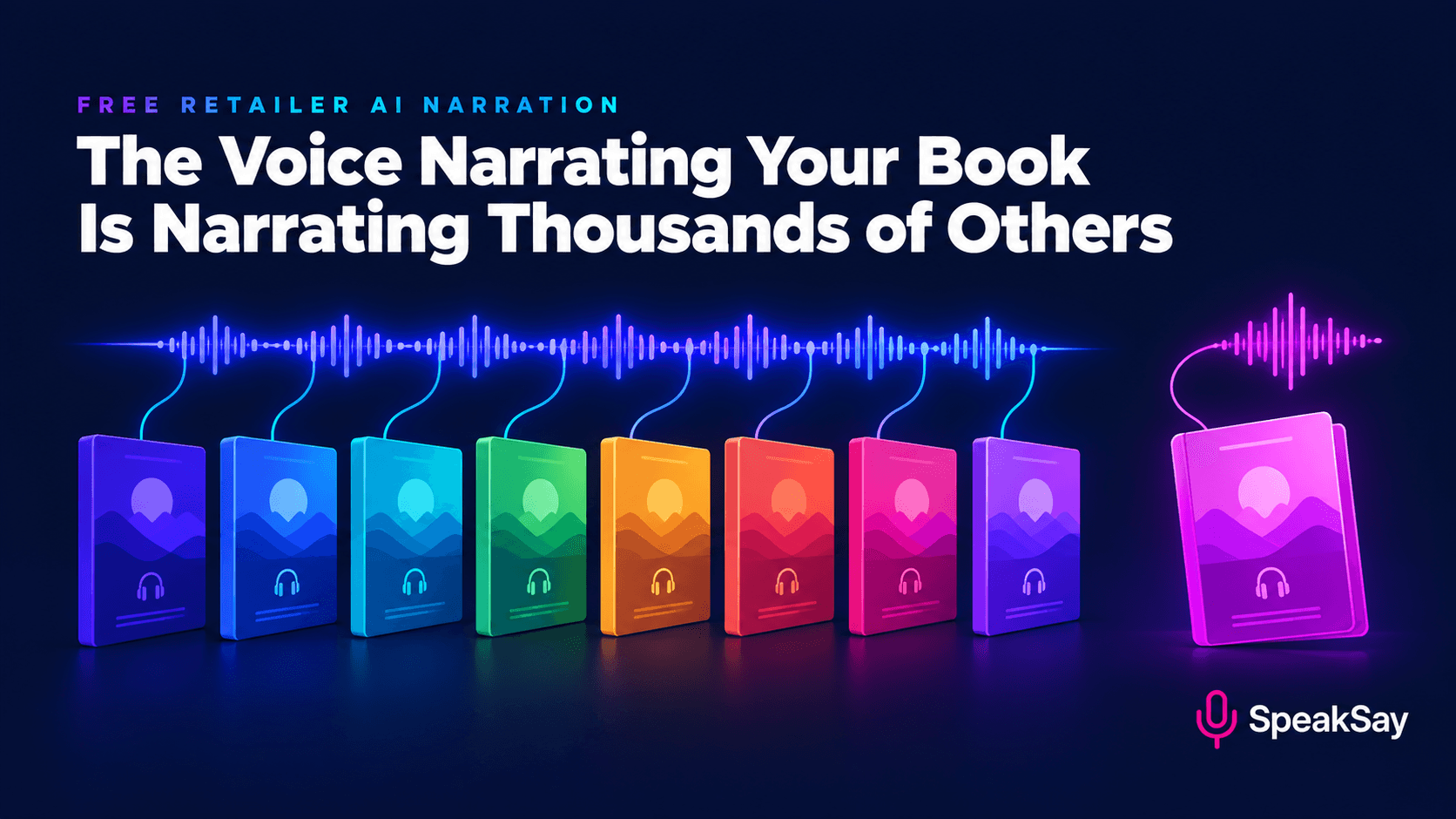
Retailer programmes offer a curated set of voices. The exact count varies and changes, but the pattern is consistent: a few dozen voices at most, presented as a picker.
Now apply the filters an author actually applies. You need the right language. You need a plausible gender for your narrator. You need an age impression that fits. You need a register that suits your genre. By the time a romance author has filtered a thirty-voice pool for "warm, female, thirties, contemporary", they are choosing between perhaps four or five. A nonfiction author filtering for "authoritative, male, forties, American" lands in a similarly small bucket.
Against that, consider volume. AI narration production has scaled dramatically — by mid-2026 a single platform reported narrating thousands of chapters a month, and every retailer opening the gate adds to that. The result is straightforward:
A small number of voices, chosen by a large number of authors filtering on the same handful of attributes, produces heavy concentration. A popular pool voice does not narrate a few dozen books. It narrates a lot of them.
This is the collision. And it is a new problem — it did not exist in human narration, because there were tens of thousands of working narrators and the good ones were booked out, which enforced natural dispersion. A voice model has no capacity limit, so nothing disperses.
What collision sounds like to a listener
The listener experience is the part authors have not modelled. A reader who buys two AI-narrated books in the same month, in the same genre, from the same store, has a reasonable chance of hearing the same narrator on both. Not a similar voice. The same one — identical timbre, identical mannerisms, identical way of handling a question mark.
What that does is transfer the voice's identity from your book to the platform. It stops reading as "the narrator of this novel" and starts reading as "the audiobook voice", the way a text-to-speech system voice does on a phone. Once that association forms, it is very hard to reverse, and it applies retroactively to everything narrated in that voice.
3. The four costs nobody quotes you
Cost one: you cannot build narrator recall
In audiobooks, the narrator is a discovery and retention asset. Listeners follow narrators, search for them, and buy on the strength of them; a distinctive narrator is one of the few things that reliably converts a reader of one of your books into a reader of all of them. A pooled voice cannot do this job, because it is not yours to build equity in. Every hour of listening you generate deposits recognition into a voice that belongs to the pool.
Cost two: shelf adjacency you do not control
Your book shares a narrator with whatever else selected that voice. Some of that will be excellent. Some of it will be the hastily-converted output that the "AI slop" complaints are about. A listener who has had a bad experience with a book in that voice arrives at yours carrying it — and they will not consciously know why they bounced off your sample.
This is the mechanism behind the common author complaint that "my sample sounds fine but nobody converts". Casting is being judged against a memory you did not create.
Cost three: series continuity is outside your control
Voice pools are maintained by the retailer. Voices get added, updated and retired; models get new versions with slightly different prosody. If you publish book one in 2026 and book four in 2028, there is no guarantee the same voice is available, or that "the same voice" sounds identical.
For a standalone this is irrelevant. For a series it is a real exposure, because narrator changes mid-series are one of the most reliably complained-about events in audiobook publishing — and unlike a human narrator becoming unavailable, you will get no notice.
Cost four: you finish with no master
This is the quiet one. In a retailer narration programme you generally end up with a version of your audiobook living inside that retailer's system, not a set of finished audio files you own and can take elsewhere. "No exclusivity" is a genuine and meaningful improvement — you are free to publish audio elsewhere — but freedom to publish is not the same as having something to publish. Going wide still means producing the book again, from scratch, somewhere else.
Compare: an author who produces their own master once has a single set of files that goes to every retailer, plus direct sales, plus a podcast serialisation, plus a library distributor, plus whatever exists in three years. The retailer route produces one channel and a to-do item.
4. When a pooled voice is completely fine
None of the above means you should never use it. There are clear cases where the retailer route is straightforwardly the right call and the collision cost is near zero:
- Backlist conversion at volume. Twelve out-of-print titles that currently earn nothing. Any audio is upside, and narrator equity was never on the table.
- Testing whether audio demand exists at all. If you do not know whether your readers listen, spending nothing to find out is obviously correct. Treat it as a market test, not a launch.
- Short, functional nonfiction. A 90-page practical guide where listeners want the information and have no relationship with the narrator.
- Low-stakes or reference titles. Anthologies, companion volumes, technical manuals.
- Authors with no realistic alternative right now. Free and adequate beats perfect and unmade. A book that exists in audio outperforms one that does not.
What these have in common: the narrator is not part of the product's identity, and there is no book two whose continuity you are mortgaging.
5. The decision table
| Your situation | Retailer pool voice | Your own produced master | Why |
|---|---|---|---|
| Single standalone nonfiction, no series planned | Good fit | Optional | No continuity exposure, no narrator equity to build |
| Book one of a planned series | Risky | Strongly preferred | Pool availability in three years is not under your control |
| Memoir or personal-brand nonfiction | Weak | Strongly preferred — and consider your own cloned voice | The author's voice is the product; a pooled voice actively undercuts it |
| Backlist you are converting in bulk | Good fit | Later, if a title performs | Upside-only; convert the winners properly afterwards |
| Romance, fantasy, dialogue-heavy fiction | Weak | Preferred, with careful casting | This is where listeners are most sensitive and most vocal |
| You have an established newsletter or podcast audience | Weak | Strongly preferred | Your audience already knows what you sound like; a stranger's voice is a downgrade |
| You want to sell direct, or to libraries, or bundle audio | Insufficient | Required | You need files you own |
| Testing whether your readers listen at all | Ideal | Premature | Spend nothing to learn something |
| Translated editions | Depends on pool language coverage | Preferred if the language matters commercially | Pool coverage outside major languages is thin |
6. The hybrid most authors should actually run
The two options are not mutually exclusive, and treating them as a sequence rather than a choice resolves most of the tension.
- Convert the backlist through the free retailer route. Titles that earn nothing in audio today. Cost: zero. Purpose: data.
- Wait one to two quarters and read the numbers. Not just units — look at completion, returns inside the clawback window, and whether audio buyers came back for a second title.
- Identify the one or two titles that actually move. There will usually be fewer than you expect, and they will not always be the ones you predicted.
- Produce those properly, as a master you own, with a voice chosen for the book rather than from a picker — and for memoir and personal-brand nonfiction, seriously consider your own cloned voice, which is the strongest case in the whole catalogue for cloning.
- Publish the owned master wide — every retailer, direct, libraries — and keep the retailer version only where you have no better option.
- From then on, new releases and series start on the owned master. Never start a series on a pool voice.
This sequence spends nothing to learn, and spends properly only where the data says it will return. It is also the only version that leaves you owning something at the end.
Produce a master in a voice that is actually yours
A cloned voice is the one narrator nobody else can pick from a list — and for memoir, personal-brand nonfiction and any author with an existing audience, it is the strongest narration decision available. SpeakSay's voice cloning produces files you keep.
7. How to audit a voice pool before you commit
Twenty minutes of work that most authors skip entirely.
- Count the genuinely usable voices, not the headline number. Filter for your language, your narrator's gender and rough age, and your genre register. Write down how many survive. If the answer is three, you now know what you are choosing from.
- Search the store for other titles using the same voice. Play samples from several books in your genre and listen for voices you recognise. Where you find a voice used repeatedly in your category, treat it as high-collision.
- Listen to the adjacency. When you identify a candidate voice in use elsewhere, listen to two minutes of one of those books. Would you be comfortable sharing a narrator with it? That is a real question, not a snobbish one.
- Test the voice on your hardest passage, not your best one. Dialogue between two characters of the same gender. A long technical paragraph. A quiet emotional beat. A list of proper nouns. Whatever your book does that is hard, do that.
- Check what happens to your production if the voice disappears. Read the programme terms on voice availability and versioning. If there is no commitment to continued availability, assume there is none.
- Check what you end up owning. Specifically: do you receive downloadable master files you may distribute elsewhere? If the answer is no, you are in a conversion programme, not a production one — which is fine, as long as you know it.
General information, not legal advice. Programme terms differ by retailer and change over time — read the current terms for the programme you are entering.
8. The series continuity protocol
If you write series, this is the section that matters most. Narrator changes mid-series generate more listener complaint than almost any other production decision, and a pooled voice puts that decision in someone else's hands.
- Never begin a series on a voice you do not control. This is the one hard rule. Book one sets an expectation you are contractually unable to honour.
- Record the settings, not just the audio. Voice identifier, version, rate, any style or stability parameters, and your pronunciation lexicon, all in a written specification document stored with the manuscript. A year later, "which voice was that?" is not answerable from an MP3.
- Keep a per-series pronunciation lexicon. Character names, invented place names, spells, ship names, technical terms. This is the thing most likely to drift between books, and it is trivially preventable.
- Produce the whole series in one voice generation if you can. If books are years apart, re-verify the voice against a held-back reference passage from book one before producing book three.
- If a forced change happens, mark it. A brief note in the front matter — "this volume is narrated in a new voice" — massively outperforms letting listeners discover it in chapter one and write a review about it.
- Match, do not upgrade. When you must replace a voice mid-series, the target is similarity to book one, not the best voice currently available. Listeners are comparing to what they have, not to the state of the art. Register and pace carry recognition more than timbre does, so match those first.
9. If you do use a pool voice, differentiate everywhere else
Sometimes the pool is the right call and the collision cost is just something to mitigate. Four levers, in order of effectiveness:
- Pick the least-used plausible voice, not the best one. The most popular voice in a pool is popular because it auditions well in ten seconds, which is exactly the selection pressure that produces collision. The second- or third-best-fitting voice with visibly lower usage in your category is usually the better commercial choice.
- Own the front matter. The opening credits are the one part of the audio that is unambiguously yours. A 30–60 second author's note recorded in your voice, before the narration starts, is consistently among the best-received elements in AI-narrated books — it establishes a human presence the pooled narrator cannot.
- State the narration honestly and specifically. "Narrated by a synthetic voice" is the safe general wording. Crediting a human-sounding first name with no qualifier is the reliable route to a one-star review about deception. Honest, specific framing in the credits and the description converts a disclosure into a trust signal.
- Choose the sample deliberately. Cut it from the master, mid-chapter rather than from the opening, and include the thing the narration handles least well. A sample that oversells produces early returns, and returns inside the first week claw back the royalty.
Stop renting your narrator
One-time pricing for unlimited narration means a backlist conversion, a re-production of the title that performed, and every future book, all under one payment — and every file is yours to distribute anywhere.
10. What owning your master actually buys
| Retailer pool narration | Your own produced master | |
|---|---|---|
| Upfront cost | None | Production time, plus tooling |
| Voice choice | A picker of a few dozen, shared | Any voice, including your own cloned voice |
| Narrator exclusivity | None | Total, if cloned from you |
| Distribution | That retailer | Every retailer, direct sales, libraries, bundles |
| Series continuity | Dependent on the pool | Under your control, if you store the settings |
| Corrections and re-renders | Via the programme, if supported | Whenever you want |
| Sample control | Usually automatic | Cut where you choose |
| Front matter and credits | Limited | Fully yours |
| Translations | Pool language coverage | Your voice in other languages, if you produce them |
| What you have in three years | A listing | A file |
The last row is the whole argument. Retailer narration gives you a title in a store. Producing your own gives you an asset that outlives any single store's programme terms — and in a market where three retailers changed their AI narration policies inside eighteen months, that durability is not a theoretical benefit.
General information only — not legal or financial advice. Royalty terms, programme rules and rights implications vary by retailer and by territory.
11. FAQ
Should I use Spotify's free AI audiobook narration?For backlist titles that currently earn nothing in audio, for short functional nonfiction, and for testing whether your readers listen at all — yes, the economics are unarguable. For book one of a series, for memoir or personal-brand nonfiction, or if you intend to sell direct or go wide, produce a master you own instead. The free route gives you a listing inside one retailer, not files you can take anywhere.
What is "narrator collision"?It is what happens when a large number of books draw narrators from the same small shared voice pool. Once you filter a few dozen retailer voices by language, gender, age impression and genre register, most authors are choosing between a handful — so popular voices end up narrating very large numbers of titles. The effect is that the voice stops reading as your book's narrator and starts reading as the platform's voice.
Does it actually matter if other books use the same AI narrator?It matters in three measurable places: you cannot build narrator recall, which is one of audiobook's strongest repeat-purchase drivers; you inherit the listening experience of every other book in that voice, good or bad; and you have no control over whether the voice still exists when your next book comes out. For a standalone nonfiction title none of those may bite. For a series, all three do.
Can I start a series with retailer AI narration and switch later?You can, but it is the scenario that generates the most listener complaint. Mid-series narrator changes are consistently among the most-reviewed negative events in audiobook publishing, and with a pooled voice you will get no warning that the voice is changing or disappearing. If you write series, start on a voice you control and store the full settings specification alongside the manuscript.
Is cloning my own voice better than picking a professional-sounding stock voice?For memoir, personal-brand nonfiction and any author with an existing newsletter, podcast or video audience, a clone is usually the strongest option — it is unique to you, it cannot collide, and "narrated in the author's own voice" converts a disclosure into a selling point. For dialogue-heavy fiction the trade-off is different: a clone inherits the prosodic range of your recording sessions, while a purpose-built stock voice may have wider designed range. Test both on your hardest passage before deciding.
What should I put in the credits if I use AI narration?Something specific and honest. "Narrated by a synthetic voice" works as a general answer; "narrated in the author's own cloned voice" is stronger still because it is both a disclosure and a selling point. Crediting a human-sounding first name with no qualifier is the reliable path to reviews accusing you of deception — which, inside the first week, also claws back royalties on the returns that follow.