School Districts Translate the Newsletter and Lose the Families Anyway: The 2026 Audio Language-Access Playbook
Title VI requires districts to communicate meaningfully with limited-English-proficient parents, and districts respond with translated PDFs. A translated PDF assumes a reader — the exact assumption that fails for oral-tradition languages, unstandardised written forms and low-literacy adults. Audio closes that gap, and its cost scales with languages rather than documents. Here is how to build the layer, and where it must not go.
1. What the requirement actually says
Worth restating precisely, because the details do work that summaries lose.
Title VI of the Civil Rights Act prohibits national-origin discrimination, and federal guidance to districts and state education agencies applies it to communication with LEP parents. The core obligation is that districts must ensure meaningful communication with LEP parents in a language they can understand, and adequately notify them of information about any programme, service or activity that is brought to the attention of non-LEP parents.
Two features of that framing matter here.
First, the standard is parity, not translation. The test is whether LEP parents received the information that English-proficient parents received. Translation is a means. It is not the obligation.
Second, the guidance is explicit that written translation of notices is expected "to the extent practicable", and that where written translation is not practicable, districts must offer free oral interpretation of the written information. Federal guidance has recognised from the outset that some communications cannot travel in writing — and has named the oral channel as the remedy.
That second point is the opening. The oral channel is not an exotic workaround; it is in the guidance. What has changed in 2026 is that providing it proactively at scale is finally cheap enough to do.
This article is general information about a practice area, not legal advice. Districts should confirm their specific obligations with counsel and with their state education agency, whose requirements may be more demanding than the federal floor.
2. The assumption inside every translated PDF
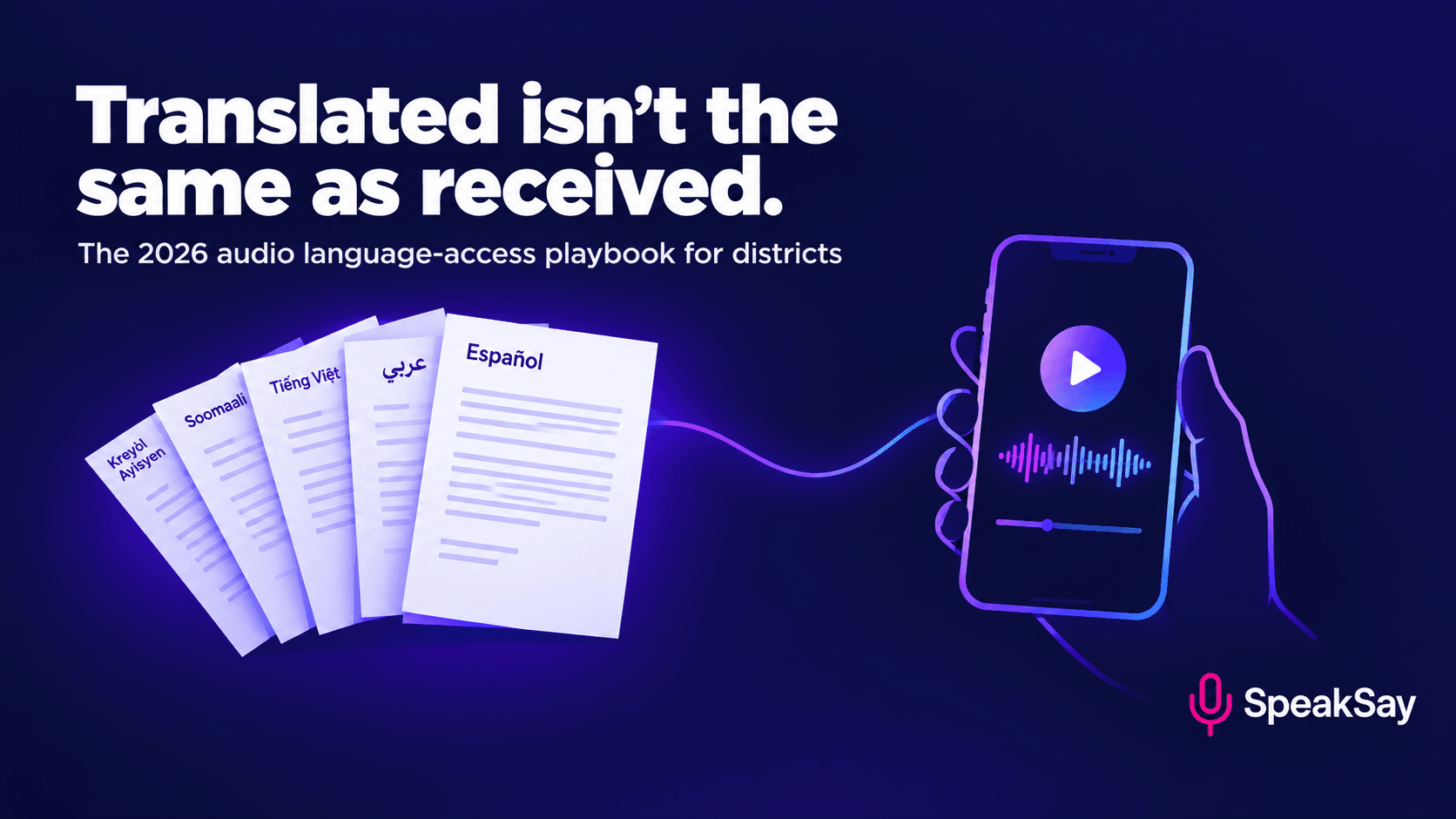
A translated document delivers information to a person who can read that language, fluently enough to get through an administrative text, on a device or on paper, with enough time and quiet to do it. Each of those is an assumption, and each fails for a describable group of families.
- Languages with limited written tradition or no standardised orthography. Several languages commonly spoken by US school families are predominantly oral, or have competing written standards, or have writing systems most speakers were never schooled in. A district can commission a written translation into these and produce a document that a large share of the intended readers cannot use.
- Adults with limited literacy in their own first language. Interrupted schooling, refugee trajectories and rural origins all produce adults who speak a language fluently and read it haltingly or not at all. Translating into their language does not help them; it only moves the barrier.
- Readers of a different variety or script. A translation into a standard written form can be genuinely hard going for a speaker of a distant regional variety, and script choices can exclude whole populations within a single named language.
- Administrative register. Even a fluent reader can stall on a translated document that preserves the original's bureaucratic phrasing. Translated jargon is still jargon.
- Circumstance. A parent working two shifts, reading on a phone, at eleven at night, is not going to get through ninety pages in any language.
None of this is an argument against translation. Written translation is required, useful, and often the only appropriate channel. It is an argument that written translation alone leaves a predictable, identifiable group uncovered — and that the group it leaves uncovered is disproportionately the group the requirement exists to protect.
3. Why "free interpretation on request" under-performs
Districts do offer oral interpretation. The offer is usually genuine, adequately funded and rarely used, and the reasons are structural rather than anybody's fault.
| Barrier | What happens in practice |
|---|---|
| It is reactive | The parent must know the service exists, know it is free, and initiate. Each step loses people. |
| The notice of the service is itself written | The line telling parents that free interpretation is available is frequently a paragraph in a document they could not read. This is the circularity at the heart of the problem. |
| Asking has a social cost | Parents report reluctance to identify themselves as needing help, particularly in small communities or where they worry it will attach to their child. |
| It is synchronous | Interpretation happens at a scheduled time, on a phone line, during working hours. Shift workers are structurally excluded. |
| It does not scale to routine communication | Nobody books an interpreter to hear the weekly newsletter or a snow-day notice. So the routine stream — which is where most information actually lives — stays English-only in practice. |
That last row is the important one. Interpretation covers the high-stakes, scheduled moments reasonably well. The continuous drizzle of ordinary school communication — reminders, schedule changes, event notices, the "bring a coat tomorrow" of school life — is where families actually fall out of sync, and interpretation-on-request has never touched it.
4. What an audio layer is, concretely
The proposal is narrow and unglamorous: every communication that goes out in writing also goes out as audio, in each of the district's threshold languages, attached to the same send. Not instead of the written version. Alongside it.
In practice that looks like:
- A short audio file linked at the top of every translated notice, or embedded as a play button in the parent app or portal.
- A 60–90 second spoken summary of anything long, in each language, rather than a full reading of a ninety-page handbook nobody will listen to either.
- Audio on the automated channels that already reach every family: the SMS link, the app push, the portal banner.
- A standing "what this school year involves" audio orientation per grade level, per language, recorded once and refreshed annually.
- An audio version of the one notice that matters most and is read least — the one explaining that free interpretation and translation are available and how to request them.
That last item deserves emphasis. If a district did nothing else from this article, producing the language-assistance notice as audio in every threshold language would break the circularity described above, and it is perhaps two hours of work.
The production reality in 2026: a district clones one voice from a staff member who consents, then generates the audio for each notice in each language from the already-translated text. The translation still comes from a qualified human translator. What automation replaces is not the translation — it is the recording session that would otherwise have to be booked, per language, per document, forever.
Start with the notice nobody can read
The language-assistance notice — the one telling families that free interpretation and translation exist — is usually the highest-value single item to produce as audio, because it unlocks everything else.
5. The boundary: what must never be automated
This section is the most important one in the article and it argues against the product.
There is a category of school communication where synthesised audio of a machine-translated or even human-translated text is not an acceptable channel, and a district that blurs the line will end up in a worse position than one that never started. The boundary is roughly: anything legally operative, individualised, or requiring a two-way exchange goes to a qualified human.
| Communication | Channel |
|---|---|
| IEP meetings, evaluations, special education process, consent for services | Qualified human interpreter, in person or by phone. No exceptions. These are individualised, legally consequential and inherently interactive. |
| Discipline proceedings, suspensions, expulsions, due-process notices | Qualified human interpreter and certified written translation. |
| Anything requiring informed consent or a signature | Certified written translation plus human interpretation. Audio may accompany it; audio may not replace it. |
| Student-specific academic, health or safeguarding information | Human. Also a privacy question — do not route individual student data through any third-party system without a data agreement and a district review. |
| Emergency and life-safety instructions | Prepared in advance, human-reviewed, and tested. Audio is excellent here precisely because it is fast and needs no reading — but the scripts must be pre-approved, not generated in the moment. |
| General notices, newsletters, events, schedules, reminders, orientation, handbook summaries | Audio layer is appropriate. |
Two further rules that belong in the district's written procedure:
Never generate audio from machine-translated text without human review. The audio layer's job is to deliver a human translation to people who cannot read it. If the translation itself is unreviewed machine output, you have automated the wrong step and built a fluent, confident, authoritative-sounding error.
Never let audio substitute for a required written translation. Where written translation is required and practicable, it is required. Audio is additive.
6. The cost structure, and why it inverts
The reason districts do not have an audio layer already is that under the old cost model it was absurd. Consider what it used to take to produce spoken versions of routine communications in five languages.
| Model | What you pay for | What scales |
|---|---|---|
| Studio / voice talent | A booking per language, per document, plus editing and delivery | Cost scales with documents × languages. Twelve notices a month in five languages is sixty sessions a month. Nobody does this. |
| Staff recording | Bilingual staff time, pulled from their actual job, with variable audio quality | Scales with documents × languages and burns goodwill. Also fails the moment that staff member leaves. |
| Interpretation line | Per-minute interpreter time, on request | Scales with requests, and requests stay low for the reasons in section 3. Routine communication never enters this channel. |
| Generated audio layer | A platform licence; translation still purchased separately from qualified translators | Cost scales with languages configured, roughly flat in documents. The twelfth notice of the month costs the same as the first. |
That is the whole economic argument and it is worth stating baldly: the old models price the channel per send, so routine communication never gets one. Generated audio prices it per language, which is a number that does not grow week to week. It is the same reason districts have websites in five languages but not phone trees in five languages.
The budget comparison that tends to land with a school board is not against the interpretation line — that budget is required and stays. It is against the annual translated-handbook spend, where adding an audio summary of the same content costs a small fraction of the translation that has already been paid for and substantially raises how many families actually receive it.
7. How to build it in one term
A realistic sequence for a district communications office with no additional headcount.
- Confirm your threshold languages from your own data, not assumption. Home-language survey data usually already exists in the student information system, and it is frequently more varied than the five-language PDF folder suggests.
- Pick the ten communications that go to every family every year. Enrolment, calendar, handbook summary, attendance policy, conferences, meal programme, transport, closure procedure, health requirements, language-assistance notice.
- Get human translations of those ten if you do not already have them. This is the part you pay for and do not shortcut.
- Write spoken versions. Not the document read aloud — a 60–90 second script per item, in plain register, written to be heard. This is a real writing task and it is where most of the quality comes from.
- Get those spoken scripts translated too, by the same translators. A document translation does not convert into good spoken copy.
- Record one consenting staff voice and clone it once. Section 9 covers whose.
- Generate, review, publish. Attach audio to the existing send — do not build a new channel families have to discover.
- Add the emergency scripts as a second phase, pre-approved and tested, since those have a different review requirement.
- Measure something. Play rates by language, form-return rates before and after, conference attendance by home language. If you cannot show movement in one of those, you have built a compliance artefact rather than a communication channel — and knowing that is worth the effort of measuring.
One voice, every language, no re-booking
A single cloned district voice delivers every notice in every threshold language, and re-rendering a changed date or a new principal's name costs nothing. No session to book, no staff member to chase, no drift when someone leaves.
8. Quality control without a speaker on staff
The obvious objection: how does a district verify audio in a language nobody in the office speaks? Five checks that do not require fluency, in order of value.
- Native review before publication, always, for the first cycle. A community liaison, a bilingual staff member, a parent-group volunteer or a paid reviewer listens to each file once. This is not optional for launch; it is how you find the errors that matter. After the first cycle you can move to sampling.
- The duration-outlier check. Compare audio length against the source text length across languages. Languages differ in natural length, but an item that is 40% shorter than its siblings usually means content was dropped; 60% longer usually means something was read out that should not have been, like a URL spelled character by character.
- The proper-noun pass. School names, staff names, street names and programme names are the most common failure and the most damaging, because a parent who cannot recognise their own school's name in the audio will discard the whole message. Check these specifically and set pronunciation overrides once, centrally, so they are right everywhere.
- The numbers and dates pass. Times, dates, phone numbers, room numbers and deadlines. These carry the operational content and they are exactly what conventions differ on across languages. Listen to them specifically.
- The phone-speaker test. Play the file through a phone speaker at arm's length. That is the real listening condition, and it catches level and intelligibility problems that headphones hide.
Build the proper-noun list once. It is the single highest-leverage artefact in the whole project, it takes an afternoon, and it stops the same three names being mangled in every notice for the next five years.
9. Whose voice, and why it matters more than you think
Districts default to whoever is available. It is worth being deliberate, because the choice has consequences that outlast the person.
Get explicit written consent, with scope and duration. Whoever's voice you use, the agreement should say what it may be used for, for how long, and what happens when they leave the district. This protects the staff member first and the district second, and it is the one piece of paperwork that is genuinely hard to add retrospectively.
Prefer a role to a person where you can. A voice tied to "the district" rather than to a named superintendent survives a change of superintendent. If you clone the superintendent's voice, plan for the day they leave — and put that plan in the consent agreement.
Disclose that the audio is generated. A short line in the notice and on the district's language-access page: the audio is produced using a recorded model of a staff member's voice, from human-translated text. Families are entitled to know, and the disclosure costs nothing while an eventual discovery costs a great deal.
Do not clone a voice to speak a language that person does not speak, and present it as them. Generating audio in Somali using a model of an English-speaking staff member's voice is technically straightforward and reputationally risky — it can read as a district pretending to a competence and a community connection it does not have. The safer pattern is a neutral, clearly-institutional voice per language, disclosed as generated, rather than one person apparently speaking eleven languages fluently.
Consistency is a feature. Once families associate a particular voice with "this is the school telling me something real", that recognition does work — especially in an emergency, and especially against the background of scam calls that families are rightly wary of. That benefit only accrues if the voice does not change every year, which is the practical argument for cloning once rather than re-recording with whoever is available each August.
10. FAQ
What does Title VI actually require districts to translate for parents?Federal guidance frames the obligation as meaningful communication with limited-English-proficient parents in a language they can understand, and adequate notification about any programme, service or activity brought to the attention of English-proficient parents. Written translation of notices is expected to the extent practicable, and where written translation is not practicable, districts must offer free oral interpretation of the written information. The standard is parity of information, not translation as such — translation is one means of achieving it. This is general information, not legal advice; confirm specifics with counsel and your state agency.
If we already translate everything, why are families still missing information?Because a translated document assumes a reader. That assumption fails for speakers of predominantly oral languages and languages without a standardised orthography, for adults with interrupted schooling who speak a language fluently but read it haltingly, for speakers of regional varieties distant from the standard written form, and for anyone reading administrative register on a phone after a double shift. Translation is still required and useful — it just leaves a predictable group uncovered, and that group overlaps heavily with the families the requirement exists to protect.
Doesn't offering free interpretation on request already solve this?It covers scheduled, high-stakes moments reasonably well and almost never covers routine communication. It is reactive, so the parent must know it exists and initiate; the notice announcing it is usually itself a written document they cannot read; asking carries a social cost; it is synchronous and so excludes shift workers; and nobody books an interpreter to hear a weekly newsletter or a snow-day notice. The continuous stream of ordinary school communication is where families fall out of sync, and interpretation-on-request has never reached it.
Which school communications should never use generated audio?Anything legally operative, individualised or interactive. IEP meetings, evaluations and special-education consent; discipline and due-process notices; anything requiring informed consent or a signature; and student-specific academic, health or safeguarding information all require qualified human interpreters and certified written translation. Emergency instructions can use audio but only from pre-approved, human-reviewed, tested scripts rather than anything generated in the moment. General notices, newsletters, schedules, reminders and handbook summaries are the appropriate territory.
Can we generate the audio from machine-translated text?No. The point of the audio layer is to deliver a human translation to families who cannot read it — if the translation itself is unreviewed machine output, you have automated the wrong step and produced a fluent, confident, authoritative-sounding error in a channel families are likely to trust. Buy human translation, then generate audio from it. Audio also never substitutes for a required written translation; it is additive.
How much does an audio language-access layer cost compared to what we do now?The structural difference is what the cost scales with. Studio bookings and staff recording scale with documents multiplied by languages, which is why twelve notices a month in five languages never happens. An interpretation line scales with requests, which stay low. A generated audio layer scales with the number of languages configured and is roughly flat in documents, so the twelfth notice of the month costs what the first one did. The comparison that usually lands with a board is against the existing annual translation spend, since audio adds a fraction on top of translations already paid for.
How do we check audio quality in a language nobody on staff speaks?Native review before publication for the entire first cycle, then sampling. Alongside it, run four checks that need no fluency: compare audio duration against source-text length across languages to catch dropped or over-read content; check proper nouns specifically, since a parent who cannot recognise their school's name discards the whole message; check numbers, dates, times and phone numbers, where conventions differ most; and listen through a phone speaker at arm's length, which is the actual listening condition. Build a central proper-noun pronunciation list once — it is the highest-leverage artefact in the project.
Whose voice should a district use, and do we have to disclose it is generated?Get explicit written consent covering scope, duration and what happens when the person leaves. Prefer a voice tied to the institution over a named individual so it survives staff turnover. Disclose plainly that the audio is generated from a recorded model of a staff member's voice and from human-translated text. And do not present a cloned English-speaking staff member as fluently speaking eleven languages — use a clearly institutional voice per language instead, because the alternative reads as claiming a community connection the district does not have.