Text to Speech Online in 2026: What the Free Tools Actually Cost You
Free text to speech is genuinely useful, and most of the guides ranking it are useless — because they rank tools on voice quality when the thing that will actually stop your project is a licence clause, a download button that is not there, or a voice that quietly changes between episode four and episode five.
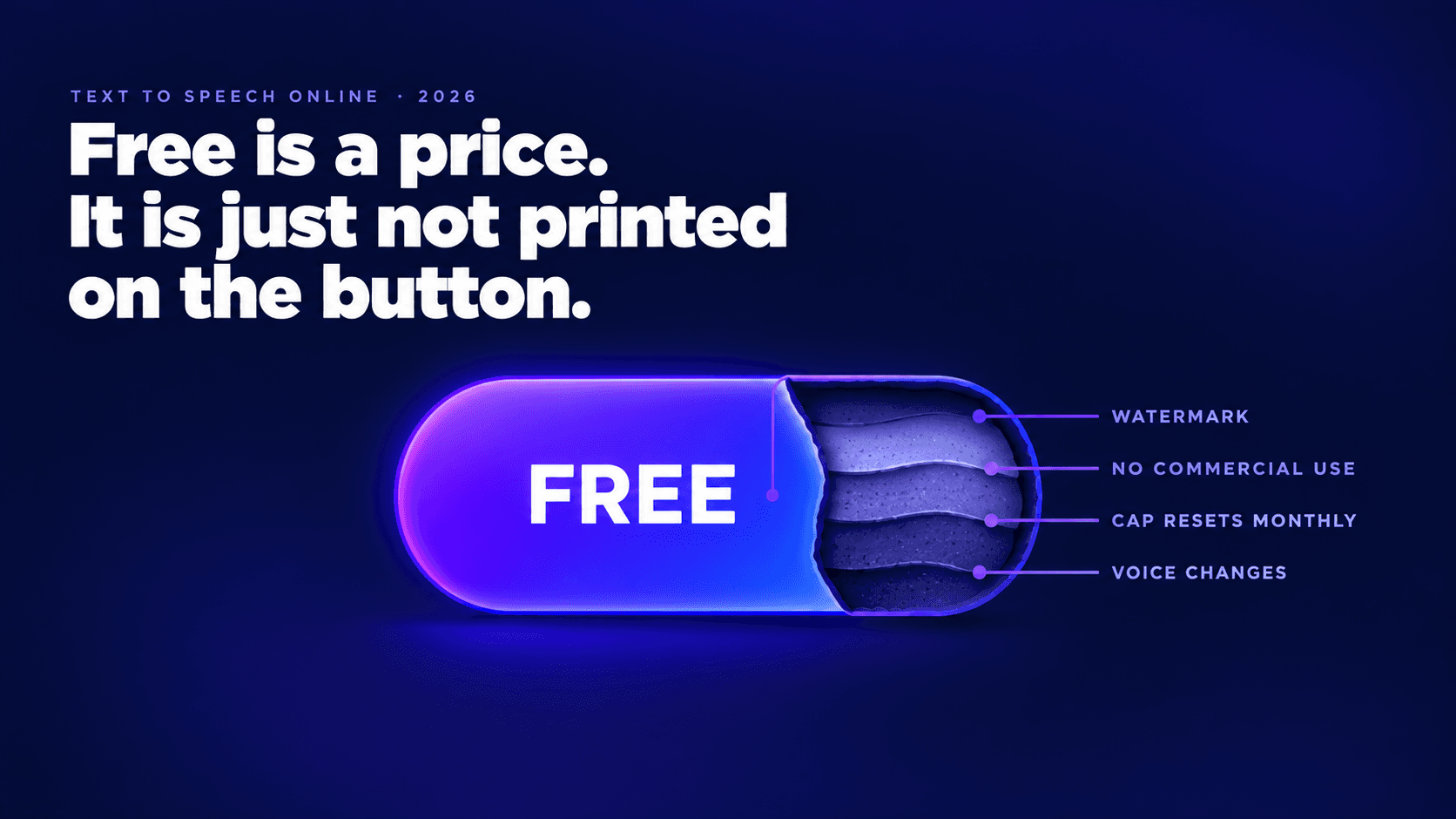
1. What "free" actually means on a TTS site
There are four distinct business models wearing the same word, and they behave completely differently once you have a deadline.
| Model | What you get | Where it breaks |
|---|---|---|
| Free tier of a paid product | A real monthly character allowance, real voices, real downloads | The allowance. You will hit it mid-project, usually on a re-render, not a first render. |
| Free demo / preview | Playback in the browser | No download, or a download with an audio watermark. The output is a sales pitch, not an asset. |
| Ad-supported or data-supported | Generous limits, no card | The terms. Read what rights you grant over the text you paste and the audio produced. |
| Open-source or local | Genuinely unlimited, genuinely free | Setup, no cloning, older-generation prosody, and you maintain it. |
The important thing is that these are not points on a quality spectrum. A free demo of a top-tier model may sound better than anything you can run locally, and still be completely unusable because you cannot get the file out without a voice saying the company's name over the top of it.
So the first question is never "how good does it sound." It is "what am I allowed to walk away with."
2. The four hidden costs, in the order they bite
These arrive in a reliable sequence. Knowing the sequence is most of the value of this article, because it tells you how far you can get before you need to make a decision.
Cost one: the download (bites on day one)
Many free tools let you generate and listen but not export, or export at a reduced bitrate, or export with an audible watermark. This is the cheapest cost to discover and the most annoying to discover late — after you have pasted in 900 words and tuned the pacing.
Cost two: the cap (bites in week two)
Free allowances are usually quoted in characters per month, and creators consistently underestimate their real usage by a factor of three to five. The reason is re-renders. A 1,200-word script is roughly 6,500 characters. A finished 1,200-word script is rarely one render — it is the first pass, the pass where you fixed two pronunciations, the pass where you cut a paragraph, and the pass where you changed the voice. That is 26,000 characters for one video, and free tiers commonly sit in the 10,000 to 40,000 character range per month.
Cost three: the licence (bites when money appears)
Covered in full below, because it is the one that can retroactively invalidate work you already published.
Cost four: voice drift (bites in month three)
Also covered below. It is last because it is invisible until you have enough back catalogue for the inconsistency to be audible — and by then the back catalogue exists.
Want to skip straight to the part where you can download the file?
SpeakSay's free tools generate real, downloadable audio with no watermark on the output, so you can test a voice against your actual script rather than against a demo paragraph about productivity.
3. The licence clause that ends projects
This is the part the ranking articles skip, and it is the only part with a lawyer attached.
A large share of free TTS tiers grant you personal, non-commercial use only. That phrase is doing more work than most people realise. It does not only mean "you cannot sell the audio file." In practice, platforms and rights holders have treated the following as commercial use:
- A monetised YouTube video, including a channel below the partner-programme threshold that is intended to monetise.
- Any video with an affiliate link in the description.
- A social post promoting a product, service, or your own freelance work.
- Internal corporate training material, even though nobody outside the company hears it.
- A podcast with a single sponsor read, even if the AI voice does not read the sponsor segment.
The exposure is asymmetric and it is worth being clear-eyed about it. The realistic downside is rarely a lawsuit. It is a takedown, a monetisation hold, or a client discovering during procurement that your deliverable was produced under a licence that does not permit the delivery. That last one is a business problem, not a legal one, and it is far more common.
The rule: if the audio will ever sit next to a payment — yours or someone else's — you need a licence that says so in writing. Not a forum post, not a support reply, not an absence of prohibition. An affirmative grant of commercial rights.
One genuinely useful exception: a handful of free engines are explicitly cleared for commercial use, and locally-run open-source models generally carry permissive licences. If you are going to build on free, build on one of those rather than on a free tier whose terms can be revised in a product update.
This is general information about how licences are commonly written, not legal advice. Read the actual terms of the tool you use, and get advice if real money depends on the answer.
4. Voice drift: the one nobody warns you about
Here is the failure mode that costs the most and gets discussed the least.
Free tiers are where providers do their model rollouts. There is no contractual obligation to keep a free voice stable, no version pinning, no deprecation notice, and frequently no way to request the old render. So the voice you used in January is not quite the voice you get in April. Slightly different pace. Slightly brighter. A vowel that lands differently. Nothing you would notice comparing two clips a week apart — and very obvious to a subscriber who binges episodes one through twelve on a Sunday.
The symptom is not "the voice sounds bad." The symptom is that your channel stops feeling like one channel.
Three things make this worse on free tiers specifically:
- No settings persistence. Most free tools do not save your speed, pitch and stability settings between sessions, so you re-dial them by ear each time. Your ear on a Tuesday afternoon is not your ear on a Sunday night.
- Voice-name reuse. A voice labelled with the same name can be re-trained underneath the label. The name is a UI string, not a version identifier.
- No re-render path. Even if you notice, you cannot regenerate episode three on the new model without paying for it, so the catalogue stays split.
The mitigation, whether you stay free or not: keep a reference clip. Thirty seconds of your chosen voice reading a fixed paragraph, saved as a file on the day you choose it, with the settings written in the filename. Every month, render the same paragraph again and listen to them back to back. It takes four minutes and it is the only way to catch drift before your audience does.
Consistency is a product feature, not a habit
A stable voice you control, with saved settings that render the same way in month nine as they did in week one, is the difference between a channel and a folder of videos. SpeakSay's voice library is built for back catalogues, not one-off clips.
5. Five jobs where free is genuinely the right answer
This is not an article arguing that everyone should pay. For a large set of real jobs, paying is a waste of money. Here is where free wins outright:
- Proofreading by ear. Pasting your own writing into a TTS tool and listening to it is the single best editing trick there is, and it produces no deliverable at all. Free forever.
- Reading long documents you did not write. PDFs, research papers, contracts, a 40-page brief on a commute. Nothing leaves the browser.
- Casting auditions. Testing eight voices against your actual opening paragraph before you commit to one. You are evaluating, not shipping.
- Accessibility for personal use. Reading assistance for yourself or a family member.
- Genuinely one-off clips. A single announcement, a single greeting, something with no episode two.
The pattern across all five: no publication, no payment, no series. The moment any one of those three appears, re-run the maths.
6. The breakpoint: when free becomes more expensive than paying
Free has a real cost and it is denominated in your time. The honest comparison is not "£0 versus £X per month." It is "£0 plus the workarounds versus £X per month."
Count the workarounds. Each one is a recurring tax:
| Workaround | Typical time cost | Per month, at 8 videos |
|---|---|---|
| Splitting a script to fit a character cap | 10 min | 80 min |
| Stitching split renders in an editor so the joins are inaudible | 15 min | 120 min |
| Re-dialling settings you could not save | 5 min | 40 min |
| Rotating between two or three free accounts to stay under caps | 8 min | 64 min |
| Re-rendering because the voice changed | occasional | ~45 min |
That is roughly six hours a month of unpaid production labour to avoid a subscription. If your time is worth anything at all — and if you are producing eight videos a month it is — free stopped being cheaper somewhere around video three.
The three-signal test. You have passed the breakpoint if any two of these are true:
- You have split a script to fit a cap more than twice.
- You maintain more than one account on the same service.
- Someone other than you is going to hear this on a schedule.
Do the subscription maths once, then stop doing it
If you have crossed the breakpoint and you know this is a long-term workflow, a one-time lifetime plan removes the monthly cap calculation from your life permanently — which is the actual thing you were buying.
7. How to evaluate a free TTS tool in ninety seconds
Do this before you paste in a full script, not after. In order:
- Find the export button first (15s). Before generating anything, look for "download". If you cannot find it while logged out, assume there isn't one.
- Paste your hardest sentence, not a nice one (20s). Use a real sentence from your real script containing a proper noun, a number, and an acronym. Demo paragraphs are written to flatter the engine.
- Check the exported file, not the browser preview (20s). Preview players sometimes sound better than the file. Download it and play it in something else.
- Search the terms page for "commercial" (20s). Ctrl-F. You want an affirmative sentence, not silence.
- Look for a character counter (15s). If the tool does not show you your remaining allowance, you will discover it by hitting it.
Any tool that fails steps 1, 3 or 4 is not a tool. It is a demo, and a demo is fine — just do not build a workflow on it.
8. Moving off free without re-recording everything
If you have a back catalogue rendered on a free tool and you are moving, you do not need to redo all of it. You need to stop the split from widening.
- Do not re-render the archive. Old episodes are consumed by people who already accepted how they sound. Money spent re-rendering episode four buys almost nothing.
- Do re-render your evergreen top five. Whatever still gets traffic every week is worth putting on the voice you will keep. That is usually three to six pieces, not forty.
- Make the switch at a visible boundary. A season break, a rebrand, a numbered milestone. A change the audience can see is a change they stop hearing.
- Say it once, briefly. One sentence in one episode — "the show sounds slightly different from here on, we upgraded how it's produced" — converts a confusing inconsistency into a deliberate decision. Do not make it a segment.
- Save the new settings immediately. Voice, speed, stability, model, date. In a text file next to your scripts, not in your head.
The general principle is that inconsistency is only a problem when it is unexplained. Explained once, it costs nothing.
Start with the free tools, upgrade when the maths says so
SpeakSay's free tools are built to produce real files you can actually use — and when your volume outgrows them, your voices, settings and workflow come with you instead of starting over.
9. FAQ
What is the best free text to speech online in 2026?There isn't a single answer, because the tools differ on the axes that matter rather than on voice quality. If you need commercial rights, choose an engine that explicitly grants them or run an open-source model locally. If you need a clean MP3 download, test the export before you write the script. If you need the same voice to sound identical in six months, free tiers are the wrong category entirely — that is a paid-plan feature because it requires version stability the provider has to commit to.
Can I use free text to speech for YouTube monetisation?Only if the tool's terms affirmatively grant commercial use. A monetised video is commercial use, and so is an unmonetised video with an affiliate link. The absence of a prohibition is not a grant. Check the terms page for the word "commercial" and keep a dated screenshot of what it said when you started.
Why does my AI voice sound different than it did last month?Because the model underneath the voice name was updated. Voice names are UI labels, not version numbers, and free tiers are where rollouts happen first. Keep a thirty-second reference clip of your chosen voice from the day you picked it and re-render the same paragraph monthly to catch drift early.
How many characters is a typical video script?Roughly 5.5 to 6 characters per word including spaces, so a 1,000-word script is about 5,800 characters. Budget three to four times that per finished video to account for re-renders, which is the number free tiers are not sized for.
Is free text to speech with no sign-up safe to paste sensitive text into?Treat anything you paste into a browser tool as submitted to that company. For client scripts under NDA, internal documents, or anything with personal data in it, use a tool with terms you have actually read, or run the model locally. This is the one case where "no sign-up" is a reason for more caution, not less — there is no account, no agreement, and often no named company.
When should I stop using free tools?When two of these are true: you have split a script to fit a cap more than twice, you maintain multiple accounts on the same service, or someone is expecting your audio on a schedule. At that point you are paying in time instead of money, at a worse exchange rate.