TikTok's AI Voice Ban Explained (2026): Where AI Voices Are Banned, Where They're Allowed, and How Shop Affiliates Still Scale
TikTok now prohibits AI voices in Shop livestreams, enforced through Creator Health Ratings — and sellers are panicking about their AI-voiced product videos. The ban is narrower than the headlines. Here's the actual rulebook and the workflow that still scales.
1. What TikTok Actually Changed
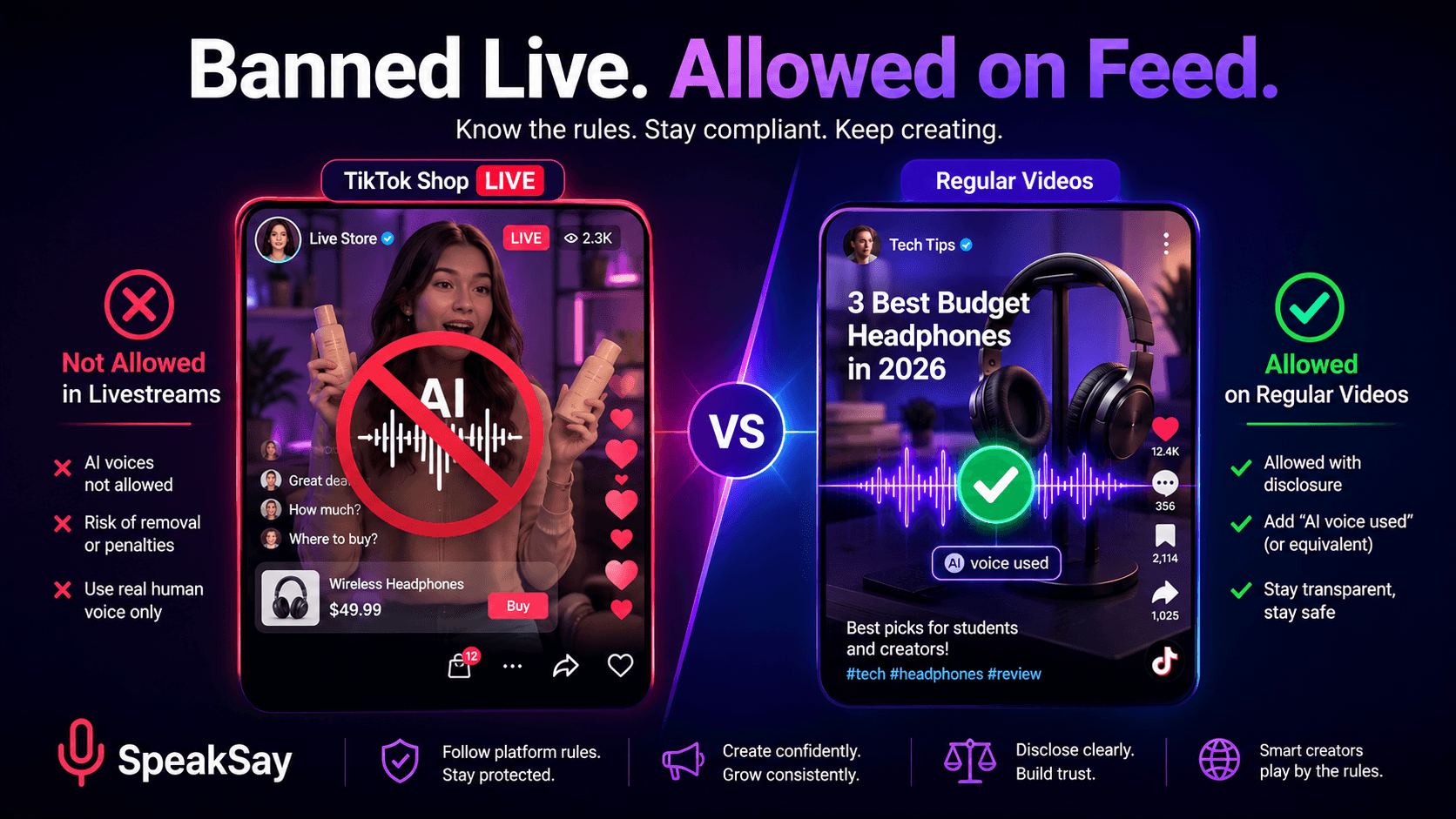
TikTok's updated Shop policies prohibit three things in commerce livestreams: AI-generated voices, pre-recorded audio presented as live, and non-real-time communication with viewers. The enforcement mechanism is the Creator Health Rating — the scorecard that already governs Shop sellers' visibility and privileges. Violations drag the rating down, and a degraded rating throttles livestream reach, Shop features, and ultimately selling eligibility.
What the update did NOT do: ban AI voices from TikTok. Regular feed videos — including product showcases, affiliate reviews, and paid ads — can still use AI voiceovers under the platform's existing synthetic-media disclosure rules that have been in place since the 2025 policy wave. The confusion comes from headlines compressing "banned in Shop LIVE" to "banned," and sellers are asking in every community whether their AI-voiced product videos are next. Current policy and platform statements draw a clear line: the live selling context is the target, not the technology.
2. Banned vs Allowed: The Complete 2026 Map
| Context | AI voice status | Notes |
|---|---|---|
| Shop LIVE selling streams | Prohibited | Real human presenter, real-time interaction required |
| Pre-recorded audio in LIVEs | Prohibited | Includes looped "live" replays presented as real-time |
| Regular short videos (organic) | Allowed with disclosure | Product showcases, reviews, storytelling — all fine |
| Shop product videos / showcase tab | Allowed with disclosure | The core affiliate format remains open |
| Paid ads (Spark and standard) | Allowed with disclosure | Follow ad-policy synthetic media rules; voice rights matter |
| TikTok's native TTS voices | Allowed | Platform-provided voices remain fully supported in videos |
| Undisclosed synthetic voice anywhere | Violation | Disclosure rules predate and survive the Shop update |
One more nuance for voice cloning: using your OWN cloned voice in videos is treated like any synthetic voice (disclose it). Using someone else's voice without rights was already prohibited under impersonation rules — nothing new in 2026, but enforcement is stricter in commerce contexts.
3. How the Creator Health Rating Enforces It
The Creator Health Rating aggregates policy compliance, fulfillment metrics, and content quality signals into a single score that determines Shop privileges. What makes it a sharper enforcement tool than content moderation: it's cumulative and commercial. A single flagged livestream doesn't just remove one video — it lowers the score that gates your next month of reach. Sellers report the practical escalation as: warning and stream interruption first, then rating deductions, then LIVE feature restrictions, then Shop suspension for repeat violations.
The takeaway: don't test edge cases in LIVE. A "mostly human" stream with AI-voiced segments, or a human presenter lip-syncing a synthetic track, risks the same deductions. Keep LIVE fully human, and spend your AI leverage where it's allowed.
4. Why TikTok Drew the Line at LIVE
Understanding the why helps you predict what's next. Live commerce is TikTok's highest-trust surface: viewers buy because a real person demonstrates, answers, and reacts in real time. Automated "live" selling — AI voice loops running 24/7 over product carousels — was scaling fast in 2025 and eroding exactly the trust that makes live commerce convert. The ban protects the realness premium of LIVE.
Feed videos carry no real-time promise, so disclosed AI voiceover doesn't break any implicit contract there. That's why the policy is surgical rather than total — and why a total feed ban remains unlikely: TikTok itself ships native TTS voices as a creation feature. Plan your stack around the line staying roughly where it is, with enforcement tightening on disclosure rather than expanding the ban.
5. The Affiliate Playbook: Batch Video, Human LIVE
The winning 2026 structure splits your funnel by surface:
- Batch-produce feed content with AI voice. Product demos, "5 things I wish I knew" reviews, unboxing narrations, comparison videos — scripted, AI-voiced in a signature voice, disclosed, published at volume. This is where AI's scale advantage is legal and decisive: 20–30 videos a week per product line is realistic for a solo affiliate.
- Go human for LIVE. Fewer, better livestreams — weekly rather than daily, fully human, driven by traffic from your AI-voiced feed content. The feed videos do discovery; the LIVE does conversion.
- Recycle winners into ads. Top-performing AI-voiced videos become Spark Ads with the same disclosure. Performance data from organic runs de-risks the spend.
Affiliates who ran this split through the policy change report the counterintuitive result: total GMV holds or grows, because the feed volume compounds while LIVE frequency mattered less than LIVE quality all along.
Batch a week of product videos in an afternoon
Script your reviews, pick a signature voice, and generate every voiceover in one session — disclosed, compliant, and unmistakably yours.
6. Voice Strategy: Standing Out in the Feed That's Still Open
With every affiliate crowding into the same allowed surface, the default TikTok TTS voices are approaching saturation — the same handful of voices narrate half the Shop showcase tab. Differentiation now comes from the voice itself:
- Remix a signature seller voice. Start from a base voice and remix tone, pace, and character until it's recognizably yours across every product video. See SpeakSay Voice Remix.
- Match voice to product category. Energetic and bright for gadgets; calm and warm for home/wellness; crisp and factual for tools. One archetype per storefront niche.
- Keep the hook human-paced. The first 1.5 seconds decide the scroll. Write hooks as speech ("okay so nobody told me THIS") and let pacing controls deliver them naturally.
- Test voices like thumbnails. Same script, two voices, 48 hours — keep the winner. Voice A/B testing is the cheapest CTR lever most affiliates never pull.
Build a voice shoppers remember
Try SpeakSay's free voice generator, then remix your pick into a signature storefront voice nobody else on the feed has.
7. Disclosure Rules: Doing It Right
Disclosure is the part sellers skip and shouldn't. The 2026 baseline: toggle TikTok's AI-generated content label on any video with synthetic voice or visuals; keep the label on ads as well (ad policies apply additional synthetic-media rules — never use AI voices implying a real person's endorsement without rights); and don't rely on a caption hashtag as a substitute for the platform toggle. Labeled AI voiceover content shows no meaningful reach penalty in 2026 — undisclosed content that gets flagged shows a severe one, and in Shop contexts it also hits your Creator Health Rating. The label is free insurance.
8. FAQ
Did TikTok ban AI voices completely?No. The ban applies to Shop livestreams (AI voices, pre-recorded audio, non-real-time interaction). Regular videos, Shop product videos, and ads still allow AI voices with the synthetic-media disclosure toggle.
Can I still use AI voiceovers in my affiliate product videos?Yes — that format remains fully allowed with disclosure. It's the core of the compliant 2026 affiliate playbook: AI-voiced feed volume driving human-hosted LIVEs.
What happens if I use an AI voice in a LIVE anyway?Reported escalation: stream interruption/warning, Creator Health Rating deductions, LIVE feature restrictions, and Shop suspension for repeat violations. The rating impact throttles your reach well beyond the single stream.
Does TikTok's own text-to-speech count as banned AI voice?In LIVEs, real-time human presence is required regardless of the voice source. In regular videos, TikTok's native TTS remains a supported creation feature.
Will this ban expand to all TikTok videos?Nothing in current policy signals that. TikTok ships native AI voice features and monetizes AI-assisted ads; the LIVE ban specifically protects real-time commerce trust. Watch disclosure enforcement to tighten, not the ban to widen.