The 15 Seconds Before the Human Picks Up: Writing and Voicing the Warm-Transfer Whisper Your Voice Agent Plays to Staff (2026)
When a voice agent escalates, the human hears a short private briefing before the caller is connected. Most teams treat that whisper as a summary dump. It is a piece of audio with a time budget, a listener who is mid-shift, and one job: make sure the caller never has to repeat themselves. Here is the slot order, the voice choice and the test plan.
1. Why handoffs still make callers repeat themselves
The handoff is where a voice deployment either earns trust or loses it. Your agent can get every other step right (recognition, intent, tools, latency) and a clumsy handoff still leaves the caller explaining their problem to someone who wasn't there for it.
The numbers are vendor-reported, but they line up with what most support leads already suspect. ETS Labs, which reviews contact-center handoffs, says that across its own deployments 68% of bot-to-agent handoffs lost critical context. In one financial-services case it describes, the bot didn't pass on dispute details or amounts, and average handle time for escalated billing disputes rose from 8 minutes to 11.5. Those are one firm's measurements, not an industry census. The mechanism behind them is easy to recognise, though: context the bot collected never reaches the person who needs it, in a form they can use, at the moment they need it.
Warm transfer was meant to fix this. The agent puts the caller on hold, dials a human, briefs them privately, then bridges the call. Testing platform Roark lists the whisper as one of five separate places a warm transfer fails, alongside the trigger, context capture, bridge mechanics and what the agent does after the bridge. It scores whispers on two things: whether they're complete, and how long they take. Both are design problems, and the rest of this guide covers them.
2. Who is actually listening to the whisper
Designers usually write the whisper as if it were a report. The person hearing it is in a very different state from someone reading a report:
- They are mid-shift. They may have just finished a hard call, and they'll take the next one the moment this one ends.
- They hear it once. There is no scroll-back in an audio briefing. Anything said in the first two seconds, while they're still settling the headset, is half-lost.
- They are trained listeners. Agents parse spoken account numbers, dates and complaints all day. They can take a faster, denser read than a member of the public.
- They are deciding one thing. What do I say first? Everything in the whisper should serve that decision.
- The caller is waiting. Every second of whisper is a second of hold for someone who is probably already frustrated.
So the whisper is not a summary of the call. It is the shortest set of facts that lets a human open the conversation correctly and avoid asking anything the caller has already answered.
3. The five-slot whisper
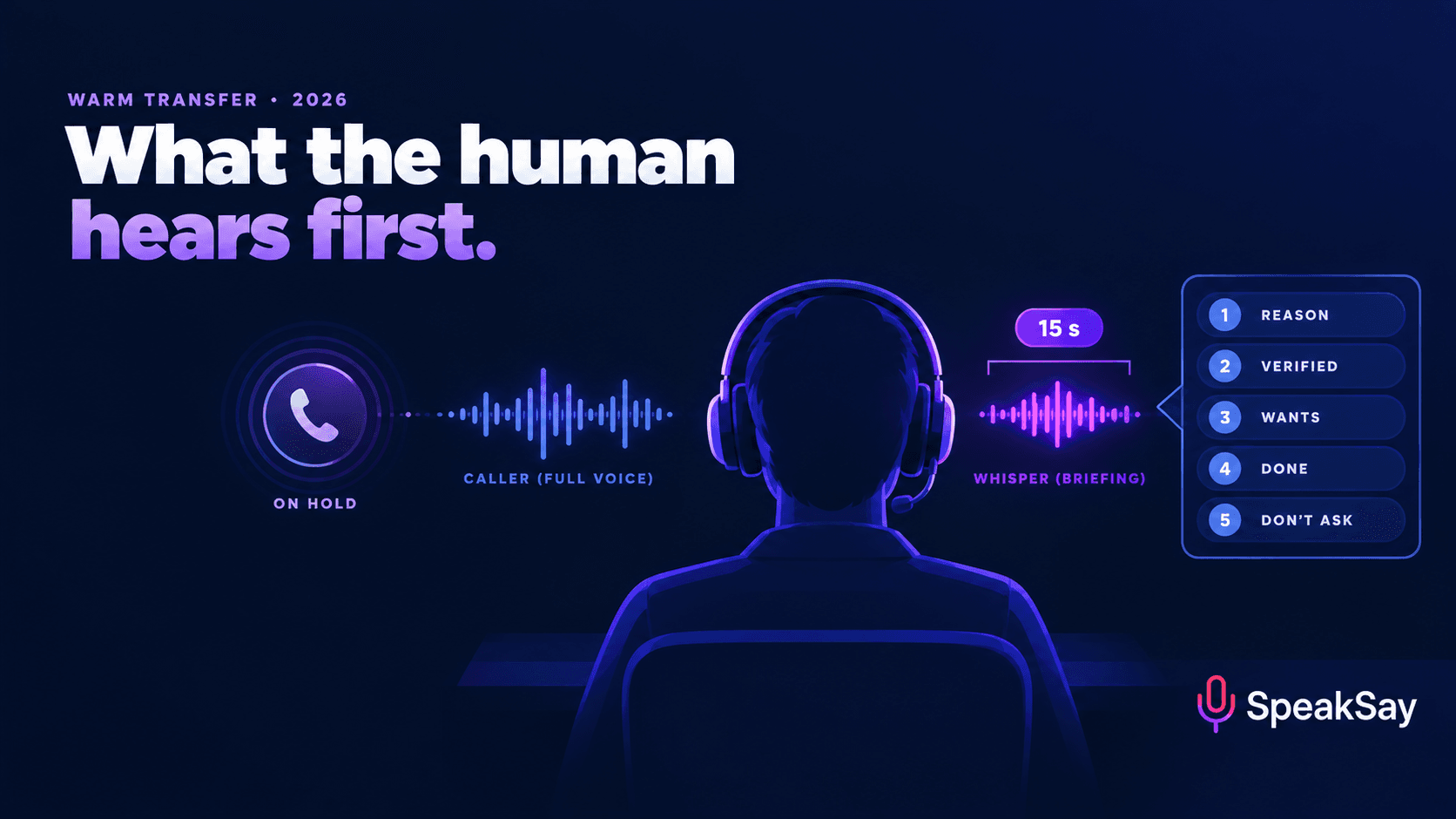
Fixed slots in a fixed order matter more than clever wording. If every whisper puts the same kind of information in the same place, agents learn where to listen, and that matters more than a perfect sentence in any one briefing. Here is the order we recommend, with the reason for each position:
| Slot | What it says | Why it's in this position | Example |
|---|---|---|---|
| 1. Reason | Why the agent is transferring, in one clause | The human needs to know what kind of call this is before anything else | "Billing dispute, refund over policy limit." |
| 2. Verified | Identity status and the name to use | Stops the most hated repeat of all: re-verification | "Verified. Priya Shah, account ending 4471." |
| 3. Wants | The outcome the caller asked for, in their words if short | The agent's guess and the caller's request can differ, so give the request | "Wants the 89-dollar charge reversed." |
| 4. Done | What the agent already tried, said or promised | Prevents the human repeating a fix or contradicting a promise | "Offered store credit, declined. Told her a specialist can review." |
| 5. Don't ask | Anything the caller has already given, plus a mood flag if it matters | Last thing heard is what sticks, so make it the guard rail | "Already gave order number and date. Frustrated, second call this week." |
Read together, the example whisper above is about 40 words. At a brisk briefing pace that runs to roughly 13–15 seconds, and the human can open with "Hi Priya, I understand you'd like the 89-dollar charge reversed, and you've already been offered credit. Let me look at that review now." The caller hears that they were listened to, and that is the whole point of a warm transfer.
A few rules keep the slots honest:
- The reason slot uses your team's own categories. If the queue is labelled "billing disputes", say "billing dispute", not "a question about a charge".
- Use the caller's stated intent, not the model's inference. Roark makes the same point in its test plan. If the caller switched topics partway through, the whisper gives the latest one.
- The "done" slot must include promises. If the agent said "a specialist will waive the fee", the human needs to hear it before the caller quotes it back.
- Leave a slot out when it's empty. If identity wasn't verified, say "Not verified", not nothing. Silence in a fixed slot is ambiguous.
- Don't editorialise. "Frustrated" is useful. "Rude and unreasonable" sets the human against the caller before they've spoken.
4. The time budget: 15 seconds, not 30
Industry write-ups describe the whisper as a briefing of fifteen to thirty seconds, and Roark's suggested test asserts that it stays under 25. Treat 25 as the failure line, not the target. Aim for 10–15 seconds, for three reasons:
- The caller is on hold the whole time. A 30-second whisper plus dial time plus answer time is easily a minute of silence or music for someone who was mid-conversation a moment ago.
- Attention falls off fast. A human who has just picked up a transfer is listening for what to say first. After 15 seconds they're already forming their opener and half-listening to the rest.
- Long whispers hide the important slot. If "already gave the order number" is the ninth fact, it won't be remembered.
| Whisper length | Roughly | What usually happens |
|---|---|---|
| Under 8 seconds | About 20 words | Often missing the "done" slot, so the human repeats a fix |
| 10–15 seconds | 35–45 words | All five slots fit at a brisk pace. This is the target |
| 16–25 seconds | 50–70 words | Acceptable for complex cases such as multiple accounts or a promise made |
| Over 25 seconds | 70+ words | Caller hold time climbs, humans stop listening, and the whisper has turned into a transcript |
The easiest way to hold the budget is a hard word cap in the generator, around 45 words with a 70-word ceiling for flagged complex cases, rather than relying on the model to "keep it short".
5. Voice it differently from the caller-facing agent
Here is the design choice that most teams never consider: the whisper should not use the same voice as the agent the caller has been talking to.
When a human picks up a transfer and hears the caller-facing voice, they have a split second where they don't know whether they're hearing the briefing or the call has already been bridged. On a busy floor that confusion leads to people speaking over the whisper, or greeting a caller who isn't there yet. A distinct whisper voice removes the ambiguity in the first syllable.
- Pick a clearly different voice, not a slightly different setting of the same one. Ideally use a different timbre or gender presentation and a flatter, more "internal" delivery.
- Keep it the same on every whisper. Consistency is how staff learn to recognise it. Don't rotate voices.
- Run it faster than the caller-facing voice. Customer-facing agents are usually tuned to a calm, even pace. Staff are trained listeners, so a whisper about 10–20% faster than your customer voice is normally fine. Test it with your team rather than guessing.
- Keep the pitch neutral. Very bright or very deep voices tire listeners over a shift. A mid-range, plain-spoken voice is easier to hear 80 times a day.
- Avoid warmth cues aimed at customers. No "Hi there!" opener, no smile in the voice. It's a colleague passing a note, not a greeting.
Audition a whisper voice in two minutes
Paste the example whisper above into SpeakSay's text-to-speech and try it in three or four plain, mid-range voices from the library. Then play each to someone on your support floor and ask which one they'd want to hear 80 times a shift.
6. Numbers, names and the "say it once" problem
The whisper is generated at runtime, so you can't proofread each one. What you can do is control how the values inside it are written before they reach the voice. The normalization pass we use for prices and dates applies here, with a few rules specific to whispers:
| Value | Write it for the voice as | Why |
|---|---|---|
| Account or order number | Last 4 digits only, in pairs: "ending forty-four, seventy-one" | The full number is on screen. Hearing the last four is enough to confirm the match |
| Money | "89 dollars", not "$89.00" or "eighty-nine point zero zero" | Cents rarely matter in a whisper. Round unless the dispute is about the cents |
| Dates | "Last Tuesday, the 29th" rather than "2026-09-29" | Relative plus day number is fastest to place |
| Caller name | The name the caller gave, with a pronunciation hint stored from the call if possible | The human will say it out loud within seconds, so getting it right is the first impression |
| Product or plan names | Your internal short name | Staff know "Pro Annual". They may not know the marketing name |
| Times | "Around two this afternoon" | Precision to the minute is screen information, not whisper information |
The underlying rule: the whisper confirms, the screen records. If a value needs exact precision, it belongs on screen and the whisper only needs enough of it to confirm the human is looking at the right record. That rule also keeps whispers short.
Names are where speech engines most often slip. If your agent captured the caller's own pronunciation of their name, pass it through. Otherwise, check the pronunciation and locale QA we recommend for voice agents and build a small lexicon of the names that come up often in your customer base.
7. Screen pop and whisper do different jobs
A common objection: "We already send a summary to the agent's screen, so why whisper at all?" Because the two do different jobs, and in practice screens often aren't ready in time. ETS Labs describes screen pops arriving after the agent has already answered, and legacy telephony middleware that only passes around 256 characters of data, enough for an account number and a flag.
| Whisper (audio) | Screen pop (visual) | |
|---|---|---|
| Arrives | Before the bridge, guaranteed while the caller waits | Whenever the integration delivers it, sometimes late |
| Best for | The opener: reason, name, request, what not to ask | Exact values, full transcript, history, notes |
| Read how | Once, in order, at a fixed speed | Scanned, re-read, searched |
| Fails how | Too long, wrong slot order, confusing voice | Late, cluttered, buried below the fold |
| Length | 35–45 words | As long as needed, with a summary panel at the top |
Design them as a pair. The whisper's five slots should be the screen's top panel, in the same order and with the same words, so the human hears it and then sees it confirmed. If the screen is late, the whisper alone is enough to open the call well. If the whisper is missed, the top panel says the same thing.
8. How to test the whisper
Our guide to evaluating voice agents covers how to measure escalation as an outcome. These checks are narrower: does the whisper itself work?
- Length. Log whisper duration on every transfer. Alert on anything over 25 seconds and review the weekly median against your 15-second target.
- Slot completeness. For a weekly sample, check that each of the five slots was filled or explicitly marked empty. Missing "done" slots are the most common failure.
- Repeat questions. In recordings or speech analytics, flag calls where the human asked for something the caller had already given the bot, such as the order number or verification. This is the metric the whisper exists to drive down.
- First-line test. Play ten real whispers to staff who weren't on those calls and ask them to say their opening line. If they can't form a sensible opener from the whisper alone, the whisper failed, however accurate it was.
- Voice recognition test. After two weeks, ask staff whether they can tell the whisper from the caller-facing voice in the first second. If anyone hesitates, the voices are too close.
- Intent-switch cases. Include test calls where the caller changes topic halfway. The whisper should give the latest intent, not the first.
- Bridge timing. Roark suggests checking that someone speaks within 1.5 seconds of the bridge. A good whisper helps here, because the human knows their first line before the caller arrives.
Also keep an eye on how long the whole handoff takes. A shorter whisper is wasted if dialling a human takes 40 seconds. Our voice-agent latency budget covers the caller-facing side of the same problem.
Give the whisper its own voice
Choose one distinct, plain-spoken voice for staff briefings and keep it fixed. SpeakSay's library has more than 1,900 voices across 20+ languages, so you can match briefing voices to every queue you run.
If your whisper volume is high, cost per minute matters too. A 15-second whisper on every transfer adds up across a busy contact center, so the plan you choose should fit your volume.
Plan for every transfer, not just the demo
Whispers run on every escalation, all day. Check SpeakSay's plans against your expected transfer volume before you scale.
9. FAQ
What is a warm-transfer whisper?It is a short private audio message played to the human agent before the caller is connected. The caller is on hold while it plays. It tells the human why the call is being transferred and what the caller has already said, so the caller doesn't have to repeat themselves.
How long should a whisper be?Aim for 10–15 seconds, about 35–45 words. Treat 25 seconds as the upper limit. Longer whispers add hold time for the caller and are less likely to be remembered by the agent.
What should the whisper include?Five slots in a fixed order: the reason for the transfer, identity verification status and name, what the caller wants, what the agent already tried or promised, and what not to ask again (with a mood flag if relevant).
Should the whisper use the same voice as my voice agent?No. A clearly different voice tells staff right away that they're hearing the briefing and not the caller. Keep the whisper voice the same on every transfer so staff learn to recognise it.
Do I need a whisper if I already have a screen pop?Usually yes. The whisper is guaranteed to arrive before the bridge, while screen pops can be late or cluttered. Put the same five slots at the top of the screen so the two confirm each other.
How do I read account numbers in a whisper?Read only the last four digits, in pairs, and leave the full number on screen. The whisper's job is to confirm the right record, not to deliver exact data.
How do I know if the whisper is working?Track how often humans ask callers for information the bot already collected. If that rate falls after you redesign the whisper, it's working. Also track whisper duration and whether staff can open the call from the whisper alone.