Your AI Podcast Forgets Every Episode: Building a Series Memory So Episode 12 Can Reference Episode 3 (2026)
Generated podcasts are produced one episode at a time from one source set, so nothing accumulates between them — no shared vocabulary, no callbacks, no position, no relationship. Here is the artefact stack that gives a generated show a memory: a series canon, an episode ledger, callback mechanics and locked voices.
1. Why your generated show has amnesia
Gemini Notebook is source-grounded: it answers and generates only from the material you upload into a given notebook. The Audio Overview pipeline is roughly read the sources, build a script, then synthesise that script as two conversational voices. Nothing enters the script that was not in the sources or your instructions.
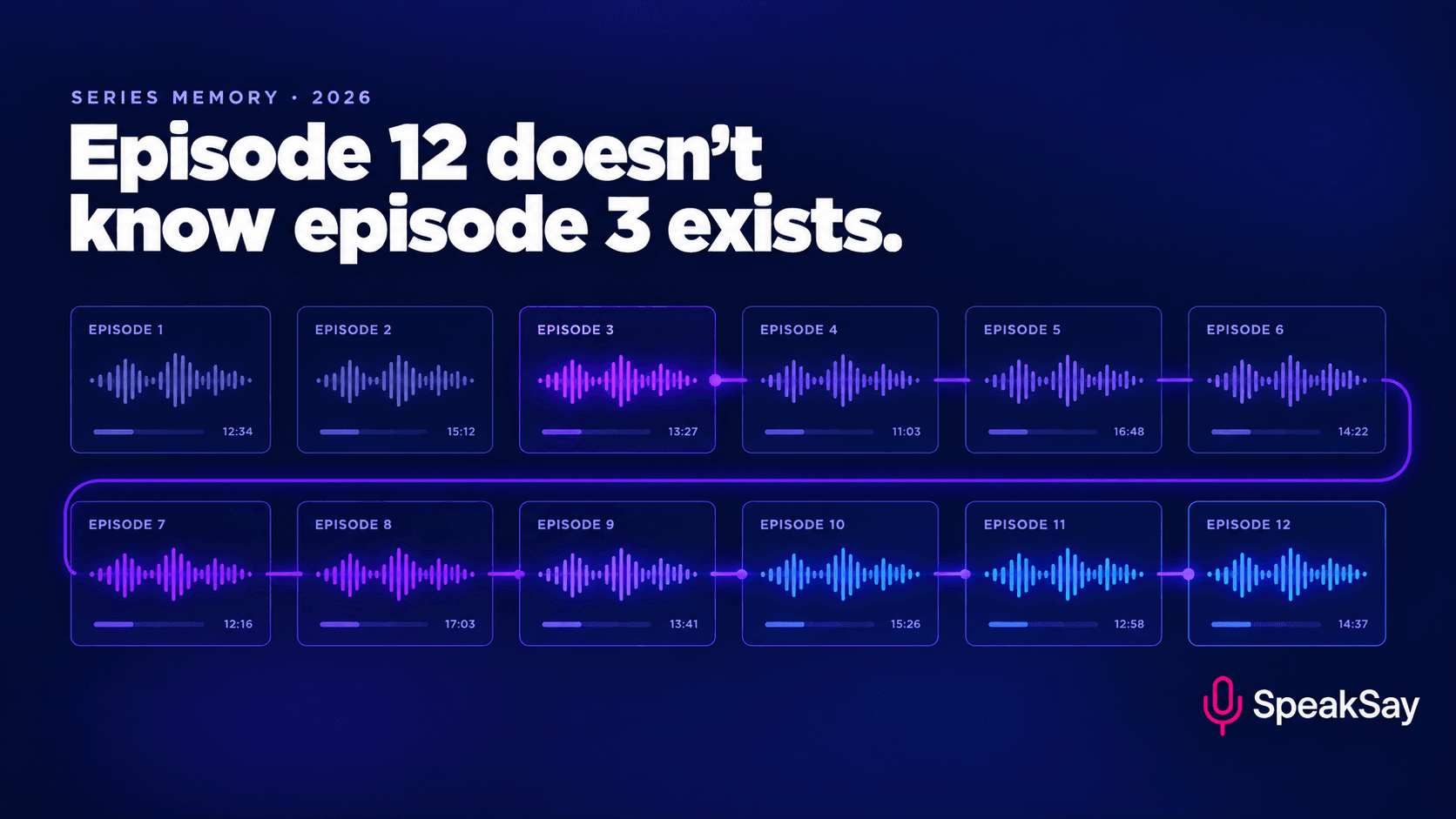
Now the constraint that breaks series work: as of 2026 documentation and user write-ups, separate notebooks still cannot search one another. Each notebook is an island. The standard podcast workflow — one notebook per episode — therefore produces one amnesiac episode after another.
This is not a bug, and it will probably never be "fixed" in the way people expect. Source-grounding is exactly why the output is factual rather than invented; the isolation is the same mechanism from another angle. You are not fighting a defect, you are paying a cost — and the cost is memory.
Budget matters too. Free accounts get roughly three Audio Overviews a day and Pro around twenty; from 2 September 2026, chat and Studio usage moved to a compute-based quota refreshing on a rolling five-hour cycle under a weekly ceiling. Regenerations are finite, so front-loaded artefacts beat brute force.
The other recurring 2026 complaint is that generated hosts are too agreeable and formulaic. Same missing memory: hosts with no history have nothing to be consistent with.
2. What a series actually accumulates
A series is not a set of episodes. A series is the accumulation between them.
A human show accumulates four things without anyone deciding to.
- Shared vocabulary. By episode 5 the hosts stop re-defining terms. Regulars feel fluent; the show stops sounding like a tutorial.
- Callbacks. A throwaway line in episode 3 lands harder in episode 12, because the audience earned it. Callbacks convert listening into membership.
- Position. The hosts have said things before, so they can now be wrong, inconsistent, or — better — visibly change their minds. A show with a position is one you can argue with.
- Relationship. In month six the hosts know each other. They interrupt in patterns; one has a predictable objection. That texture is what people mean by chemistry.
A generated show has none of the four unless you build them. Every episode opens at zero: re-explaining basics, agreeing with itself, ending without leaving anything hanging.
This is the real reason people sample a generated show and do not subscribe. Not audio quality — synthetic audio in 2026 is fine. It is that there is no reason to come back, because nothing is being built. Subscription is a bet that next week pays off something this week set up. Remove the accumulation, remove the bet.
Produce the episodes, keep the continuity
SpeakSay's AI Podcast generator turns a script, article or outline into a two-host conversation — and because you control the hosts and instructions, the canon below actually carries between episodes.
3. The series canon document
The highest-leverage artefact here is a plain text file. The canon is one to two pages describing your show as a thing that persists: the hosts, what the show has already said, which terms are already defined, the running bits. You then attach it as a source to every episode's notebook.
That is the whole trick. You cannot make notebook 12 search notebook 3 — but you can put a summary of notebook 3 inside notebook 12. The canon routes around cross-notebook isolation by turning continuity into a source, the one thing the system will definitely read.
The canon skeleton
| Section | What goes in it | Worked example |
|---|---|---|
| Premise (one sentence) | What the show argues, not what it covers. | "Most e-commerce growth problems are inventory problems in a marketing costume." |
| Host A | Name, role, assigned stance, default move. | Ravi — operator, enthusiast. Reaches for a warehouse example. |
| Host B | The opposing stance. Asymmetry is assigned, never emergent. | Nadia — sceptic. Asks who maintains it. |
| Shared glossary | Term, definition, episode first defined, instruction not to re-explain. | See below. |
| Running bits | Two or three maximum: a segment name, a phrase, an ongoing argument. | "The Spreadsheet Graveyard" — an abandoned tool, every episode. |
| Position log | What the show has asserted, so later episodes build instead of rediscover. | "Ep 2: discounting is a forecasting failure. Ep 6: against weekly counts. Ep 7: softened — fine under 200 SKUs." |
| Listener promises | Anything said on air a listener could hold you to. | "Scorecard template promised ep 5, undelivered." |
| Banned phrases | The tells — your defence against the formulaic register. | "dive into", "fascinating", "game-changer". |
The glossary column that does the work
Most people write a glossary as definitions. The third column is the one that works.
| Term | Definition | Status |
|---|---|---|
| Stock cover | Days of sales current stock will last. | Defined ep 1 — do not re-explain. |
| Dead stock | Units with no sale in 90 days. | Defined ep 2 — do not re-explain. |
| Service level | Demand met from stock on hand. | Defined ep 4 — one-clause reminder allowed. |
| Lead-time variance | Promised versus actual delivery. | Not yet defined — full explainer permitted. |
Point at it in your instructions: "For any term marked 'do not re-explain', use it as established vocabulary — no definition, example or analogy." That one line separates a show that sounds like episode 12 from one that sounds like episode 1 again.
4. The episode ledger
The canon describes the show; the ledger records what happened. Fill it in right after publishing, while you still remember — about four minutes. It becomes your input for the next episode's instructions.
| Ep | Thesis | Terms defined | Claims made | Callbacks planted | Open threads | Cliffhanger |
|---|---|---|---|---|---|---|
| 1 | Stock levels are a forecast made visible. | Stock cover | Most stockouts are known 3 weeks ahead and ignored. | Nadia: "every dashboard is a to-do list". | Never explained why. | "Next time: the spreadsheet that ate a business." |
| 2 | Discounting is a forecasting failure. | Dead stock | A scheduled sale is usually an apology. | First Spreadsheet Graveyard entry. | Promised to define service level later. | None — flat ending, noticeably weaker. |
| 3 | Suppliers are a variance problem. | — | Lead time is a distribution, not a number. | The pallet that arrived twice. | Whether to name suppliers on air. | "Ravi wants supplier scores. Nadia says that's a spreadsheet waiting to die." |
| 4 | Scorecards work only if one person owns them. | Service level | Paid off ep 2's promise; contradicted ep 3. | The twice-arriving pallet, one line. | Scorecard template promised. | "The ep 3 argument isn't settled. Nadia has receipts." |
Two things here no prompt can give you. "Open threads" is your episode backlog — you will never again stare at a blank notebook wondering what episode 9 is. And "claims made" lets you deliberately contradict yourself, the most underrated move in series podcasting, and one generated shows never make because they have no record of what they thought.
5. Callback mechanics: planting and paying off
A callback is any reference to earlier material that rewards a returning listener. Three types are worth planting deliberately.
- A term. Cheapest: use vocabulary the show already owns, unexplained. Ten per episode is fine. The listener barely notices — that is the point.
- A claim. Referring to a position the show took. "We said in episode 2 that discounting is an apology. This is the awkward case." This is where authority accumulates.
- A running bit. Highest payoff, easiest to overdo. The Spreadsheet Graveyard works because it is one slot, once per episode, never re-explained after episode 2.
The payoff rule
A callback must work for a first-time listener too, or it is a tax on new subscribers.
Read the line aloud as if you had heard nothing before it. If it is still a complete thought, it passes. If it is a wink at an in-group, add four words of context.
- Fails: "Classic Spreadsheet Graveyard material." Means nothing cold.
- Passes: "Another one for the Spreadsheet Graveyard — a 40-tab reorder sheet nobody has opened since March." Complete cold, richer if you are a regular.
The difference is one clause: self-contained on the surface, layered underneath.
Density
One or two real callbacks per episode, not five. Five turns the show into a members-only club and makes episode 12 unusable as an entry point — and your newest listeners arrive at your newest episode. Vocabulary callbacks are free.
6. Segment architecture: the furniture of a show
Much of what makes a show feel like a show is fixed furniture arriving in the same order every week — and furniture is the easiest continuity to generate, because you specify structure rather than hope for personality.
| Segment | Length | What it does for continuity | How often |
|---|---|---|---|
| Cold open | 15–25 sec | One specific claim before any greeting. Trains listeners that the show starts with substance. | Every episode |
| Stakes recap | 20 sec | Carries last episode's unresolved thread. The load-bearing device. | Every episode |
| Recurring segment | 2–4 min | What people describe when recommending the show. Format identity independent of topic. | Every episode, same slot |
| Mailbag slot | 3–5 min | Makes the audience part of the canon; hands you legitimate callbacks. | Every second or third |
| Position check | 1–2 min | Defends or revises an earlier claim. Where a show stops sounding agreeable. | Every fourth |
| Sign-off | 20–30 sec | Same closing shape, ending on a hook for next time. Missed when absent. | Every episode |
Name your segments in the canon and keep the sign-off nearly identical each week. Predictable endings are not lazy — they are the audio equivalent of a title sequence, and the cheapest way to make twelve files feel like one show.
Lock your hosts before episode 2
Pick two voices with genuinely different textures — one warmer, one drier — and keep them for the whole run. Note the exact voice IDs in your canon.
7. The recap problem
You have a split audience: much of episode 12's listenership heard episode 11, and the rest did not. Summary recaps bore the first group and fail the second, because a summary of a conversation interests nobody who was not in it.
The rule: a recap carries stakes, not summary. Do not report what was discussed. State what was left unresolved and why it matters now.
The 20-second structure
- The unresolved thing (7 sec). "Last time we couldn't agree whether supplier scorecards survive contact with a real warehouse."
- Why it matters now (7 sec). "Which gets expensive the moment two suppliers ship the same part."
- Today's entry point (6 sec). "So today: what you do when two suppliers ship one SKU at different reliabilities."
Someone who heard episode 11 gets continuity; someone who did not gets a clean premise. Compare the failing version — "last week we talked about supplier scorecards, which was really interesting" — the default if you do not specify otherwise.
Write the recap as fixed copy rather than asking for one. Twenty seconds by hand is the highest-value twenty seconds in the episode.
8. Voice continuity: the other half of series memory
People discover this too late, usually around episode 5, and no canon will save you from it. If your hosts' voices change between episodes, you do not have a series.
Listeners identify a show by voice before anything else. Recognition is what your continuity hangs off — a callback delivered by a different-sounding host is not a callback, it is a stranger claiming to remember something.
- Pooled or auto-assigned voices. If a tool picks hosts for you, it may not pick the same ones twice, and an update can shift the default pairing mid-run.
- Undocumented settings. Same voice, different speed or stability value, and it reads as a different person.
- Level drift. Inconsistent loudness feels inconsistent even when the voices are identical. Pick a target and keep it.
- Silent model upgrades. A better model is still a different voice. Change one only at a season boundary.
Treat voices as canon, not a production setting. Add a voice block: each host's voice name and exact ID, speed, stability and style values, target loudness; one line on why the pairing works ("B is drier and slower — carries the sceptic role without acting"); the episode range they are locked for; a backup voice each.
For a long run, voices you own beat voices you rent. A cloned host voice — yours, or a collaborator's with permission — cannot be reshuffled by a platform default, and stays available for the promo cuts a growing show needs. If you would rather not clone, the principle holds: fixed library, recorded IDs, no improvising mid-run.
Keep final voicing in one place so settings are reproducible. Working from scripts, a text-to-speech workflow with saved per-host presets beats re-selecting voices each time, and voice cloning removes the reassignment risk. The rest of the toolset sits alongside it — consistency is easier when nothing moves.
Twenty episodes is a volume question
A weekly two-host show is a lot of synthesis. Check generation limits and voice slots before committing to a schedule you will ration.
9. The 45-minute retrofit
Eight episodes out already? You do not need to start over.
- Listen back at 2× (20 min). No careful notes. You want four things: terms you defined, claims you made, anything you promised, any line that could become a running bit.
- Fill the ledger retroactively (10 min). Eight rows, rough is fine. "Callbacks planted" will be mostly empty — that blank column is the diagnostic.
- Write the canon (10 min). Premise, two hosts with opposing stances, glossary from the terms, position log from the claims, unkept promises, banned phrases from your own tics.
- Name the furniture (3 min). One recurring segment, one sign-off shape. If an accidental bit exists, promote it — retroactive continuity is real continuity.
- Attach and instruct (2 min). Add the canon as a source in episode 9's notebook and reference it explicitly.
Then do the thing that converts a back catalogue into a series: in episode 9, pay off something from episode 4 and revise a claim from episode 6 out loud. Bingers will read the seam as the show finding its feet.
After that, overhead is about eight minutes an episode: four for the ledger, two for the canon, two for the recap. The whole cost of having a show instead of a feed.
10. What this does not fix
- A show with no thesis. If your premise is "we discuss interesting things in marketing", continuity makes the emptiness consistent, not less empty. Fix the premise first.
- A topic with no depth. Some subjects are one good episode. Series memory on a five-episode topic is elaborate callbacks to nothing.
- Weekly output nobody asked for. If nobody is listening at episode 3, the problem is distribution. A canon makes a show retainable, not discovered.
- Source-grounding itself. The canon is a workaround, not a capability. Episode 12 still cannot search episode 3 — it reads only what you wrote down. Your ledger discipline is the real ceiling.
Everything else is tractable, and most of it is a two-page text file. The gap between a generated feed and a generated show is not a prompt — it is an artefact you maintain. Start the ledger with your next episode.
11. FAQ
Can Gemini Notebook search across multiple notebooks?No. As of 2026 documentation, separate notebooks cannot search each other, and an Audio Overview is generated only from the sources in its own notebook. The workaround is to attach a short series canon document as a source in every episode's notebook, so continuity travels with the material rather than across notebooks.
How do I make an AI podcast series instead of one-off episodes?Maintain three artefacts: a series canon (premise, hosts with assigned opposing stances, glossary, position log, running bits, banned phrases), an episode ledger (thesis, terms, claims, callbacks, open threads, cliffhanger), and a fixed segment architecture. Attach the canon to every generation and lock your host voices for the run.
Why do AI-generated podcast hosts sound so agreeable?Because they have no history to be consistent with. 2026 reviewers frequently describe generated hosts as too agreeable and formulaic; the cause is structural — with no record of what the show asserted, there is nothing to defend or revise. Assign opposing stances in the canon and keep a position log.
How many callbacks should an episode have?One or two substantive callbacks. Vocabulary callbacks — terms the show already defined, used without re-explanation — are unlimited and do not count. Every callback must still make sense to a first-time listener, otherwise it taxes new subscribers, who typically arrive at your most recent episode.
How do I open episode 12 without boring returning listeners?Use a 20-second stakes recap rather than a summary: seven seconds on what was left unresolved, seven on why it matters now, six on today's entry point. Write it by hand as fixed copy. Summary recaps bore returning listeners and fail new ones; unresolved stakes serve both.
What are the current Gemini Notebook generation limits?Roughly three Audio Overviews per day on the free tier and around twenty on Pro. From 2 September 2026, chat and Studio usage moved to a compute-based quota refreshing on a rolling five-hour cycle under a weekly ceiling. For series work, front-loaded documentation is cheaper than repeated regeneration.
Should I clone my own voice for a podcast series?It is the most reliable option for a long run: a cloned voice cannot be reassigned by a platform default or shifted by a model update, and it stays available for trailers and ad reads. If you prefer library voices, the requirement is the same — pick two contrasting voices, document the exact IDs and settings in your canon, and change them only at a season boundary.