Should Your Ads Use the Same Voice as Your Content? The 2026 AI Voice Casting Decision (With the Trust Data)
One 2026 study found AI-voiced audio ads perform as well as human-voiced ones — and that regional AI accents beat a neutral human voice three to one on recommendation. Another found human voices outperform AI by 34% on trust. Both are right. Here is what they actually mean for how you cast.
1. The contradiction, stated properly
Here is what the 2026 research actually said, as precisely as it can be stated:
| Finding | What it measured | Result |
|---|---|---|
| AI vs human audio ads, brand uplift | Standard brand-lift metrics after exposure to matched creative | Roughly 3% uplift either way — no meaningful difference |
| AI vs human audio ads, attention and distinctiveness | Whether the ad was noticed and gave a reason to choose the brand | The AI-voiced examples scored higher on distinctiveness and attention |
| Location-matched AI regional accents | "Would you recommend this brand?" | 33% for a matched regional AI voice vs 10% for a neutral human voice |
| Consumer trust perception | Stated trust in the voice, asked directly | Human voices ahead by 34% |
| Stated preference | "Do you prefer ads voiced by real people?" | 43% say yes |
| Awareness | "Have you heard a voice and wondered if it was AI?" | 88% yes |
| Host-read podcast ads | Brand recall vs produced spots | 71% recall premium; 69% say host-read feels more authentic |
Read the rows in isolation and you can justify any decision you like. Read them together and a pattern appears: the metrics where AI voices win are behavioural and measured after exposure. The metrics where AI voices lose are attitudinal and measured by asking people directly.
That is not a debunking of the trust data. Stated preferences are real and they predict certain things very well — particularly what happens when a listener finds out something they were not told. It is a clarification of what the trust number is about, which is the next section.
2. The two things being measured — and why only one is about AI
The performance studies measure a spot's ability to get attention and shift an impression in a single exposure. On that job, voice provenance turns out not to matter much, which is unsurprising: a thirty-second spot from a brand the listener has no relationship with is judged on clarity, distinctiveness and relevance. A well-cast synthetic voice does those things as well as a well-cast human one, and the 2026 data says sometimes better.
The trust studies measure something else: whether the listener will extend credibility to a voice they believe is a person. The 34% gap is not a judgement about audio quality. It is a judgement about a relationship. And the tell is in the host-read numbers — a 71% recall premium and 69% saying host-read feels more authentic. Nothing about a host-read ad is technically superior. What it has is a voice the listener chose, vouching for something.
So the honest summary is:
- For a spot, provenance is close to irrelevant. Cast for clarity, distinctiveness and audience fit. The 2026 performance data supports using AI voices without apology in produced advertising.
- For a recommendation, provenance is the whole thing. The value of "I use this and it's good" comes entirely from who is saying it. A synthetic voice can deliver information; it cannot deliver a personal vouch, and a listener who works out that it tried to will discount everything that voice ever said.
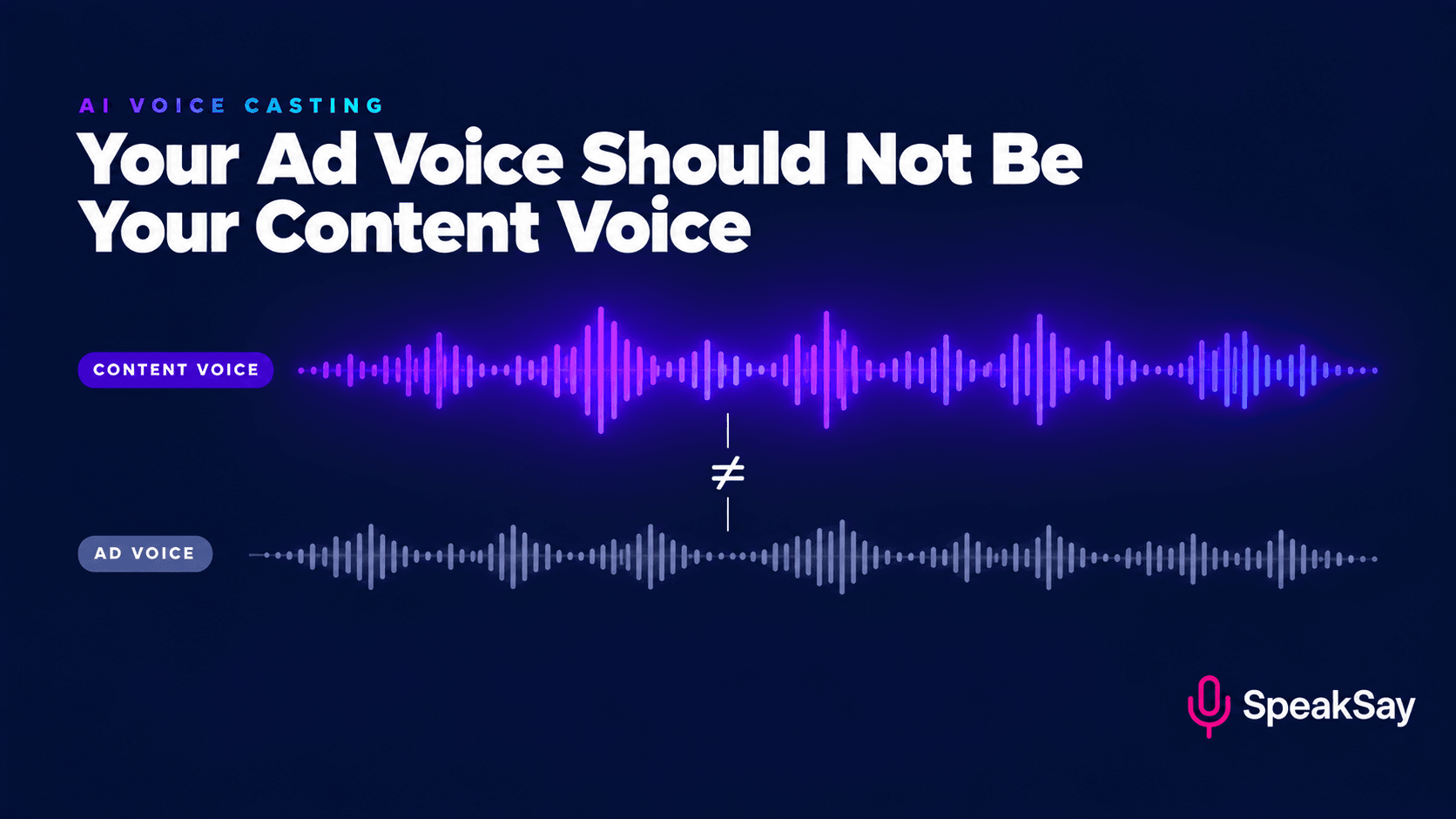
That distinction — spot versus vouch — is the axis your casting decision should turn on. It is not AI versus human. It is "is this voice informing, or is it recommending?"
3. Credibility transfer: the rule that decides the casting
Here is where the question in the title gets answered. Should your ads use the same voice as your content?
No — and the reason is an accounting one.
Your content voice accumulates credibility over time. Every video, episode or explainer where that voice was useful and did not oversell adds a small amount to a balance. That balance is the reason a host-read ad outperforms a produced spot by 71% on recall: the ad is drawing on the balance.
Drawing on it also spends it. That is fine and it is the intended use — that is what sponsorship is. But three things follow that most brands and creators do not think through:
- Every paid read is a withdrawal. If your content voice also reads your own promos, your product announcements, your upsells and your affiliate links, the balance depletes. The listener's model of the voice shifts from "this explains things" to "this sells things", and the shift is not reversible on any useful timescale.
- A synthetic content voice has a smaller balance to start with. Not zero — a consistent, well-cast narrator earns real familiarity over a year — but smaller, because part of the host-read effect is parasocial and a listener who knows the host is synthetic does not form the same attachment. Spend it more carefully, not less.
- Separation protects the balance at zero cost. A different voice for ads makes no withdrawal at all. The audience learns within two or three exposures that the shift in voice means "this is an ad", and — counter-intuitively — the content voice's credibility rises, because it is never heard selling.
The general principle, stated as a rule you can apply without re-reading this article:
The voice that explains should never be the voice that sells. If a voice is going to make a recommendation, it has to be a voice with standing to recommend — which means a real person, on the record, or nobody.
Two voices, one account
You do not need two subscriptions to run a separate ad voice. Cast and store both, and keep the settings fixed so neither drifts.
4. The per-placement casting table
Work down this table for each place your brand makes sound. "Same as content" means the channel's regular narrator; "distinct ad voice" means a second, deliberately different cast voice; "human, named" means a real person identified on the record.
| Placement | Cast | Why |
|---|---|---|
| Produced radio / streaming audio spot | AI, cast for the market | Pure spot. Provenance irrelevant; distinctiveness and accent match are what move the numbers. |
| Pre-roll / mid-roll video ad | AI, distinct ad voice | Same as above; keep it distinct from any content voice you also run. |
| Podcast host-read endorsement | Human, named — no exceptions | The entire value is the vouch. A synthetic host-read is the one case where the trust data bites hard. |
| Podcast produced spot inside your own show | Distinct ad voice | Legitimate and effective. The voice change is the ad marker, which is also good for the listener. |
| Your own product promo inside your own content | Distinct ad voice, or content voice used sparingly | If your narrator must do it, cap it: one short promo per episode, clearly bounded, never mid-explanation. |
| Explainer / how-to / documentation | Content voice | Informing, not selling. This is where the balance is built. |
| Customer support, IVR, on-hold | A third, service voice | Should be neither: an ad voice here feels like being sold to while you wait, a content voice feels like a bait-and-switch. |
| UGC-style / testimonial creative | Human, or do not make it | A synthetic voice performing a personal experience is the highest-risk use of AI audio in marketing. |
| Social short-form ad | AI, distinct ad voice, accent-matched | Short exposure, no relationship, strong accent-match effect. |
| Internal comms, training, L&D | Content voice or a dedicated internal voice | Informing. Do not reuse the ad voice; staff hear it as marketing at them. |
| Brand sonic logo / sign-off tag | Its own single voice, rendered once, reused forever | Consistency is the entire point. Render once, keep the file. |
5. What the regional-accent finding actually licenses
The most-shared number from the 2026 ad testing is the accent result: 33% would recommend the brand after hearing a location-matched AI regional accent, against 10% for a neutral human voice. It is a genuinely large effect and it is being over-read.
What it supports: matching the accent to the market. The mechanism is straightforward — a listener who hears their own region's speech assigns local belonging to the brand, and local belonging converts into recommendation more readily than polish does. AI voices make this practical for the first time, because casting twelve regional reads used to mean booking twelve sessions.
What it does not support:
- Accent as a substitute for relevance. The lift comes from a matched accent on creative that was already relevant to that market. A regional voice reading copy written for somewhere else scores worse than neutral, because now the mismatch is audible.
- Broad or approximate accents. "Generic Northern" or "generic Southern" is heard as an impression, and an impression of a region reads as mockery to the people from it. If you cannot cast the accent precisely, cast neutral.
- Accent-matching a vouch. The finding is about spots. Putting a regional accent on a synthetic testimonial does not make it a testimonial.
- Ignoring the saturation risk. The flagship "neutral professional" presets are now used widely enough that they can read as a marker of automation rather than of production quality. A regional cast is one escape from that. It is not the only one, and if your competitors all make the same move it will stop being one.
Practical version: run a matched regional read wherever you have market-specific creative and enough volume to justify a separate cut. Run neutral where the creative is pan-market. Never split the difference.
6. Building a second, deliberately distinct ad voice
The separation only works if the audience can tell the two voices apart instantly, on a phone speaker, while distracted. Two voices that are merely different are not enough — the listener has to register the change before they register the words.
The distinctness spec
| Dimension | Requirement |
|---|---|
| Gender read | Different from the content voice if at all possible. This is the single fastest discriminator. |
| Pitch | At minimum a clearly different register; same-pitch different-timbre is not enough on a phone. |
| Rate | Ad voice faster: 155–170 wpm against a typical content 135–150. |
| Energy | Higher and more front-loaded. Ads have a job to do in the first two seconds. |
| Warmth | Lower than the content voice. Warmth is what creates the vouch impression you are deliberately avoiding. |
| Accent | Free variable — use it for market matching per section 5. |
The five-second discrimination test
Cut two five-second clips — one content, one ad — and play them back to back to five people who do not work for you, on a phone speaker, at arm's length, with background noise. Ask one question: "same person or different?" If anyone hesitates, recast. This takes twenty minutes and it is the only test that matters.
Three rules once you have cast it
- Fix the roles and never swap them. A content voice that occasionally does an ad, or an ad voice that occasionally narrates, destroys the signal in one episode. The audience learns the convention; breaking it reads as an error, not a variation.
- Store the settings, not just the audio. Rate, pitch, style and any style controls, saved in a document alongside the voice. You will need to produce a matching ad eighteen months from now.
- Render the recurring lines once. Your sign-off, your URL, your brand tag — generate them a single time and reuse the file across every spot. Regenerating the same seven words repeatedly produces small variations that the ear reads as sloppiness.
Design an ad voice that sounds nothing like your narrator
Start from a preset, shift the pitch, rate and character until it fails the "same person?" test, and save it as a second brand voice.
7. Disclosure: when to say it, and why it usually helps
88% of listeners have heard a voice and wondered whether it was AI. That number is the argument for disclosure, and it is not a moral argument — it is a performance one. A listener running that question in the background is spending attention on it, and if they resolve it as "yes, and nobody said so", the discount they apply is much larger than the discount they would have applied to a disclosed synthetic voice.
Where disclosure is worth the words:
- Anywhere the voice appears to be recommending. If a synthetic voice says anything in the first person about using the product, either disclose or rewrite it into third person. Rewriting is usually better.
- Anywhere platform rules require it. Several major platforms now require synthetic-media labelling on advertising creative, and the EU AI Act's transparency duties apply from August 2026. Requirements differ by platform and jurisdiction and change often — check the current rules for each surface you buy, and treat this paragraph as general information rather than legal advice.
- In the ad-boundary marker inside your own content. "That was a partner message" costs three seconds and does more for the content voice's balance than the ad cost you.
Where it is not needed: an ordinary produced spot with no first-person claims, where nothing is being represented as a personal experience and platform rules do not require a label. Adding "this ad used an AI voice" to a straightforward retail spot draws attention to a question the listener was not asking.
8. A four-week test that will settle it for your brand
Every argument above is a prior, not a result. Here is a cheap test that produces your own number.
- Week 1 — baseline. Run your current creative as-is. Record recall, click-through and, if you can, a single post-exposure question: "would you recommend this brand to a friend?" That last one is where the accent and trust effects show up; standard ad metrics will not surface them.
- Week 2 — swap the voice, hold everything else. Same script, same music, same placements, distinct ad voice. Any difference is voice.
- Week 3 — accent match. In your two largest markets, run a locally accented cut against the neutral cut. Same script, same voice character where possible.
- Week 4 — the separation test. In your own content, run the ad in the distinct voice with a spoken boundary marker on both sides. Compare not just ad performance but content-episode completion and comment sentiment — the separation is supposed to protect the content, so measure the content.
Two cautions. First, hold the creative constant; if you change the script and the voice at once you have learned nothing. Second, do not run this on your highest-value campaign — run it on steady-state evergreen inventory where a bad week is survivable.
9. Six casting mistakes that show up in the data
- Using the flagship preset because it sounds the most professional. It is the most-used voice in the category. "Professional" and "anonymous" are now the same sound, and anonymity is the opposite of distinctiveness — the metric on which AI-voiced ads were actually winning.
- Casting deep for authority. Deep voices lose their body on phone speakers and in cars, which is where most ad listening happens. Perceived loudness on a small speaker is decided in the presence band, not the bass.
- Writing the ad script for reading, not for the ear. Sub-clauses, parenthetical qualifiers and long noun phrases survive on a page and collapse in a thirty-second spot regardless of who reads them.
- Letting the ad voice drift. Regenerating the sign-off every time produces micro-variation across a campaign. Render once, reuse.
- Putting first-person experience claims in a synthetic mouth. "I've been using this for months" from a voice with no months is the single most damaging line you can run, and it is the exact scenario the 34% trust gap is measuring.
- Treating the accent finding as a licence to fake a region. A near-miss accent is worse than no accent, because it reads as an outsider doing an impression of the audience.
Run both voices, and every regional cut, on one plan
Market-matched reads stop being a budget decision when each additional cut costs a render rather than a session.
10. FAQ
So do AI voices work in ads or not?In produced spots, yes — 2026 testing found brand uplift roughly equal to human-voiced creative (about 3% either way), with the AI examples scoring higher on attention and distinctiveness. In host-read endorsements, no, because the value of an endorsement is that a specific person is putting their name to it. The question "does AI voice work in ads" has two different answers because "ads" covers two different jobs.
If AI voices perform as well, why does the trust research say the opposite?Because it is measuring a different thing. Performance studies measure what a spot does in one exposure; trust studies ask people directly how much credibility they extend to a voice they believe is a person. Both results are real. The practical implication is not "avoid AI voices" — it is "do not use a synthetic voice to make a personal recommendation."
Can I use my own cloned voice for my ads?Yes, and it is one of the few cases where a synthetic voice can carry an endorsement, because the person doing the vouching is you and the voice is genuinely yours. Disclose the cloning where required, and keep the same separation discipline — if your cloned voice narrates your content and reads your ads, you still have the balance problem described in section 3.
Does a regional accent really triple recommendation rates?That was the finding in one 2026 test: 33% versus 10% for a neutral human voice, on the "would recommend" question specifically. It is a large effect on one metric, in creative already relevant to the market, with a properly cast accent. Treat it as a strong reason to produce market-specific cuts, not as a number you should expect to reproduce.
How different do the two voices actually have to sound?Different enough that five strangers can tell them apart in five seconds on a phone speaker with background noise. That is a much higher bar than "different enough that I can tell", because you know the answer. Different gender read is the fastest way to clear it.
Do I have to disclose that an ad used an AI voice?It depends on the platform and jurisdiction, and requirements have been moving quickly — several major platforms now require synthetic-media labels on ad creative, and EU transparency duties apply from August 2026. Check the current rules for each surface you buy. Separately from any requirement, disclose whenever the voice makes first-person claims: the downside of an undisclosed synthetic endorsement discovered later is far larger than the cost of the label. This is general information, not legal advice.