You Upgraded the Voice Model and Broke Your Back Catalogue: AI Voice Consistency Across a Multi-Year Channel (2026)
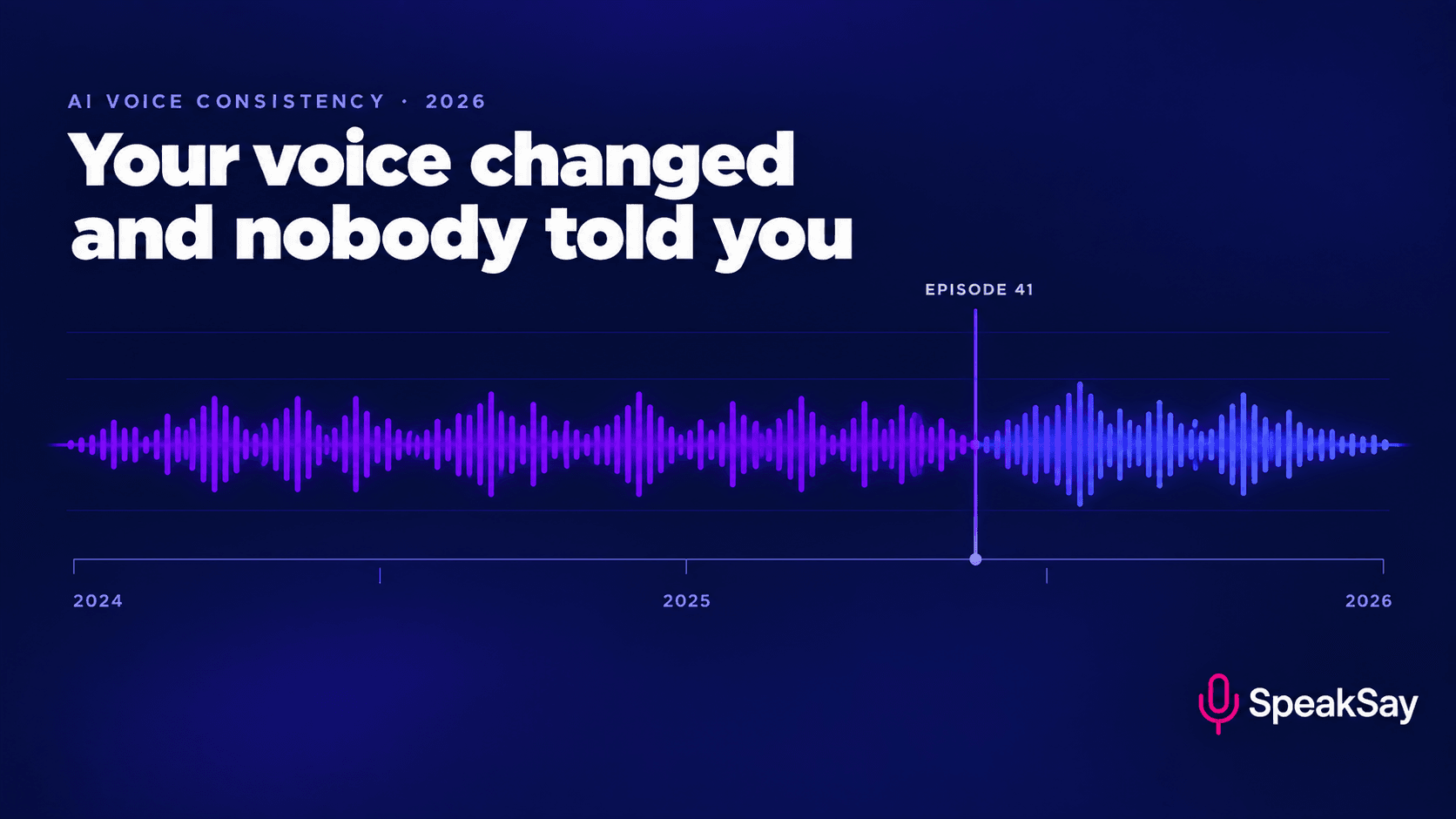
Your AI narrator sounds slightly different in episode 41 than it did in episode 12 — and you never changed the voice. Model versions move underneath you. Here is what actually drifts, why listeners register it without being able to name it, and how to decide what to re-render.
1. What voice drift actually is (and why it is not your imagination)
A synthetic voice is not a file. It is the output of a model, and the model is a moving object. Providers ship new versions, retire old ones, retrain on new data, change their default prosody handling, adjust how they interpret punctuation, and occasionally rename a voice while quietly swapping what sits behind it. Your settings panel keeps saying the same thing. The audio does not.
This is structurally different from every consistency problem a human narrator has. A human narrator's voice changes too — with age, with a cold, with the room, with how much they slept — but those changes are legible. Everyone involved knows what a cold sounds like. Model drift has no such vocabulary. It produces a voice that is recognisably the same person and measurably not the same recording, and the producer has no frame for it, so the usual conclusion is "I must have changed a setting" followed by twenty minutes of fruitless comparison.
The reason this matters more in 2026 than it did two years ago is that AI-narrated catalogues are now old enough to have a back catalogue. A channel that started in 2024 has two hundred videos across three or four model generations. An audiobook publisher has thirty titles. A podcast has a hundred and ten episodes. The consistency question used to be theoretical because everyone's catalogue was six weeks deep. It is not theoretical now.
One clarification before the diagnostics, because it saves a lot of wasted effort: drift is not degradation. Newer model versions are usually better — more natural, better at emphasis, less prone to the mechanical fourth-syllable stress that gave early TTS away. That is exactly what makes this awkward. You are not choosing between a broken voice and a working one. You are choosing between two good voices that are not the same voice, in a catalogue that assumes they are.
2. The six things that change when a model version moves
"It sounds different" is not actionable. When you compare an old render against a new one from the same script and the same voice, the difference is almost always concentrated in a small number of dimensions. Knowing which ones lets you decide whether the change is cosmetic or structural.
| Dimension | What changes | Audible? | Fixable after the fact? |
|---|---|---|---|
| Timbre / spectral balance | Brightness in the 2–5 kHz range, amount of body below 250 Hz | Only on a direct A/B, and mostly on headphones | Partly — EQ can close a small gap, not a large one |
| Baseline speaking rate | The same text renders 2–6% longer or shorter | Not as speed; audible as a duration mismatch against picture or music | Yes — time-stretch, but it costs quality past about 4% |
| Pause length derived from punctuation | Commas, full stops and paragraph breaks get different default durations | Yes, as "pacing feels different" | Yes, but only by editing the gaps individually |
| Prosodic contour | Where the model puts emphasis, how it handles question intonation and lists | Yes, and this is the one people actually hear | No — this is generated, not applied |
| Breath and mouth-noise synthesis | Whether, where and how loudly breaths are inserted | Very — an added or removed breath pattern changes perceived intimacy | Partly — breaths can be removed, not convincingly added |
| Loudness and dynamic range of the raw output | Output level and how much the model compresses its own dynamics | No, if you normalise; yes, if you do not | Yes — this one is genuinely trivial to fix |
Read the fourth column. Two of the six — prosodic contour and breath synthesis — are effectively unfixable in post, and they are the two that carry personality. Everything on the list that post-production can fix is the part listeners were least likely to notice anyway. This is the same asymmetry that shows up everywhere in synthetic audio: the cheap-to-fix problems are the ones nobody hears.
3. Why listeners register a change they cannot name
Here is the part that surprises producers. Listeners are extremely good at detecting that a voice has changed and extremely bad at describing how. This is not a failing on their part — voice identity is processed largely below the level of conscious description, which is why you can recognise a friend from two syllables on a bad phone line but could not write down what makes their voice theirs.
The practical consequence is that drift does not generate the feedback you would need to catch it. Nobody comments "your speaking rate increased by four percent and your question contours flattened." They comment that the show feels "more corporate lately", or "less like you", or they do not comment at all and simply weight the channel slightly lower in a way that never becomes a data point. If you are waiting for someone to tell you your voice changed, you will wait through the whole drift.
There is a second-order effect worth naming for anyone running a channel built on a cloned voice. A cloned voice carries an implicit claim: this is a person. A stock voice that shifts slightly is a production inconsistency. A cloned voice that shifts slightly is an inconsistency in someone who is supposed to be a human being with one throat. Audiences extend a lot of latitude to production and much less to identity, which is why drift in a cloned host reads as stranger than the same amount of drift in a stock narrator.
The honest counter-argument: most of the time, none of this matters. A viewer watching one video in a recommendation feed has no reference point and no drift to detect. The exposure that matters is sequential — the binge listener, the audiobook, the person who works through a playlist, the returning subscriber. If your format is one-off discovery traffic, drift is close to a non-issue and you should stop reading and go do something more useful. If your format is a sequence, keep going.
Lock a voice and keep it
SpeakSay's voice library and cloning tools let you save a configured voice — settings, pronunciation lexicon and all — so the same text renders the same way on episode 12 and episode 212.
4. The seam problem and the catalogue problem are different problems
Almost every confused conversation about this collapses two distinct failures. Separating them is most of the work.
The seam problem is drift inside one finished asset. You wrote a 40-minute episode, rendered most of it in March, came back in May to fix three lines, and the patched lines sit in a different timbre from the material around them. This is severe out of proportion to its size, because a seam is a discontinuity and human hearing is built to flag discontinuities. A two-second patch that does not match is far more noticeable than a whole episode that is uniformly four percent different.
The catalogue problem is drift between assets. Episode 12 and episode 41 are internally consistent and differ from each other. This is much milder per unit, but it accumulates, and it is the one that produces the "the channel feels different" comment. There is no discontinuity to flag — just a slow slide.
| Seam problem | Catalogue problem | |
|---|---|---|
| Where it lives | Inside a single file | Across a series |
| Severity per instance | High — reads as an error | Low — reads as a vibe change |
| Detection | Immediate on playback, if you listen to the join | Only on A/B across months |
| Correct response | Re-render the whole section or the whole asset | Usually: do nothing, and draw a line going forward |
| Cost of ignoring | One obviously broken asset | A slow, unattributable erosion of consistency |
The single most useful rule in this article: never patch across a model version boundary. If you need to fix one line in an asset rendered on an older version, re-render the entire contiguous section it sits in — at minimum the paragraph, preferably the chapter or segment. A uniformly new-version section abutting a uniformly old-version section at a natural structural break is nearly invisible. A new-version sentence dropped inside an old-version paragraph is not.
5. The render manifest: the ten-line file that saves the catalogue
You cannot manage drift you cannot see, and you cannot see it retroactively unless you wrote things down at the time. The fix is unglamorous: a small text file stored alongside every finished asset recording exactly how it was produced.
What to capture, per asset:
- Voice identifier — the exact voice name or ID, not "my usual one"
- Model or engine version, if the provider exposes it, and the date if it does not (the date is a usable proxy)
- Render date
- Rate, pitch and stability/expressiveness settings as literal numbers
- Whether a pronunciation lexicon was applied, and which version of it
- Post-processing chain — EQ, compression, loudness target in LUFS
- A 20-second reference render of a fixed calibration script, saved as audio
That last one is the part people skip and the part that does all the work. Keep one short, fixed paragraph — call it your reference script — containing a couple of long vowels, a question, a list, a number, and a proper noun. Render it every time you start a production session and keep the file, dated. You now have a time series of your own voice. When something feels off in eight months, you do not have to reason about it: you line up two reference renders and listen.
A good reference script is about fifteen seconds and deliberately boring. Something like: "Here is the thing worth knowing. The report came out on the fourteenth of March, and it covered three areas: pricing, distribution and support. Was any of it a surprise? Not really." Long vowels in "knowing" and "March", a date, a three-item list, a question with a real contour, and a short clipped answer. Fifteen seconds, and it exercises every dimension in the table in section 2.
6. Re-render, leave it, or draw a line: a decision table
Once you have detected drift, there are exactly three responses and most people reach for the wrong one. The instinct is to re-render everything. That instinct is almost always wrong, and it is wrong for a reason worth stating plainly: re-rendering a back catalogue replaces a mild, invisible inconsistency with a large, dated, audit-trail-destroying one, and it costs real money and real hours to do it.
| Situation | Response | Why |
|---|---|---|
| Drift inside one unpublished asset | Re-render the whole asset | Cheapest possible fix, and the seam is the worst failure mode |
| Drift inside one published asset, discovered later | Re-render the contiguous section, not the line | Structural breaks hide version boundaries; sentence boundaries do not |
| Catalogue drift on an episodic show | Draw a line: new version from here on, leave the archive | Listeners accept "the show evolved"; they do not accept a rewritten archive |
| Catalogue drift on an audiobook series with a continuing narrator persona | Consider re-rendering the most recent title only, to match the newest | Series listeners consume sequentially and recently; deep backlist gets less sequential exposure |
| Drift on evergreen assets that still drive traffic | Re-render only the top performers, newest-version-forward | Effort follows exposure; the long tail is not worth the hours |
| Voice retired or deprecated by the provider | Re-render forward only, and announce nothing | You have no choice on new work; silence is correct because the alternative draws attention to something most people will not notice |
| Cloned voice, and the clone itself was re-trained | Re-render the most recent 3–5 assets, then draw the line | Identity drift is the one case where a small re-render window genuinely pays |
| Drift discovered mid-series on a limited run | Finish the run on the old version if it is still available | A finite series is a single work; internal consistency beats being current |
"Draw a line" deserves defending, because it feels like giving up. It is not. Every long-running audio production in history has changed sound over time — different studios, different engineers, different mastering conventions, narrators who aged. Listeners have always absorbed this without difficulty, because it happens forward, at a natural rate, in one direction. What they have never absorbed is an archive that changes retroactively. Forward drift is history. Backward re-rendering is revision.
Re-render without watching a meter
Drift management means re-rendering sections you have already paid to render once. On a per-character plan that is a bill. On a flat plan it is an afternoon.
7. How to build a voice setup that survives a model change
Some production choices are more robust to model updates than others. None of them make you immune, but the gap between a fragile setup and a resilient one is large.
- Move pronunciation out of the script and into a lexicon. Inline respellings are tuned to how one model version handles one spelling. A voice-level lexicon entry is a declaration of intent that survives translation to a new version far better than "speak-SAY" hard-coded into four hundred scripts.
- Prefer punctuation and sentence structure over explicit markup for pacing. A short sentence is short on every model version ever built. A 400 ms break tag is a number whose perceptual effect depends on the surrounding rate, which moves.
- Normalise loudness as a separate, final step. Never rely on the model's raw output level. Master every asset to a fixed LUFS target as the last thing you do, and a whole category of drift stops existing.
- Keep settings numeric and written down. "Stability around the middle" is not a setting. 0.55 is.
- Do not chase every new voice. The most common cause of catalogue drift is not the provider — it is the producer auditioning a nicer voice every few months and quietly switching. Your voice is a brand asset. Change it deliberately or not at all.
- Batch by series, not by week. If you are producing a limited series, an audiobook, or a course, render all of it in as few sessions as you can. Assets rendered within one session cannot drift relative to each other. This single habit eliminates the seam problem entirely for finite works.
- Re-render your reference script at the start of every session. Fifteen seconds. It is the smoke alarm.
Number 6 is the highest-leverage item on the list and the one most likely to be ignored, because batching conflicts with the drip-feed rhythm of publishing. The point is that rendering and publishing do not have to share a schedule. Render the series in one sitting; publish it weekly. The audio was fixed at the moment of render and no update can reach it afterwards.
8. The 30-minute drift audit
Do this once, then quarterly. It is not difficult and it produces a real answer instead of a suspicion.
- Pick three assets — your oldest, one from the middle of your catalogue, and your newest. (2 minutes)
- Extract 20 seconds of clean narration from each, ideally similar content: an intro, a plain explanatory paragraph. Avoid music beds and anything heavily processed. (5 minutes)
- Listen to them back to back on headphones, twice, then once on a phone speaker. Write down what you hear in ordinary words — brighter, faster, flatter, more clipped. Do not try to be technical. (8 minutes)
- Measure the boring things. Integrated loudness of each clip, and the duration of a comparable sentence. If your loudness varies by more than about 1.5 LU between assets, you have a mastering problem, not a model problem, and it is trivially fixable. (5 minutes)
- Re-render one old paragraph with today's settings and compare it to the original. This is the decisive test: same script, same settings, different date. Any difference here is drift by definition. (5 minutes)
- Classify and decide. Seam or catalogue? Then run the table in section 6. (5 minutes)
The expected result for most people: loudness inconsistency is the biggest measurable difference, it has nothing to do with model versions, and fixing it accounts for most of the perceived improvement. Model drift is real, but it is usually the second problem, and doing step 4 before you go hunting for the exotic explanation saves an afternoon.
9. Three things not to do
Do not re-render the archive to "fix" it. Covered above, but it bears repeating because it is the most common reflex. The archive is fine. Nobody is A/B-ing your 2024 episodes against your 2026 ones except you.
Do not announce the change. There is a temptation to post "hey, my AI voice updated, you might notice." Resist it. Most listeners had not noticed, cannot un-notice once told, and the announcement converts an inaudible technical detail into a reason to think about the fact that the voice is synthetic at all. Disclosure obligations about synthetic media are a separate matter and should be handled in your standing disclosure, not as news.
Do not try to EQ your way back to the old timbre. You can close a small spectral gap. You cannot recover a prosodic contour, and prosody is the part carrying the identity. Time spent matching timbre with a parametric EQ while the emphasis pattern remains different is time spent on the one thing listeners will not hear, in service of ignoring the one they will.
10. FAQ
Why does my AI voice sound different when I did not change any settings?Because the model behind the voice moved. Hosted speech providers ship new model versions, retrain existing ones and adjust default behaviour without changing the name or the settings panel. Your configuration is the same; what it is configuring is not. The fastest way to confirm it is to re-render an old script with today's settings and compare against the original file.
Can I lock a specific model version so it never changes?It depends entirely on the provider — some expose explicit version selection and some do not, and versions that are exposed are usually retired eventually. Treat version pinning as a way to finish a project in progress rather than a permanent strategy. The durable strategy is to render finite works in as few sessions as possible and to keep a written manifest of how each asset was produced.
How much drift is enough to justify re-rendering?For a seam inside a single asset, any audible difference justifies re-rendering the surrounding section — discontinuities are disproportionately noticeable. For drift across a catalogue, the threshold is much higher: re-render only assets that are still driving significant traffic or that sit in a sequence people consume back to back. Most catalogue drift is best left alone.
Does drift affect a cloned voice more than a stock voice?It affects it differently. A cloned voice carries an identity claim, so listeners read inconsistency as something being wrong with a person rather than something being wrong with the production. In addition, a clone can drift for a second reason — if you retrain or re-clone from new source audio, the clone itself changes independently of any model update. Keep your original clone source material archived so you can re-create from the same inputs.
What should I write down about each render?Voice ID, model version or render date, rate and pitch and expressiveness values as literal numbers, whether a pronunciation lexicon was applied, your post-processing chain and loudness target, and a dated 15–20 second render of a fixed reference script. The reference render is the single most valuable item because it turns a vague suspicion months later into a direct A/B comparison.
My patched lines do not match the rest of the episode. What now?Re-render the whole contiguous section the patch sits in — the paragraph at minimum, the chapter or segment if you can. Version boundaries placed at natural structural breaks are close to inaudible; the same boundary in the middle of a paragraph is obvious. Never patch a single sentence across a model version change.
Should I tell my audience the voice was updated?Generally no. Most listeners will not have noticed, and an announcement makes the synthetic production method salient for no benefit. This is separate from your standing disclosure that the content uses AI narration, which should be clear, permanent and unrelated to individual model updates. Follow whatever disclosure rules your platforms and jurisdiction require.
Is newer always better?Usually yes on naturalness, and that is precisely the problem. You are not choosing between broken and working — you are choosing between two good voices that are not identical, inside a catalogue that assumes one voice. The quality improvement is real and it does not make the consistency question go away.
Start with a voice worth keeping
The cheapest drift management is picking a voice you will still want in two years — or cloning your own, which is the only voice that is definitionally yours.


