Where Does the Translation Actually Come From? Sourcing and QC-ing a Translator for AI-Narrated Foreign Editions (2026)
AI narration removed the production cost of a foreign-language audiobook and AI translation removed the text cost. What nobody budgeted for is the thing that cannot be automated: you cannot QC a language you do not speak. Here is where the text comes from, what each route costs in 2026, and how to judge it without the language.
1. The constraint moved from cost to verification
For most of the last decade the arithmetic said no: a five-figure translation invoice plus a four- or five-figure narration invoice, against a market where you had no name and no reviews. Two things broke that. AI narration took production from a booked studio to a rendering job you run from your desk. AI-assisted translation with human review on top took the text side down to something a mid-list indie can absorb. Audible in 2026 offers publishers AI narration plus AI-assisted translation from English into Spanish, French, Italian and German, with an option to have professional linguists review the translation for accuracy — which tells you where the industry puts the cost floor and, read carefully, where it puts the risk.
Money is no longer the gate. This is: you cannot quality-check a language you do not speak. That is why editions ship with a register error running through all fourteen hours — no mechanism for noticing it, no budget line for someone who could.
2. Why a translation error costs more in audio
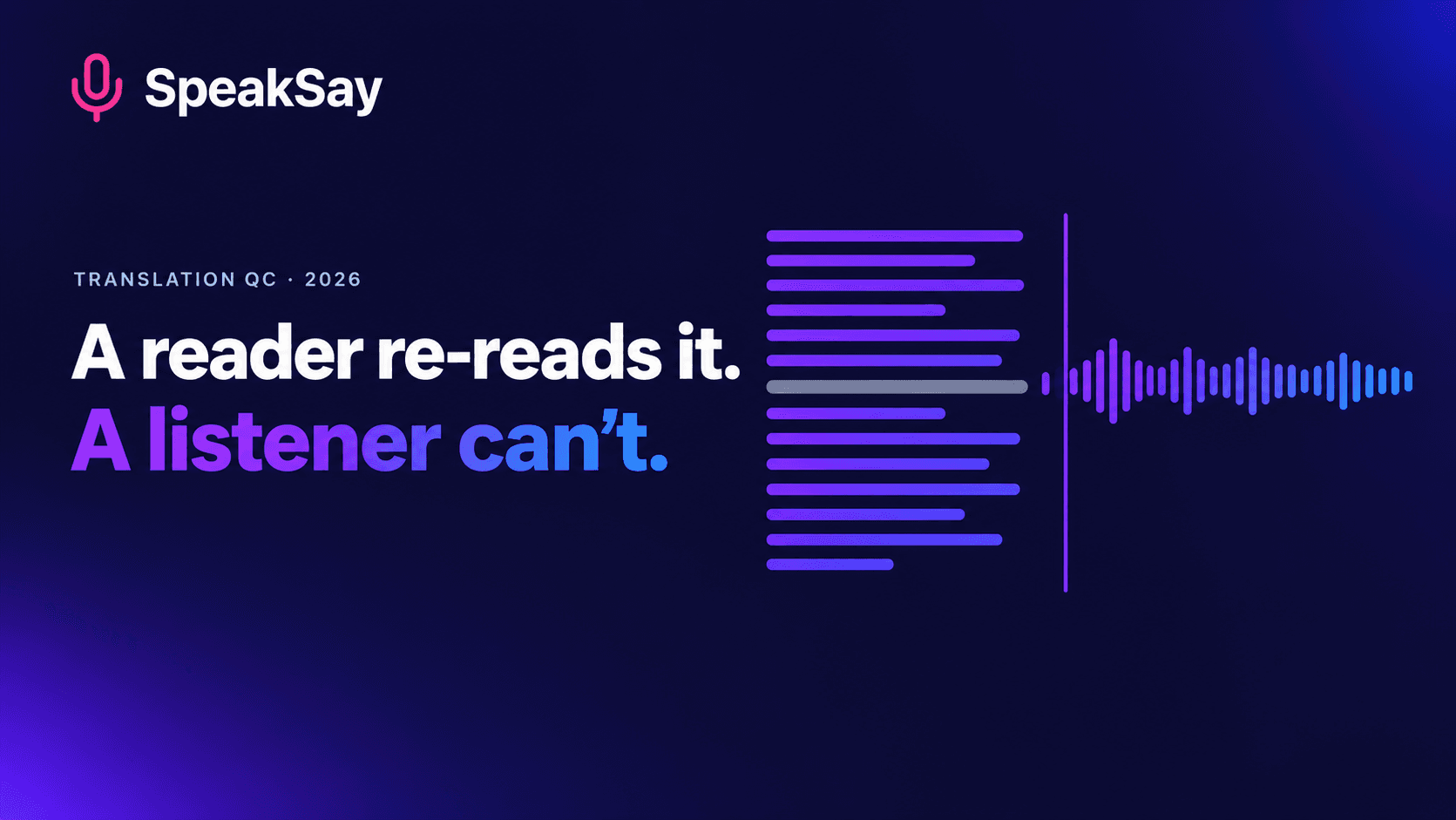
A reader who hits a slightly wrong sentence repairs it in half a second: the eye stops, backs up, re-reads, resolves, moves on, usually without registering that anything happened. Reading is self-correcting. It has a retry loop.
Audio has no retry loop. The odd sentence arrives at speaking speed, in a voice that sounds completely confident, and then it is gone. The listener cannot back up three words — only scrub fifteen seconds, which nobody does mid-commute. Instead they register a wrongness they cannot locate, and it accumulates. Four hours in, they are not thinking "that idiom was calqued"; they are thinking "this book is a bit off."
Synthetic narration sharpens it. A human narrator hesitates over a bad sentence, and the hesitation tells the listener the problem is in the text; a rendered voice delivers a mistranslation with the assurance it brings to everything else, so the listener blames the writing — which means you.
Hence the rule the rest of this follows: the QC standard for a translated audiobook has to be higher than for a translated ebook. Authors have this backwards because they treat audio as a derivative of the ebook, when for error tolerance it is the more demanding format.
3. Where the text comes from: three tiers
Three routes exist and vendors blur the lines between them. The middle one is MTPE — machine translation post-editing — and it is where most indie translation now happens, whether or not the invoice says so.
| Tier | What it is | Cost (80k words) | Turnaround | Fit for |
|---|---|---|---|---|
| 1. Full human | A literary translator works from your source, making authorial decisions about voice, rhythm and idiom, plus their own revision pass. | ~$5,000–$25,000 by pair | 2–5 months; good translators are booked | Literary fiction, humour, anything where prose is the product |
| 2. AI draft + human revision (MTPE) | Machine translation drafts the book; a native editor revises line by line against the source for register, idiom, names and rhythm. | 40–60% of tier 1 | 3–8 weeks | Genre fiction, most nonfiction, markets you are testing |
| 3. Raw AI output | Machine translation, no native-speaker pass. Indie wrappers advertise $200–$400 per language for a large box set. | $200–$400 per language | Hours | Sample chapters for market research. Nothing published. |
The hard rule: raw unrevised AI output is never publishable as audio. Not as a budget option, not for a small market, not for book one to test demand. Raw MT produces exactly the failure mode audio punishes hardest — locally plausible sentences with a drifting register and idioms rendered literally — delivered confidently, with no chance to re-read. As an ebook that is a bad idea some authors survive; as an audiobook it is a fourteen-hour demonstration of the problem.
Tier 3 is still good for one thing: run chapter one through it for pocket change, hand that to a native speaker, and learn whether your book is culturally legible there before spending anything real. For sourcing people, marketplaces like Reedsy's translation service are the sensible default on a first attempt. Otherwise look up the translator credited in a comparable book in your genre on the local store. A general freelance bid does not work: thirty proposals at a cent a word, all tier 3 with a human name attached.
Get the text right, then make the audio the easy part
Once a translated manuscript is signed off, producing the edition should be a rendering job, not a second project. SpeakSay narrates full-length books in dozens of languages from finished text.
4. What book translation costs in 2026
Professional book translation runs roughly $0.06 to $0.12 per word, depending on language pair, genre, prose complexity and translator experience. Anyone quoting a flat rate has not read your book. For an 80,000-word novel, 2026 translation-industry rate surveys put the bands here:
| Language group | Full human, 80k words | Why it sits there |
|---|---|---|
| German, French, Italian, Spanish | ~$8,000–$20,000 | Deep pool of literary translators, but high living costs and strong commercial demand keep rates up |
| Brazilian Portuguese, Polish, Czech | ~$5,000–$12,000 | Strong professional pools at lower local rates; often the best value per unit of quality |
| Japanese, Korean, simplified Chinese | ~$10,000–$25,000 | Greater distance from English, more restructuring per sentence, smaller pool working from English |
- The spread within a language is wider than the spread between languages. German at $0.06 and German at $0.12 are both real prices from real professionals. You are choosing a person, not a market rate. And the cheap row is not the low-quality row — those pairs sit lower because of local rate structures, which is why a first affordable market often lives there.
- Per-word pricing hides the revision question. Ask whether the quote covers the translator's second pass and responding to reviewer notes. A quote excluding both is not comparable to one including them.
When the gap between routes is a factor of fifty, the decision stops being financial. It becomes entirely about whether you can tell the difference in the output.
5. The translator brief nobody writes
Most authors send a print brief: manuscript, glossary of invented terms, please keep the voice. Fine for an ebook, insufficient for audio, because it omits every constraint that exists only when words are spoken.
- No footnotes, endnotes or parentheticals. They cannot be spoken. A translator working for print will add a parenthetical gloss for a culturally specific term — good practice on the page, a strange interrupting clause in audio. Ask for it woven into the sentence or dropped.
- Flag homophone collisions. Two character names that sound identical aloud, a coined term colliding with a common word, a place name that is also a verb: obvious in writing, invisible to a translator reading their own output on screen. Ask them to read dialogue aloud and flag collisions.
- Names must be pronounceable in the target language. Decide per name whether it is kept, transliterated or adapted, and get the decisions back as a list. A name the language cannot carry will appear thousands of times in the finished audio.
- Sentence length has a physical ceiling. A narrator, human or synthetic, carries a sentence on roughly one breath's worth of structure. Give a working maximum; ask for long sentences split, not chained.
- Say in the first line that the text is for audio. Translators make hundreds of micro-decisions differently when they know the destination, and most have never been told.
6. Register and dialect: decisions you must not delegate
Formality register. Most languages you will translate into distinguish formal from informal address in ways English does not: tu and vous, tú and usted, du and Sie, with layered systems in Japanese and Korean. English gives no signal, so the translator must choose, and the choice sets the emotional distance between every pair of characters and between narrator and listener.
Lock it explicitly. For fiction, a short table of who addresses whom formally and where that changes — the switch from formal to informal is a plot event in these languages, invisible in your English. For nonfiction, decide whether your narrator addresses the reader as an equal or an audience. Get this wrong and no single sentence is incorrect; the book is continuously wrong in tone — the most damaging error class in section 8.
Dialect. European versus Latin American Spanish, Brazilian versus European Portuguese. Pick one and name it in the brief, because the dialect decision silently casts your narrator. A Castilian text read by a Mexican voice is immediately audible in either market, and swapping the voice does not fix it, because the vocabulary and idiom belong to the other variant. Changing your mind later means revising the translation and re-rendering everything. In print you can ship one Spanish edition and get away with it; in audio you made a casting decision months before you looked at a voice.
Hear the dialect decision before you commit to it
Before briefing a translator, render the same short passage in both candidate variants and listen. Two minutes of audio settles an argument that otherwise gets settled by whichever translator you happened to hire.
7. How to QC a language you do not speak
Hire the reviewer separately — and never let the translator pick them
Budget an independent native-speaking reviewer from the start. Two absolute rules. The reviewer is not recommended by the translator — people who work together share blind spots, and a reviewer expecting future referrals softens their notes without deciding to. And the reviewer does not do the fixing, because someone paid to revise has an incentive to find work; notes go back to the translator, who has a revision obligation under section 9. Reviewers are cheap next to translators, and this is the line item everyone forgets — the one that makes the cheap tier viable.
Back-translation on 5–8 targeted passages
Full-book back-translation wastes money and generates false alarms, because a good translation never back-translates to your exact sentences. Targeted back-translation, blind to your original, is the best diagnostic a monolingual author has. Pick the passages that break: the opening page, which is the retail sample and the first thirty seconds of audio; two dialogue exchanges between characters of different status, where register errors surface first; your best joke; one culturally specific scene, which shows whether the translator adapted, explained or stranded it; and the last chapter, because translator fatigue is real and sample checks never look there. You want three signals, not word-for-word agreement: meaning that has moved, tone flattened, passages stiffer than your original.
The read-aloud test
Have the reviewer record themselves reading two or three passages aloud, cold, then listen even though you understand none of it. You are listening for mechanics: hesitations, restarts, a stumble mid-clause, the rising-then-abandoned intonation of someone realising the sentence is going somewhere unexpected. A fluent native speaker reading natural prose does not stumble; when they do, you can hear where the problem is without knowing why. It is also the best proxy for the finished narration — a competent reader meeting the text at speaking speed, exactly as your listener will.
Ask the right question
"Is the translation good?" returns a polite yes, every time, in every language. It is a question about the reviewer's relationship with you, not about the text. Ask instead: "Timestamp or quote the first moment this stopped sounding like a person talking." It presupposes such a moment exists, so finding one is compliance rather than criticism; it asks for a location instead of a judgement; and it targets the exact failure mode audio punishes. Good follow-ups: which character sounds least like a real person, and whether the formality matches a commercial novel in this genre here.
8. Error classes ranked by damage to audio
Authors panic about mistranslation and shrug at register. Audio inverts that.
| Error class | Damage | Why | How you catch it blind |
|---|---|---|---|
| Wrong or inconsistent register | Severe, book-wide | Not localised. Every page carries it, so the listener spends fourteen hours with a book that feels subtly condescending or over-familiar and cannot name why. | Dialogue back-translation; the formality question |
| Idiom rendered literally | High, cumulative | Each instance is small and there are hundreds. In print the eye glides over a calque; spoken, it is a wrong note nobody can re-read past. | Read-aloud test — reviewers stumble on calques audibly |
| Name and place pronunciation | High but fully fixable | A mispronounced protagonist recurs thousands of times. Uniquely, a rendering fix rather than a translation fix: hours, not weeks. | Send the reviewer the name list and first rendered chapter |
| Humour flattened | Moderate to high by genre | Nothing is incorrect; the book is just less good. A joke has audible timing, and a flattened one leaves a dead beat. | Back-translate your best joke; is it still a joke? |
| Numbers and units in source convention | Moderate, disproportionately irritating | Miles, Fahrenheit and US date order spoken aloud in a metric market break immersion. Also a synthesis failure: decimal commas voiced by the wrong locale rules. | Searchable. Sweep for digits, then check those lines in the audio |
| Outright mistranslation | Lowest of the six | Counterintuitive but consistent: with a competent human in the loop these are rare and local. One wrong sentence damages one sentence; a wrong register damages the book. | Back-translation; reviewers report these unprompted |
Budget implication: spend reviewer hours on register, dialogue and the opening, not on a line-by-line accuracy sweep — which costs the most and finds the least damaging class of error.
9. Contract terms a print agreement does not cover
Most translation agreements circulating among indie authors were written for ebooks. Five terms to insist on.
| Term | What to specify | What goes wrong without it |
|---|---|---|
| Audio adaptation rights, explicitly granted | The licence covers the translated text in audio form, including synthesised and AI narration, all territories, in perpetuity. | A print licence does not automatically cover audio, and in several jurisdictions the translator holds a separate copyright. You can end up owning a text you may not narrate. |
| Credit, and where it appears | Exact wording plus placement: retailer contributor metadata, the audio front matter, or both. | Contributor fields are not always editable after publication, and in some markets a known translator's name is a discovery asset. |
| Per-word vs royalty share | Per-word in milestones is the cleaner default. If royalty share, cap the term and set a buyout price. | Open-ended shares are administratively painful forever and complicate any later sale of rights. |
| Translation memory and glossary ownership | You receive the glossary, the name and pronunciation list, and the translation memory file with the final manuscript. | This is what makes books two through eight cheap and consistent. Without it every sequel restarts terminology and a new translator respells your names. |
| Revision window | A defined period — 30 days is typical — in which the translator addresses reviewer notes free. Scope: corrections, not rewrites. | Without it, findings arrive after the translator has moved on and every fix is a new negotiation. That is where authors ship as-is. |
One addition for this workflow: ask for a clean, structurally tagged manuscript with chapter breaks intact and no tracked changes or comments. Residual markup that looks invisible in a word processor gets read aloud by a narration pipeline.
10. Lock the text before you render a single minute
Sign off the translation — reviewer notes resolved, name list final, register confirmed, dialect locked — before you render any narration. Not the first chapter. Not a test chapter for a friend to admire.
The reason is a cost asymmetry that runs opposite to traditional production. Re-rendering AI narration is nearly free: change the text, run it again. A translation change after narration triggers a chain — re-render, re-QC, re-master, re-upload, re-submit, wait out a retailer queue, re-cut the sample and any promo clips. Each link is small; together they are a fortnight, and that is where authors lose months.
- Lock register and dialect, in writing.
- Send the audio-aware brief with the manuscript.
- Receive the translation. Do not open a narration tool.
- Independent reviewer: back-translation, read-aloud test, the timestamp question.
- Notes to the translator inside the revision window; receive the revision.
- Reviewer confirms those findings are resolved. Sign off formally — date it, archive that version, treat it as frozen.
- Only now: cast the voice and render one chapter.
- Reviewer listens to that chapter for delivery only — names, numbers, abbreviations, pacing. Audio QC, not translation QC.
- Render the full book.
Step 8 is what makes this safer than studio production: a pronunciation problem found there is a text tweak and a re-render, not a re-booked narrator. The audio side has its own failure modes — our guide to producing a translated audiobook edition covers steps 7 onward.
Re-rendering should be cheap enough that QC stays honest
This protocol only works if acting on a finding is painless — otherwise you will talk yourself out of the fix. Per-edition costs that do not punish a second render are what make thorough QC possible.
11. Which languages first, honestly
The usual answer is "the biggest markets," which is how authors end up with a German edition they cannot evaluate, support or read the reviews of. The better answer has two criteria, and market size is neither.
Can you find a reviewer you trust? Someone whose judgement you can calibrate, who will tell you something is bad, with no connection to your translator. If you have a long-standing reader who reads your genre in Polish, Polish beats Japanese whatever the market-size tables say. The QC mechanism is the constraint, so build where it already exists.
Does your genre have a real audio market there? Adoption is uneven by country and wildly uneven by genre within a country. Check whether your category has a visible audiobook bestseller list on the local store at all. A large market where your genre exists only in print is worse than a mid-sized one where it is a normal purchase.
Tiebreakers, in order: demand evidence — traffic, emails asking for a translation, non-native buyers of your English edition; cost per unit of quality, since the Portuguese / Polish / Czech band buys a full human translation for what MTPE costs in German; series length, because the glossary and translation memory carry forward; and whether you can read your own reviews.
One market done properly, then repeat. Once an edition exists the work shifts to discovery and commerce — see our guides to per-market metadata and discovery and per-market pricing and promotion, both of which assume the text problem here is solved.
12. A realistic budget for a proven English seller
An 80,000-word novel with a track record in English, going into one European language — with the reviewer as a separate line, because that is the line everyone leaves out and the one that decides whether the cheap route works at all.
| Line item | Tier 1: full human | Tier 2: MTPE | Tier 3: raw AI |
|---|---|---|---|
| Translation | $8,000–$20,000 | $3,500–$9,000 | $200–$400 |
| Independent native reviewer | $300–$700 | $600–$1,500 | $1,500–$4,000 if you insist |
| Second reviewer, opening chapter | $80–$200 | $80–$200 | $80–$200 |
| Revision pass after notes | Included per contract | $0–$1,200 by contract | No translator to revise |
| AI narration, full length | Subscription or per-edition | Same | Same |
| Audio QC listen | $100–$300 | $100–$300 | $100–$300 |
| Realistic total, text side | $8,500–$21,000 | $4,300–$12,000 | Not publishable at any reviewer spend |
- The reviewer line moves opposite to the translation line. Cheaper text means more verification, not less. Tier 2 needs roughly double the reviewer hours of tier 1, because the reviewer is hunting pervasive register and idiom problems rather than confirming a professional's work.
- Tier 3 does not become tier 2 by adding a reviewer. Once a reviewer is finding that many problems they are post-editing, at review rates, without the brief or the tools — tier 2 rebuilt badly and usually more expensively.
- Tier 2 is the honest default in 2026 when the revision is real and the reviewer is independent. That is roughly what the large platforms offer when they pair AI translation with optional linguist review; the optional part is what matters.
- Narration is the smallest number on the page. That is why the text is now the whole risk, and why a one-time plan pushes that line toward zero across several editions.
A marginal $500 buys more as reviewer time than as translator rate: $0.08 to $0.09 a word buys better prose you cannot evaluate, while $500 of review buys findings you can act on.
13. FAQ
How do I get my book translated with almost no budget?Do one market rather than five, and pick from the lower-cost band — Brazilian Portuguese, Polish or Czech buy a full human translation at roughly what MTPE costs in German. If that is out of reach, use AI draft plus human revision and protect the reviewer budget even if you cut the translation budget. Never publish raw machine output as audio.
What does book translation cost per word in 2026?Roughly $0.06 to $0.12 per word. For an 80,000-word novel: about $8,000–$20,000 for German, French, Italian or Spanish; $5,000–$12,000 for Brazilian Portuguese, Polish or Czech; $10,000–$25,000 for Japanese, Korean or simplified Chinese. AI draft plus revision lands at 40–60% of that; raw-AI wrappers advertise $200–$400 per language.
Is AI book translation quality good enough to publish?With a real native-speaker revision pass, often yes for genre fiction and most nonfiction. Without one, no — and specifically no for audio. Raw machine translation produces plausible sentences with drifting register and literally-rendered idiom, exactly the failure mode audio cannot absorb.
How do I judge a translation in a language I do not speak?Hire a native reviewer separately from the translator and never let the translator pick them. Run targeted back-translation on five to eight passages, a read-aloud recording you listen to for stumbles rather than meaning, and the question "timestamp the first moment this stopped sounding like a person talking."
Should I hire a translator for the audiobook separately from the ebook?No — use one translation for both, but brief it for audio: no footnotes or parentheticals, flagged homophone collisions, a pronounceable name list, a sentence-length ceiling, register and dialect locked by you. Make sure the contract grants audio adaptation rights explicitly, because a print licence does not automatically cover audio.
Why is a translation error worse in an audiobook than in an ebook?Audio removes the reader's error-correction loop. A reader re-reads an odd sentence in half a second, usually without noticing. A listener cannot — it goes past at speaking speed, unrepairable, in a confident voice, and the wrongness accumulates as a sense that the book is off.
What is the most damaging kind of translation error in an audiobook?Wrong or inconsistent formality register, because it is not localised — it colours every page for the whole runtime. Outright mistranslation is usually the least damaging: it is rare with a human in the loop, and it damages one sentence rather than the book.
Can I narrate the first chapter while the translation is still being revised?Don't. A text change after narration triggers re-render, re-QC, re-upload, re-submission and a retailer queue you do not control. Freeze the signed-off file first, then cast and render.