Study Your Driver Handbook by Ear: Turn Your Own Permit or CDL Notes Into Drive-Time Audio (2026)
A driver manual is long, dry and written for the eyes. Here is how to turn your own condensed notes into question-and-answer audio you can review on a commute, and what to check before you share it.
1) Why the handbook is hard to learn by eye
The material is mostly lists of numbers and exceptions: following distances, speed limits by zone, who yields to whom, what a sign shape means. That kind of fact sticks through repetition, not a single careful read. Learners with long commutes, shift work, or limited reading time often have hours in the car and almost no desk time.
There is clear demand for the audio format. Test-prep sites already publish audio versions of state handbooks that run for hours, which tells you people want to listen. The weakness of a straight read-aloud is length: a nine-hour recording is hard to review quickly. Your own short version fixes that.
2) Check first: whose text is it, and what is current?
- Use the current official manual. Rules and numbers change. Download the latest edition from your state or provincial licensing agency and note its edition date at the top of your notes.
- Write in your own words. Government manuals are often public documents, but terms of use differ. Paraphrased personal notes are the safest basis for audio. If you want to publish or sell study audio, read the agency's terms first and consider asking permission.
- This is a study aid, not legal advice. The official test and the official manual decide what is correct. For a commercial licence, also check which endorsements you need and which sections apply to them.
3) Step 1: write your own condensed notes
Aim for one to two pages per section, not a copy of the manual. Keep only what you are likely to be tested on or tend to get wrong.
- Read one section of the manual, then close it.
- Write the rules you remember. Open the manual again and fix or add what you missed.
- Mark the facts you got wrong first time. These go into the audio twice.
Turn your notes into audio in minutes
Paste your notes into SpeakSay text to speech, pick a clear voice and download the result for your phone.
4) Step 2: use a question, pause, answer format
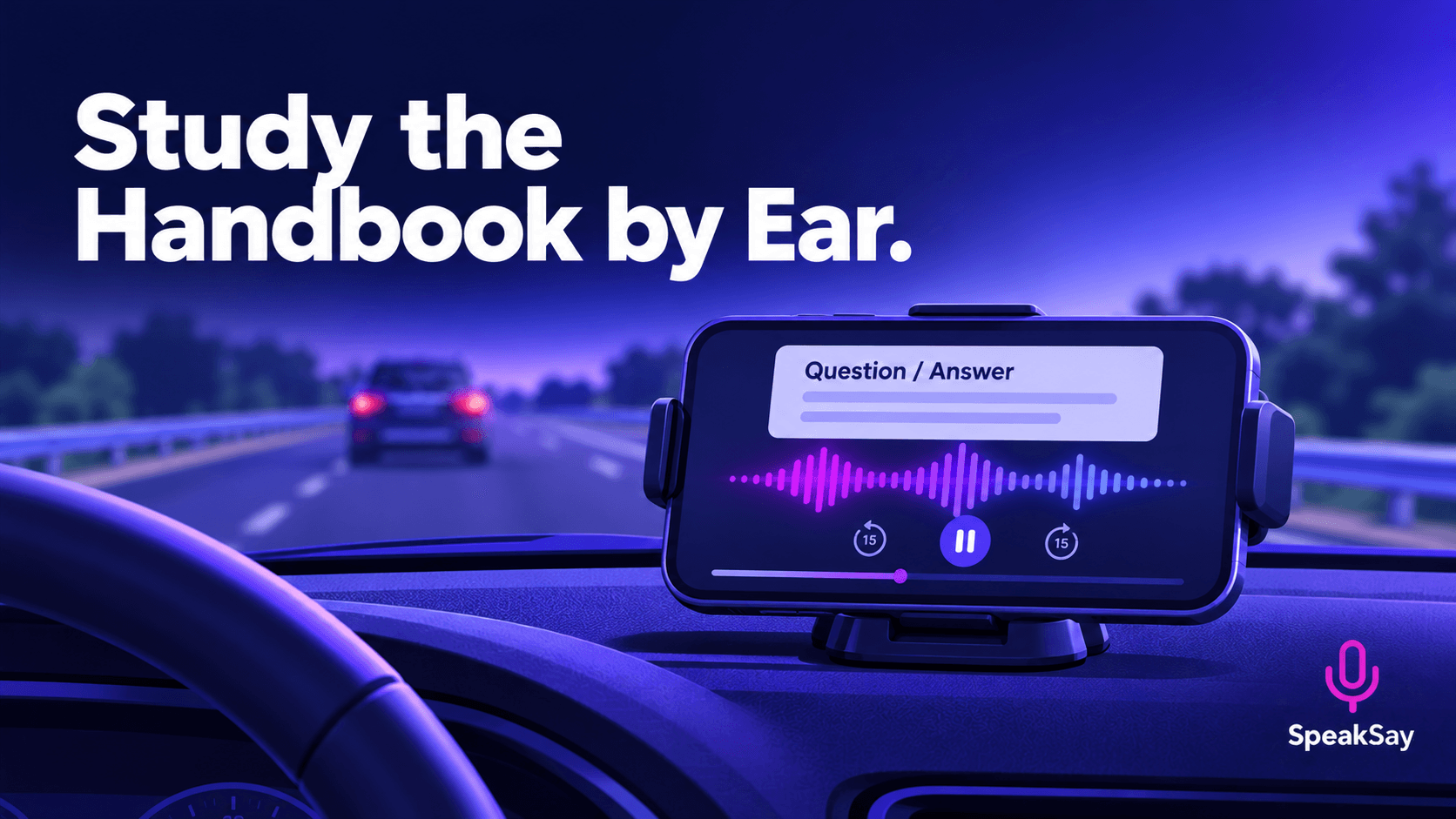
Passive listening helps, but recall helps more. Write each fact as a short question, leave a gap, then give the answer. Text to speech does not take a "pause" command from plain words, so create the gap with a short filler line such as "Think." followed by a blank paragraph, or by splitting the script into question and answer files.
| Format | Example script line | Best for |
|---|---|---|
| Plain statement | "At a four-way stop, the first vehicle to arrive goes first." | First pass through a section |
| Question then answer | "Who goes first at a four-way stop? Think. The first vehicle to arrive." | Second and third passes |
| Mistake list | "People often forget: a flashing red light is treated like a stop sign." | The week before the test |
Spell out numbers and abbreviations the way you want them said, for example "eighty thousand pounds" instead of "80,000 lbs", so the voice reads them correctly.
5) Step 3: generate and tune the audio
- Split by topic. Make files of five to ten minutes: signs, right of way, speed and distance, parking, and so on. Short files are easy to repeat.
- Choose a calm, clear voice. Browse the SpeakSay voices and pick one you can listen to for weeks.
- Slow slightly. A touch below normal pace helps with numbers.
- Even out the volume. Road noise masks quiet passages, so run the files through the free audio normalizer.
Listen only where it is safe and legal. Do not use headphones in a way your local rules forbid while driving, and do not study while you are the one behind the wheel if it divides your attention. A speaker in the car is common, and many learners also use audio on public transport or while walking.
6) Step 4: a one-week review plan
- Days 1 to 3: plain statements, one topic per day.
- Days 4 to 5: question and answer files, repeating the topics you miss.
- Day 6: the mistake list and a practice test from your agency's official site, if one is offered.
- Day 7: one light pass, then rest.
Keep every study guide you will ever need
If you will make study audio for yourself, family members or a class, the Lifetime plan keeps the cost predictable.
7) What audio cannot do
- It cannot show you signs, diagrams or road markings. Pair audio with the official images.
- It cannot replace driving practice or an instructor where one is required.
- It is only as accurate as your notes. Recheck them against the current official manual.
8) Frequently Asked Questions
Can I record the official handbook word for word?Check your licensing agency's terms of use. For personal study, your own paraphrased notes are the safest route. If you plan to publish or sell audio, ask the agency or read its copyright notice first.
Will audio alone get me through the test?Not reliably. Use it for recall and repetition, then confirm with the official manual, any official practice test, and the required road training.
How long should each audio file be?Five to ten minutes per topic is easy to repeat and easy to resume if you are interrupted.
Does this work for a CDL with endorsements?The method works for any rule-heavy material. Build a separate set of notes for each endorsement and check your agency's list of what each requires.