The Real Cost of AI Voiceovers in 2026: Credits, Caps, and the Subscription Math
Credit caps and monthly fees turn AI voiceovers into a moving target. Here's the honest math on what creators pay in 2026 — and how to escape the credit-anxiety treadmill without sacrificing quality.
1) The Sticker Price Lie
Most AI voice tools advertise a low monthly number. What they don't put on the banner is the output cap. A plan isn't "X dollars a month" — it's "X dollars for Y minutes of audio, after which you pay more or wait until next month." For anyone producing daily videos, that cap is the number that matters.
2) How Credits Actually Work
Most premium TTS platforms meter usage in credits or characters. Typically one character of text equals one credit on the highest-quality model, and faster/lower-fidelity models consume fewer credits per character. The practical effect:
- Your best-sounding voice burns credits twice as fast as the budget model.
- Re-generating a line because it sounded off? That's billed again.
- Run out mid-month and you're either upgrading or waiting.
This is the source of the "credit anxiety" creators complain about: you start self-censoring how much you generate to protect your balance, which is a terrible way to make content.
3) Worked Example: A Popular Plan's Real Limits
Take a widely used creator tier priced around $22/month. It includes roughly 100,000 credits. On the top-quality multilingual model that's about 100 minutes to ~2.5 hours of audio depending on the model you pick — and the better it sounds, the less you get.
| Scenario | Monthly audio need | Does ~100k credits cover it? |
|---|---|---|
| Hobby channel (1 video/wk) | ~40–60 min | Usually fine |
| Faceless channel (3–4/wk) | ~3–5 hours | No — overages or upgrade |
| Daily Shorts + long-form | 8+ hours | Not close |
For a serious creator, the entry plan is a trial, not a workflow. The moment you scale, the "cheap" plan isn't the one you're on anymore. (Pricing and credit allowances change — always confirm current numbers on the provider's site before committing.)
5) Monthly vs. One-Time: The Break-Even Point
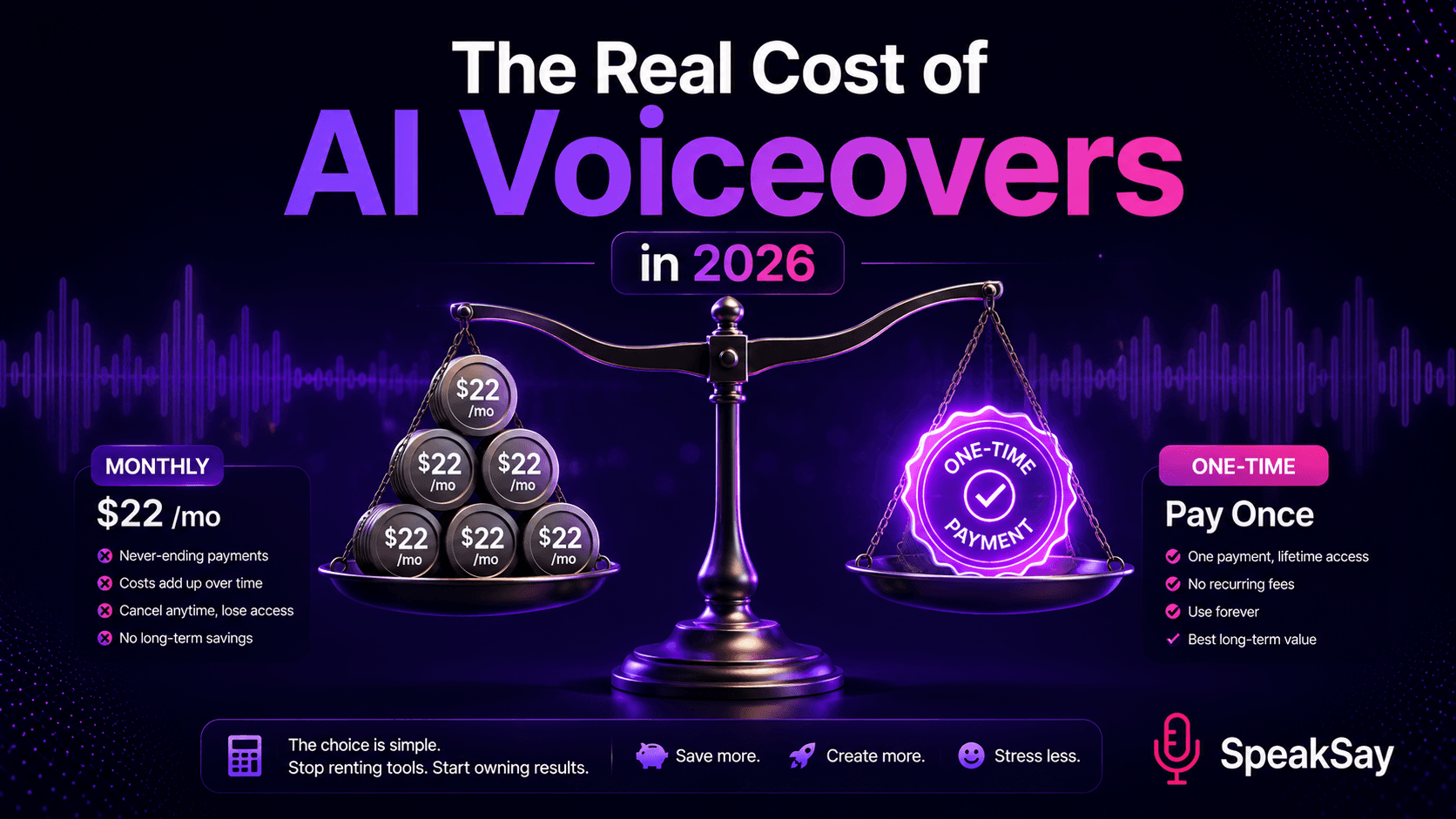
Here's the math creators skip. A $22/month plan is $264 a year — every year, with caps. If your output reliably exceeds the entry tier, you're realistically looking at a higher plan, so the true annual figure climbs further.
A one-time / lifetime plan changes the equation: you pay once and stop renting your own production pipeline. For anyone publishing consistently, the break-even often lands inside the first year.
Stop renting your voiceover workflow
SpeakSay's lifetime plan lets you pay once and generate without the monthly credit dread. Predictable cost, studio-quality voices, commercial rights included.
See the lifetime plan →6) How to Choose Without Regret
- Estimate your real monthly minutes — be honest about re-generations and languages.
- Convert every plan to cost-per-minute at that volume, not at the advertised cap.
- Check commercial rights — a cheap plan that bans monetization isn't cheap, it's unusable.
- Compare monthly vs. one-time over a 12–24 month horizon.
- Test voice quality on your actual scripts before you commit. Preview SpeakSay's voices here.
7) Frequently Asked Questions
Is there a cheaper alternative to subscription TTS tools?Yes. Lifetime/one-time plans like SpeakSay's remove recurring fees, and per-minute cost drops sharply once you produce at volume.
Why do my AI voice credits run out so fast?High-quality models consume more credits per character, and re-generations and multilingual output add up. Caps are usually set for light use, not daily publishing.
Do cheaper plans include commercial rights?Not always — verify before you monetize. SpeakSay includes commercial-use rights so your content revenue is safe.
When does a lifetime plan beat a subscription?For consistent creators, often within the first year. Compare your real annual spend (including likely upgrades) against a single one-time cost.