Find the BPM of Any Song Free — and Lock Your Voiceover to the Beat (2026 Guide)
Tapping the tempo by ear gets you within two or three BPM, which is enough to drift a full beat out of phase by the end of a forty-five second Short. Detect the exact number first — then use the bar maths, the syllable budget and the downbeat rule that make a spoken voice sit inside music instead of on top of it.
1. Why "close enough" drifts
Tempo error compounds. If the track is 92 BPM and you build your edit to 90, every beat is roughly 14 milliseconds late. That is inaudible on beat one. By beat thirty — about twenty seconds in — you are 430 ms out, which is a third of a beat and very audible as "this edit feels wrong". By beat seventy you are approaching a full beat, at which point the voice and the music are actively fighting.
| Error | Drift after 15 s | Drift after 45 s | Perceptible? |
|---|---|---|---|
| 0.5 BPM at 90 | ~40 ms | ~125 ms | No |
| 1 BPM at 90 | ~80 ms | ~250 ms | Borderline by the end |
| 2 BPM at 90 | ~165 ms | ~500 ms | Yes — reads as sloppy |
| 4 BPM at 90 | ~330 ms | ~1.0 s | Yes — reads as broken |
Tap-tempo by ear typically lands within two to four BPM. That is squarely in the "reads as sloppy to broken" band for anything longer than about twenty seconds — which is every Short, every reel, every intro bed, every ad read over music.
The other thing exact BPM buys you: you can pre-compute every cut point, every caption change and every line length in seconds before you touch the timeline, rather than nudging clips until they feel right.
2. Detecting the BPM (and sanity-checking it)
Run the track through a detector rather than tapping it. Detection reads the actual transient spacing across the whole file and returns a precise figure — often with decimals, which matter for longer pieces.
Then sanity-check the result, because every detector makes the same two mistakes:
- Octave errors. A detector may return 75 when the track is 150, or 160 when it is 80. If the number feels wrong, halve it or double it and count along — one of the three will fit.
- Intro confusion. If the track opens with an ambient or half-time intro, detection over the whole file can be skewed. Run it again on a thirty-second window from the middle of the track.
The manual check that resolves both: count "one, two, three, four" along with the music for eight bars. If you are counting comfortably at a walking pace, you have the right octave. If you are counting frantically, halve it. If you are counting so slowly it feels like waiting, double it.
Get the exact number in seconds
Drop any track into the free BPM detector, sanity-check the octave, and write the number at the top of your script — everything below is built on it.
3. Bar maths: turning BPM into seconds
Three formulas do all the work. In 4/4 time, which covers almost everything you will use:
- One beat = 60 ÷ BPM seconds
- One bar = 240 ÷ BPM seconds
- Four bars (one phrase) = 960 ÷ BPM seconds
| BPM | 1 beat | 1 bar | 4 bars | 8 bars |
|---|---|---|---|---|
| 70 | 0.857 s | 3.43 s | 13.7 s | 27.4 s |
| 80 | 0.750 s | 3.00 s | 12.0 s | 24.0 s |
| 90 | 0.667 s | 2.67 s | 10.7 s | 21.3 s |
| 100 | 0.600 s | 2.40 s | 9.6 s | 19.2 s |
| 120 | 0.500 s | 2.00 s | 8.0 s | 16.0 s |
| 140 | 0.429 s | 1.71 s | 6.9 s | 13.7 s |
| 150 | 0.400 s | 1.60 s | 6.4 s | 12.8 s |
| 174 | 0.345 s | 1.38 s | 5.5 s | 11.0 s |
Two things fall out of this table immediately.
Your structural units are now fixed. A 45-second Short at 90 BPM is not "45 seconds" — it is roughly sixteen bars and a bit. Design it as four four-bar phrases plus a tail: hook (4 bars), setup (4), payload (4), turn (4). Every section boundary now lands on a downbeat automatically.
Your line lengths are now fixed too. A line that has to fit one bar at 120 BPM has exactly two seconds. That is the number you write to, and — if you are generating the voice — the number you regenerate against until the line fits.
4. The syllable budget per bar
Spoken delivery over music has a comfortable density range, and exceeding it is what makes a voiceover sound crammed rather than confident.
| BPM | Bar length | Comfortable syllables/bar | Maximum before it feels crammed |
|---|---|---|---|
| 70–85 | 2.8–3.4 s | 12–18 | 22 |
| 86–100 | 2.4–2.8 s | 11–16 | 19 |
| 101–120 | 2.0–2.4 s | 9–13 | 16 |
| 121–140 | 1.7–2.0 s | 7–11 | 13 |
| 141–175 | 1.4–1.7 s | 6–9 | 11 |
Two rules make the budget usable:
- End the line early. Aim to finish about half a beat before the bar ends. That gap is what lets the music breathe through, and it is the difference between a voice sitting in the track and sitting on it. Filling the bar completely, every bar, is the most common mistake.
- Budget by syllables, not by words. "Absolutely unnecessary" is two words and nine syllables. Word counts will mislead you every time.
At the fast end of the table, notice how tight the budget is: six to nine syllables per bar at 150 BPM. This is why hard-hitting short-form content over fast tracks uses fragments rather than sentences. It is not a style choice; it is what fits.
5. Where the words go: the downbeat rule
The single technique that separates locked voiceover from voiceover-that-happens-to-have-music-under-it: put the stressed syllable of the key word on beat one.
Not the start of the line — the stressed syllable of the word that matters. Everything before it becomes a pickup that runs into the downbeat.
- Line: "Nobody tells you this about compound interest."
- Key word: compound. Stressed syllable: com.
- Placement: "Nobody tells you this about" is the pickup, landing com exactly on the downbeat of the next bar.
Three supporting rules:
- One downbeat hit per line. Trying to land every stressed syllable on a beat produces a nursery-rhyme cadence — the classic mistake in spoken-word-over-beat content.
- Hooks land on beat one of a four-bar phrase, not mid-phrase. A hook placed on bar three of a phrase is audibly weaker even when the words are identical.
- Pauses go on beats, too. A 0.667-second silence at 90 BPM is exactly one beat, and reads as intentional. A 0.5-second silence at 90 BPM reads as a mistake. Build your pause lengths from the beat table rather than from round numbers.
If you are generating the voice, this is where the workflow gets easy: render the line, see where the stressed syllable actually falls, and nudge the clip so it lands on the downbeat. If nudging puts the line's start in an awkward place, cut a word from the pickup and regenerate. Two or three iterations per line, at no cost.
Regenerate until it lands
Fitting a spoken line to a 2.4-second bar is trial and error — trivial with a generated voice, painful with a recorded one. Render, nudge, trim a word, render again.
6. Why spoken voice locks differently from singing
Advice written for vocalists will send you wrong, because singing and speech relate to a grid in opposite ways.
| Singing | Speech | |
|---|---|---|
| Pitch | Discrete notes from the track's key | Continuous glide, unrelated to key |
| Timing | Every syllable sits on a subdivision | Only the stressed syllables need to |
| Vowel length | Stretched to fill the note | Fixed, 50–200 ms, cannot be stretched naturally |
| Phrase ends | Held to the bar line | Should stop short of it |
| What carries the rhythm | The melody | The consonant attacks |
The practical consequences:
- Do not time-stretch spoken audio to fit a bar. Stretching a vowel beyond its natural length is instantly audible as processing. Rewrite or regenerate instead.
- Align to consonants, not to waveform peaks. The perceived beat of a spoken syllable is at the consonant attack — the "t" in "tells" — which sits slightly before the loudest part of the waveform. Aligning peaks puts you consistently late.
- Do not try to pitch the voice to the key. Speech has no key. Pitch-shifting a spoken line to "fit" the track changes the voice's identity and fixes nothing.
7. Half-time, double-time and the tempo trap
Some tracks have a detected BPM that is technically correct and practically useless. A track detected at 174 has bars of 1.38 seconds — six to nine syllables — which is unworkable for explanatory content. But many fast tracks are felt at half that rate: the snare lands on the half-time backbeat, and the phrase length your ear perceives is 2.76 seconds.
Practical resolution:
- Detect the true BPM and keep it for cut points and caption timing.
- Write to the felt tempo — usually half — for syllable budgets and line lengths.
- Use double-time deliberately for a single burst: one line at the full rate inside an otherwise half-time delivery is a genuine emphasis tool. Doing it throughout is exhausting to listen to.
The same trick runs the other way. A 70 BPM track with 3.43-second bars can feel sluggish for punchy content; write to the double-time subdivision and your effective bar becomes 1.71 seconds.
8. Mixing a locked voiceover
Timing is most of the job, but a few mix moves protect it:
- Carve the music, do not just duck it. A 2–4 dB dip between roughly 1.5 and 4 kHz in the music lets speech through without the pumping of heavy sidechain. Blanket level reduction makes the track feel weak and still masks the voice.
- Sidechain gently if at all. 2–3 dB, fast attack, release timed to the beat — at 90 BPM, a release around 300 ms (under half a beat) recovers before the next hit.
- High-pass the voice at 80–100 Hz so it stops competing with the low end.
- Do not put reverb on a locked voiceover. A tail longer than about 200 ms smears the consonant attacks that are doing your rhythmic work.
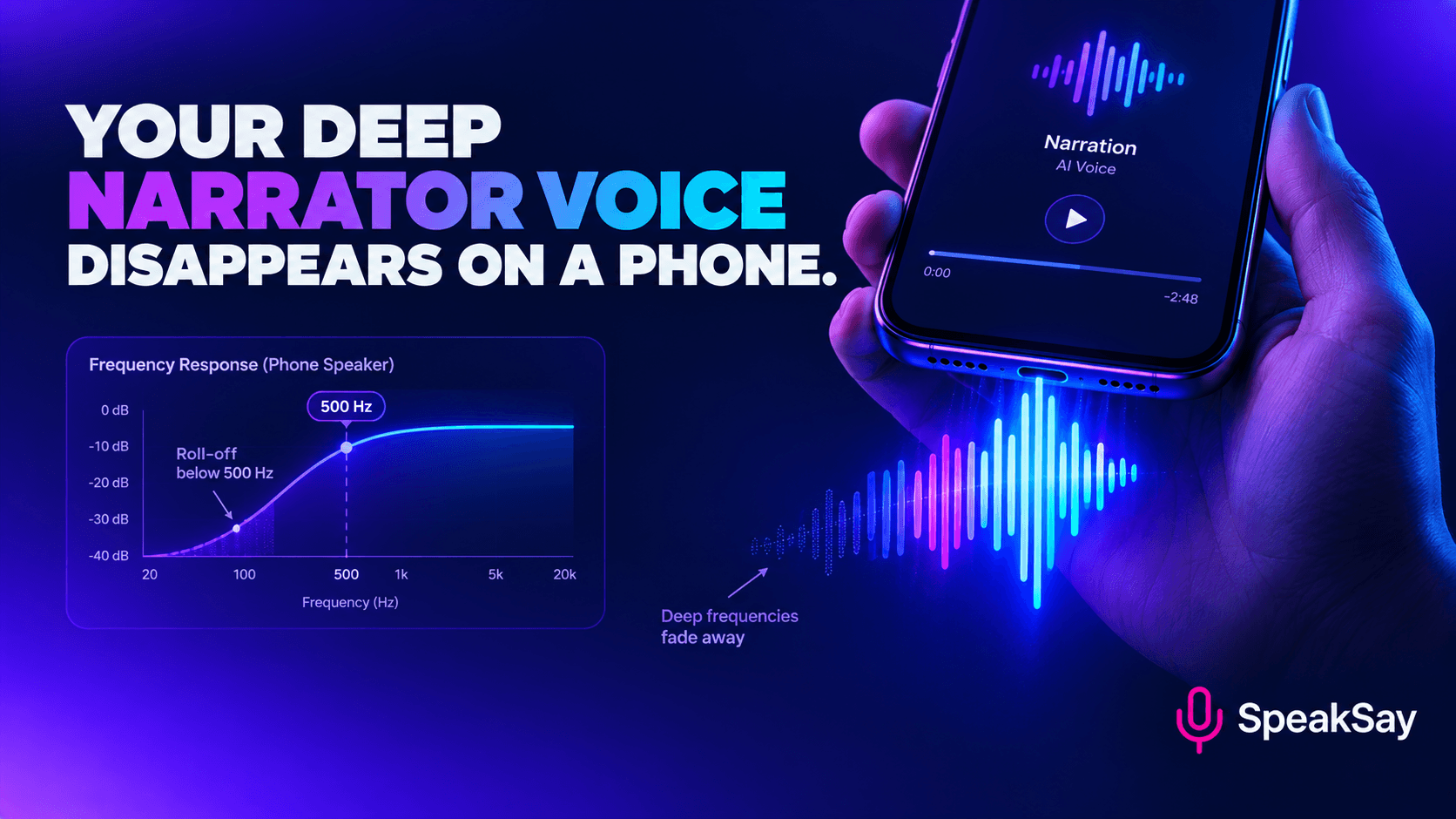
- Check on a phone speaker. Small speakers reproduce almost nothing below 400–600 Hz, so the balance you set on headphones is not the one most viewers hear.
- If the source is a finished song, strip the vocal first. Two voices competing for the same frequency band will never sit together, regardless of timing.
Clear the band before you drop the voice in
Pull the vocal out of any track first — an instrumental bed gives your voiceover somewhere to live.
9. FAQ
Do I really need the BPM for a fifteen-second clip?Less so — at fifteen seconds a two-BPM error accumulates to about 165 ms, which is at the edge of noticing. The payoff at short lengths is structural rather than corrective: knowing the bar length tells you exactly how long your hook can be, which is worth the fifteen seconds it takes to check.
What if the track has no clear beat at all?Ambient and drone beds have no grid, so there is nothing to lock to — write to natural phrasing and use the music purely for mood. Do not force a grid onto material that does not have one; it sounds stranger than free delivery.
What BPM should I choose for a voiceover bed?For explanatory or narrative content, 80–100 BPM gives you 2.4–3.0 second bars, which comfortably fits a spoken clause. Under 70 tends to drag; over 130 forces you into fragments. If the content is energetic short-form, go faster and accept the fragment style — that is what fast tracks are for.
Can I change the music's tempo to fit my voice instead?Within about 5% of the original, yes, with a good algorithm and no audible damage. Beyond that you start hearing artefacts in the drums. It is nearly always easier to rewrite the line or regenerate it at a different rate than to stretch a finished track.
Does this apply to podcast intros as well as short-form video?Yes, and it is where the technique is most under-used. An intro where the show name lands on the downbeat and the bed resolves at the end of a four-bar phrase sounds professionally produced for reasons listeners cannot name. Same maths, same downbeat rule.