Make It Sound Human" Is the Wrong Instruction: What Listeners Actually Detect in an AI Voice (2026)
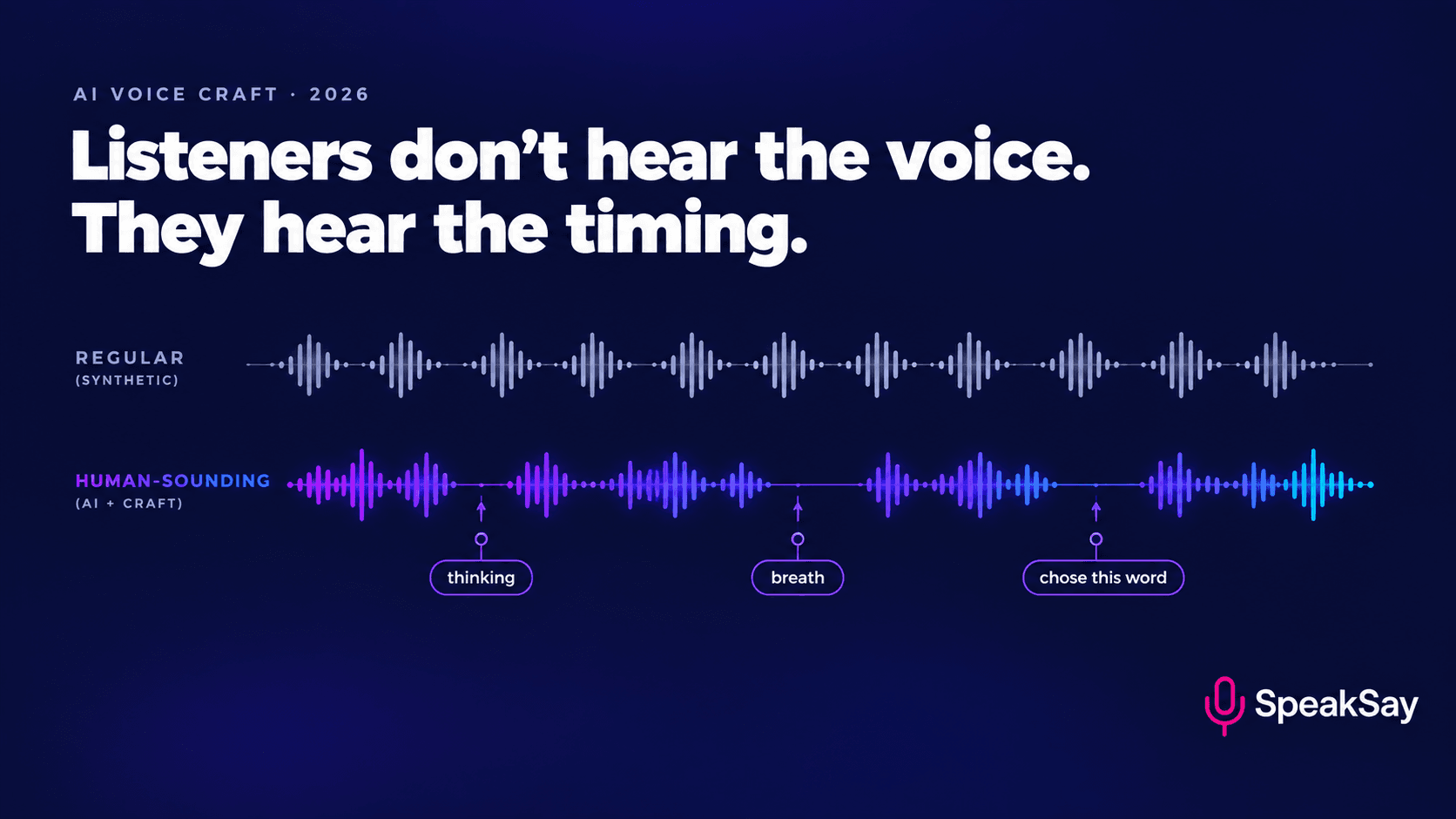
The timbre problem was solved years ago. In 2026, people who say an AI voice "sounds fake" are almost never reacting to the sound — they are reacting to timing, to emphasis landing on the wrong word, and to a read that never changes its mind. Here is how to test for each, and fix them.
1. Why "pick a better voice" stopped working
For about a decade, the honest answer to "how do I make this sound human" was "wait for better models." The artefacts were in the signal — buzzy sibilance, concatenation seams, a metallic edge on sustained vowels, that flat fourth-syllable stress that made every sentence sound like an announcement at a railway station. Those were real problems and they got solved, and anyone whose mental model of synthetic speech was formed before 2023 is arguing with a product that no longer exists.
What did not get solved is everything above the signal. A speech model generates a plausible reading of a sentence. It does not know what your sentence is for. It does not know that the whole paragraph exists to set up the number in the fourth line, that the word "actually" is doing contrastive work against something you said ninety seconds ago, or that you are bored of your own introduction and the listener can tell when you are not.
So the current failure is not acoustic, it is interpretive, and that changes where the work goes. Auditioning a fifth voice is optimisation on the axis that already works. It feels productive because voices are easy to compare and comparing them takes no skill. It is the equivalent of adjusting the typeface on a page whose sentences do not parse.
One thing worth saying directly: "sounds human" is not actually the goal anyway. Plenty of excellent human narration sounds nothing like conversation — documentary narration, audiobook prose, ad reads all have conventions no human uses at dinner. The goal is that the delivery matches the meaning. When it does, nobody asks whether it was synthetic. When it does not, the synthetic label is just the vocabulary people reach for to describe a mismatch they can hear but not name.
2. The three channels listeners actually detect
| Channel | What the listener says | Root cause | Fixable by changing voice? | Fastest real fix |
|---|---|---|---|---|
| Rhythm uniformity | "It's kind of hypnotic" / "I zoned out" | Pause lengths derived mechanically from punctuation | No | Vary sentence length; move pauses off the commas |
| Semantic stress error | "It sounds like it doesn't know what it's saying" | The model cannot know which word carries your meaning | No | Mark the operative word per sentence, or perform the line |
| Flat energy arc | "It sounds like a robot" (said about a 20-minute file, not a sentence) | No fatigue, no build, no variation across a long read | No | Structure energy deliberately; render in sections |
Look at the fourth column. This is the whole argument of the article: not one of the three detection channels responds to changing the voice. They respond to writing, direction and structure. The voice library is where you choose a character; it is not where you fix a performance.
3. Channel one: rhythm that is too regular
Human speech rhythm is wildly irregular and the irregularity is not noise — it is information. People pause before a word they are choosing, rush through a clause they consider obvious, stretch a phrase they want you to sit with, and stop dead when they realise they need to restate something. Listeners do not consciously parse any of this, but they use it continuously to track where the meaning is going.
A generated read derives its pauses from punctuation. Comma, short gap. Full stop, longer gap. Paragraph, longer still. Every comma in the file gets approximately the same gap, because from the model's position every comma is approximately the same thing. The result is a read whose rhythm is a direct function of your punctuation, which means it is regular in a way no person has ever spoken.
The symptom is not "this sounds robotic." The symptom is that people stop paying attention. Regular rhythm is soporific — it is precisely what sleep audio is engineered to produce — and a listener who drifts out of an explainer at ninety seconds will not report a rhythm problem, they will report that the video was boring.
What to do about it:
- Vary sentence length on purpose. Three long sentences in a row will render with three similar contours. Put a four-word sentence after them. The rhythm change does more than any prosody setting.
- Put pauses where the thinking is, not where the grammar is. The most useful pause in a spoken sentence usually falls before the key word, not after the comma. Grammar-derived pauses are correct and uninformative.
- Use the paragraph break as a rhythmic tool. Breaking a paragraph mid-thought forces a longer gap at a point your punctuation would not have produced one.
- Delete about one comma in four. Most written commas are conventions of print, not instructions for the mouth. Every one you remove is a mechanical gap you do not get.
- Read the script aloud before rendering. If you run out of breath, the sentence is too long for speech regardless of whether it is correct on the page.
4. Channel two: emphasis on the wrong word
This is the most diagnostic of the three and the least discussed. Take a sentence: "We didn't test it on mobile." There are five distinct meanings depending on which word is stressed. We didn't test it (someone else did). We didn't (denial). We didn't test it (we used it, but did not test). Test it (we tested something else). On mobile (we tested it elsewhere). The words are identical. The meaning is not.
A model choosing among those five has no access to what you meant, because the information that decides it lives outside the sentence — in the argument you have been building, in what the viewer just saw on screen, in the objection you are pre-empting. So it picks the statistically ordinary contour, which is right maybe seventy percent of the time and wrong in exactly the places that matter most: pivots, contrasts, corrections, punchlines, the sentence the whole paragraph was built for.
And here is the bit that explains the listener reaction. A stress error is not heard as a stress error. It is heard as the speaker not understanding what they are saying — which is precisely the intuition people are reporting when they say a voice sounds artificial. They are not detecting synthesis. They are detecting an absence of comprehension, and correctly inferring the cause.
What to do about it:
- Mark one operative word per sentence while drafting. Not every sentence needs emphasis, but every sentence has one word that carries it — find it, and check the render landed there. This is a ninety-second pass over a script and it is the highest-value ninety seconds available.
- Rewrite instead of tagging, where you can. Moving the important word to the end of the sentence gets you natural emphasis for free, on any model, with no markup. "Mobile was the one case we never tested" needs no direction.
- Split contrastive sentences. Contrast is where models fail most and it is usually a sentence trying to hold two ideas. Two sentences, each with one idea, removes the ambiguity entirely.
- Check the pivots specifically. You do not need to audit a whole script. Listen to every sentence containing "but", "actually", "however", "instead" or a negation. That is where the errors concentrate.
Hear the difference on your own script
Paste a paragraph you have already published and render it against a few SpeakSay voices — then run the emphasis check in section 4 on the result.
5. Channel three: a read that never changes its mind
The first two channels operate at the sentence. The third only becomes audible over minutes, which is why it survives every audition — you tested with a paragraph and shipped twenty minutes.
A human narrator reading for twenty minutes changes continuously and involuntarily. They get slightly tired, they get interested in a section and speed up, they mis-say a word and fix it, their breath deepens after a long sentence, their energy sags before a break and lifts after. None of this is deliberate, and collectively it is a large part of what makes extended listening feel like attending to a person rather than processing a file.
A generated read has none of it. Minute nineteen has precisely the same energy, pace and vocal weight as minute one. It is, in a narrow technical sense, a better read — no fatigue, no stumbles, no degradation. In the sense that matters it is inert, and the listener's word for inert is "robotic", applied to a file whose individual sentences would each have passed inspection.
What to do about it:
- Design an energy arc before you write. Decide where the read should be at its most animated and where it should drop back. Typically: a brisk open, a calmer explanatory middle, a lift into the most consequential section, a settled close. Then write and render to that map.
- Render in sections with different settings. This is the concrete mechanism and almost nobody does it. Three or four sections, each with a slightly different rate and expressiveness, joined at natural structural breaks. The variation between sections is what a human's involuntary variation does for free.
- Change the sentence texture every few minutes. A stretch of short declaratives, then a longer flowing passage, then a direct question. Texture change reads as energy change even when the settings are identical.
- Let the middle be quieter. The instinct is to keep everything at maximum engagement. Constant maximum is itself a flat arc — there is nothing to lift into.
- Never render a long piece as one unbroken block unless you have specifically decided uniformity is the goal, which for sleep and meditation audio it genuinely is.
6. The blind test: find out what your listeners actually hear
Everything above is diagnosis from the outside. The way to get real data takes fifteen minutes and almost nobody does it, because the result is occasionally humbling.
- Take 60 seconds of your published narration. Not a showcase clip — a normal, explanatory stretch from the middle.
- Send it to five people who are not creators with one question: "Does anything about this recording feel off to you? If yes, what?" Do not mention AI. Do not mention voice. The moment you say "AI" you have contaminated the answer, because people will confirm whatever frame you hand them.
- Record their exact words. The vocabulary is the data. "I got bored" points at channel one. "Sounds like they're reading it" points at channel two. "It's kind of flat" over a long clip points at channel three. "It sounds fine" is also data.
- Run the same test on a 60-second clip of human narration from a show in your category, without telling them it is a different source. This is the control, and it is the step that gets skipped. You will often find people flag things in the human clip too — which recalibrates how much of your problem is actually about synthesis.
- Fix only the channel that got named. Two of the three are probably fine.
The common result: people do not say "this is AI." They say "it went on a bit" or "I lost the thread halfway." Those are structure and rhythm complaints, they would apply equally to a human reading the same script, and they point at your writing rather than your voice selection — which is the conclusion this article keeps arriving at from different directions.
7. The fastest fix: perform it, then convert it
Everything in sections 3 to 5 is you supplying interpretation to a model that cannot have it — through writing, marking, structuring, sectioning. There is a shortcut, and it is dramatically underused relative to how well it works.
Speech-to-speech conversion — sometimes called voice remix — takes a recording of you performing the line and re-voices it in a different voice while keeping your delivery. The timing is yours. The emphasis is yours. The energy arc is yours. The breath placement is yours. All three detection channels are solved at once, not because the model got smarter but because you stopped asking it to guess.
Where this wins outright:
- Character work and dialogue, where the entire point is an acted line rather than a read one
- Comedy and anything with timing — a punchline's timing cannot be typed, and this is the most reliable failure of text-to-speech in any language
- Emotionally weighted passages in fiction, testimonials and personal narrative
- Any line you have already re-rendered four times — at that point performing it is faster than continuing to guess at markup
- When you want a different voice but your own delivery, which includes anonymity, a consistent channel voice, or casting a narrator who does not sound like you
Where text-to-speech still wins, and it is not a small list: volume work, multilingual output, long-form narration where a performance take would be exhausting, anything you want to be able to fix by editing text later, and anyone who does not want to record their own voice at all. The professional answer for most people is a split — type the bulk, perform the lines that carry weight — and the practical rule for deciding is simple: if the line needs an interpretation, perform it; if it needs information delivered clearly, type it.
Keep your delivery, change the voice
Record the line the way you hear it in your head, then convert it into any voice you like. Your timing, your emphasis, a different performer.
8. Eleven script-side fixes, ranked by payoff
If you do nothing else, work down this list in order. It is ordered by audible improvement per minute spent, and the top four are worth more than the bottom seven combined.
- Read the whole script aloud before rendering. Every problem in this article is audible when you read it yourself, and free to find.
- Cut sentence length by a third. Written prose is longer than spoken prose. Almost every first-draft script is too dense for the ear.
- Mark and verify the operative word in every pivot sentence. Section 4.
- Structure an energy arc and render in sections. Section 5.
- Remove roughly a quarter of your commas.
- Move the important word to the end of the sentence wherever the grammar allows it.
- Replace written connectives with spoken ones — "so", "but", "and here's the thing" instead of "furthermore", "consequently", "in addition".
- Put a short sentence after every run of three long ones.
- Spell out numbers the way you would say them — "about twenty-five thousand" rather than "25,431" when the precision is not the point.
- Build a pronunciation lexicon for names, products and jargon instead of respelling inline every time.
- Add contractions. "It is not" reads as formal; "it isn't" reads as speech. This is small, but it is free.
9. The failure mode on the other side
There is an equal and opposite error, and it is increasingly common among people who have read advice like this and applied it enthusiastically. You can over-direct a synthetic read into something worse than the plain version.
Inserted breaths that do not correspond to breathing. A breath before a long sentence is physiology. A breath scattered every eight words because "humans breathe" is a tic, and once a listener notices it they cannot stop hearing it.
Hesitation markers as decoration. "Um" and "uh" are produced by real cognitive load at the moment of speaking. Typed into a script they land in the wrong places, and a hesitation before a word the speaker could not possibly be struggling to find is more artificial than no hesitation at all.
Emphasis on everything. If four words in a sentence are stressed, none of them are. The restraint is the technique.
Emotion set higher than the content supports. Warm, animated delivery over neutral factual material reads as a sales pitch, and audiences are extremely sensitive to being sold to. Mismatch in either direction is the problem; overshooting is not safer than undershooting.
The governing rule: if a technique is audible as a technique, it is not working. The aim is not that people notice how human it sounds. The aim is that nobody thinks about the voice at all.
10. FAQ
How do I make an AI voice sound human?Stop working on the voice and work on three other things: vary your rhythm so pauses are not all derived from punctuation, make sure the stressed word in each sentence is the word carrying your meaning, and build a deliberate energy arc across long pieces by rendering in sections with different settings. If you want all three at once, record yourself performing the line and use speech-to-speech conversion, which preserves your delivery in a different voice.
Which AI voice sounds the most human?This is the wrong question in 2026, and it is the question almost everyone asks first. Top-tier voices from any major provider are acoustically convincing; what listeners detect is timing, stress placement and energy variation, none of which change when you swap voices. Choose a voice for its character and its fit to your content, then spend your effort on the script and the render structure.
Why does my AI voiceover sound robotic even though the voice is good?Most likely one of three causes. If people say they zoned out, your rhythm is too regular. If they say it sounds like the speaker does not understand the text, your emphasis is landing on the wrong words. If the complaint only appears on long files, your energy arc is flat across the whole piece. The three have different fixes and it is worth identifying which one you have before changing anything.
Does adding "um" and breath sounds make it more human?Rarely, and it usually backfires. Real hesitations and breaths are produced by cognitive load and physiology at specific moments; inserted ones land in places a speaker would not produce them, and a listener who notices the pattern cannot un-notice it. A breath before a genuinely long sentence is fine. Decorative disfluency is not.
What is speech-to-speech conversion and when should I use it?You record yourself performing the line and the system re-voices it in a different voice while keeping your timing, emphasis and energy. Use it for character work, dialogue, comedy, emotionally weighted passages, and any line you have already re-rendered several times without getting it right. Use ordinary text-to-speech for volume work, multilingual output and long-form informational narration.
How do I test whether my narration sounds artificial?Send 60 seconds to five non-creators and ask only "does anything feel off?" — never mention AI, because naming it produces the answer you asked for. Then run the same test with a clip of human narration from a comparable show as a control. Their exact words tell you which of the three channels you have a problem in, and the control tells you how much of it is really about synthesis.
Do I need SSML or markup to get good results?Less than most people think, and markup has a cost — on per-character billing, tags are billed alongside your words. Sentence structure, punctuation choices and word order get you most of the way for free and transfer across voices and model versions. Reserve explicit markup for pronunciation you cannot solve any other way and for the few emphasis decisions that rewriting cannot fix.
My voice sounds fine in a 30-second test but bad over 15 minutes. Why?You are hearing the third channel. Sentence-level quality is fine; what is missing is the involuntary variation a human produces across a long read — slight fatigue, sections that speed up, energy that lifts and settles. Fix it by rendering the piece in three or four sections at slightly different rate and expressiveness settings, joined at natural structural breaks, rather than as one continuous block.
Put the hours where they pay
Voice selection is one afternoon. Delivery is every video you will ever publish. SpeakSay gives you both — a full voice library and the tools to control the performance.


