Maritime & Shipping Faceless Channels in 2026: The Ocean-Scale AI Narrator Playbook
Maritime channels have no visual drama to hide behind — a hull, a crane, a chart. The voice carries everything. Here is the casting spec, the two-register split, the TEU/DWT/port-name lexicon and the speculation boundary that separates a shipping channel people subscribe to from one that feels empty.
1. Why maritime is growing — and why copies of it feel empty
Shipping stopped being a background industry somewhere around 2021 and never went back. Chokepoint closures, tariff rounds, port congestion, shipbuilding competition, sanctioned "dark fleet" tankers — the subject now sits at the intersection of geopolitics, economics and engineering, which is three high-interest verticals in one.
The channels that grew into that space share a structural feature: they are voice-led. What's Going on With Shipping? is a maritime historian talking over charts and stock footage. Cargo Ship is long lens footage carried by commentary. FD Engineering's ship documentaries run on narration over slow exterior shots. None of them depend on cuts, reaction faces or motion graphics.
That is exactly why the niche looks easy to a faceless creator — no filming, no face, footage available — and exactly why the copies fail. When you remove the visual interest and then narrate in a flat, generically "cinematic" preset at one constant rate, you have produced twelve minutes of a grey hull and a voice that does not change. Viewers describe this as "empty" or "AI slop" without being able to name the cause. The cause is that the only variable channel in the video was left constant.
The rest of this playbook is about using that channel deliberately.
2. The scale problem: numbers are the content
In most niches, numbers are supporting evidence. In maritime, numbers are the story — 24,000 TEU, 400 metres, 200,000 deadweight tonnes, 1.2 million barrels, 12% of global trade, 21 days. The viewer's entire emotional response is a reaction to magnitude.
Generated speech handles numbers badly by default. It reads them at the same rate and energy as the surrounding words, which is precisely backwards: a number in maritime narration is the payload and the words around it are packaging.
The three-part scale sentence
Write scale sentences in a fixed shape so the voice has somewhere to put the emphasis:
- The raw figure — "Twenty-four thousand containers."
- A pause. 500–700 ms. Written as a paragraph break, not a comma.
- The human-scale translation — "Stacked end to end, that is a line of steel boxes from London to Birmingham."
The translation is what makes the figure land, and it must be a different unit of intuition from the figure itself — distance for volume, time for distance, a familiar object for mass. Repeating the same comparison device ("that's the size of X football pitches") three times in one video is the single most-mocked tic in the genre.
Rate handling for figures
| Element | Rate relative to base | Why |
|---|---|---|
| The headline figure | −15% (slower) | The viewer needs time to form a mental image; rushing it wastes the whole sentence |
| Unit of measure after the figure | Base rate | Slowing "deadweight tonnes" as well makes it sound laboured |
| Lists of figures (three or more) | Base, with 300 ms between items | Slowing every item flattens the list into a drone |
| Comparison/translation clause | +5% (slightly faster) | It is the explanation, not the payload — speed marks it as subordinate |
| Dates and years | −10% | Generated speech compresses years; they need room |
If your tool lets you generate per-segment rather than per-script, generate scale sentences as their own segments. This is the single highest-return production habit in the niche.
Audition voices against a real scale line
Paste "Twenty-four thousand containers. Four hundred metres from bow to stern. Twenty-one days at sea." into the free generator and listen to how each voice handles the figures — most presets flatten all three into one shape.
3. Casting spec: not the disaster-trailer voice
The default instinct in maritime is the bottom-of-range, heavily-processed documentary trailer voice — the one that makes every sentence sound like the beginning of a catastrophe. Resist it. Maritime content is mostly not catastrophe; it is systems, economics and routine operations at extraordinary scale. A trailer voice applied to a container throughput report is instantly comic, and a trailer voice applied to an actual incident has nowhere left to go.
| Attribute | Target | Note |
|---|---|---|
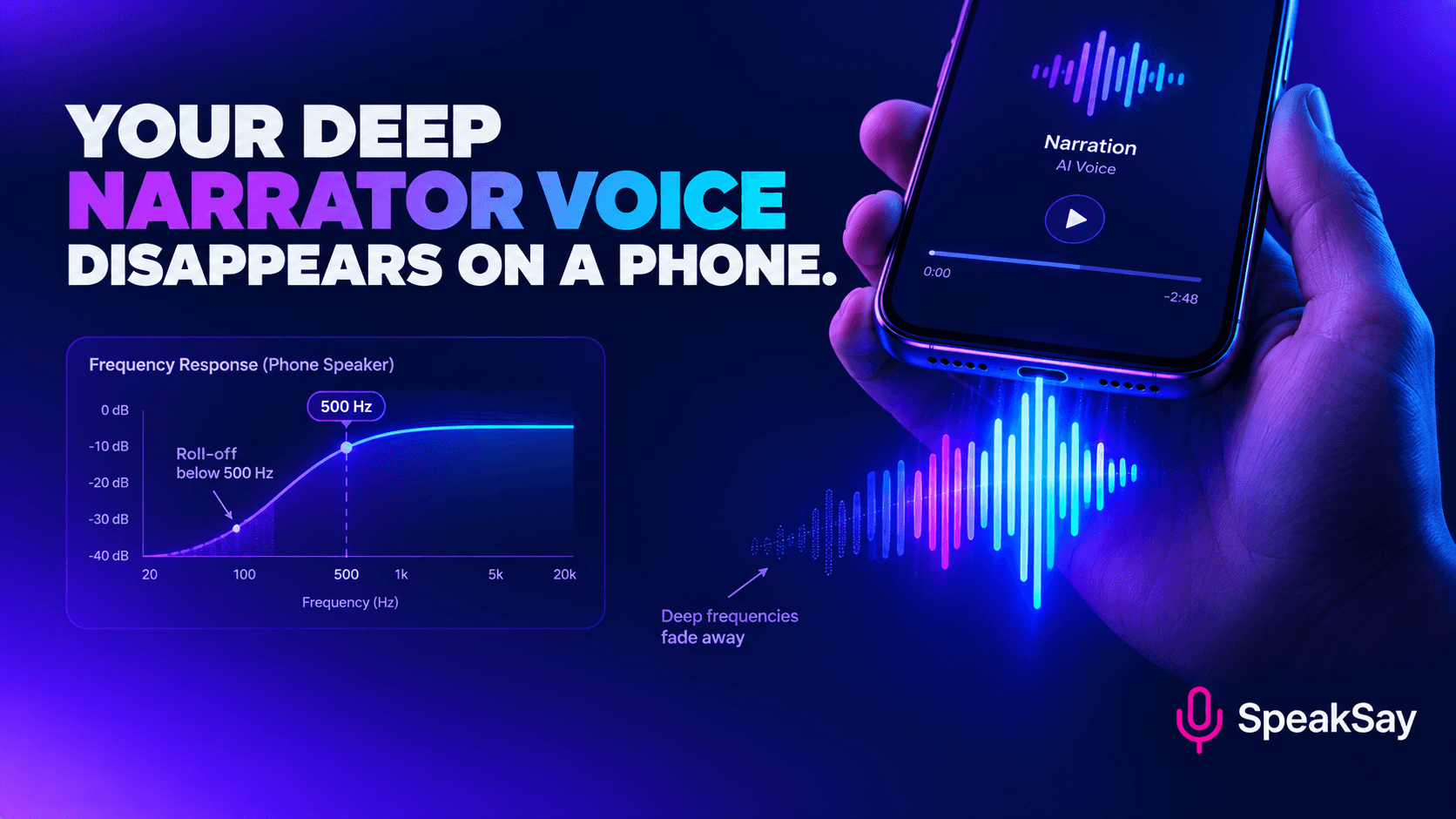
| Pitch | Mid to mid-low, not bottom of range | Deep voices lose their body on phone speakers, which is where a large share of this audience watches |
| Age impression | 40–60 | The register is "someone who has followed this industry for years", not "young explainer" |
| Base rate | 140–150 wpm | Slower than explainer content, faster than the trailer preset |
| Warmth | Moderate | Cold and clinical reads as a chart voiceover; warm reads as a podcast; you want between |
| Emphasis density | Low — figures only | If everything is emphasised, the numbers stop standing out, which destroys the genre |
| Accent | Deliberate, then fixed | Maritime has a genuinely global audience; a strongly-marked regional accent is fine and memorable, but pick it on purpose |
The disqualifying audition line
Give every candidate voice this line, without direction:
"The vessel was carrying 8,900 containers when the main engine failed 340 nautical miles from the nearest port."
Reject any voice that drops pitch and slows into "main engine failed" on its own. That is the trailer reflex, and it will do it on every routine sentence in every video you make. You want a voice that delivers the sentence as information, so that you can decide when to add weight.
4. The two-register split: systems vs voyage
Almost every maritime video mixes two fundamentally different kinds of content, and most AI-narrated ones read both identically. Splitting them is the fastest quality jump available.
| Systems register | Voyage register | |
|---|---|---|
| Used for | How a ship, port, route, contract or market works | A specific voyage, incident, crossing or historical episode |
| Rate | 135–145 wpm | 145–155 wpm |
| Sentence length | Longer, with subordinate clauses | Short. One event per sentence. |
| Tense | Present ("the crane lifts", "the charter covers") | Past ("the ship cleared the breakwater at 04:10") |
| Pauses | 400–600 ms at clause boundaries | 700–900 ms between events |
| Emphasis | On the mechanism word | On the time or position marker |
The transition between registers should be audible. Mark it with a one-second gap and a short orienting sentence — "That is the system. Here is what happened to one ship inside it." The listener recalibrates instantly, and the video stops feeling like a single undifferentiated block.
The never-accelerate rule
In voyage register, do not let the rate increase as events escalate. Generated speech has no natural braking, so an accelerating passage runs straight through the outcome and lands on nothing. Keep the rate flat or drop it slightly across an escalating sequence, and let the shortening sentences carry the acceleration instead. Short sentences at a steady rate feel faster than long sentences at a fast rate.
5. The maritime lexicon: TEU, DWT, vessel names and ports
Maritime is dense with abbreviations, tonnage units, vessel prefixes, flag states and port names in a dozen languages. Generated speech gets most of them wrong, and — the important part — most of the errors are silent: the audio sounds fluent, so you will not catch them by listening casually. You catch them by building a lexicon once and running a search pass on every script.
| Written | Write in the script as | Note |
|---|---|---|
| TEU | T E U | Spaces force letter-by-letter; expand on first use: "twenty-foot equivalent units" |
| DWT | D W T | Expand once as "deadweight tonnage" |
| IMO 9074729 | I M O nine zero seven four seven two nine | Never let it read as a single large number |
| MV Ever Given | M V Ever Given | "MV" reads as a word otherwise |
| MSC / CMA CGM | M S C / C M A C G M | CMA CGM is six separate letters, not two words |
| VLCC | V L C C | Expand once: "very large crude carrier" |
| Panamax / Neopanamax | Panamax / Neo-panamax | The hyphen prevents "Neopan-amax" |
| 20 kn | twenty knots | Never leave the abbreviation |
| 340 nm | three hundred and forty nautical miles | "nm" will read as nanometres |
| Strait of Malacca | Strait of Ma-lacca | Stress on the second syllable; check per engine |
| Piraeus / Rotterdam / Jebel Ali | Pi-ray-us / Rotterdam / Jebel Ali | Port names are the most common silent error class |
| 1.2m bbl/d | one point two million barrels per day | Never leave slashes — they become pauses |
The symbol-and-digit search pass
Before generating, search the script for every digit, every capital-letter run of two or more, and the characters / % ° ' ". Each hit is either already written out in words or gets a lexicon entry. This pass takes about four minutes on a twelve-minute script and eliminates the overwhelming majority of maritime narration errors.
Keep the lexicon as a living file. By your twentieth video it will cover almost every term you use, and script prep drops to a minute.
One narrator, every video, no drift
A maritime channel lives on recognisability across dozens of long videos. Lock one voice and one settings profile, and reuse them — SpeakSay keeps voice presets consistent across sessions so episode forty sounds like episode one.
6. The speculation boundary you must not cross
Maritime incidents — groundings, engine failures, collisions, fires, sinkings — are the highest-performing content in the niche and the fastest route to destroying a channel's credibility. The pull is to publish within 48 hours, while there is search demand and before any investigation has reported.
Set the boundary in the script, not in your intentions:
- Do not attribute cause to named individuals. Not the master, not the pilot, not the chief engineer — including by implication ("the decision to proceed" is an attribution when only one person makes that decision).
- Do not present preliminary reporting as findings. A preliminary report describes; it does not conclude. Say which document you are reading from and what stage it is at.
- Do not reconstruct bridge dialogue. Reading published transcript lines in the narrator's voice, with spoken attribution, is fine. Generating a voice to play a crew member is not — that is the same line drawn for aviation content, and for the same reason.
- Do not speculate about crew nationality, fatigue or competence in the absence of findings. This is where maritime comment sections turn ugly fastest.
The three-tier hedge, and where the stress goes
Hedging only works if the voice performs it. Generated speech will stress the claim and throw away the qualifier unless you force it.
| Confidence | Phrasing | Stress lands on |
|---|---|---|
| Established | "The vessel grounded at 07:42." | The time |
| Reported but unconfirmed | "Local authorities reported a loss of steering." | "reported" |
| Open | "What caused it has not been determined." | "not been determined" |
Force the stress by putting the hedge word alone in a short sentence, or by inserting a 300 ms pause immediately before it. Do not rely on the model finding it.
This section is general editorial guidance, not legal advice. Defamation and publication rules vary by jurisdiction; if you cover live incidents involving named parties, take proper advice.
7. Formats that work — and three that do not
| Format | Length | Register | Why it works |
|---|---|---|---|
| Route explainer (a chokepoint, a trade lane) | 10–16 min | Systems | Evergreen, chart-friendly, high search volume |
| Ship-class profile | 12–20 min | Systems + voyage | Strong for the engineering-curious audience |
| Market/rates update | 6–10 min | Systems | Returns viewers weekly; low footage demand |
| Incident analysis, post-report | 14–25 min | Voyage | Highest retention; only viable after findings publish |
| Port profile | 10–14 min | Systems | Local-audience pickup, strong comments |
| Historical voyage | 15–30 min | Voyage | Long-session content; no news risk |
Three that do not
- 72-hour incident speculation. Ranks for a week, then becomes a permanently wrong video attached to your channel when the report lands.
- "Deadliest disasters" countdowns. Saturated, demonetisation-adjacent, and they teach the algorithm that your audience wants disaster rather than shipping.
- Dramatised bridge re-enactments with generated crew voices. Crosses the impersonation line and, separately, reads as fabrication to the industry viewers who are your most valuable subscribers.
8. The production workflow, start to finish
- Pick the register before you write. Decide whether this video is systems-led or voyage-led. Mixed videos need marked transitions, planned in the outline.
- Write scale sentences in the three-part shape. Figure, break, translation. Vary the translation device.
- Run the symbol-and-digit pass. Every digit, every capital run, every
/ % ° ' ". - Apply the lexicon. Vessel prefixes, ports, tonnage units, company names.
- Mark the hedges. Short sentence or 300 ms pause before every qualifier.
- Generate per segment, not per script. Scale sentences, register blocks and hedged passages each get their own generation at their own rate.
- Assemble with a continuous room-tone bed at roughly −65 dBFS so segment seams are inaudible.
- Check on a phone speaker. If the numbers do not survive at arm's length with background noise, the video does not work for a large share of your audience.
- Log the settings. Voice, rate, pause profile, lexicon version — into a channel voice document. This is what lets episode forty match episode one.
Build the channel, not one video
A maritime channel is a long game — twenty-minute videos, a fixed narrator, a growing lexicon. If you are producing weekly, a one-time plan costs less than a year of per-minute billing.
9. FAQ
Is maritime a monetisable faceless niche, or just an interesting one?It sits in a good position: the subject matter overlaps logistics, finance, insurance and engineering, which are high-value advertiser categories, and the audience skews toward working professionals in those industries. Watch time is also unusually strong because the format supports long videos. The trade-off is that production research is heavier than in entertainment niches — you cannot fake familiarity with the industry in the comments.
Where do I get footage if I am not at sea?Route and market content runs on charts, satellite imagery and animated maps you can build yourself, which is most of the niche. For vessel footage, use properly licensed stock and archive sources and keep a footage ledger recording the source and licence for every clip — the same discipline any documentary channel needs. Do not scrape other channels' footage; the maritime audience is small enough that it gets noticed.
Should I clone my own voice or use a stock AI voice for this?Either works, but the decision is about range, not authenticity. This niche needs a voice that can hold a steady, low-emphasis systems register for twelve minutes and then shift into a tighter voyage register — a range most one-session voice clones do not have, because they were built from one careful reading. If you clone, record across both registers deliberately before you build the clone.
How do I cover a live incident without speculating?Cover the context rather than the cause. What class of vessel is this, what route was it on, what does that chokepoint carry, what has historically gone wrong here, and what will the investigation look at? That video is useful on day two and still accurate on day two hundred. Save the cause analysis for when the report exists.
Do I need to disclose that the narration is AI?Platform disclosure rules differ and are still changing, so check the current requirements for wherever you publish. Beyond the requirements, in this niche a quiet line in the description tends to go down better than being asked in the comments — the audience values straightforwardness about sourcing, and narration is part of sourcing.