Your Spanish Channel and Your Hindi Channel Are Not on the Same Model: Auditing Multilingual Voice Drift Across a Back Catalogue (2026)
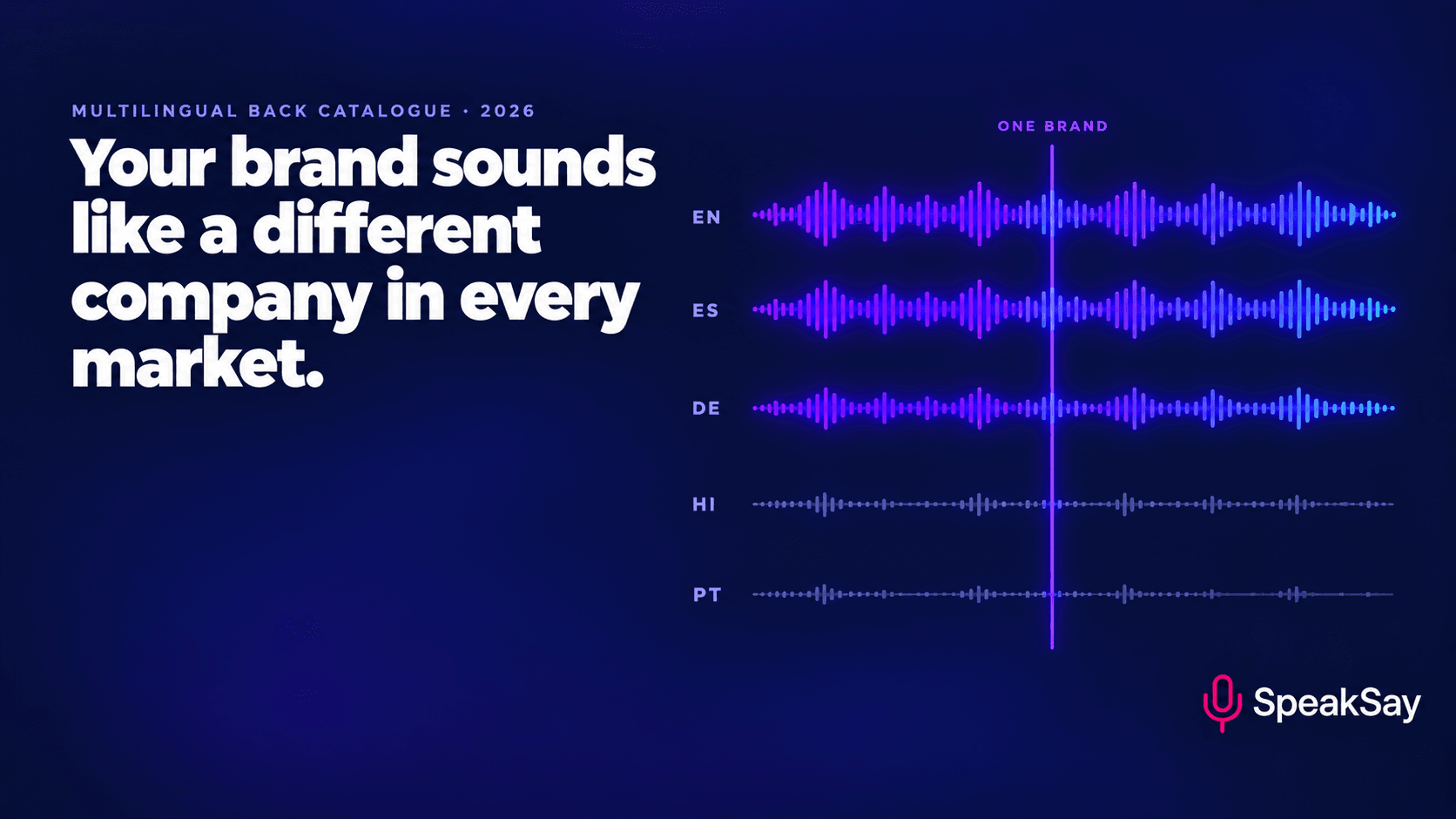
Every dubbing platform advertises a hundred languages. Quality is genuinely comparable in about ten of them. If you have been publishing in five or six markets for a year, your catalogue is now sitting on several different model generations at once — and you have almost certainly never listened to the weakest one.
1. Two problems that look like one
When a creator says "my German videos don't perform," there are two completely different causes sitting underneath, and they need different fixes.
| Tier gap | Version drift | |
|---|---|---|
| What it is | The model is simply weaker in this language than in English | The model changed between your early and recent uploads in this language |
| Compare across | Languages, same month | Months, same language |
| Sounds like | Foreign rhythm, wrong stress, flat affect throughout | Episode 4 and episode 30 are recognisably different voices |
| Fix | Different voice, different model, or native re-write of the script | Re-render a subset, or accept and mark the boundary |
| Who notices | Any native speaker, immediately, from one clip | Only binge listeners and returning subscribers |
Almost everyone assumes they have the first problem. Most multi-market catalogues over a year old have both, and the second one is doing more damage, because it hits the audience that already committed to you.
2. Why language tiers exist and why they will not go away soon
This is worth understanding, because it tells you which languages to trust and which to check.
Speech models are trained on recorded speech paired with text. The volume, diversity and cleanliness of that data varies enormously by language, and roughly tracks how much broadcast, audiobook and podcast audio exists in a form that can be licensed. English has an order of magnitude more than most languages. Spanish, French, German, Portuguese, Italian and Mandarin have a lot. After that it falls away sharply, and it falls away fastest for languages with many regional variants, non-Latin scripts, or tonal systems.
Three specific consequences you will hear:
- Prosody degrades before pronunciation does. A tier-three language usually gets the phonemes approximately right and the music wrong. That is why it sounds like a competent foreigner rather than like a machine.
- Regional variants collapse. The model produces a homogenised version that belongs to no particular place, which reads as "neutral" in some markets and as "wrong" in others — Latin American versus European Spanish, Brazilian versus European Portuguese, and the various Arabics are the classic cases.
- Code-switching breaks. A sentence containing an English brand name inside a Hindi or Japanese script is where tier-three models fail most visibly, and product and tech content is full of these.
None of this is a reason not to publish in those markets. It is a reason to check them rather than assume the platform handled it.
3. What tier-three audio actually sounds like to a native listener
You cannot hear this yourself in a language you do not speak, which is exactly why it persists. Here is what native speakers consistently report, so you know what you are asking them to listen for.
- Stress on the wrong syllable in common words. Not exotic words — common ones. This is the single most jarring symptom and the most reliable tier indicator.
- Sentence-final intonation that does not resolve. Statements that sound like questions, or lists where every item lands identically so the listener cannot tell the list has ended.
- Uniform speed. Human speech in every language speeds up on familiar material and slows on the important clause. Weaker models render everything at one pace, which reads as disengaged rather than robotic.
- Loanwords pronounced by the wrong rules. An English word inside a non-English sentence either gets fully nativised when it should not be, or gets an incongruous English pronunciation dropped into the middle of the line.
- Register mismatch. Many languages encode formality grammatically. A model trained mostly on formal written sources will produce a narration that is technically correct and socially strange for a casual YouTube video.
Notice that four of these five are invisible in a transcript. A perfect translation can produce all of them. This is why "the translation was fine" is not evidence that the audio is fine.
Cast the voice for the language, not the language for the voice
The most common cause of foreign-sounding output is a single multilingual voice asked to cover six markets. Casting a voice built for each target language fixes more than any setting you can adjust.
4. The six-step multilingual drift audit
Budget two hours for the whole thing plus whatever it takes to reach native speakers. Do it once a year, or after any provider model update you are told about.
Step 1 — Build the inventory (20 min)
One row per language. Columns: language, number of published pieces, date of first publish, date of most recent publish, voice name used, model or tier used if you know it, settings used. Most people cannot fill in half of this, and discovering that is itself the finding — it means you have no version history and section 7 is the most important part of this article for you.
Step 2 — Pull the bookends (15 min)
For every language, pull the earliest published piece and the most recent one. Take sixty seconds from the middle of each — not the intro, which is often rendered separately and differently. You now have two clips per language.
Step 3 — Render the control paragraph (15 min)
Write one short paragraph — six to eight sentences containing a proper noun, a number, a list of three, a question, and one English loanword. Translate it into each of your languages. Render it today, in each language, on your current voice and settings. This is your control. Save every file with the date and settings in the filename.
The control paragraph is the single most valuable artefact this audit produces. From now on you re-render it whenever anything changes, and comparison becomes a two-minute job forever.
Step 4 — Self-check what you can (10 min)
Even without the language, you can detect three things reliably: overall loudness differences between languages, obviously different speaking rates, and whether the two bookend clips in the same language have audibly different tonal character. Do a quick loudness measurement across all files. Markets frequently drift several LU apart, which alone changes how professional a channel sounds.
Step 5 — Get native ears on it (the real step)
One native speaker per language, fifteen minutes each, using the scoring sheet in section 5. Sources that actually work: a paid freelancer for thirty minutes, a language-exchange community, your own audience (ask in that market's comments — people are flattered to be asked), or a colleague. Do not ask "does this sound good?" You will get "yes" from politeness every time. Use the sheet.
Step 6 — Rank and decide (20 min)
You will end up with a ranking of markets from strong to weak. Do not try to fix all of them. Section 6 covers what to actually do.
5. A scoring sheet you can hand to a native speaker
Copy this. Each item is scored 1 to 5, where 1 is "a local person would not say it this way" and 5 is "indistinguishable from a local presenter." The specificity is the point — vague questions get vague answers.
| # | Question | What a low score tells you |
|---|---|---|
| 1 | Is the stress correct on ordinary everyday words? | Tier gap. Not fixable with settings. Change voice or model. |
| 2 | Do statements sound like statements and questions like questions? | Tier gap in prosody. Try shorter sentences and explicit punctuation. |
| 3 | Are brand names, place names and English words pronounced the way a local would say them? | Fixable. Use pronunciation overrides or phonetic respelling. |
| 4 | Is the formality level right for this kind of content? | Script problem, not voice problem. Rewrite in the target register. |
| 5 | Does it sound like it comes from a specific place, and is it the right place? | Wrong regional variant. Recast to a regional voice. |
| 6 | Does the pace change when the content gets important? | Tier gap in expressivity. Break long paragraphs; add deliberate pauses. |
| 7 | If you heard this in the wild, would you assume it was made by a local company? | The summary question. This is the one that predicts subscriber behaviour. |
Add one free-text question at the end: "Write down the first moment you noticed something was off, with the timestamp." That single answer is usually worth more than the seven scores, because it tells you where the listener's trust broke rather than what you can quantify.
6. Fixing the weak markets without re-rendering the world
You now have a ranking. The instinct is to re-render everything in the worst market. That is almost always the wrong spend. Work in this order.
Fix one: recast, don't re-tune (cheapest, biggest effect)
If question 1 or 5 scored low, no amount of speed and stability adjustment will help. Change the voice to one built for that language, and where the language has strong regional variants, to one built for that region. Test with the control paragraph before touching any real content.
Fix two: rewrite for the language, not for translation
A script written in English and translated carries English sentence architecture — long subordinate clauses, front-loaded qualifiers, three-part rhythms. Some languages tolerate that; several do not. If questions 2, 4 or 6 scored low, the fix is in the text. Shorter sentences, one idea per sentence, and a native rewrite of your opening and closing lines specifically. Those two carry most of the perceived quality.
Fix three: fix names once, globally
Build a pronunciation list per language — your brand name, your show name, recurring proper nouns — and apply it to every render from now on. This is a one-hour job that permanently removes the most-reported complaint.
Fix four: re-render selectively, by traffic not by age
Pull your top ten pieces by ongoing views in that market. Those are the ones new listeners hear first. Re-render those and stop. Re-rendering your whole archive costs real money to fix audio that almost nobody plays.
Fix five: normalise loudness across all markets
Whatever else you do, get every language to the same loudness target. It is a batch operation, it takes minutes, and a listener who switches between your English and Portuguese feeds notices a level jump long before they analyse prosody.
The option worth considering: publish in fewer languages
This is the recommendation nobody in the dubbing industry will give you. If a market scored 2 out of 5 on question 7 and produces a rounding error of your traffic, the honest move may be to stop publishing there rather than to ship audio that makes your brand sound cheap in a country you are not serving. Four markets done well beats nine done by default. Revisit in a year — these models improve fast, and the language that is unusable in 2026 may be fine in 2027.
Re-rendering should not be a budgeting decision
Selective re-rendering only works if the marginal cost of a render is near zero. A lifetime plan removes the per-character calculation that currently stops you from fixing your weakest market.
7. Version pinning: the practice that prevents all of this
Everything above is remediation. Here is the prevention, and it is four habits that cost nothing.
- Record the render context with every publish. Date, voice name, model or tier, speed, stability, any overrides. In a spreadsheet next to your content calendar. This is the thing whose absence makes a drift audit take two hours instead of ten minutes.
- Keep the control paragraph and re-render it monthly, in every language. Four minutes. It is a smoke alarm for model changes you were never notified about, and it catches them before your audience does.
- Treat voice names as labels, not versions. A voice with the same name can be retrained underneath. If your provider exposes an explicit model version, pin it and write it down; if it does not, the control paragraph is your substitute.
- Change one language at a time. When you decide to move to a new voice or model, roll it out in one market, watch retention for three weeks, then roll it wider. Changing five markets at once means you learn nothing from the result.
The general principle: a multilingual catalogue is a set of parallel products, and parallel products drift apart unless something is measuring them against each other. The control paragraph is that something.
8. What this means for which language you add next
The usual method for choosing the next market is audience size. That is the wrong first filter, because a large market where your audio scores 2 out of 5 will convert worse than a small market where it scores 4.
Better order:
- Render the control paragraph in the candidate language before committing anything. Get one native speaker to run the scoring sheet. Total cost: under an hour.
- Only then look at audience size. Among languages that score 4 or above, pick the biggest.
- Weight for regional variant coverage. A language where you must choose between two variants is a language where you will eventually need two feeds, not one. Factor that in as double the ongoing cost.
- Check whether your content type is loanword-heavy. Tech, business, gaming and beauty content are full of English terms. Those categories suffer most in tier-three languages and should have a higher passing score.
This inverts the normal expansion logic, and it is the right inversion: model quality is the binding constraint in 2026, not market size. Market size is what you optimise within the set of languages that actually work.
Test a language before you commit a catalogue to it
Render your control paragraph in every candidate language, compare them side by side, and only then decide where to expand. It is the cheapest market research available to you.
9. FAQ
Why does AI dubbing sound worse in some languages than others?Because model quality tracks the volume and cleanliness of available training speech in that language, which varies by an order of magnitude. Quality is broadly comparable across roughly the top ten languages and drops noticeably outside English and Western European languages. Prosody — stress, intonation, pacing — degrades before pronunciation does, which is why weaker languages sound like a fluent foreigner rather than like a machine.
How do I check quality in a language I don't speak?You cannot do it by ear, so do not try. Render one fixed control paragraph in each language and have one native speaker score it on seven specific questions — stress, intonation, name pronunciation, register, regional placement, pacing, and whether they would assume it came from a local company. Specific questions get honest answers; "does this sound good?" always gets yes.
Should I re-render my whole back catalogue when a model improves?No. Re-render your top pieces by ongoing traffic in that market — usually five to ten — and leave the rest. New listeners encounter your best-performing content first; the archive is consumed by people who already accepted how it sounds.
My translation is professionally done but the audio still sounds foreign. Why?Because four of the five things that make narration sound foreign are invisible in a transcript: syllable stress, sentence intonation, pacing variation, and formality register. A perfect translation of an English-architecture script still carries English sentence architecture. The fix is a native rewrite of at least your opening and closing lines, plus shorter sentences throughout.
What is a control paragraph and why does it matter so much?A fixed six-to-eight-sentence paragraph containing a proper noun, a number, a list, a question and an English loanword, translated once per language and re-rendered monthly on your current settings. It is the only way to detect that a provider silently changed a model, because it holds everything constant except the thing you are trying to measure.
Is it better to publish in fewer languages?Often, yes. A market where your audio scores poorly and traffic is negligible is costing you brand perception in exchange for almost nothing. Four markets done well outperform nine done by default — and the language that is unusable this year is frequently fine within twelve to eighteen months, so pausing is not the same as abandoning.


