Spotify Makes a Podcast for Each Listener and Apple Just Licensed the Tech Behind Another: What an Independent Show Has That a Personalized Feed Can't Copy (2026)
Spotify has announced AI-generated personal podcasts, and a regulatory filing reported on October 10 shows Apple licensing technology from the personalized-podcast startup Huxe. If a feed can generate an episode on any topic, what is a show for? Here is a practical plan for independent podcasters, with the limits of what we know.
1. What is actually known
It's worth separating reported facts from speculation.
- Spotify (announced May 2026). Per coverage of its investor presentation, users describe a topic and Spotify produces a spoken episode. It can draw on listening history, location where permitted, and documents, links or notes the user supplies. Users choose a voice and a tone. Episodes can regenerate daily or weekly and live in a private library, and listeners can ask follow-up questions. The first rollout was to select US Premium subscribers, with a limited number of monthly generation credits.
- Huxe and Apple (reported October 10). Apple's filing with the European Commission, notified on June 9, says it will make offers to certain employees of Huxe AI and receive a non-exclusive license to Huxe's IP. The article calls it a reverse acqui-hire. No price was reported, and the filing doesn't say what Apple will build.
- Huxe's background. It was founded by developers who had worked on AI-generated podcast features in NotebookLM.
We have not seen listener numbers for any of these products. Anyone claiming to know how many people prefer generated audio to a show is guessing.
2. What a personalized feed competes with
A feed that generates an episode on demand is strongest where the listener wants information and doesn't care who delivers it:
- A five-minute briefing on a topic they're curious about this morning.
- A summary of a document or article they haven't had time to read.
- A daily digest of things they already follow.
If your show is mostly "here are the facts about X, read out loud", you are in that category. A generated version can do the same job at the exact moment a listener asks, and it costs the listener nothing extra. Shows that are interchangeable read-outs of public information are the ones most exposed.
3. What an independent show owns
None of these are guaranteed advantages. They're the things a personalized feed doesn't currently offer, as far as the public reporting shows.
| What a listener gets | Personalized feed | Independent show |
|---|---|---|
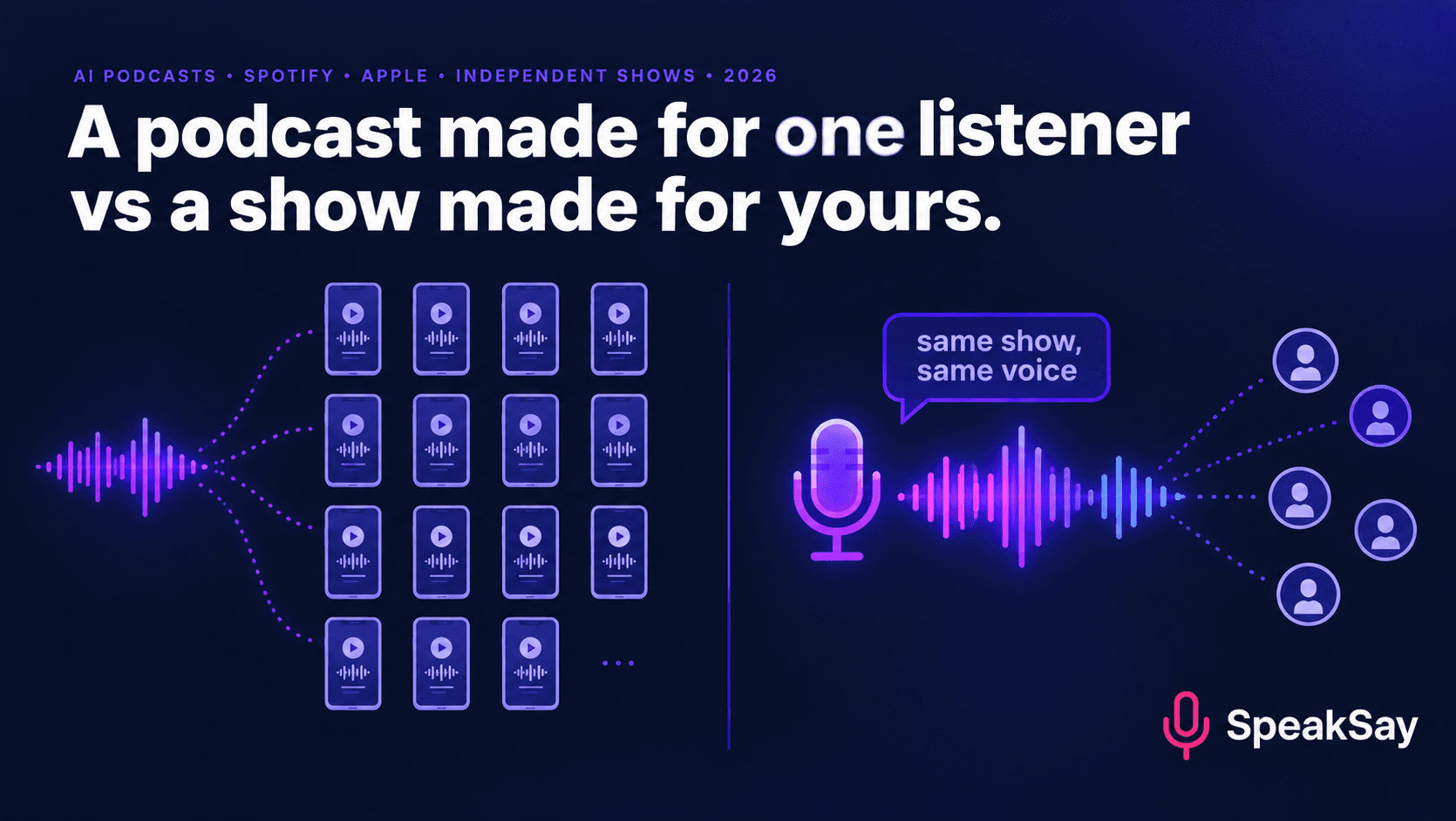
| A shared episode to talk about | Each listener hears a different one. | Everyone heard the same episode, so people can discuss it. |
| A consistent voice and point of view | Chosen by the listener from a menu. | Built by you over months. |
| Original material | Draws on existing sources. | Interviews, reporting, first-hand experience. |
| A relationship | With the app. | With a host or a team. |
| A reason to come back on a schedule | On demand. | A recurring appointment. |
4. Six moves to make now
- Add something a generator can't pull from the web. A listener question you answered, your own numbers, a conversation you had last week. Even one original segment per episode changes what the show is.
- Make the voice recognizable. Pick one narrator or one pair of hosts and keep them. A distinct, consistent voice is part of the brand. Our guide to casting two hosts who don't sound alike covers how to do this with AI voices.
- Write for a shared moment. Give episodes a clear title, a take people can quote, and something to argue about. Shared episodes get talked about; personal ones don't.
- Fix the first minute. A listener with a feed of options will leave faster. See our post on the first-minute drop-off.
- Own a direct channel. An email list or a community is yours whatever happens to any platform's recommendations.
- Be clear about how you make the show. If AI voices are part of production, say so plainly. Listener trust is the asset that a generated feed has the least of. We discuss where that line sits in where AI belongs in a show people trust.
Give your show a voice that's yours
Build a recurring show with consistent AI hosts, a clear format and a repeatable weekly workflow.
5. Where AI still helps your own show
Using AI to make a show is a different thing from competing with a feed that makes shows for nobody in particular. Production help is where small teams gain the most:
- Turning your own notes, newsletter or research into a draft episode.
- Producing a consistent cast of hosts without scheduling anyone.
- Making a second-language version of an episode.
- Cutting the time between idea and publish, so topical episodes can go out while they matter.
The test is simple: is the human part of the show, such as the idea, the angle, the reporting or the judgment, still yours? If so, the voice is a production tool.
6. What to watch next
- Whether Apple announces anything built on the Huxe license, and whether it's in the Podcasts app.
- How Spotify's credits are priced when the feature expands beyond the first group of subscribers.
- Whether platforms label generated episodes differently from published shows.
- Whether listeners treat generated episodes as a replacement for podcasts or as something else, like a news alert.
We will update this post as facts are confirmed. Until then, treat anything stronger than the reporting above as opinion.
Prefer one flat price to counting credits?
If you publish weekly, a lifetime plan can be simpler than a monthly credit allowance.
7. FAQ
Is Spotify replacing podcasts with AI?No. Spotify announced a feature that lets individual subscribers generate personal episodes. The coverage doesn't say it replaces published shows. It was reported as an addition for select US Premium users, with limited monthly credits.
What is Huxe and why does it matter?Huxe was a personalized audio startup founded by developers who had worked on NotebookLM's podcast features. It announced it was shutting down on May 21. Apple's filing says it will hire certain employees and license the technology on a non-exclusive basis.
Is Apple launching AI-generated podcasts?Not that anyone has announced. The filing doesn't say what Apple will do with the technology. Speculation about a future feature is only speculation.
Should I stop making a podcast that's mostly summaries?You don't need to stop, but add something a generator can't: original reporting, your own data, interviews or a strong point of view. Interchangeable read-outs are the easiest format to replace.
Can an AI-voiced show be distinctive?Yes, if the voice, the format and the ideas are consistent and clearly yours. A recognizable cast and a regular structure matter more than whether a voice is recorded or generated.
Do I have to disclose AI voices in my podcast?Rules vary by platform and region, and trust matters regardless. Saying how you make the show is the safe choice. Check each directory's current policy.