18% of Podcast Superfans Quit a New Show in the First Minute: Rebuild the Opening of Your AI-Produced Episodes (2026)
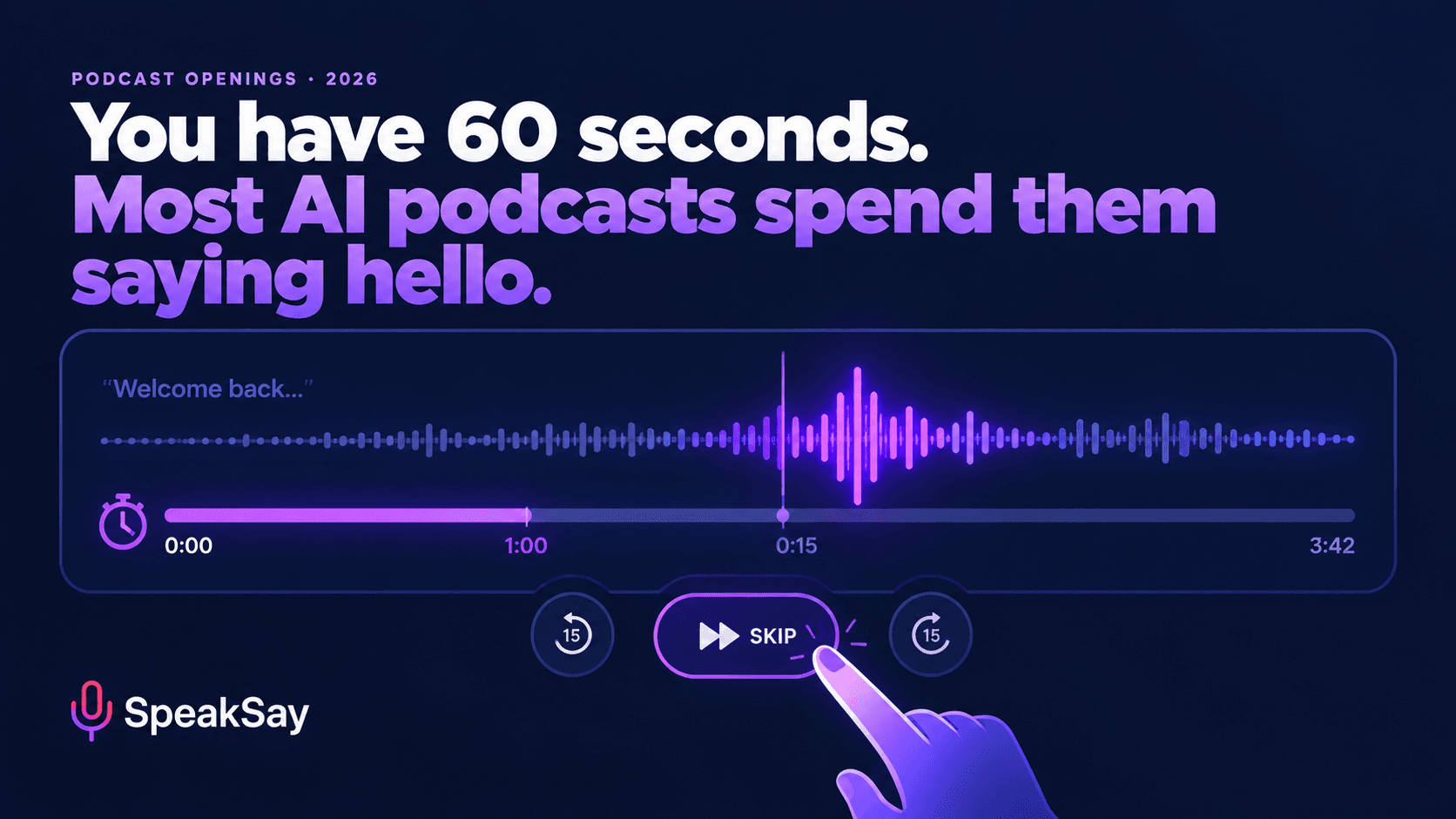
The Podcast Study 2026 found that even superfans, the most patient listeners there are, give up on a new podcast within 60 seconds 18% of the time, and 21% would definitely leave a favourite show if its host left. AI-produced episodes are especially prone to slow, generic openings. Here's a 60-second audit, four openings that work and a fix you can apply to your next episode.
1. What the Podcast Study 2026 found
The findings were released through a Podnews press release on October 4, 2026, ahead of a free webinar on October 6 called "Turning Listeners / Viewers Into Superfans." The parts that matter here:
- 18% of superfans abandon a new podcast within the first minute. The study's framing is that this puts "outsized weight on how a show opens."
- 21% would definitely stop consuming a favourite podcast if its host left.
- Nearly half of superfans have contacted a host directly. The relationship with the host is the brand.
Put the two together. New listeners judge you in a minute, and the ones who stay attach to a person. Both are about the opening: it's where a listener decides whether to stay, and where they first meet the host.
2. Eight opening habits that lose new listeners
These are common in all podcasts and close to universal in AI-generated ones, because AI scripts copy the conventions of the shows they learned from.
| Habit | What a new listener hears | Fix |
|---|---|---|
| "Welcome back to…" | A show that assumes you were here last week | Speak to someone hearing you for the first time |
| Reading the episode title and number | Information they already saw on the screen | Cut it |
| "Today we're diving deep into…" | A promise with no content yet | Start with the content itself |
| Long music intro | Twenty seconds of waiting | Five seconds or less, or move it after the cold open |
| Sponsor read first | An ad before any reason to stay | Move it to minute two or three, or mid-roll |
| Recap of last episode | A story they can't follow | Only if this episode needs it, and in one sentence |
| Two hosts agreeing ("That's so interesting." "It really is.") | Filler | Disagreement or a question, or one host only |
| Housekeeping and calls to subscribe | A request before you've given anything | Move to the end |
If your show uses NotebookLM-style two-host overviews, the "agreeing hosts" habit is built into the format. Our guides to scripting real disagreement between AI hosts and taking control of the script show how to write past it.
3. The 60-second audit
This takes one afternoon.
- Open your five most recent episodes.
- For each, play from 0:00 with a stopwatch. Write down the time at which the first specific, useful or surprising thing is said: a fact, a claim, a question with stakes or a moment of story. Call that the "promise moment."
- Write down everything that comes before it.
- Score each episode: promise moment under 15 seconds is good, 15 to 30 is fair, over 30 needs fixing.
- Look for the pattern. It's usually the same three or four things every time, because they're built into your template.
Then do the same for the first minute of your trailer and your most-played episode, which are the two places new listeners are most likely to start. Our trailer and audiogram guide covers the trailer side.
4. Four openings that work
Every example below is made up, for a fictional show about city history.
- The cold open. Start with the best 15 to 30 seconds from inside the episode, then the show name. "In 1871 the city council voted to move the river. Not the bridge. The river." [show sting] "This is Old Streets. I'm Mara."
- The question with stakes. "Why does every map of downtown have a street that doesn't exist? By the end of this episode, you'll be able to find it."
- The number. "Forty-one buildings on Main Street are older than the city itself. Today, how that's possible."
- The scene. "It's 3 a.m., February 1903. A night watchman sees smoke coming out of the post office…"
All four put the promise moment inside 15 seconds and name the host by 30. Write the opening last, after you know what the best moment in the episode is.
5. The host is the show, even when the host is AI
If 21% of superfans would leave when a host leaves, the host's identity is an asset, and AI shows often waste it.
- Give the host a name and keep it. "I'm Mara" in the first 30 seconds of every episode.
- Don't rotate voices. Pick one voice and lock its settings. A host who sounds slightly different each week isn't a host. If you have two, make sure they're easy to tell apart. See casting two AI hosts.
- Give the host a point of view. Opinions, recurring phrases and a sign-off. Those are what superfans write in about.
- Be honest about what the host is. A short disclosure in the show notes and, if you like, a light mention in the opening. Our post on where AI belongs in a podcast explains why surprising listeners with an AI host backfires.
One host voice, every episode
SpeakSay AI Podcast lets you lock a host voice and its settings, so episode 40 sounds like the same person as episode 1, and you can write the opening you want instead of a template's.
6. Where everything you cut should go
- Theme music: a five-second sting after the cold open. Our sonic identity guide covers how to make it short and recognisable.
- Sponsor read: after the first segment, around minute two to five.
- Episode number, recap and housekeeping: the show notes, or the last minute.
- Subscribe and review requests: the end, when the listener has a reason to agree.
- Show description: rewrite it with the same rules, because it's increasingly read aloud by AI previews. See our post on descriptions that survive being read aloud.
7. Fix it in your production workflow
- Change the template, not just one episode. Delete the welcome line from your script template.
- Add an "opening" field to each episode brief: the promise moment and which of the four structures to use.
- Write two openings for important episodes and render both. That costs a minute of audio, not a whole episode.
- Re-render only the first minute of your top five back-catalogue episodes. That's where new listeners arrive from search and recommendations.
- Check the first 60 seconds on a phone speaker at normal volume. That's how many people first hear a show.
8. Measure whether it worked
Most hosting and listening platforms show some kind of per-episode retention or drop-off chart. Compare the first-minute drop on the five episodes before the change with the five after. Look at the shape of the curve, not the total plays. Plays depend on promotion, while the first-minute drop depends on the opening. If one structure clearly beats another, make it the default. For problems later in the episode, such as a mid-episode sag or a cliff at the ad break, see our guide to reading your podcast drop-off curve.
Rework the openings across your catalogue
Re-rendering openings, testing two versions and keeping a host voice consistent works best on a plan that doesn't penalise iteration. Pick the SpeakSay plan that fits your show.
9. FAQ
How quickly do listeners decide whether to keep listening to a podcast?Fast. The Podcast Study 2026 found 18% of podcast superfans give up on a new podcast within the first minute. Less committed listeners are likely to be quicker still.
How should I start a podcast episode?Get to the first specific, useful or surprising thing within 15 seconds, with a cold open, a question with stakes, a striking number or a scene. Name the host by 30 seconds. Move music, sponsors and housekeeping later.
How long should a podcast intro be?Keep theme music to about five seconds and put it after a short cold open. The whole run-up before real content should be under 15 to 30 seconds.
Does the host matter if the podcast is AI-generated?Yes. The Podcast Study 2026 found 21% of superfans would definitely stop if a favourite host left. Give your AI host a name, a consistent locked voice and a point of view, and disclose that the host is AI.
Should the sponsor read go at the start?For new listeners, no. Put it after the first segment or mid-roll, once the listener has a reason to stay.
What is the Podcast Study 2026?An audience study by Strategic Solutions Research and Point-to-Point Marketing. Its findings on superfans, hosts and first-minute abandonment were released on October 4, 2026.