You Can Read a Script. Can You Answer a Question? Unscripted Interviews and Q&A for Scripted Creators (2026)
Creators who are excellent on script often freeze the first time a host asks something sideways. Here is why reading and answering are different skills, the anchor-story method that replaces memorised answers, and a rehearsal loop that uses your own cloned voice as a reference — not a stand-in.
1. Why answering is a different skill from reading
When you read a script, three hard jobs are already done: you chose the order, you chose the words, and you know where the sentence ends. When you answer a question, you do all three in real time, while listening and while being recorded. Scripted creators are often worse at this than people who have never scripted, for a specific reason: they have a clear internal standard of what "good" sounds like, and they can hear themselves missing it mid-sentence.
We covered the monologue version of this gap — why your live delivery sounds worse than your edited delivery — in closing the gap between live delivery and rendered audio. This post is the interaction version: someone else controls the questions.
| Scripted delivery | Being interviewed |
|---|---|
| You choose the order | The host chooses the order |
| You know the ending of every sentence | You find the ending as you go |
| Mistakes get edited out | Mistakes are often kept — hosts like authenticity |
| Success = accuracy | Success = a clear point, reached reasonably quickly |
2. The first 90 seconds are the hard part
Guest-coaching advice consistently makes the same observation: anxiety tends to peak in the opening minute or two of a speaking situation and then falls as your body adapts. Knowing that in advance breaks the loop of being nervous about being nervous.
Use it practically:
- Prepare the first answer harder than any other. Hosts almost always open with some version of "tell us about yourself" or "how did you get into this". Have a 45-second answer that ends on something the host can pick up.
- Use the pre-show chat. Most hosts talk with guests for a few minutes before recording. Treat it as your warm-up rather than small talk.
- Relabel the feeling. A common coaching technique is to reappraise the physical symptoms as excitement rather than trying to force calm — the physiology is similar, and it's easier to reframe than suppress.
3. Anchor stories instead of memorised answers
The instinct of a scripted creator is to script the answers. Don't. Memorised answers are audible — the cadence changes, the listener can hear you reciting — and they lock you into a shape that ignores how the host actually phrased the question.
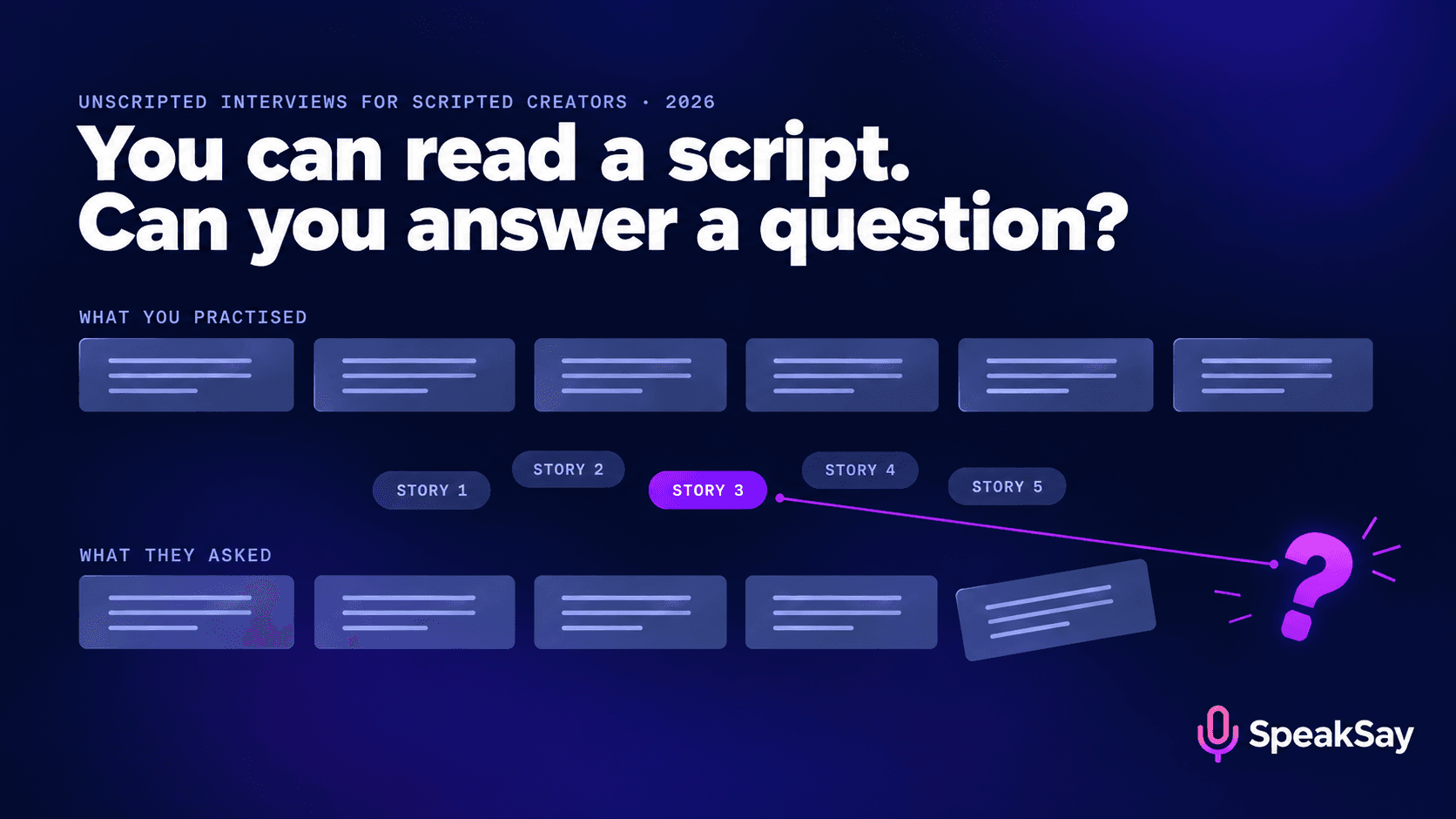
Instead, prepare three to five anchor stories, each tagged with the questions it can answer. An anchor story is a short, specific, true episode with a beginning, a turn and a point.
| Anchor story | Point | Answers questions like… |
|---|---|---|
| The video that flopped and what the comments taught you | Audience feedback beats your own taste | "Biggest mistake?", "How do you pick topics?", "What surprised you?" |
| The week you almost quit | Consistency beats inspiration | "Was it hard at first?", "Advice for beginners?" |
| The first time a viewer used your advice | Why you do this | "Why this niche?", "What keeps you going?" |
| The tool/process change that doubled output | Systems over effort | "What's your workflow?", "How do you stay consistent?" |
Write each story as bullet points, not sentences. You want to know the beats, not the words. Five stories with a few tags each will cover the large majority of what a typical host asks.
4. Bridges: getting from their question to your story
A bridge is a short, honest phrase that connects the question you were asked to the story you have. It is not dodging — you still answer the question — it's giving yourself a route.
- "The clearest example I have of that is…"
- "I learned that the hard way, actually…"
- "Short answer: yes. The reason I'm sure is…"
- "I don't know about in general, but in my case…"
And one for the question you truly can't answer: "I haven't thought about that — let me think out loud for a second." Hosts respect it far more than a confident wrong answer, and it buys you three seconds.
A good answer shape for most interview questions: point → story → point again. Say the answer in one sentence, tell the story that proves it, and land back on the one sentence. Then stop. Scripted creators tend to keep talking because there's no script telling them the answer is over.
Hear your stories in your own voice first
Clone your voice once, render each anchor story as a clean reference take, and listen for pacing before you're on someone else's mic.
5. A rehearsal loop with your own voice as the reference
Here's where a voice clone is useful — as a mirror, not a substitute.
- Write each anchor story as a tight 60–90 second version. This is the only time you write full sentences, and it's for reference only.
- Render it in your cloned voice. You now have a "best-case you" telling the story — well-paced, with the ending landing.
- Listen twice, then put the text away. Note where the pauses fall and how long the story actually takes. Most people are surprised how short a good version is.
- Tell it out loud from bullets only, and record yourself. Don't try to match the words — match the length and the landing.
- Compare. Is yours twice as long? Did you bury the point? Did the ending trail off? Fix one thing and do it again.
If your phone recordings are noisy, clean them with a free noise remover before comparing, so you're judging delivery and not the room.
The reason this works: the rendered version gives you a concrete target for shape and length without handing you words to memorise. You're calibrating, not reciting.
6. Running mock interviews that ask things sideways
Real hosts rarely ask the question you prepared for. They ask it sideways. Your rehearsal should do the same.
- Generate sideways questions. Give a chatbot your anchor-story list and ask it for 20 interview questions a host might ask that don't name any story directly. Practise bridging each to a story.
- Add the three hard ones. Every guest spot has a version of: a question that challenges you ("Isn't AI content killing the platform?"), a question about money, and a personal one. Prepare a calm first sentence for each.
- Use an AI-hosted mock. If you want to hear questions rather than read them, an AI podcast format can act as a host prompting you — we described the format in letting an AI host interview you. For rehearsal, don't edit your answers; the point is continuous, unrecoverable speech.
- Do one real one with a friend. Nothing replaces a human who interrupts.
7. Live audience Q&A: the extra rules
Audience questions are harder than a host's, because they're unfiltered. Four rules:
- Repeat or rephrase the question. It helps everyone hear it and gives you a few seconds.
- Answer the person, then the room. One sentence to them, then widen it.
- Cap each answer. If you've spoken for more than about a minute, land and invite the next question.
- Have a parking phrase. "That deserves a proper answer — ask me after, or I'll cover it in a video." Then actually do it.
If this is also the first time your audience hears your real voice, read what happens the first time a faceless channel goes live first.
8. What not to use AI for here
Be clear with yourself about the boundary. A cloned voice is a rehearsal tool here. Using it to answer live questions for you, or to send a "pre-recorded interview" that pretends to be spontaneous, isn't what hosts or audiences agreed to — and if your clone is presented as you in a live setting without disclosure, you're burning the trust the appearance was meant to build. The goal of every step above is that, on the day, it's you talking.
9. FAQ
How do I prepare for a podcast interview as a guest?Prepare three to five anchor stories tagged with the questions they answer, a strong 45-second opening answer, bridge phrases, and calm first sentences for challenging questions. Rehearse out loud from bullet points, not a script.
Should I memorise my answers?No. Memorised answers are detectable on audio and don't adapt to how the host phrases the question. Memorise the beats of your stories, not the words.
How do I stop saying "um" when answering questions?Filler usually appears when you don't know where the sentence is going. The point–story–point shape gives you a destination. A deliberate silent pause also sounds far better on audio than a filler word.
How does a voice clone help with interview practice?Rendering a tight version of each story in your own cloned voice gives you a reference for pacing and length. You then practise telling it live from bullets and compare. It's a mirror, not a stand-in.
What if the host asks something I can't answer?Say so, and think out loud: "I haven't thought about that — here's my first instinct." Honest uncertainty sounds far better than a confident guess.