Your Audience Has Never Heard You: What Happens the First Time a Faceless Channel Goes Live (2026)
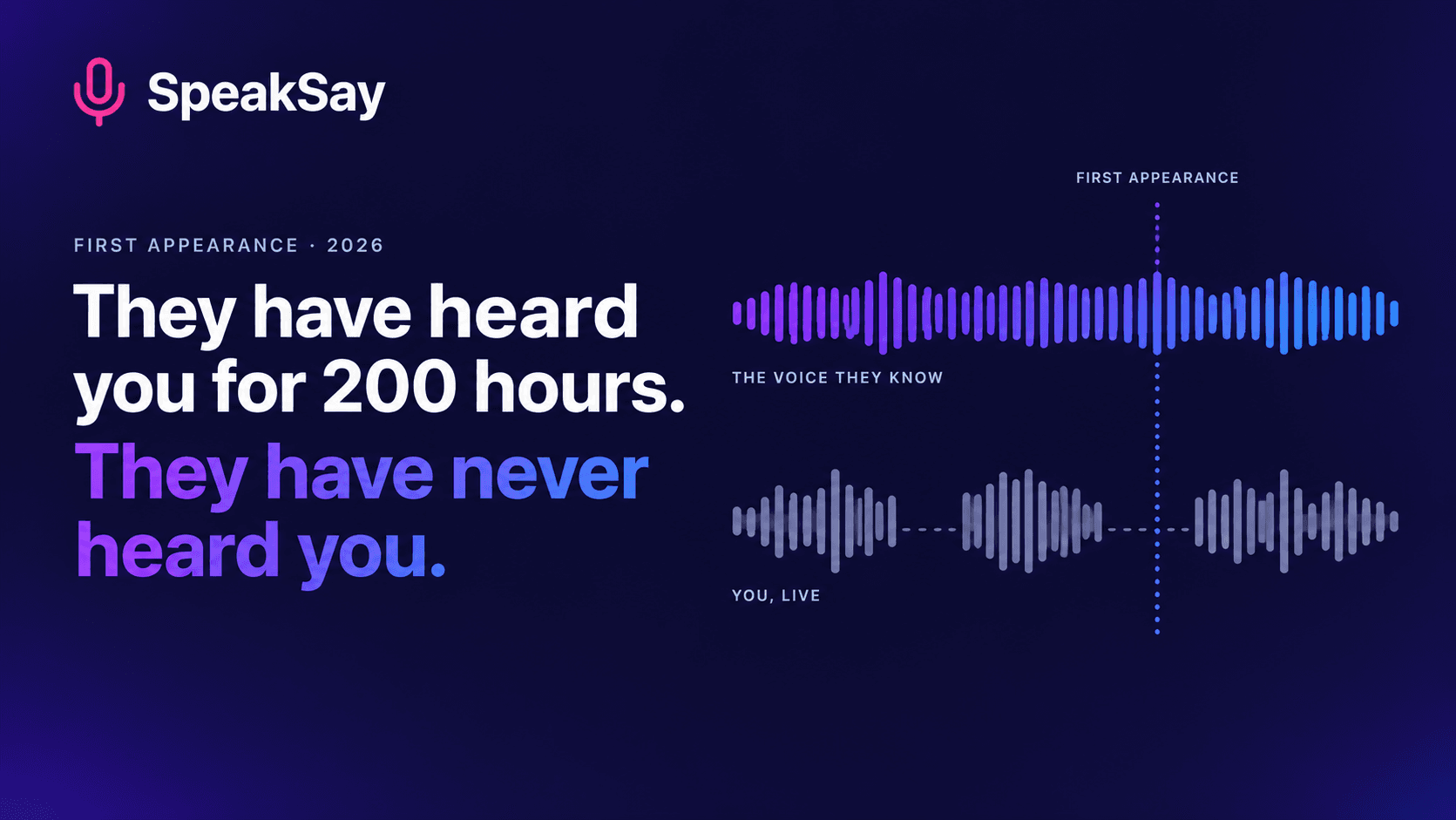
The fear is that people will be angry you used an AI voice. That is almost never what happens. What happens is a continuity problem: the voice your audience has spent two hundred hours with turns out to belong to nobody, and they find out by accident, mid-livestream. The fix is sequencing, not ethics — and it has a deadline set by whether you own the voice.
1. This is a continuity problem, not an ethics problem
The anxiety usually presents as a moral one. Have I been deceiving people? Separate that out early: it is the wrong frame, and it produces the wrong actions — the apology, the video essay, the defensive thread. Almost nobody in your comments is upset that a narration was synthetic. That argument was settled by volume: by 2026 a large majority of educational and explainer channels use AI narration as their primary voice, with commonly cited figures putting it above 70%. The synthetic-ness is not news.
What unsettles people is more specific. They have spent two hundred hours with a voice — fallen asleep to it, cooked to it, commuted with it — and built a picture of a person. Then they discover the voice belongs to nobody, and they discover it by accident, from a stranger in a chat. The damage lives in that gap, between what the audience reasonably inferred and what they later find out, and it is amplified by one thing only: the appearance of concealment. Not the AI use.
Which is good news, because a gap created by sequencing is closed by sequencing. The creator who says it first — once, plainly, before anyone asks — has no problem at all. Not a smaller problem. None. The creator whose audience works it out live has a bad week, and the bad week is about the discovery.
2. Why the voice became the channel
It is tempting to file the voice alongside your font and your lower thirds. It does not belong there, for a structural reason rather than a sentimental one: the voice is the only element present for the entire runtime, from first frame to last, across every video, for years. The prevailing view in 2026 creator coverage is that audiences broadly tolerate AI narration when the content is good, but that this continuity makes the voice function as the channel's identity in practice. People subscribe to a voice.
Two consequences follow. Recognition attaches to timbre, not to you: if that timbre is a stock preset, the recognition is attached to an asset you do not control. And a different voice reads as a different channel — which is exactly what a live appearance is.
3. The collision scenarios, ranked by risk
The risk concentrates in a few moments, which differ in how the audience experiences the discovery and in how much warning you get. The second matters more than creators expect, because sequencing is the whole mitigation.
| Scenario | How the audience experiences it | Warning | Risk |
|---|---|---|---|
| Guest on someone else's podcast | A stranger introduces you and may raise the voice question in words you did not choose. Clips circulate without context. | Days, but no control of framing | Highest |
| First or unplanned livestream | Real time, no edit. One viewer types "wait, that isn't the narrator?" and the thread becomes the stream. | None, once you are live | Very high |
| Sponsor wants the read in your "real" voice | One segment in a different voice inside a video narrated by the channel voice. The join is audible, and it is the paid part. | Weeks — a negotiation | High |
| Community or Discord voice call | Engaged viewers hear it first, usually warmly — but they hold information the wider audience does not, and screenshots leave rooms. | Good; you choose the room | Moderate |
| A Q&A short or voice note | Short, edited, with your framing. You answer comments at your own pace. | Total | Low |
| A viewer simply asks in the comments | One question among many. Whether it becomes anything depends on your reply. | Total | Lowest — unless mishandled |
Read the table as one instruction. The bottom three rows are places you can put the information; the top three are where it gets extracted from you. Every strategy that works moves the disclosure down the table.
The guest appearance is worst because the framing is not yours. A host can ask "so, the channel uses an AI narrator — talk to me about that" curiously or faintly accusingly, and that tone defines how sixty thousand strangers meet your channel. You can only make it old news first.
4. Your deadline is set by who owns the voice
This turns a philosophical question into a scheduling one. The deadline is set not by when you next go live, but by whether the voice on your channel is yours.
| Built on a stock voice | Built on a clone of your own voice | |
|---|---|---|
| Can you become the channel voice? | No. You cannot grow into a preset. The gap is permanent by construction. | Yes — live you and rendered you are the same instrument. |
| Does the voice appear elsewhere? | Yes, on other channels, ads and Shorts, including poor ones, indefinitely. | No. It appears where you put it. |
| What a live appearance sounds like | A new host. The audience recalibrates from scratch. | The same person, less polished. |
| What you have to say | An acknowledgement — one sentence, once. | Nothing, though nothing is hidden. |
| Cost of waiting a year | Rises with every hour of catalogue anchored to a voice you cannot cheaply leave. | Roughly zero. |
The asymmetry is the point. On a stock voice there is no future in which the gap closes. You can manage it — section six is about exactly that — but every month of publishing makes the eventual switch more expensive. On a clone of your own voice the question barely exists: someone hears you live and thinks that's him, tidier on the channel.
So the cheapest insurance available to a faceless creator is to clone your own voice early, while the catalogue is small and before the audience locks onto a stranger's timbre. The framing matters, because it is the honest one: this is not a quality upgrade — good stock voices will out-perform a mediocre clone recorded on a laptop mic. It is continuity insurance, buying the ability to appear as yourself later without it registering as a change of cast. The underlying trade-off, if you are still choosing, is in our clone-versus-stock decision guide.
Clone your voice before the catalogue makes it expensive
A clone built in your first fifty videos costs one recording session. A clone built in your five hundredth costs a migration plan.
5. Position one: never appear
A legitimate position, dismissed too easily. Plenty of durable channels have never put a human voice out. But it only holds if you plan it, because the default drifts towards appearing anyway: an invitation arrives at a flattering moment and you say yes.
- A written policy you can send. "The channel is produced with a synthetic narration voice and I don't do audio or on-camera appearances. Happy to do written Q&A instead." Write it before you need it; the decision is much harder with a flattering invitation in front of you.
- A standard decline. Short, unapologetic, no explanation owed. Hosts accept this constantly and it costs nothing socially.
- Sponsor formats that need no voice appearance. Integrated reads in the channel voice, on-screen graphic segments, narrated demos, a dedicated video rather than a personal endorsement. State the constraint in your first email, so brands needing a personal read self-select out early rather than at contract stage.
- Honest acceptance of the growth cap. You lose live formats, most of the high-ticket sponsor tier, and the podcast-and-collaboration circuit — in authority niches like finance, law, health and tech, a primary discovery and credibility mechanism. You keep search, recommendation, evergreen compounding and Shorts. It caps one kind of growth, not growth.
One thing it does not buy: silence. A creator who never appears still gets asked, and the answer is still a sentence. This is a policy about appearances, not about questions.
6. Position two: appear, and say the sentence
If you are going to appear, the technique fits in a paragraph, and the difficulty is restraint rather than wording.
- One sentence. Two if the second is a joke. Not a paragraph, not a thread, and under no circumstances a video.
- Early. First minute or two. Later is worse: by then people have formed the question and you are answering rather than framing.
- Matter-of-fact. The register you would use to mention that you film in a spare room.
- No apology. An apology tells the audience there was something to apologise for, and they will accept the invitation.
- Never as a confession. The dramatic pause, the "there's something I've never talked about" — the one move that manufactures a scandal out of a production note.
- Then move on. Do not wait for a reaction, do not check chat.
The governing principle: the tone you use sets the audience's tone. They have no prior for how serious this is, so they take the reading from you. Treat it as a production detail and it is received as one.
Three worked examples
History or documentary channel, opening a first livestream: "Before anything else — the narration on the channel is a synthetic voice, has been since video one, and I'm the person who writes and makes them. So I sound different, and less tidy. Right, the thing I actually wanted to talk about tonight —"
Tech or tutorial channel, on someone else's podcast: "Worth flagging for anyone who knows the channel: the tutorials use a TTS voice — I write the scripts, I do the builds, the narration is rendered. This is my actual voice, and it has considerably more ums in it."
Finance or business channel, in a community voice call: "Quick one so nobody's confused: the channel voice isn't mine, it's generated. Everything else — the research, the models, the calls — is me. Okay, first question."
All three state the fact, state what is yours, pre-empt the delivery gap with light self-deprecation, and end on a pivot. All three also say what the voice is, not what it is not — "I don't use my real voice" is shaped like a denial and reads like one.
7. Position three: clone your own voice now
This position removes the problem rather than managing it, with one caveat people skip: a clone built today will not match a back catalogue narrated by a stock voice. Nothing will. So choosing to clone is also choosing to run a switch — and if you simply start publishing in the new voice, you have made a second continuity problem, this one visible to everyone rather than only to people who hear you live.
| Decision | What to do | Why |
|---|---|---|
| What to re-render | Permanent front doors only — trailer, intro, pinned introduction — plus your top three to five evergreen pieces. Leave the mid-catalogue alone. | Front doors are heard by more new people than anything else. Re-rendering the archive costs real time and unsettles returning viewers more than inconsistency does. |
| Where to switch | At a visible boundary — a season, a new series, a redesign, a milestone episode. | When the change coincides with something visible, people hear a deliberate update, not inconsistency. |
| What not to do | Never mix voices inside one video. Assign voices to formats, not segments. | An audience accepts that your main show and interview series differ. Not both inside one piece. |
| The announcement | Once, one sentence, in the first video of the new era, plus a line in the channel description. | The description covers later arrivals. A video about the change is a video about your production process. |
| Loudness | Normalise levels across old and new in one batch pass. | A level difference between eras is more noticeable than a timbre difference. |
One note on the clone itself: record at baseline, and use real script material rather than a neutral read. Whatever state you are in becomes the channel's voice for years.
The slower version of the same gap — the one that opens between you and your own clone over years — is covered in our piece on voice ageing across a multi-year channel. That gap grows gradually from a matching start. This one exists from day one, because the voice was never yours.
Two voices, one plan, no per-attempt anxiety
A switch means holding the old channel voice and your new clone side by side and comparing takes before committing — which only happens in practice if rendering is not metered by the minute.
8. The mismatch nobody prepares for: live you is worse
Creators brace for a trust problem, and what arrives is a performance problem: your live delivery will be worse than your narration. Not slightly — structurally, for reasons unrelated to your ability. The rendered voice was reading an edited script; you are improvising. It held a fixed energy level for the full runtime; yours sags at minute fourteen. It had no filler words, because filler words are not in scripts, and no restarts or dead air, because those were cut before rendering.
So the honest comparison is not real voice versus fake voice. It is an unrehearsed human versus an edited script read at optimal energy — and the script wins every time. A portion of your audience will register this as the AI was better: a specific disappointment that stings more than the continuity question, because it is about you rather than your tooling. It is a broader pattern too, treated separately in our post on audiences preferring the AI voice to the real one.
Mitigation is practical:
- Prepare a structure, not a script. Five bullets, plus your first two sentences verbatim — the opening is where nerves do most damage and it is what everyone clips.
- Keep the first appearance short. Twenty to thirty minutes. Stamina is a specific skill you do not have yet.
- Pick a format that plays to conversation, not monologue. The highest-leverage choice here. An interview or co-hosted stream is far easier than talking alone at a camera: the other person handles transitions, fills gaps and buys you thinking time. A solo monologue invites the comparison you lose.
- Do not try to sound like the channel voice. Your advantages are the things narration cannot do: reacting, laughing, changing your mind mid-sentence.
- Practise once, unpublished. Fifteen minutes on likely questions removes most of the surprise.
Then set expectations lightly in the acknowledgement — "less tidy", "more ums". Nobody is let down by something you told them in advance.
9. If they work it out first: the 24-hour response
Sometimes sequencing fails: someone runs a detector, notices the same voice on another channel, or a live moment gets there first. This is recoverable in almost every case, and the recovery is short.
- Reply in the thread where it came up, and pin one comment: two to four sentences covering what the voice is, what is yours, and that you should have mentioned it earlier. Then stop.
- Answer the first few follow-ups briefly, then let the pinned comment work.
- Publish nothing about it. No community post campaign, no video, no thread.
- Upload on your normal schedule the next day — the strongest signal that this is not a crisis.
Why a pinned comment beats a video. A video is a permanent, indexed, recommendable artefact about your production process — found by people who had no question, surfaced for years, clipped by anyone looking for drama. A pinned comment sits where the question exists and expires from attention naturally. Match the response to the size of the question, and the question is one comment.
Deleting comments is the one action that reliably makes it worse. Everything else here is a judgement call. Deletion is not. It converts a non-event into a story, because it supplies the missing ingredient — evidence of concealment — that the AI use never provided. Deleted comments get screenshotted before they vanish and reposted with the deletion as the headline, and the subtler versions — shadow-hiding a thread, turning comments off "for a bit" — are read just as accurately.
And the useful thing to know in the moment: the people asking are almost always your most engaged viewers, not critics. Working out that a narration is synthetic across two hundred hours requires having watched two hundred hours. The tone is usually curiosity. Respond as though they are building a case and you will manufacture the adversary you feared. Reaction to synthetic narration as such is a different problem, covered in our post on AI-voice backlash in your comments.
10. Staying voiceless on purpose
Much of the advice here assumes the only reason to stay faceless is squeamishness. There are serious ones. Safety: abuse situations, stalking, politically or religiously dangerous subjects, where a voice is identifying and in small communities instantly so. Employment: media clauses, regulated professions, employers who would treat a side channel as a conflict — many of the best niche channels exist only because their maker cannot be recognised. Disability and health: speech and fatigue conditions, voice injury, anxiety disorders that make live formats inaccessible, where synthetic narration is assistive technology rather than a shortcut. And privacy as a considered preference, since permanent searchable audio of yourself is irreversible.
The point worth stating plainly: none of these require deception, and all are satisfied by a stated policy. "This channel uses a synthetic narration voice and I don't do audio appearances" protects everything on that list while revealing nothing about which reason applies. You owe no explanation or story — only the fact, once, somewhere findable. The operational detail is in our guide to keeping your real voice off your channel for privacy reasons, the inverse case, where never appearing is the goal.
One note, since the two get conflated: platform AI-disclosure rules are a separate, narrower matter, covered in our post on AI voiceover disclosure and labelling. A ticked box in an upload form does nothing for the problem here. Compliance is about the platform; continuity is about the relationship.
11. The 30-day pre-appearance plan
One principle underneath it: never let the first place your audience hears about this be a place you do not control.
| When | Do this | Purpose |
|---|---|---|
| Days 1–3 | Clone your own voice, at baseline, using real script material rather than a neutral read. | A rendered voice that matches the live one. Everything after is easier. |
| Days 4–10 | Publish two or three pieces of new content in the clone — Shorts, a community audio post, one segment. | Introduces your timbre in an edited context first. |
| Days 8–12 | Put the acknowledgement somewhere low-stakes: a community post, a caption, a comment reply, the channel description. | Moves the disclosure to the bottom of the collision table. |
| Days 12–20 | Re-render front doors only — trailer, intro, pinned video — and normalise loudness across old and new. | New arrivals meet the voice you are keeping. |
| Days 20–26 | Practise, unpublished. Write your opening two sentences verbatim. | Removes the delivery surprise — the failure mode you are likeliest to hit. |
| Days 27–30 | Do the appearance. Conversational format, thirty minutes, acknowledgement in the first two minutes, then never mention it again. | Nothing left to reveal. A guest spot, not an event. |
The ordering is the entire value: every step makes the appearance less interesting, which is the goal. Nobody clips a creator mentioning something everyone already knew.
Day one is the only step with a deadline
Every other step gets easier the longer you wait. Cloning does not: the cost rises with every hour of catalogue narrated in a voice that is not yours.
12. FAQ
Will my audience mind that I use an AI voice?Broadly no. By 2026 a large majority of educational and explainer channels use AI narration as their primary voice, commonly cited as above 70%. What people react to is not the narration but the discovery — finding out by accident, after two hundred hours.
What do I say on a podcast if the host asks about my AI narrator?One sentence, early, matter-of-fact, no apology: what the voice is, what is yours, and a light note that you sound less tidy live. Then pivot. The tone you use sets the audience's tone.
Should I clone my own voice before going live for the first time?If you can, yes, for continuity rather than quality. With a clone of you as the channel voice, hearing you live is the same instrument slightly less polished. With a stock voice, it is hearing a new host.
My viewers found out before I said anything. What now?Reply in the thread where it came up, pin one short comment covering what the voice is and what is yours, answer a few follow-ups briefly, and upload as normal the next day. Do not make a video, and do not delete comments — deletion is what turns a non-event into a story.
Why did my real voice sound worse than my AI narration?You were not comparing a real voice to a synthetic one. You were comparing an unrehearsed human to an edited script read at fixed optimal energy, with every filler word, restart and dead patch removed. Prepare a structure, keep it short, choose conversation over monologue.
Can I switch from a stock voice to my own clone without losing viewers?Yes, if you switch at a visible boundary — a season, a new series, a redesign — rather than mid-stream. Re-render only front doors and top evergreen pieces, normalise loudness across eras, never mix voices inside one video, and announce it once.
Is it okay to stay faceless and voiceless permanently?Entirely — safety, employment contracts, disability and privacy are all real reasons. It requires a stated policy rather than silence: one line in your channel description and a saved paragraph you can send when invitations arrive.