Launching Your Podcast in a Second Language (2026): Separate Feeds, and the Show-Name Problem Nobody Plans For
Producing your show in another language is now a rendering job, not a hiring job. The hard parts are structural: one feed or several, which language second, and whether a synthetic host in Japanese can actually say your show's name. Here is the feed architecture, the three naming strategies, and the per-language lexicon.
1. One feed or several? (It is several)
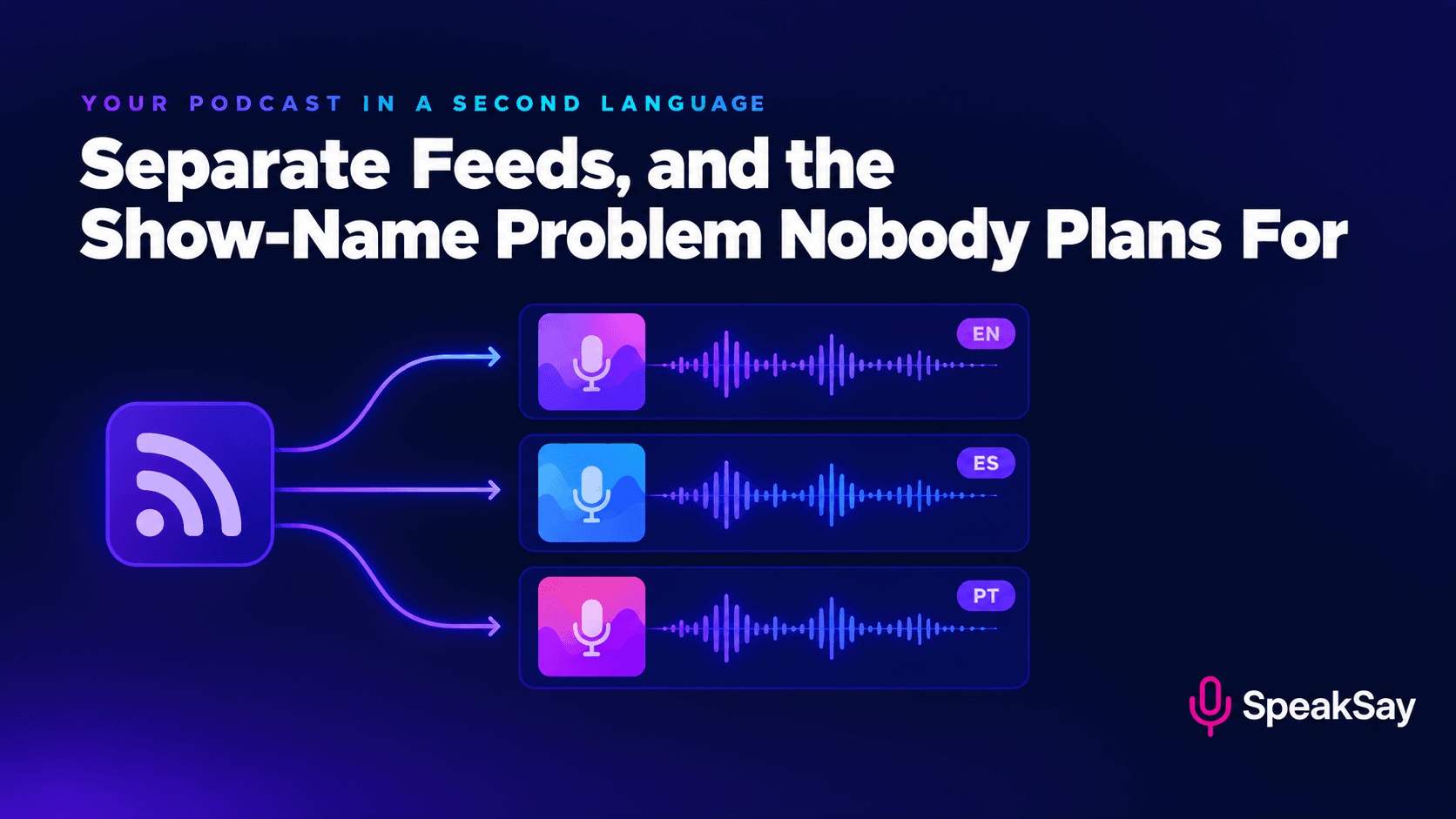
The tempting shortcut is to keep one feed and publish the Spanish version of each episode alongside the English one. It is less setup, one place to manage, and the numbers all aggregate into a single flattering total. Do not do it.
Four reasons, in descending order of how much damage they do:
Your subscribers unsubscribe
A subscriber to a mixed feed receives, on average, every second episode in a language they cannot understand. From their app's point of view they now have a show that half-works. The behaviour that follows is not "skip the ones I don't want" — it is a slow drop in completion rate, then unsubscribes. You have not doubled your audience; you have degraded the one you had.
The language tag is a property of the feed, not the episode
RSS carries a single language declaration for the whole feed. Directories use it for territory placement, for language filters, and increasingly for recommendation. A feed declared as English that is half Spanish is misdeclared, and there is no episode-level fix — the field simply does not exist at that granularity in any way the major directories act on consistently.
Charts and recommendations are language- and territory-bound
Category charts are computed per territory. Recommendation systems cluster shows by what their listeners also listen to, which is almost entirely language-partitioned. A mixed feed sits in the middle of two clusters and belongs to neither, so it gets recommended to nobody. Two clean feeds each get a clear signal.
Your analytics stop meaning anything
Aggregate downloads across two languages tell you nothing actionable. Which language is growing? Which retains? Which converts to your list? With one feed you cannot answer any of it, which means you cannot decide whether to continue.
The rule: one feed per language, always, unless you are in one of the three exceptions below.
2. The three cases where one feed is right
- Your audience is genuinely bilingual and expects both. A show for, say, Catalan-Spanish or Hindi-English speakers where the audience routinely consumes both languages. Here a split creates two half-shows for one audience.
- The show itself code-switches. If mixing languages within an episode is the format — language-learning shows, diaspora shows, some comedy — there is only one show and one feed.
- A one-off or a short test. Three translated episodes to see whether anyone bites, clearly labelled in the title, before committing to a feed. Migrate to a separate feed the moment it works.
Everything else — including "my audience is international" — is a separate feed. "International" usually means "English-speaking in many countries", which is one language.
3. Per-feed setup: the full checklist
This is where multilingual podcasting actually goes wrong. Most of these are set once, and most of them are quietly wrong on new-language feeds because the setup was copied from the original.
| Element | What to do | Common mistake |
|---|---|---|
| Feed language tag | Set to the correct code, including region where it matters (pt-BR vs pt-PT, es-419 vs es-ES) | Left as the source language because the feed was duplicated |
| Episode GUIDs | Must be unique across every feed | Copied GUIDs — apps treat the episode as already-seen and never deliver it |
| Show title | See sections 4–5 — this is the biggest decision | Untranslated English pun that nobody in the target market can parse or search for |
| Show description | Written natively in the target language, not machine-translated from the English | Translated description containing English idioms rendered literally |
| Category | Chosen for the target market's browsing behaviour, which may differ | Copied from the source feed without checking |
| Artwork | Same visual identity; any text on the cover in the target language | English text on artwork for a non-English feed |
| Author / owner fields | Consistent across feeds so the shows are recognisably related | Inconsistent spelling, which breaks author-based discovery |
| Episode titles | Written for search in the target language | Literal translations of English titles, which match no real queries |
| Show notes and transcripts | In the target language; transcripts especially, since they now feed AI answer engines | English transcripts on a Spanish feed |
| Cross-links | Each feed's description links to the sibling feeds | No cross-linking at all, so bilingual listeners never find the other version |
| Hosting | Separate show in your host, or a host that supports multiple feeds properly | One show with a filter, which usually produces malformed feeds |
| Directory submissions | Submit each feed separately, everywhere | Submitting only to the big two and assuming the rest follow |
The GUID row is the one that produces the most baffling support tickets. If you duplicate a feed and keep the episode identifiers, apps that have already seen those identifiers will not present the new episodes to anyone. The feed looks fine to you and is invisible to your listeners.
4. The show-name problem
Here is the part that almost no multilingual podcast guide covers, and that bites specifically when the host is synthetic.
Your show's name is spoken aloud. Not once — it is in the opening, usually in a voice tag, often in the sign-off, and frequently in the ad-boundary re-anchor. Across a hundred episodes in a new language, your show name gets pronounced several hundred times. If it is pronounced badly, it is pronounced badly every single time, identically, forever, because a rendered file does not vary.
And podcast names are unusually hostile to speech synthesis. They tend to be exactly the things that break engines:
| Name pattern | What happens in another language |
|---|---|
| English pun or idiom ("Well, Actually") | Untranslatable; renders as a fragment with no meaning and odd stress |
| Portmanteau ("Techonomics") | The engine has no lexical entry, so it guesses — differently in each language |
| Ampersand ("Rise & Grind") | Read as the English word "and", or silently dropped |
| Acronym ("The TLDR Show") | Sometimes spelled, sometimes said as a word, inconsistently across renders |
| Numeral ("5 Minute Fridays") | Read in the target language's number system — which may be correct, or may collide with the translated words |
| Proper noun of a place | Localised pronunciation that may not match what your brand is called |
| Mixed-case brand ("goFast") | Word-boundary collapse: "gofast" as one blurred word |
| Name with a silent or foreign letter | Pronounced according to the target language's orthography, not your intention |
Test this before you commit to a name in a new market, not after. Render your show name, alone, in every target language, and listen. Then render it inside the actual voice-tag sentence, because a name in isolation and a name inside a sentence are pronounced differently.
5. Three naming strategies, and when each wins
| Strategy | What it means | Wins when | Cost |
|---|---|---|---|
| Keep the name | Identical title on every feed; teach the engine to say it via a lexicon respelling per language | You have existing brand recognition, the name is short and phonetically simple, or your audience is internationally connected | Requires a per-language respelling; some names cannot be rescued |
| Translate the name | Render the meaning in the target language | The name is descriptive ("The Weekly Science Review"), and search intent in the target market is descriptive too | Loses cross-language brand continuity; two names to maintain |
| Keep and qualify | Original name plus a target-language descriptor: "Techonomics — el podcast de economía y tecnología" | Almost always the default. Brand travels, search works, and the descriptor carries the meaning the name cannot | Longer title; some directories truncate |
In practice, keep and qualify is right for most shows. It preserves the brand asset, supplies the searchable words in the target language, and lets the synthetic host say the brand once and then use the descriptor naturally.
Three rules regardless of strategy:
- The name must be sayable in one breath. This constraint is much harder on a synthetic host than a human one — a human naturally hurries through an awkward name; a rendered voice plods through every syllable at the same rate. If the spoken name takes more than about 1.5 seconds, shorten what the host says even if the feed title stays long.
- Render the voice tag once and reuse the file. Do not regenerate the show name in every episode's render. Produce one approved voice tag per language, save the audio, and drop it in. This eliminates drift entirely and is the single most reliable fix in this whole article.
- Decide the pronunciation once and write it down. If your show is "gow-FAST" in one language and "go-FAHST" in another, that is fine — as long as each is deliberate, documented, and stable across a hundred episodes.
6. The per-language brand lexicon
Your show name is not the only recurring proper noun. Build a lexicon file per language containing every term that repeats, with an explicit respelling for each. Apply it by find-and-replace before every render.
What belongs in it:
- The show name, and the shortened spoken form if different
- Host names — including your own, which is the one most likely to be mangled
- Your company or brand name
- The website, spoken form ("speaksay dot com", not "speaksay.com" — URLs are a common silent failure)
- Your email or contact destination, if it is read aloud
- Segment names ("the mailbag", "the rundown") if they are proper-noun-ish
- Recurring guest, client or product names
- Any hashtag or social handle read aloud
- Place names specific to your show
The technique that fixes most of these is hyphenated respelling to force word boundaries: "speak – SAY", "go – FAST", "tech – oh – NOM – iks". Engines routinely collapse mixed-case and compound words into a single blurred syllable, and inserting an explicit boundary is what stops it.
Two habits that keep the lexicon honest:
- Render a 60-second test clip of the lexicon in sequence before producing a season in a new language. Twenty proper nouns back to back exposes errors that are invisible inside flowing prose.
- Have a speaker of the language listen to that clip. Ask them the open question — "tell me anything that sounds wrong, not just anything that is wrong" — because register and naturalness problems will not show up in any check you can run alone.
7. Translating the show versus re-making it
A literal translation of an English podcast script produces audio that is technically correct and subtly unlistenable. Four things need localising beyond the words.
| Element | Why a literal translation fails | What to do |
|---|---|---|
| Length | Most languages expand or contract against English — Spanish and French run noticeably longer, some run shorter | Let the episode length change. Do not compress delivery to hit the original runtime; re-cut the structure instead |
| Examples and references | A reference to a domestic retailer, sports league or political figure lands as noise | Substitute local equivalents. This is the highest-return change and it is editorial, not linguistic |
| Units and currency | "Twelve dollars", "ninety degrees", "two miles" require conversion in the listener's head, mid-sentence | Convert in the script, and round to natural local figures |
| Register and formality | English has one "you"; many target languages force a formality choice you did not make consciously | Decide formal or informal once, per feed, and document it. Inconsistency here is very audible to native speakers and invisible to you |
| Idiom and humour | Translated idioms are the clearest marker of machine-produced audio | Cut them or replace them with local equivalents. Do not translate them |
| Structure and cold opens | Expectations around how a show opens vary by market | Listen to three successful shows in your category in that market before locking the format |
A useful way to think about it: you are not translating the episode, you are producing the same episode for a different audience. The transcript is the input, not the deliverable.
Produce the same show in a second language this week
The production cost of a parallel-language feed is now a rendering cost. Build the lexicon, localise the references, render the episodes — and keep one voice tag file per language so your show name never drifts.
8. Same voice or a native voice per language?
This is a real trade-off with no universally correct answer.
| Same voice across languages | Native voice per language | |
|---|---|---|
| Brand continuity | Strong — one recognisable identity everywhere | Weak — each feed is effectively a different show sonically |
| Naturalness in the target language | Variable; cross-lingual synthesis can carry accent characteristics from the source language | Strong — this is what a native-language voice is for |
| Listener perception | Can read as a foreigner reading a script, which undercuts authority | Reads as a local show |
| Risk on proper nouns and numbers | Higher — cross-lingual handling of names, dates and currency is the weakest area | Lower |
| Best for | Author-fronted shows, personal brands, shows where "it's really me" is the product | Editorial shows, news, education, anything competing with local incumbents |
The practical resolution most shows land on: native voice for the host, your own voice for a short signed segment. A 30–60 second introduction in your own voice at the top — even in accented target-language speech, or even in English with the native host translating — establishes that a real person is behind the show, then hands off to a voice that sounds local for the body of the episode. That split gets most of the continuity benefit and almost none of the naturalness cost.
Whichever you choose, the verification problem is the same and it is serious: cross-lingual synthesis is the one production step where you cannot review your own work. Fluency is not evidence of correctness — these systems are best at sounding fluent, which makes fluency actively misleading as a quality signal. At minimum, run a back-translation of the rendered transcript through a different engine to catch dropped negations, and have a native speaker listen to a full episode before you publish the feed's first three.
9. Which language to launch second
Choose on four variables, in this order:
- Where your existing listeners already are. Check your analytics by country before doing anything else. If eleven percent of your downloads come from Brazil, Brazilian Portuguese is the answer and no further analysis is required.
- Podcast listening maturity in the market. Population is not the metric; podcast listening penetration and ad market maturity are. A smaller market with a heavy listening habit beats a large one without.
- Competition in your category, in that language. The arbitrage is real: categories that are saturated in English are frequently near-empty in Portuguese, Indonesian, Polish or Arabic. Search your category in the target market's charts and count the credible shows.
- Whether you can support the audience. If listeners write in, someone has to reply. A feed in a language nobody on your team reads generates inbound you cannot answer, which is worse than no feed.
A note on the last point, because it interacts with everything else: the growth levers in podcasting that matter most — reviews, word of mouth, listener contributions — are social. A language feed with a synthetic host and no human able to reply to a single listener message will grow only through directory search. That works, but it is the slowest of the four levers, and it is why some second-language feeds stall at a plateau that has nothing to do with audio quality.
10. The launch sequence
- Pick the language on the four variables above.
- Decide the naming strategy and render the show name in the target language. If it cannot be said cleanly, resolve that now — it is far cheaper than resolving it at episode forty.
- Build the per-language lexicon and render the 60-second test clip. Have a native speaker check it.
- Decide the voice and the formality register. Document both.
- Localise three to five episodes — not translate; localise, with substituted references and converted units.
- Have a native speaker listen to one complete episode end to end, with the open-ended brief.
- Render the voice tag once and save the file. Every episode uses it.
- Create the feed properly: new GUIDs, correct language tag, native description, localised title and category, cross-links to the sibling feeds.
- Bank three episodes before submitting so a new listener has something to continue with.
- Submit to every directory separately, including the ones that matter regionally and not globally.
- Announce it on the original feed, in the original language, once. Your existing listeners know people who speak the target language.
- Review at ninety days on retention and inbound messages, not on download totals.
One plan, every language your show needs
A second feed means roughly double the rendering, a third means triple. Per-minute pricing turns a language expansion into a budget conversation; it should be a production decision.
11. FAQ
Should I publish my podcast's other languages on the same RSS feed?No, in almost every case. The language declaration is a property of the whole feed, charts and recommendations are language- and territory-partitioned, and subscribers to a mixed feed receive episodes they cannot understand — which shows up as falling completion and then unsubscribes. Run one feed per language, with unique episode GUIDs, and cross-link them in the descriptions. The exceptions are genuinely bilingual audiences, shows that code-switch by design, and short tests before you commit.
Should I translate my podcast's name?Usually keep it and qualify it — the original name plus a short target-language descriptor. That preserves brand continuity while supplying the searchable words in the target market. Translate outright only when the name is purely descriptive. Whatever you choose, render the name in the target language and listen before committing, because puns, portmanteaus, ampersands, acronyms and mixed-case brands are exactly what speech engines mishandle.
How do I stop my AI host mispronouncing my show's name?Two fixes. First, add a hyphenated respelling to a per-language lexicon and find-and-replace it into every script — hyphens force word boundaries, which is what prevents compound and mixed-case names collapsing into one blurred syllable. Second, and more reliably, render the voice tag once per language, approve it, save the audio file, and reuse that file in every episode instead of regenerating the name each time.
Should I use the same voice in every language or a native voice per language?Native voice per language for editorial, news and education shows competing with local incumbents; the same voice where "it's really me" is the product. The hybrid most shows settle on is a short introduction in your own voice at the top of each episode, handing off to a native-sounding host for the body — which keeps the human signal without the accent-leakage cost that cross-lingual synthesis can carry.
Which language should I launch in next?Start with your own analytics — if a meaningful share of downloads already comes from one country, that is your answer. Otherwise weigh podcast listening maturity over raw population, check how crowded your category actually is in that language (frequently far less than in English), and confirm someone can reply to listener messages in it. A feed generating inbound nobody can answer is worse than no feed.
Why is my new-language feed not showing new episodes in podcast apps?The most common cause is duplicated episode GUIDs. If you created the new feed by copying the original and kept the episode identifiers, apps that have already seen those identifiers treat the episodes as previously delivered and never surface them. Regenerate unique GUIDs for every episode on every feed.