Your Clone Is Still 32 and You Are Not: Managing Voice Ageing Across a Multi-Year Channel (2026)
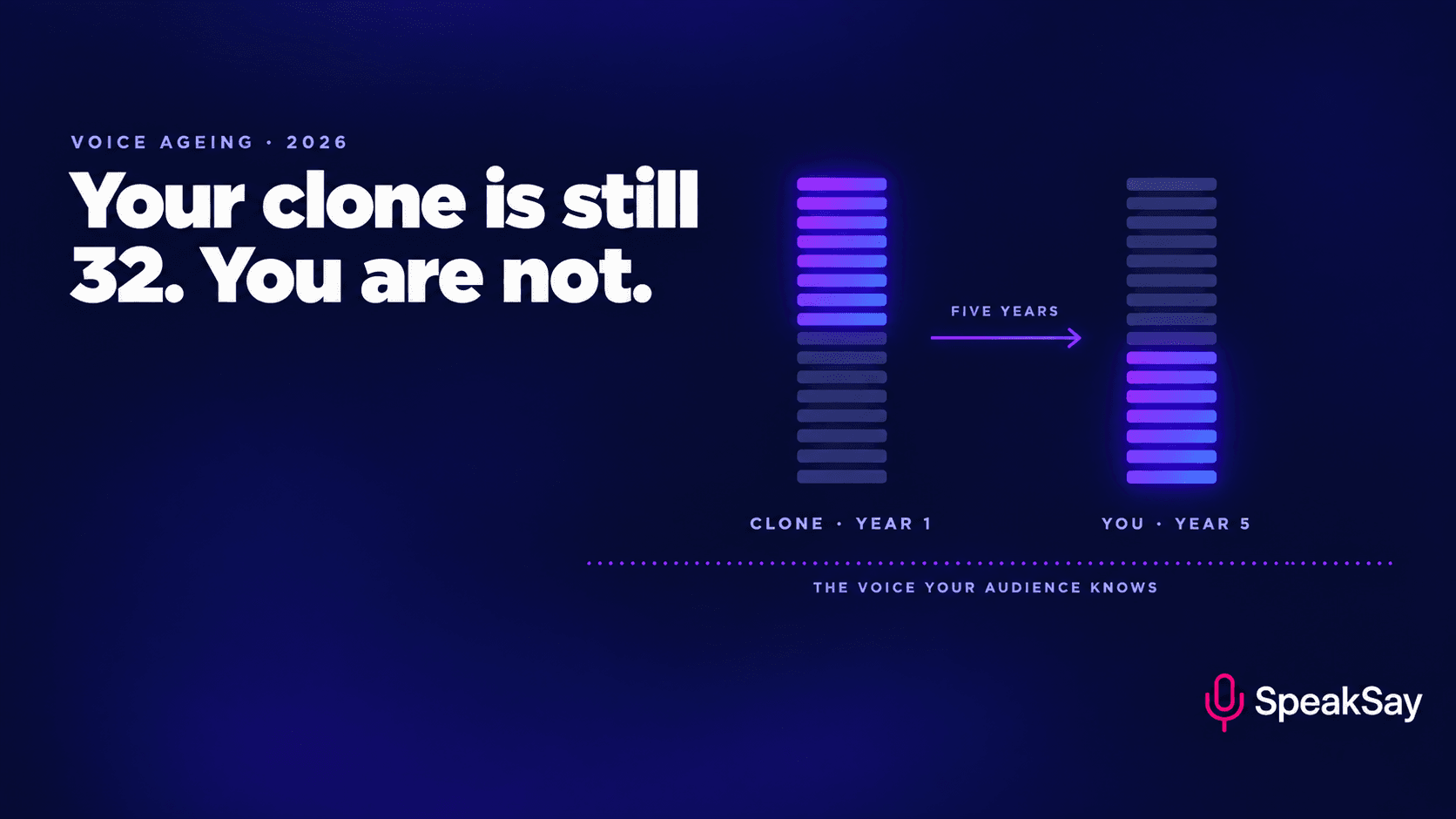
Everyone worries about the model changing underneath their voice clone. Almost nobody plans for the opposite problem — the model holds perfectly still while the person it was built from changes. Five years in, the gap between your recorded voice and your rendered one is audible, and it shows up in the worst possible place: a live appearance.
1. What actually changes in a voice over years
It is worth being precise, because the popular version of this — "voices get deeper as you age" — is mostly wrong and leads people to look for the wrong thing.
The clinical picture is roughly this. Fundamental pitch is relatively stable through adulthood: most people hold a similar pitch from around twenty until their sixties, at which point the typical pattern reverses direction by sex — men's untrained voices tend to rise, women's tend to fall. So pitch is not the early signal.
What changes earlier, and much more audibly on a recording, is everything else:
- Resonance. The vocal tract changes shape over years and the voice gains or loses body. This is the single most noticeable difference on a waveform comparison and the hardest one to describe in words.
- Breath support. Phrase length and the ease of long sentences change with fitness, weight, and habit more than with age as such. This shows up as different natural phrasing, not different tone.
- Vocal fold condition. Years of heavy use — recording daily, presenting, teaching, shouting over noise — accumulate. The symptom is reduced range at the extremes and a slightly thinner sound at low volume.
- Habit. Underrated and often the biggest one. Five years of narrating changes how you narrate. Your pacing, your emphasis patterns, your default energy level. This is not your voice ageing; it is you getting better, and it moves you away from a clone trained on your worse earlier delivery.
That last point matters most and is the one nobody mentions. The gap between a five-year-old clone and you today is usually more about skill than about biology.
2. Three gaps, not one
"My clone doesn't sound like me anymore" collapses three separate problems. They have different fixes and different urgencies.
| Gap | Cause | Timescale | Fix |
|---|---|---|---|
| Instrument gap | Your physical voice has changed — resonance, breath, fold condition | 3–10 years | Re-clone from new recordings |
| Performance gap | You deliver differently now — pacing, emphasis, energy | 1–3 years | Re-clone, or adjust settings on the existing clone |
| State gap | Today's voice differs from baseline — illness, fatigue, allergies, a bad night | Days | Nothing. This is temporary and is not a reason to re-clone. |
The single most common error is treating a state gap as an instrument gap. You record on a day when your voice feels thick, notice the clone sounds nothing like you, and conclude the clone is out of date. It is not — you are off-baseline. Never make a re-cloning decision based on one day's comparison, and never re-clone on a day your voice is not at baseline, because you will bake that day into the next three years of output.
3. How to detect drift when you cannot hear your own voice objectively
You are the worst possible judge of your own voice. Everyone is — you hear yours partly through bone conduction, and you have heard it continuously, which means gradual change is invisible to you in exactly the way it is invisible to a parent watching a child grow.
So use a method, not your ears.
The annual benchmark recording
Once a year, on a day when your voice is at baseline, record the same fixed paragraph in the same room with the same microphone. Sixty to ninety seconds. Save it with the date. That is the entire protocol and it takes four minutes.
What to put in the paragraph, because the content matters:
- A long sentence that requires a full breath — tests breath support.
- A sentence at the bottom of your comfortable range and one at the top — tests range compression.
- Sustained vowels: a held "ah" and a held "ee" for three seconds each — tests fold condition and steadiness.
- Your show's actual opening line — tests the thing that actually matters.
- A short sentence delivered with genuine energy — tests where your ceiling is.
The three comparisons that tell you something
- This year's benchmark against last year's. Adjacent years almost always sound identical. That is the expected result and it is why annual comparison alone is not enough.
- This year's benchmark against the oldest one you have. This is the comparison that reveals drift. Skip the intermediate years entirely — the whole point is to hear the accumulated change.
- Your current clone rendering the benchmark paragraph, against you reading it today. This is the one that answers the actual question. Render it, play both back to back, and — critically — have someone else listen blind and tell you which is which, and what tipped them off.
That third comparison is the whole test. If a listener who knows you cannot reliably tell them apart, you have no problem. If they can, ask what the tell was. The answer is almost always specific: "the recorded one sounds more tired," "the AI one is brighter," "you take longer pauses now."
Compare your clone against yourself in five minutes
Render your benchmark paragraph on your existing clone, record yourself reading the same words today, and listen back to back. It is the only honest test, and it is the one most creators have never run.
4. The collision moment, and why it is the real risk
Drift on its own is harmless. Nobody in your audience is A/B testing your 2022 episodes against your 2027 ones. The risk is concentrated in a small number of moments where both versions are heard close together.
The collision scenarios, in order of how badly they land:
- A live appearance. A podcast guest spot, a conference talk, a livestream, an interview. Your audience has heard your rendered voice for years and now hears the real one. If the gap is large, the reaction is not "his voice aged" — it is "wait, is that actually him?" This is the one that can cost you trust, because it makes people retroactively suspicious of everything they heard before.
- A video where you appear on camera. Face and voice mismatch is detected faster than either alone.
- A hybrid episode. You record part of something and render the rest. The join is where it shows.
- A binge listener. Someone consuming three years of back catalogue in a fortnight. Less damaging, but it is the scenario that generates comments.
The practical rule: the size of gap you can tolerate is set entirely by whether you ever appear live. A creator who never appears in real time can carry a large gap indefinitely and it costs nothing. A creator who does live appearances twice a year should keep the gap small, because the collision is guaranteed.
If you are in the second group and the gap has grown, the cheapest fix is not a re-clone — it is a short, unbothered acknowledgement the first time it comes up. "Yeah, the channel voice is a clone from a few years back, I sound slightly different now." One sentence, no defensiveness, and the issue evaporates. The damage in these moments comes from the appearance of concealment, not from the gap.
5. Re-clone, keep, or run both: a decision framework
Three real options. Most people assume the first is obviously correct; it frequently is not.
Option A — re-clone and move on
Choose this if: the gap is instrument-level, you appear live, your channel is built on your identity, and you have at least two years of publishing ahead of you.
Cost: one recording session, plus a continuity break in the catalogue.
Option B — keep the old clone deliberately
Choose this if: the clone is the brand. This is the underrated option. If your audience has associated a specific sound with your show for four years, that sound has accumulated value independent of whether it still matches you. Broadcasters have understood this for a century — the station voice does not age because the station does not want it to.
The honest condition: this only works if you are not regularly heard live. It also means being straightforward about it if asked, rather than letting people believe they are hearing you today.
Cost: nothing, plus a growing collision risk.
Option C — run both
Choose this if: you have distinct content types. The old clone continues on the flagship format where continuity matters; a fresh clone handles new formats, shorts, or anything where you also appear.
The rule that makes this work: assign voices to formats, never mix them inside one piece. A listener will accept that your main show and your interview series sound slightly different. They will not accept both inside one episode.
Cost: ongoing discipline, and a note in your production runbook saying which voice belongs to which format.
The decision test
Answer three questions:
- Will anyone hear my real voice and my rendered voice within the same month? If no, the gap does not matter and you should keep what you have.
- Is the gap instrument-level or performance-level? If performance-level, try settings adjustments first — a slightly slower rate and a shift in default energy closes more of the gap than people expect.
- Is my clone's sound part of what my audience recognises me by? If strongly yes, lean towards keeping or running both rather than replacing.
6. How to re-clone without breaking continuity
If you have decided to re-clone, the goal is not "capture my voice today." It is "capture a voice that is recognisably continuous with the one my audience knows." Those are different targets and the second is harder.
- Record at baseline, not on a convenient day. Not after a late night, not during allergy season, not the day after a long recording block. If you are unsure whether you are at baseline, you are not.
- Match the old recording conditions as closely as you can. Same room if possible, same mic, same distance. A large part of what people hear as "voice" is actually room and microphone. Changing both at the same time as your voice changed guarantees the new clone sounds like a different person.
- Listen to your original clone source immediately before recording. Five minutes of it. You will unconsciously converge towards it, which is exactly what you want here.
- Record your actual content, not a script. Read three real episode openings and a real middle section. A neutral read produces a neutral clone, and your channel is not neutral.
- Do not "perform younger." Tempting, and it produces something that sounds strained. Converge on your old pacing and energy, not on your old timbre. Timbre is what you are legitimately updating.
- Render the benchmark paragraph on both clones and compare before committing. Old clone, new clone, you today. Three files. If the new clone sits between the other two, you have done it correctly.
Then log it: date, conditions, microphone, room, and which format it is assigned to. In two years you will need this and you will not remember any of it.
A re-clone should be a Tuesday afternoon, not a project
Keeping a current clone alongside your original — and rendering both to compare before you switch — only makes sense if cloning is not metered per attempt. A lifetime plan makes maintenance cheap enough to actually do.
7. What to do with the back catalogue
Short answer: almost nothing.
The temptation after a re-clone is to re-render the archive so the whole catalogue is uniform. Resist it, for three reasons. It costs real production time. The people who listen to old episodes already accepted how they sound. And a catalogue that changes retroactively is stranger than one that changed at a point in time — a returning listener finding that episode 12 no longer sounds the way they remember is a genuinely disconcerting experience.
What is worth doing:
- Re-render your top three to five evergreen pieces. Whatever still brings in new listeners every week. Those are the first impression.
- Re-render anything that is a permanent front door — your channel trailer, your show intro, a pinned introduction video. These get heard by more new people than any episode.
- Switch at a visible boundary. A season break, an episode-100, a rebrand. When the change coincides with something the audience can see, they stop hearing it as inconsistency.
- Normalise loudness across old and new. A level difference between eras is more noticeable than a timbre difference and is fixed in one batch operation.
And say it once, briefly, in one episode. Not a segment about it. One sentence, and then carry on.
8. The archive habit that makes all of this a non-event
Everything above is manageable if you have recordings. It is unmanageable if you do not, and most creators do not, because nobody tells them to keep the source material.
Four habits, all of them cheap:
- Keep your original clone training audio forever. Raw, uncompressed, backed up in two places. This is the single most valuable file you own as a creator with a voice-based brand, and people routinely delete it after the clone is built. If you ever need to rebuild, retrain, or prove provenance, this is what you need.
- Record the annual benchmark. Four minutes a year. It is the only objective record of your own instrument, and unlike everything else here you cannot reconstruct it retroactively.
- Keep more raw recording than you use. Whenever you record yourself for any reason, keep the full unedited file rather than just the cut. In five years the outtakes are training data.
- Log every clone with its date and conditions. Which clone, built when, from what source, in which room, on which mic, assigned to which format. One row in a spreadsheet per clone.
There is a harder version of this worth mentioning for anyone whose voice is their livelihood: the same archive that protects you against ageing protects you against a much worse scenario, where your voice changes suddenly rather than gradually. That is a separate subject, and there is a well-developed practice around capturing a voice while it is healthy. The archive habit is the same either way, which is a reasonable argument for starting it this week rather than eventually.
One boundary worth stating plainly: everything in this article is about your own voice. A clone built from someone else's recordings — a colleague, a former host, a family member — needs their explicit, current, revocable consent, and consent given once for one purpose does not extend to a re-clone years later. The archive rules above make it easy to hold on to material long after the relationship that produced it has changed, which is exactly when getting this wrong becomes easy.
9. FAQ
How often should I re-clone my voice?There is no schedule, and a schedule would be the wrong tool. Run the comparison test annually — your clone rendering a fixed benchmark paragraph against you reading it the same day, judged blind by someone else — and re-clone when a listener can reliably tell them apart. For most people that is somewhere between three and seven years, and for creators who never appear live it may be never.
Does your voice really change as you get older?Yes, but not primarily in pitch, which is fairly stable from about twenty until the sixties. What changes earlier and more audibly is resonance, breath support and the condition of the vocal folds under heavy use. And for working creators the largest change is often not biological at all — it is that five years of narrating has made you a different performer than the one your clone was trained on.
My clone sounds nothing like me today. Should I rebuild it?Not based on one day. Voices vary substantially day to day with sleep, hydration, allergies and recent use, and comparing on an off day produces a false alarm. Repeat the comparison on three separate days at least a week apart, at baseline. If the gap is consistent across all three, it is real.
Should I keep using an old clone that no longer matches me?Often yes. If the clone has been your channel's sound for years, that sound has accumulated recognition value of its own, and broadcasters have used unchanging station voices on exactly this logic for a century. The condition is that you are not regularly heard live, and that you are straightforward about it if asked rather than letting people assume they are hearing you today.
What should I record for an annual voice benchmark?Sixty to ninety seconds, same room and microphone every year, containing: one long sentence requiring a full breath, one sentence at the bottom and one at the top of your comfortable range, a three-second held "ah" and "ee", your show's real opening line, and one short sentence delivered with genuine energy. Record it at baseline, date the file, and never overwrite the old ones.
Do I need to re-render my back catalogue after re-cloning?No. Re-render only your three to five best-performing evergreen pieces plus permanent front doors like your trailer and intro, then switch at a visible boundary — a season break or a milestone episode — and mention it once. Re-rendering the whole archive costs real time and unsettles returning listeners more than the inconsistency does.